
I spent a good part of this spring in the Gulf, close to this, and I came home ready to be wrong.
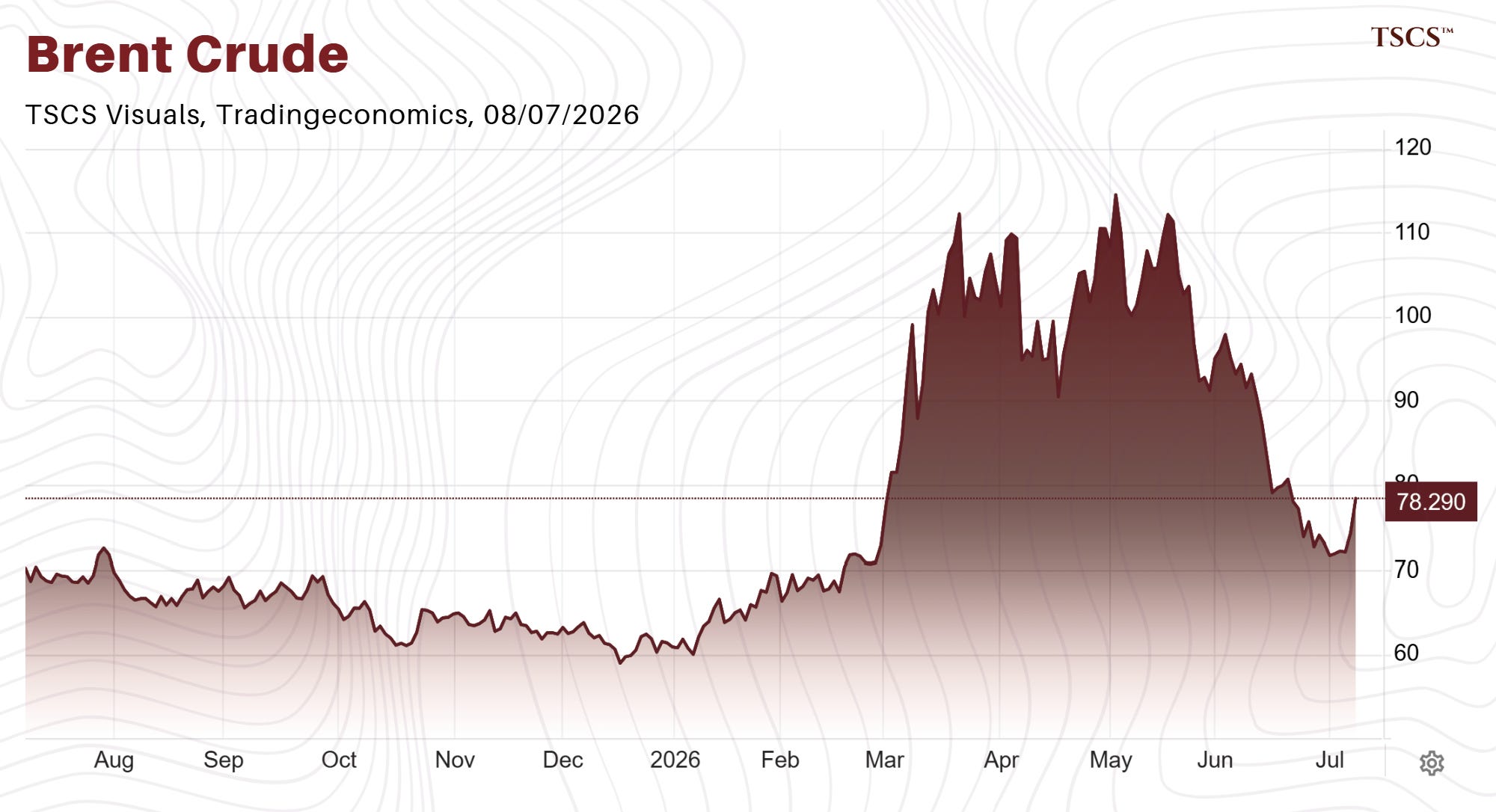
The recovery was real and it was fast. By the first week of July the barrels were back, flows out of Hormuz topping 20 million on some days, the whole pre-war rate. Kuwait was back in days to a level it had guided 6-8 weeks for. Riyadh was cutting its price and fighting for share (although it can be argued it was because no ships were willing to come).
The compliant lane was moving and the ballasters were coming in, and in the paid post on the 3rd I had already written that if they normalised I would call my own thesis and say so.
They were normalising. I was maybe two weeks from writing the concession, the one where the market had it right and I had it wrong (no, not the thesis on the L-shape recovery). You should know that before you read the rest, because it’s the reason I trust this more than I would trust the version where I stayed bearish.
Then this week happened.
At the end of last week the coffins went on display at the Tehran Mosalla, Khamenei beside his daughter, his daughter-in-law and a fourteen month old granddaughter, all killed in the February 28 strike.
Washington announced it would give Iran “a week off” for the rites, and paused the talks.
On Monday the main procession moved 10km through Tehran, crowds chanting for revenge, a eulogist calling for the deaths of both presidents, while Israel’s defence minister marked the occasion by noting that “the assassin was assassinated” and that any successor who tried the same would follow him.
The same day, off the Omani coast, a projectile went into a Qatari LNG carrier, a vessel belonging to the state hosting the mediation.
On Tuesday the prayers moved to Qom, a second tanker took structural damage in the strait, and Washington revoked the license authorising Iranian oil sales that evening and resumed strikes overnight.
On Wednesday, today, the cortege crossed into Iraq toward Najaf and Karbala while Iran struck back at American bases in Bahrain and Kuwait, the EU aviation agency closed Iranian, Iraqi and Lebanese airspace to operators until the end of August on the same day the funeral itself flew into Iraq, and the President of the United States, standing beside the NATO Secretary General in Ankara, was asked whether the ceasefire still held.
“To me, I think it’s over. I don’t want to deal with them anymore.”
The burial is tomorrow, in Mashhad.
Through all six days, one absence. Three of Khamenei’s sons prayed beside the coffins. The fourth is the Supreme Leader of Iran, and he did not appear. Not at the Mosalla, not in Tehran, not in Qom, not at the private farewell for his own wife the week before.
Iranian officials told the New York Times he was kept from his father’s funeral by his own security apparatus, on the fear that showing his face would get him killed or located.
People close to his circle told Reuters his face was disfigured in the strike and that he lost the use of a leg.
Since his installation in March, by an assembly that reportedly met online because its building had been bombed, there is no confirmed footage of him, no audio, no verified photograph. When the government put out what it called recent pictures, BBC Verify found they had been manipulated with AI.
I couldn’t get past the size of that. Nobody has seen the Supreme Leader of Iran.
The head of state on one side of the most important deal in the market is, this morning, a byline. A signature. A photograph his own government had to fake.
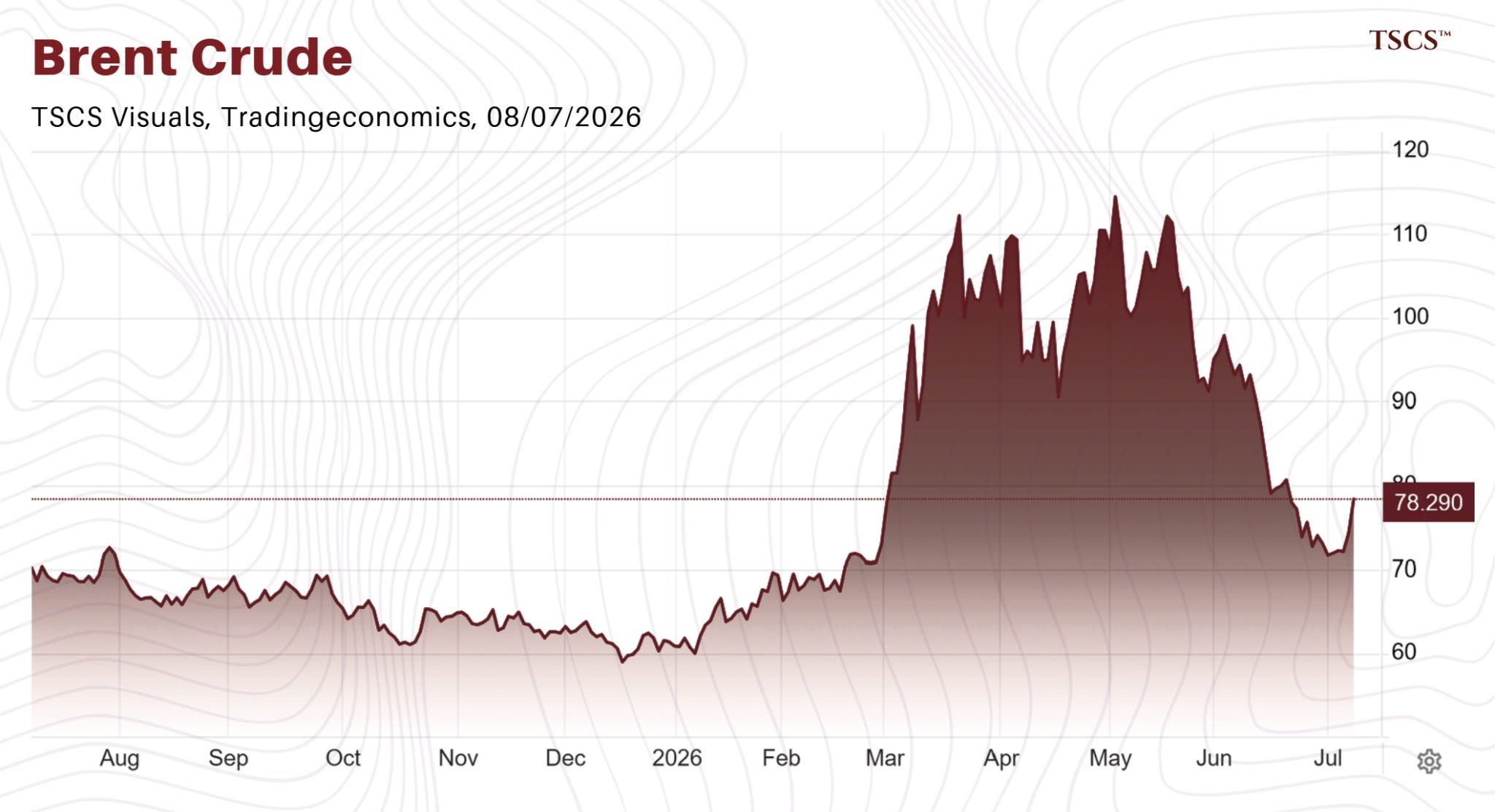
For a week the market priced that signature as a durable peace. This morning the man who signed opposite it tore the paper up on camera, oil jumped 6%, and the tape now treats the matter as settled again. It is not settled. The $72 price and the $78 price share one flaw.
Both read this as an event with a date. What changed this week is the machinery that made every earlier flare-up resolve cheaply, and I don’t think it survived.
The recovery I nearly conceded to was not soft, and I want to give it its due before I take the other side. If you only hear the bear case you’ll size this wrong.
The memorandum was signed on the 17th of June. Four weeks later the physical picture was beating every schedule anyone had set for it.
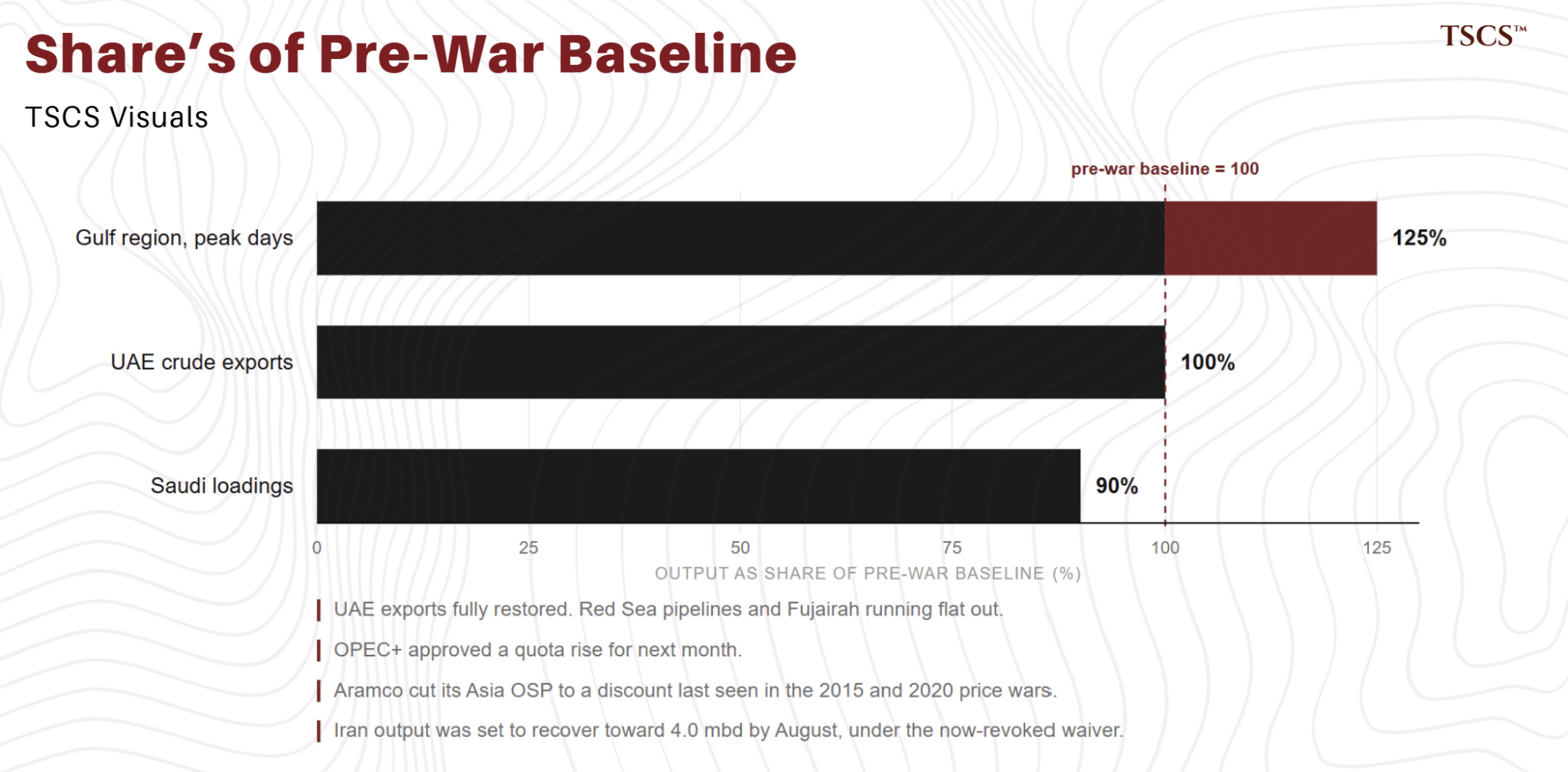
With the Red Sea pipelines and Fujairah running flat out, the region on some days pushed out a quarter more than it did before the war. The UAE restored exports in full. Saudi loadings climbed toward 90% of baseline, OPEC+ approved a quota rise for next month, and Aramco cut its official price to Asia to a discount last seen in the price wars of 2020 and 2015.
On Monday of this week, eight Japan-linked vessels, five of them supertankers, left the strait along the route Tehran approves. The EIA’s June outlook, finished on the 4th, still had the strait shut. Four weeks later Brent printed in the low 70s and the market was trading a glut.
That is how fast the peace consensus formed, and it wasn’t a stupid one.
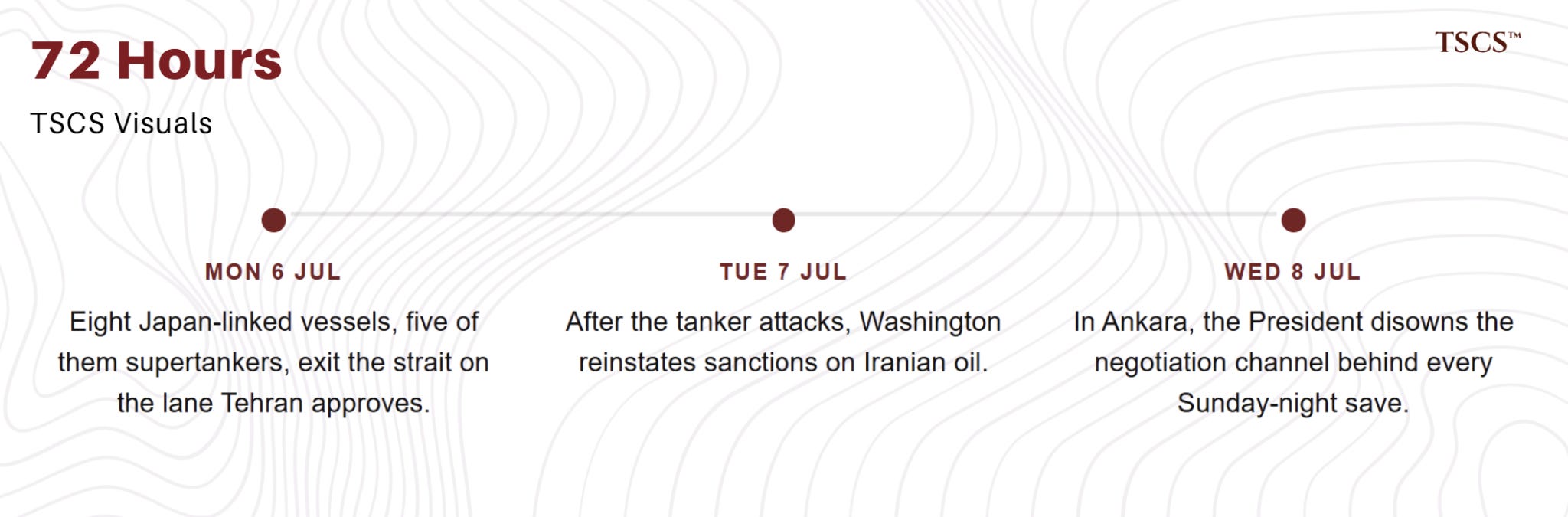
Then Tehran started shooting at the traffic that was not paying it respect, and Washington answered by cancelling the economics of the deal.
Twenty-one days, signature to shredded paper.
The question that sets the price, and the one almost nobody is asking, is why every earlier flare-up in this war resolved cheaply, and whether that mechanism still exists this morning.
You know the pattern by now. A ship hit on a Thursday, retaliation on a Friday, a ceasefire announced about 90 minutes before futures opened on Sunday night. Five months of it. The market learned it so well that it now prices every escalation as noise around a settlement that always comes, which is why a resumed shooting war between the United States and Iran, with American bases in two Gulf states under fire, is worth $6 a barrel.
That pattern was never a law of nature. It was the output of one specific arrangement, and the arrangement was funded.
Iran tolerated the reopening because it was paid to, export revenue under a sanctions waiver with production set to recover toward 4 million barrels a day by August, plus the option on a transit-fee authority in the strait.
Washington tolerated Iran’s re-emergence because it was paid in the currency it needed most, a calm pump price with the midterms 118 days out.
Every weekend ceasefire held cheap because both sides were walking away from money if they let it break.
A monetised standoff turns incidents into noise.
Three things happened to that funding this week. The transit-fee channel was already dead in practice, since Treasury named the strait authority IRGC-linked in May and OFAC guidance made safe-passage payments unavailable to much of the compliant fleet. The waiver channel died on Tuesday, when Washington reinstated sanctions on Iranian oil sales after the tanker attacks. And the negotiation channel, the phone line behind every Sunday-night save, was disowned by the President in Ankara this morning, in the line about not wanting to deal with them anymore.
The revocation is what I think people get backwards, and they get it backwards twice. It doesn’t cut Iranian supply.
The barrels that went to China at a discount before the waiver kept going during it and will keep going after it, because that flow moves ship to ship off Malaysia and mostly outside the clean customs data, and it was never really about whether the cargo was legal. It was about the markdown, and sanctions bring the markdown back. When China’s reported imports fell across the war, that was Beijing stepping back from the dollar-priced barrel it did not need, not from the cheap Iranian one.
There is a check on the tail here, and it is also Chinese. China funds Iran's floor, but it runs close to half its imported crude through that same strait and has said on the record that it does not go along with a blockade of it, so Beijing wants Iran enforcing its lane, not closing the water. That cross-pressure is a large part of why this stays harassment rather than shutdown.
What the revocation takes away is Iran’s legal, dollar-settled, Western-facing upside, the growth path the deal was dangling, while the actual revenue stays where it always was, and it does two things at once. It strips Iran of the extra it was being paid to behave for while its baseline income runs on untouched, so a man who keeps his floor and loses only his upside has very little reason left to keep the strait calm, and one obvious lever to get his leverage back.
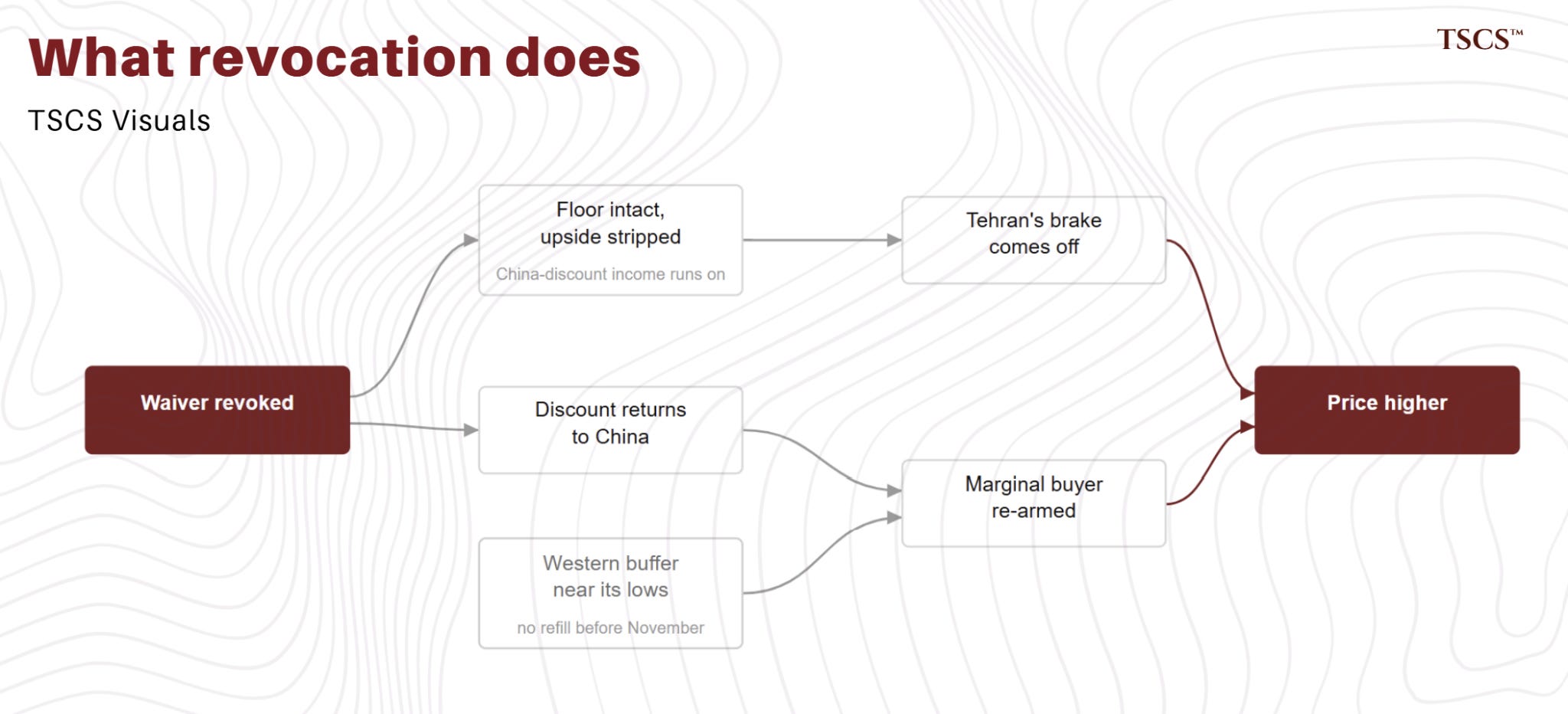
And it hands the discount back to the one buyer large enough to move the balance, at the exact moment the Western buffer that soaked up the first closure sits near its lows with no refill available before November. The headline calls this a supply cut.
On the ground it re-arms the marginal buyer and takes the brake off Tehran, and both push the price the same way.
That’s where this round started. Tehran has warned openly against ships using routes it has not designated, the vessels that moved this week went out on the lane it approves, and the vessels that were hit were on the wrong side of the channel, one of them the mediator’s own.
None of that is random. Tehran is enforcing a claim the deal never settled, because the memorandum’s one central ambiguity, who runs the strait, got left for each side to read its own way.
Naturally, this week they stopped reading and started settling it with ordnance.
Iran’s own chief negotiator, meanwhile, spent the funeral calling implementation of the ceasefire “difficult but achievable”, in the same breath as telling a visiting Hamas delegation that Iran has no peace with America.
Both halves came out of the same room, and the market is holding the first half.
A new ceasefire will very likely form, maybe within days, because the base rate of this war all but guarantees one.
What is gone is the funding, so the next ceasefire, and every one after it, holds together on nothing.
Below the line is where this gets specific.
The buffers that soaked up the first closure and how little is left in each. Why the product leg is tight for reasons that have nothing to do with Hormuz. What positioning has actually done, against what the tape is telling you. And the single instrument that prices this entire thesis in one number, which is the cheapest thing in the complex right now. That is the trade. It’s below.
Comments
Nothing yet. Say the first thing.
Sign in to join the conversation.