
An update on the TTE FOI requests
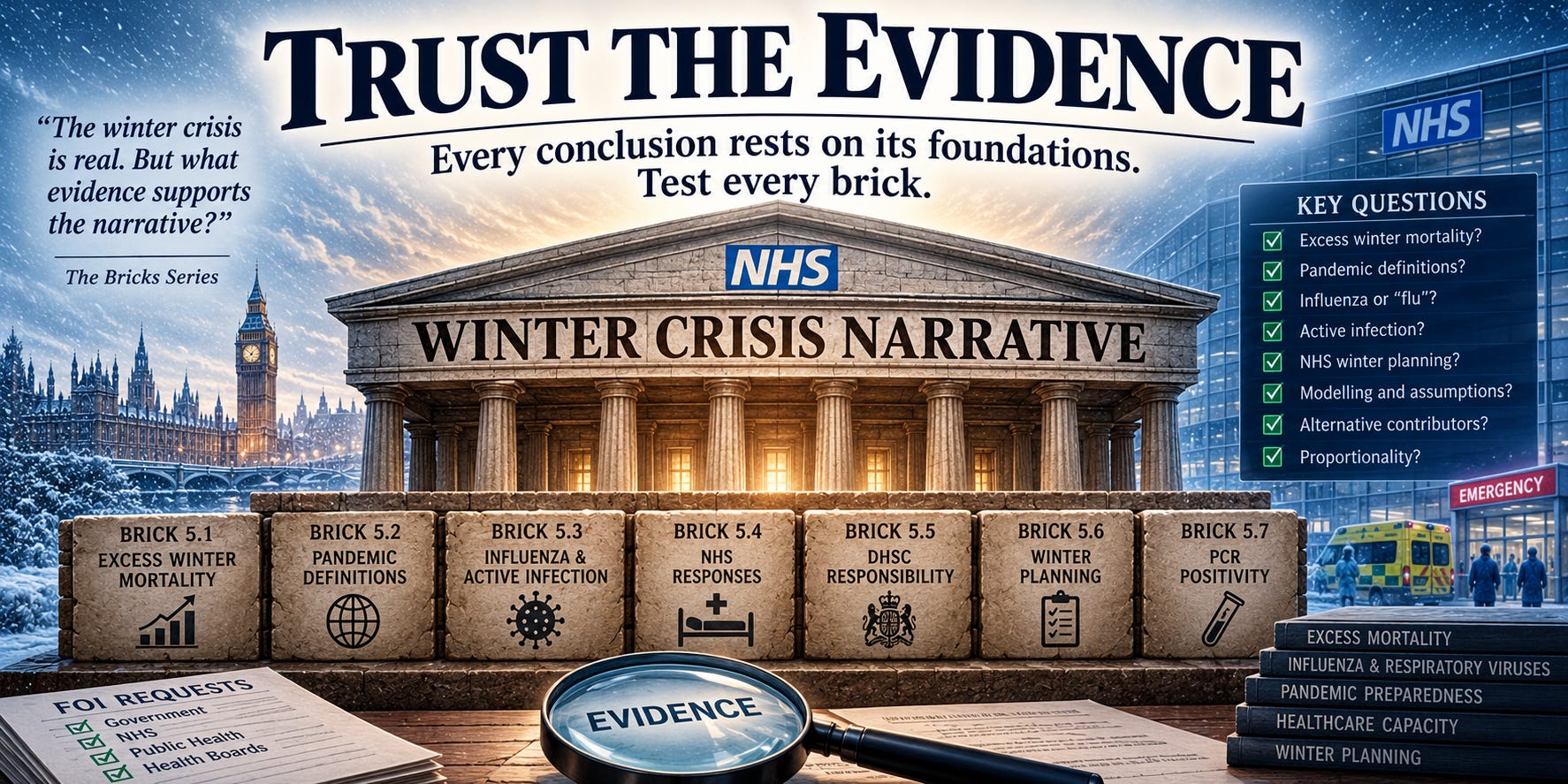
We recently summarised the themes or threads of our inquiry into the evidentiary basis of the “winter crisis”.
The third thread or theme examined influenza and active infection and we explained the rationale as follows:
“People use the word “flu” to describe almost any unpleasant respiratory illness. Clinically, influenza means something much more specific; yet even laboratory confirmation raises further questions. A positive PCR test demonstrates that influenza RNA is present in the specimen; it does not automatically prove active infection, active viral replication, or clinical illness.”
A simple analogy is: PCR is like finding fingerprints at a scene, which show that someone was there, but they don’t necessarily tell you exactly when they were there, what they were doing, or whether they caused what happened.
“After months of correspondence and an internal review, the UKHSA confirmed precisely that distinction. Clinical interpretation depends upon viral load, specimen quality, timing of sampling and the patient’s presentation. In other words, a laboratory result requires clinical context before conclusions can be drawn.
That clarification matters because surveillance statistics, modelling and planning all begin with case definitions. If the definition at the beginning of the chain remains uncertain, uncertainty inevitably travels through everything built upon it.”
Think of it like building a house using a measuring tape that may be slightly inaccurate. One measurement being a little off might not seem important. But you use that measurement to position the walls, then use the walls to position the roof, windows and doors. The further you build, the more consequential that original uncertainty becomes.
To put it simply, if you’re not completely sure what you’re counting at the beginning, you can’t be completely sure what the resulting total represents.
In Brick 5.7
we explained how we were investigating the public health use and meaning of the word “influenza” and “active infection”.
People use the word “flu” to describe almost any unpleasant respiratory illness. Clinically, influenza means something much more specific; yet even laboratory confirmation raises further questions.
Think of it like detecting smoke tells you smoke is present, but not whether there is an active fire or what caused it. Likewise, PCR detects viral genetic material; it does not, by itself, establish active infection or the cause of illness.
So, after months of correspondence and an internal review, the UKHSA confirmed precisely that distinction.
Clinical interpretation depends on viral load, specimen quality, sampling timing, and the patient’s presentation. In other words, a laboratory result requires clinical context before conclusions can be drawn.
That clarification matters because surveillance statistics, modelling and policy all begin with case definitions. If the definition at the beginning of the chain remains uncertain, uncertainty inevitably travels through everything built upon it.
In 5.7, we reported asking two simple questions to Trusts and Boards around the United Kingdom:
As you know, the Scare Agency appears remarkably willing to treat a positive influenza PCR as evidence of infection, never mind questions about contamination, residual viral RNA, or whether the detected material represents an active infection. But then, there is a reason we call them the Scare Agency.
Comments
Nothing yet. Say the first thing.
Sign in to join the conversation.