
This is TrustBridge’s monthly newsletter. TrustBridge seeks to improve India’s business environment by improving the rule of law. This month, we submitted comments on the Supreme Court’s draft regulations governing the use of AI in courts, and on CERC’s proposal for a capacity market for electricity in India. We continued our work on arbitration reform, examining how procedural design, institutional governance, and court intervention shape the effectiveness of arbitration in India. In The Bridge, our series on the quasi-judicial work of India’s regulators, we examined what recent Supreme Court judgments can teach SEBI about regulatory adjudication and better decision-making. We also contributed to conversations on India’s energy transition, cross-border capital flows, AI governance, and state-level policy reform.
Read on to see what’s kept us busy.

Comments on the Regulations for Use of AI in Courts, 2026
On June 20, Amrutha Desikan and Khushi Singh submitted comments on the Supreme Court’s draft Regulations for Use of Artificial Intelligence (AI) in Courts, 2026, which govern the use of AI in courts, tribunals, and statutory Commissions by setting out core governing principles, permissible and prohibited use cases, and mechanisms for vendor procurement, oversight, audits, and incident management. Key recommendations include:
the draft Regulations should clarify their scope of application to eliminate jurisdictional ambiguity;
a graded approach should be considered, with a separate regulatory tier for high-risk applications that fall between permissible and prohibited uses, and the pro-innovation presumption restricted strictly to low-risk administrative tasks;
the composition of both the AI Committee and the AI Secretariat should be reconsidered to mandate the inclusion of technical experts;
the draft Regulations should introduce objective risk boundaries to restrict the subjective waiver of human verification duties; and
the framework should clarify the consequences for breaches by codifying explicit disciplinary measures for internal personnel and defining specific remedial orders.
Comments on the CERC Staff Paper on Capacity Market for Electricity in India
On July 13, Upasa Borah, Chitrakshi Jain, Akshay Jaitly, Renuka Sane, and Subodh Singh submitted comments on the Central Electricity Regulatory Commission’s (CERC) 2026 staff paper proposing a capacity market for India. Key recommendations include:
near-term reform should focus on ancillary services, particularly market-based procurement of primary reserves, rather than a capacity market;
the case for introducing a capacity market remains premature and unproven on the present evidence;
before any such market is introduced, CERC needs stronger empirical grounding on resource adequacy assessments and demand curve construction;
net CONE (Cost of New Entry) estimation methodology needs to be substantiated rather than assumed; and
the staff paper does not adequately address technology eligibility criteria or the market power risks a capacity market could introduce.

On June 25, Prashant Narang and Renuka Sane published their blog on IndiaCorpLaw, ‘When Arbitration Procedure Becomes Litigation’. The piece shows that routing routine procedural tasks— constituting a tribunal under Section 11, resetting a deadline under Section 29A through adversarial court proceedings makes litigation a built-in stage of arbitration rather than an exception to it, and sketches an administrative alternative for both.
Reform debates on Indian arbitration tend to focus on the ad hoc versus institutional divide. Should parties default to institutional arbitration to reduce court intervention?
The recurring court exposure under sections 11 and 29A is a consequence of how certain procedural tasks are classified. Judicial proceedings are designed to resolve contested legal questions — to hear both sides, apply legal standards, and produce findings reviewable on appeal. Administrative mechanisms are designed to manage routine process tasks: schedule-setting, appointment, coordination.
When the latter are channelled through the former, the costs and formality of adjudication attach to tasks that do not require them. Appointments after a deadlock, deadline extensions by mutual consent, uncontested timeline resets — these are process-management tasks. Routing them through adversarial court hearings before constitutional courts is a category error, and an expensive one.

On June 16, Renuka Sane and Prashant Narang wrote an article for The Print, ‘Arbitration in India has become luxury litigation. Let retd judges go, hire a private institution’, analysing that while criticism of arbitration’s cost and delay is valid, abandoning it altogether without considering alternatives like institutional arbitration would be premature.
While institutional arbitration does hold promise, it can have its own pitfalls. It can reproduce every vice of ad hoc arbitration if it is governed badly. For example, it could have a closed panel dominated by the same retired judges, its fee-setting could be opaque, and it could give up its neutrality, losing credibility in its processes. The verdict, in short, is still out, on whether institutions build a serious model of governance. That said, there is a real opportunity for it to offer private dispute resolution that is transparent, fast and credible.
The task ahead for the institutions is clear. They must earn trust the way any credible forum does — by publishing their numbers, holding their tribunals to fixed timelines and value-based fees. They should draw arbitrators from a wider and more transparent pool than the retired bench. For the government, it is worth remembering that arbitration, which was introduced to avoid court delays in the first place, hasn’t moved cases any faster. It may be time to give the more promising version of arbitration a real chance.
On June 16, Prashant Narang co-authored an article for Mint, ‘Quasi-22: India must sort out how institutions are picked for arbitration once and for all’, examining whether courts’ ad hoc designation of arbitral institutions is procedurally sound, given that institutions themselves are not quasi-courts and have no independent judicial sanctity without party consent.
Institutional appointments hinge on party autonomy, as per the court’s ‘appointment of arbitrators’ scheme. The law stipulates that the concerned chief justice can request an institution to be designated in a particular case only once parties to the dispute make a formal request along with requisite documents. Correspondence in this regard is to be recorded and preserved by the registrar. The Supreme Court examined this procedure over two decades ago.
Yet, India lacks a consistent procedure, which is worrisome for the business environment. Not only does it add to the burden of costs, it can also unsettle previously adjudicated cases. Moreover, courts sometimes pick certain institutions over others of their own accord without explanation.
One also wonders whether recent observations by some high courts endorsing the validity of blanket designations of specific institutions through a one-time notification are remiss in their evaluation.
On July 7, Renuka Sane wrote an article for The Print, ‘India needs to prepare a strategy document that charts coal's decline, year on year’, examining the gap between India's installed renewable capacity, now over 50% of the mix and its continued reliance on coal for close to three-quarters of actual electricity generation.
That a complete switch is not possible in the near future, does not mean we should not aspire to it over time. Take the example of OECD countries. They, too, did not make the transition overnight. Many relied on, and continue to rely on, natural gas as a bridge fuel, but in a way that it does not dominate the energy landscape. The United Kingdom closed its last coal-fired station in September 2024. Their energy mix is dominated by renewables at 47 per cent, but natural gas comes second at 28 per cent. The United States, which has a relatively higher share of fossil fuels than countries in Europe, generates 41 per cent of its electricity from natural gas and 17 per cent from coal — far below India’s 70 per cent share from coal. Even in China, coal-based electricity generation has fallen to around 54 per cent. The point is simple — India needs to start planning an explicit glide path such that over the next decade coal does not dominate our electricity system.
What would such a plan look like? India needs to set a declining ceiling on coal’s generation share. It has to stop approving new coal-fired power plants, put a price on coal’s health and carbon costs, and treat storage and transmission with urgency. This runs counter to the government’s current policy which aims to add 80 GW of thermal power capacity by 2031-32. It is true that India needs far more electricity, and that demand is rising fast. But meeting that demand need not require more coal.

The Bridge is TrustBridge's series looking closely at the quasi-judicial work of India's regulators — how they decide, and how they could decide better. On July 1, Natasha Aggarwal, Amol Kulkarni, and Bhavin Patel published ‘SEBI learns fast, but has the Supreme Court been a good teacher? The Reliance judgment and how it shaped the Rajesh Exports order’. The piece examines the Supreme Court's May 2026 judgment in Reliance Industries Limited v. SEBI, which sharpened the definition of "fraud" under Regulation 2(1)(c) of the PFUTP Regulations, and tests SEBI's ex-parte interim order against Rajesh Exports Limited, issued five days later against this newly clarified standard.
The Rajesh Exports order alleges that REL, Rajesh Mehta, and certain related entities engaged in a scheme that materially misrepresented the company’s financial position and operations, and prima facie finds violations of several legal provisions, including the PFUTP Regulations.
The Rajesh Exports order responds to the Reliance judgment in Parts C (Dealing in securities and price volume impact) and D (Prima facie findings against Noticees). Part D specifically calls out the Reliance judgment, describes how it has clarified the interpretation of fraud, and goes on to argue that the order has satisfied the threshold prescribed in the Reliance judgment. Prior to the Reliance judgment, SEBI might have proceeded directly from allegations to a conclusion of fraud under the PFUTP Regulations.
On July 15, Amrutha Desikan published ‘Lessons from Balram Garg for SEBI's adjudicatory process’. Tracing the SEBI order, the SAT appeal, and the Supreme Court decision in Balram Garg v. SEBI — an insider trading case built entirely on circumstantial evidence of family ties the piece identifies four specific reasoning failures the Supreme Court found in the original order, and converts each into a systemic recommendation for SEBI's adjudicatory process.
Systematically reading appellate decisions helps identify systemic gaps and reduce appeals. Because complete lifecycle datasets are currently non-public and hard to map, SEBI should maintain a structured database linking orders to their appellate outcomes to loop feedback back into its processes. This feedback should be codified into a public procedural manual covering proceedings, evidentiary standards, and record-keeping to standardise institutional adjudication and help stakeholders navigate the system. SEBI should build a precedent bank supported by responsibly governed LLMs to verify case usage, ensuring AI aids, rather than replaces, human adjudicatory reasoning. Finally, adjudicators require continuous access to legal resources to prevent errors of law. Our synthesis of appellate feedback in the SEBI Lifecycle Datasets aims to provide precisely this support.

On June 29, Subodh Singh co-presented a paper titled ‘The Price of Reliability – Energy Justice Evaluation of CRMs in Ireland and Poland’ at the Groningen Centre of Energy Law and Sustainability (GCELS) conference on ‘Contested Transitions: Law for Energy Justice’ at the University of Groningen.

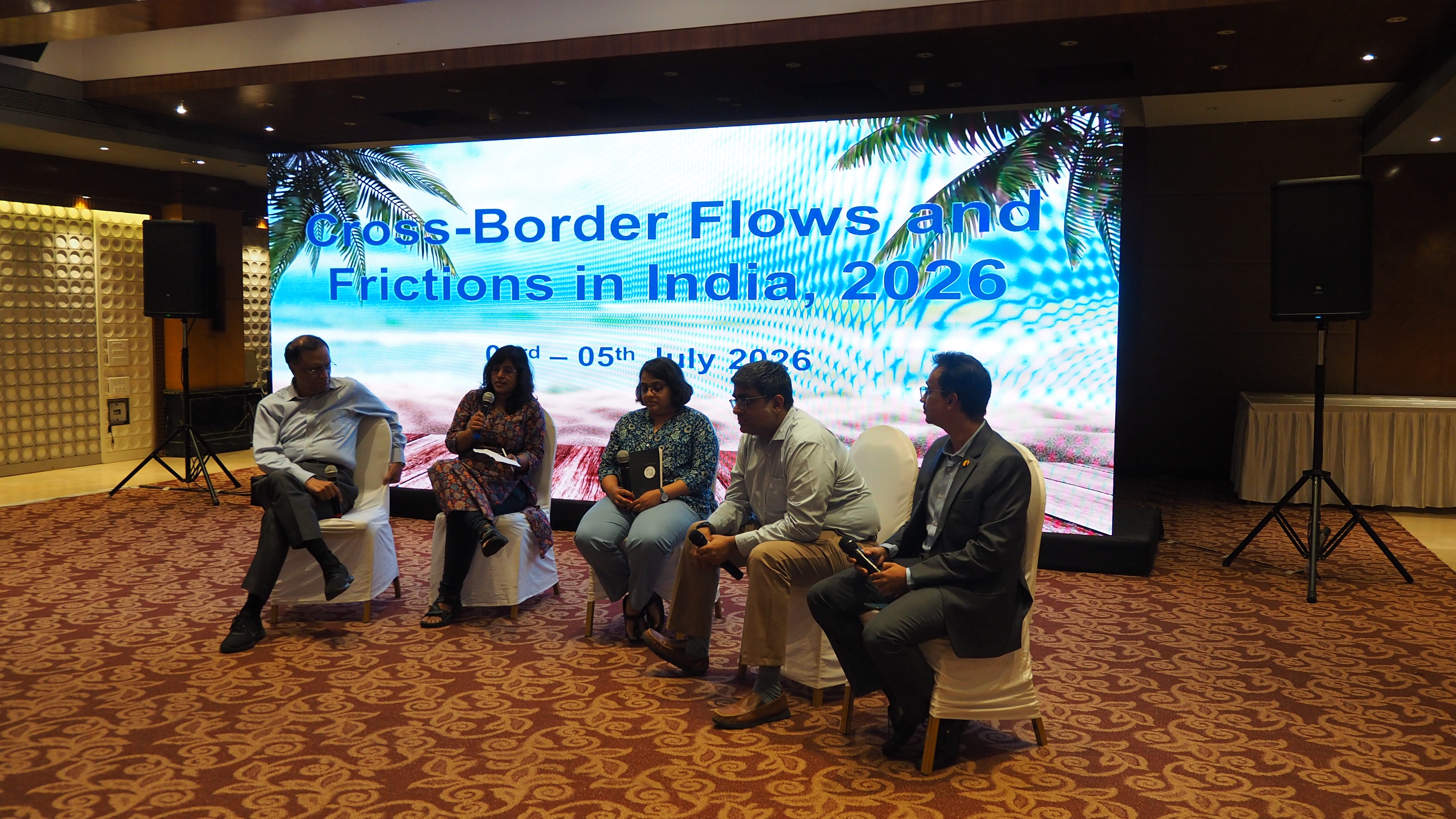
From July 3–6, Renuka Sane presented on the panel ‘Enclave vs Mainland’ and Pratik Datta was a discussant on the panel ‘Capital Controls Policy’ at Cross-border flows and frictions in India conference, organised by XKDR Forum in Goa.
On July 7, TrustBridge contributed to the AI Knowledge Consortium's comments on the Supreme Court's Regulations on the Use of AI in Courts. Amrutha Desikan attended the AIKC Huddle at the Shardul Amarchand Mangaldas office in New Delhi for a discussion on the regulations.

On June 30, Prashant Narang conducted a two-hour session for the inaugural cohort of The 1991 Fellowship at the National YMCA Hostel, New Delhi, as part of the Fellowship’s Delhi orientation. Using case studies of specific reform initiatives, the session explained how policy problems are identified, how reform is negotiated through institutions, and the factors that enable implementation in practice, for a cohort of 12 fellows working on state-level policy reform across ten states.
We're recruiting a Research Fellow for our Financial Markets function and law interns in New Delhi. If you're passionate about impactful policy research, email us at info@trustbridge.in.
Thanks for reading The TrustBridge Newsletter! Subscribe for free to receive new posts and support our work.
Comments
Nothing yet. Say the first thing.
Sign in to join the conversation.