
Troy Tassier is a professor of economics at Fordham University and the author of The Rich Flee and the Poor Take the Bus: How Our Unequal Society Fails Us during Outbreaks.
“… in the tenements all the influences make for evil; because they are the hot-beds of the epidemics that carry death to the rich and poor alike;…”
- Jacob A. Riis, from the Introduction to How the Other Half Lives, 1890.
Sometimes when you teach, student questions or lecture topics in different classes place unexpected insights next to each other and lead to insight. One of those experiences happened for me and, I hope, my students this week.
Tenements of 19th century New York City were considered to be bastions of infectious disease. Keeping people safe from tuberculosis, smallpox, influenza, cholera, and a host of other deadly diseases was a major aim of the tenement acts of the late 19th century. The acts greatly improved sanitation and ventilation within new tenement buildings and helped to keep some of the densest new immigrant neighborhoods safe (at least as safe as they could be with 19th century medicine). I’ve written about these improvements before with my friend and colleague Jason Barr (here and here).
Still however, there were great inequities across neighborhoods in terms of infectious disease risk. Some areas had around one-percent of their neighborhood’s population die each year, on average, from infectious disease. These were the safe neighborhoods! Other areas had a bit more than two-percent of their population die from disease each year. These more dangerous areas tended to have larger numbers of older tenement buildings that were not required to update to the standards set forth in the tenement acts.
Infectious disease mortality twice as great in some neighborhoods as others. What a dangerous and unequal world, right? Can you imagine?
When Covid-19 hit some were quick to point out how this pandemic would be a great equalizer. An airborne infectious disease wasn’t going to discriminate between rich or poor, Black or white. It wasn’t going to pick people with darker over lighter skin or those with less money over more. We were all in it together.
Of course, now we know better – and public health professionals and epidemiologists always knew.
Even though Covid-19 was far from a great equalizer, we might expect that modern medicine and all the affluence of the United States in general, and New York City in particular, would at least improve upon the inequities of the 19thcentury. That thinking was far from correct, too. That was our discussion in my class this week.
Take a look at the picture below. It shows the rates of Covid-19 mortality in different neighborhoods of New York City during the year 2020.
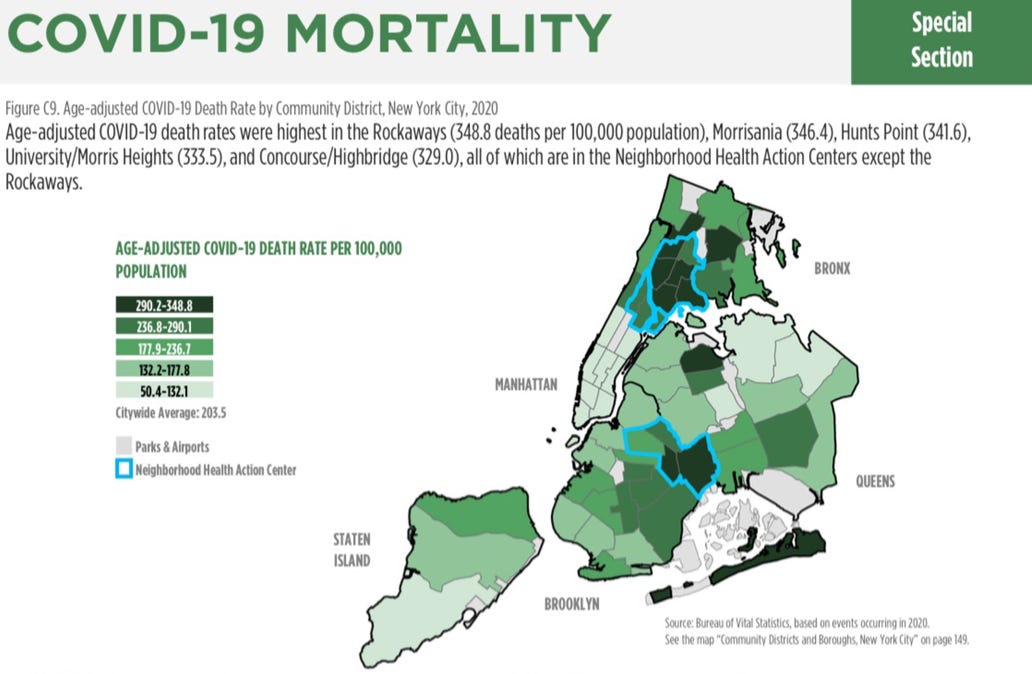
The wealthiest areas of lower Manhattan had around 50-60 Covid-19 deaths per 100,000 residents. Other areas, shown in the darkest green, and mostly in Brooklyn, the Bronx, and Queens, had rates above 300 Covid-19 deaths per 100,000 residents. These areas had rates of mortality five to six times greater than the safest areas of the city. It was an outcome far more unequal than what happened in the 19th century.
Of course, these areas with the most mortality had some of the lowest wealth and income, some of the most overcrowded housing, and some of the least access to healthcare in the city, both before and after Covid-19 arrived. They also have some of the largest proportion of residents with darker skin and the highest rates of recent immigrants.
When we compare these outcomes to the 19th century, we should be ashamed. When we think back to the horrible conditions of living in 19th century tenements and compare it to the mansions of Gilded Age wealth, it seems so vastly unfair. Yet, in comparison to the most wealthy, the people living in the worst conditions in the 19th century fared far better than those of the 21st century.
This is one of the great lessons that we failed to take to heart from the Covid-19 pandemic. Instead of looking deeply at all of the myriad causes of these differences we’ve moved into a world where Republican leaders work to outlaw words like diversity and equity. Yet, how can we create a better world if we ignore our failures and the causes of those failures? Maybe the lesson is that too many just don’t care.
Troy Tassier is a professor of economics at Fordham University and the author of The Rich Flee and the Poor Take the Bus: How Our Unequal Society Fails Us during Outbreaks.
No posts
Comments
Nothing yet. Say the first thing.
Sign in to join the conversation.