
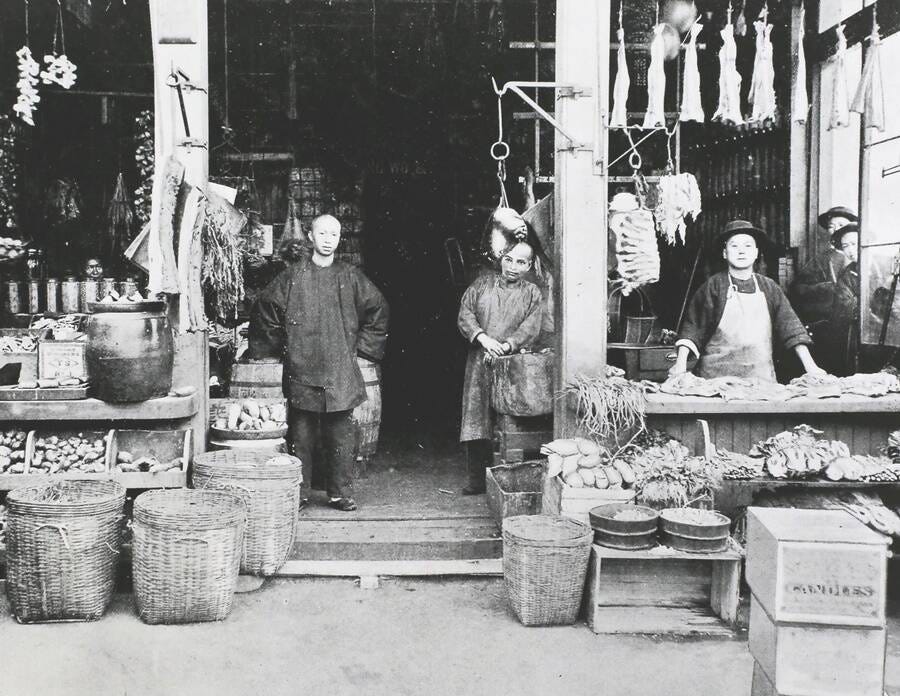
Chinatown, San Francisco, late 19th century.
A guest post by Christopher Kim, M.A. Economics, Fordham University.
When most people hear the phrase, the plague, they conjure images from times long ago. They think of medieval Europe and infected fleas and rats stowing aboard ships. They think of the devastation when a 14th century pandemic killed a third to a half of Europeans, or the Great Plague of London that wiped out up to a fifth of the city. However, the plague didn’t disappear and, it is still with us today – a resident of Arizona died of plague just last July and another Arizona resident was infected in April.
In 1855, a less well-known outbreak of the plague caused by the bacterium Yersinia pestis began in southeastern China. It marked the beginning of a new episode with the disease. By 1894 it arrived in British Hong Kong, a major trade hub. Any destination for a ship leaving Hong Kong faced the threat of an outbreak. This round of the pandemic would kill 15 million people in total including over 2 million in China and 10 million in India. It spread far across the globe and arrived at a rising city on the other side of the Pacific, San Francisco.
By 1900, San Francisco had become the main port for trans-Pacific trade in the United States. The 1848 gold rush and 1860s railroad boom brought an influx of laborers and businessmen alike, some of whom had settled down in San Francisco. A significant percentage of this population had arrived from China. These immigrants faced many challenges, however. Being non-white in the United States meant facing institutional and interpersonal discrimination. The Chinese community of San Francisco faced racial violence in the 1877 riots, had their voting rights stripped a year later, and were even cut off from their home country with the Chinese Exclusion Act of 1882. Furthermore, they did not have the right to own property, meaning most of Chinatown was owned by white landlords who were motivated by profit as much as racism to neglect their tenants and let their buildings fall into disrepair. Tenants further sublet their spaces to new arrivals, only making living conditions more cramped and unsafe (Risse 26). Many of the neighborhood’s buildings became home to rats as much as to humans. With its rat problem and location next to the port of San Francisco, Chinatown had become the perfect ground zero for a plague outbreak.
In 1899 shortly after the 1894 Hong Kong outbreak, ships with the plague arrived in Honolulu, Hawaii. The islands had just been annexed as a United States Territory, and the new Hawaii Board of Health decided to perform controlled burnings as a public health measure to rid the city of plague. One such burning in Honolulu’s Chinatown went out of control, destroying most of the buildings in the area (Takai 2020).
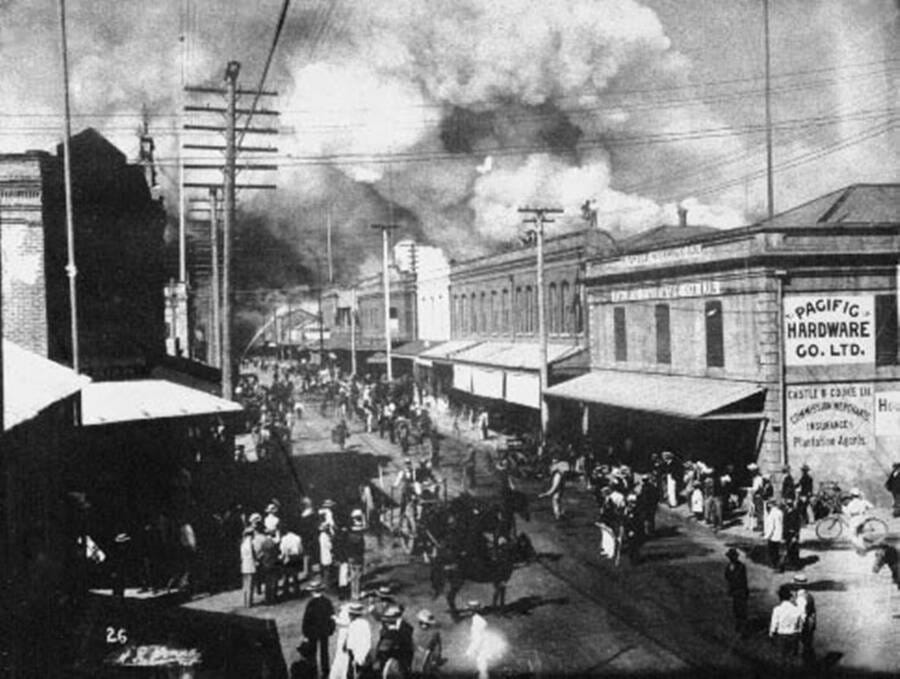
The burning of Honolulu’s Chinatown.
The residents of San Francisco’s Chinatown feared that they would be next, especially in consideration of calls for the complete destruction/removal of Chinatown by many of San Francisco’s white residents (Risse 120). When the plague arrived only two months later, the Chinese community’s fears were realized.
The plague’s impact on the Chinese community was magnified by a host of socioeconomic factors. Sick Chinese residents were less likely to trust and be able to afford western doctors. Further, those same doctors discriminated against Chinese patients. A lack of medical knowledge about the plague exacerbated these factors. The claim that plague was spread through rat fleas had only been introduced in 1898. At the time of the San Francisco outbreak only two years later, many Anglo-American doctors distrusted the theory (Risse 127).
To make matters worse, racists claimed that Chinese were more susceptible to infectious disease due to inferior genetics or the consumption of rice over meat. The reality, however, was more simple. Chinatown’s population was more vulnerable due to simple economics. They were poor. The living standards they faced in Chinatown contributed to a lower level of health for its residents. The level of uncleanliness and disrepair with the tenements they rented allowed the rats to breed and inhabit the area with ease. In retrospect, no one should be surprised that the plague took root here.
The individual and institutional responses to the epidemic ranged from negligence to outright hostility. The morning after the identification of the first plague victim, police cordoned off the borders of Chinatown. They locked in all the Chinese residents. To the Chinese community the quarantine was more a show of force than a public health response. The non-Chinese of San Francisco faced no similar measure. Non-Chinese people in the Chinatown district were allowed to leave.
Similarly, the Chinese community were heavily encouraged to use the experimental Haffkine vaccine, while unvaccinated white San Franciscans were freely allowed to move through the district. The targeted nature of the measures only further sowed distrust against any potential public health measure forced upon them.
The response to the epidemic was heavily influenced by business and political interests. Republican governor of California Henry T. Gage feared that an outbreak would damage the economy and harm the financial interests of his backers in the Southern Pacific Railroad company. As a result, he refused to acknowledge the plague existed throughout the entirety of his tenure as governor. He impeded any efforts by the federal government to aid the victims, and attempted to silence and refute any evidence that deaths were caused by the plague. While this unwittingly aligned him with Chinese community leaders who also denied the existence of an outbreak, he was still amongst those who wanted the removal of Chinatown (Risse 224). Furthermore, his actions denying the plague hindered a faster and more active response, likely resulting in more deaths. At the end of 1902, he was unable to secure the nomination from the Republican party for reelection, and their new candidate George Pardee became governor at the beginning of 1903. Pardee’s administration allowed federal authorities to more effectively pursue a rat killing campaign that would end the outbreak in 1904 after four years of terror for San Francisco’s Chinese community.
In the end, of the 119 official plague deaths, 97 were Chinese. However, the actual count was likely much higher, as the Chinese community hid the sick and dead from city officials due to mistrust and to be able to perform traditional funeral rites.
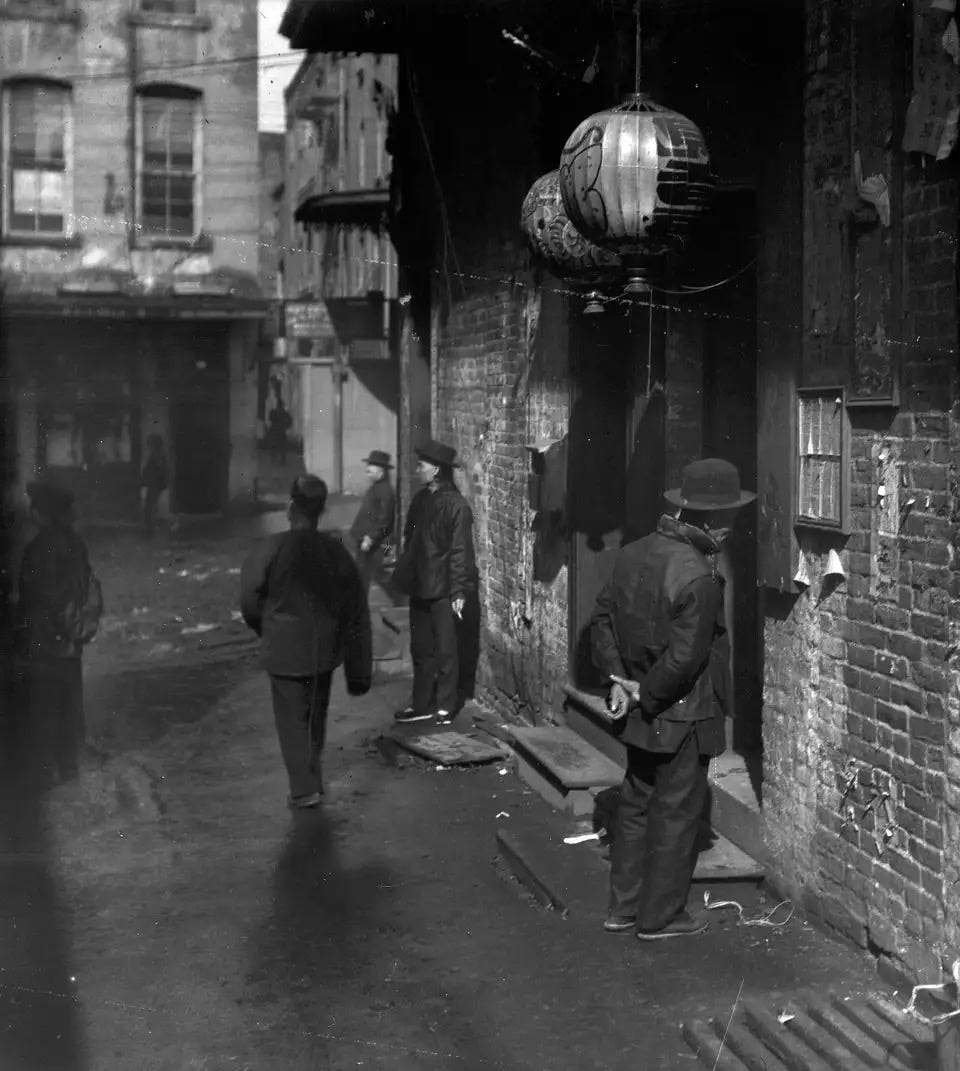
Chinatown, San Francisco, Alley around 1900.
Many facets of the 1900 outbreak of bubonic plague remain relevant today. First, the power of non-medical public health responses remain essential in the fight against infectious disease. While bubonic plague is treatable today, antibiotics had not been invented in 1900, and the then existing vaccine was not fully effective. At the time, the only way to stop the epidemic was to use non-medical public health measures to prevent transmission. In a time before penicillin, the rat killing campaigns of 1903-1904 were able to end the outbreak, although perhaps too little too late for many living in Chinatown. At the onset of Covid-19 we were in much the same position without effective vaccines or treatments. Second, disease prevention and treatment go beyond medical technology. Efforts to renovate and/or clean Chinatown were met with resistance within the community, and reasonably so considering the racist fervor to push Chinese residents out of the city. Yet, aid in terms of food, housing security, and proper sanitation were as essential then as they are today. Unfortunately, as the San Francisco government failed the Chinese in 1900, we still fail to protect vulnerable communities along these dimensions today. Third, politics can’t be separated from public health. Minority groups can be targeted, or in some cases even worse, ignored, by negligent administrations. Further the financial advantages of business-as-usual policies that ignore or stifle the risk of outbreaks often impede public health responses to epidemics. Despite being key aspects of an epidemic over a century ago, these themes all existed in the undercurrent of the initial 2020 Covid-19 pandemic response.
While infectious disease and epidemics have troubled humanity since its beginning, our relationship with disease has changed alongside changes in society and technology. While it can be easy to believe that fighting disease is a matter of only biology and medicine, the reality is that the outcome of an epidemic can be heavily influenced by economics, politics, and culture. The 1900 San Francisco bubonic plague outbreak is an example of the intersection of the three. Notably, it is an example of the heterogeneous impact of an epidemic on a specific group. The Chinese community of San Francisco disproportionately bore the brunt of the epidemic, in a history that mirrors, more than we would like, the recent events in the 2020 Covid-19 Pandemic.
Christopher Kim, M.A. Economics, Fordham University
Works Cited
Kellogg, Wilfred H.‚ “THE PLAGUE SITUATION‚” California and western medicine vol. 47,1
(1937): 69-71.
Risse, Guenter B. Plague, Fear, and Politics in San Francisco‚’s Chinatown. The Johns Hopkins
University Press, 2012.
Takai, Yukari.‚ ”Epidemics and Racism: Honolulu’s Bubonic Plague and the Big Fire,
1899-1900‚” Active History, 12 June 2020,
activehistory.ca/blog/2020/06/12/epidemics-and-racism-honolulus-bubonic-plague-and-the-big-fire-1899-1900/.
No posts
Comments
Nothing yet. Say the first thing.
Sign in to join the conversation.