

In 2025, maintaining a levered long ETH position cost roughly 18% annualized on Hyperliquid versus roughly 4% on Aave. On a $1 million position, that difference is over $100,000 a year.
Why does this massive gap exist? And more importantly, why hasn’t arbitrage closed it? The answer exposes a fundamental flaw in how DeFi structures leverage, leaving traders trapped between two suboptimal choices.
Perpetual futures (perps) look cheap, but like casinos, they take a massive rake from your winning hands. Because most traders want to be on the same side of a trade (usually long), perp platforms must continuously tax the popular side to pay the unpopular side.
When your trade wins, perps become superlinearly expensive due to two compounding traps:
>The Appreciation Tax: Funding rates are calculated against your now-appreciated position size. A 2X gain equals 2X the funding cost.
>The OI Imbalance: As an asset pumps, open interest (OI) becomes heavily one-sided, causing the funding rate itself to spike.
You tend to leak the most value precisely when you are winning, which is why unsophisticated traders don’t notice. In a spot margin system (like Tristero or Aave), you simply borrow from a pool at a stable market rate and pay it back whenever you sell—no funding spikes siphoning from your wins.
Perps can’t function without these spot markets. Because organic interest in shorting is rare, the short side of perps is heavily dominated by basis traders. These traders borrow spot, lever up, and short perps just to harvest your funding fees. In other words, if you’re trading perps you’re probably already trading levered spot, but just paying additional middle men for the privilege.
If Hyperliquid is a cash bleed, why aren’t traders flocking to Aave’s low borrow rates?
Because Aave wasn’t built for traders. It was built by lenders, for lenders, to protect depositor capital at all costs.
Think of Aave like a highly conservative local pawn shop. You hand over a valuable asset, and they let you walk out with 80% of its appraised value in cash. The shop’s core constraint is that it can never lose money on a bad loan. If the market value of your asset plummets, the pawn shop avoids holding the bag by outsourcing the liquidation risk.
The moment the market price drops below a specific buffer, the pawn shop lets anyone walk into the back room and buy your asset straight off the shelf at a massive discount. On Aave, this liquidation penalty is often a 15% haircut. If your $100,000 asset drops to $92,000, a third-party liquidator repays your $80,000 loan and claims the entirety of your remaining $92,000 collateral to cover the debt plus their 15% bonus. The pawn shop gets its money back, but you lose $12,000 in equity.
This creates a brutal environment for active traders:
A 4x long opened at $80,000 BTC on Hyperliquid gets liquidated if Bitcoin drops below $61,000. On Aave, that exact same position gets wiped out at $70,000.
At 10x leverage on Aave, a mere 0.3% price drop sends your position to zero. This isn’t bad engineering; it’s simply the limitation of a V1 architecture built around 12-second block times, fragmented external liquidity, and a strict mandate to protect passive depositors.
Creating a lending protocol that equally prioritizes the borrower requires architectural changes. We cannot fix leverage by tweaking parameters on an isolated lending protocol or by adjusting funding formulas on a perp exchange. The solution requires collapsing the distance between the lending pool and the execution venue into a single, vertically integrated environment.
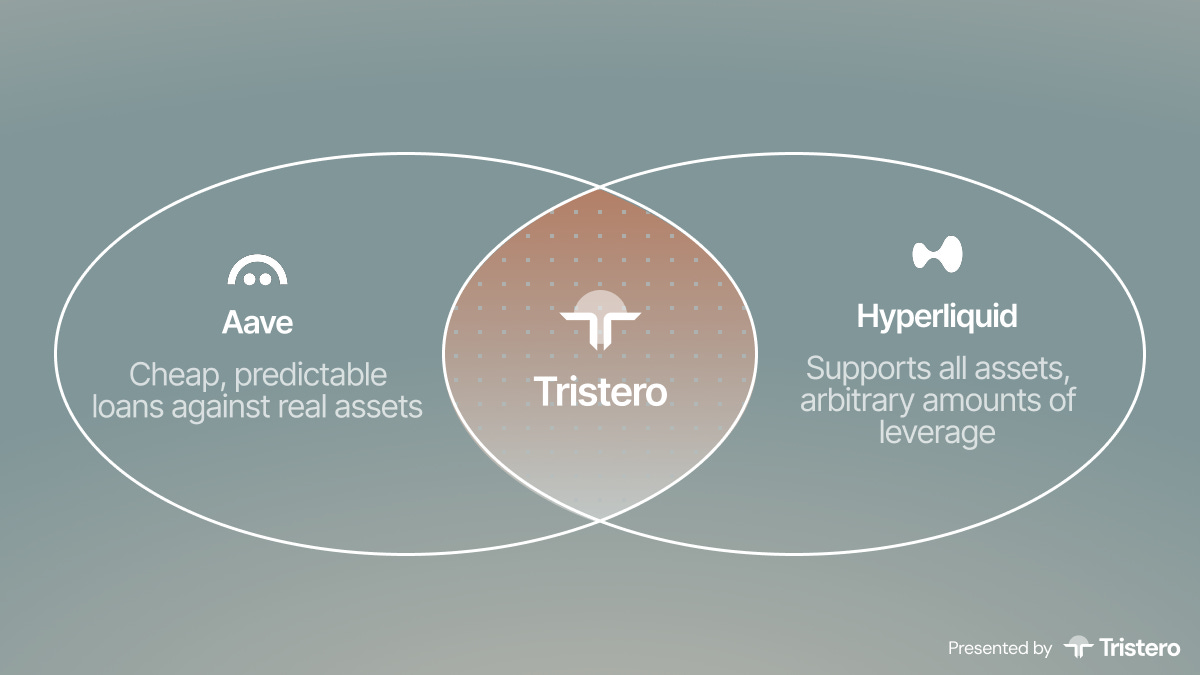
This is the design philosophy behind Tristero. By combining an institutional-grade spot execution engine with a native margin protocol, Tristero eliminates the trade-offs that hobble both Aave and Hyperliquid. To date, Tristero’s spot engine has processed over $9 billion in volume, consistently outperforming other leading DeFi venues like CowSwap for most assets.
Opening a levered long takes just a single step: select your collateral, choose your leverage, and execute. The underlying token is purchased and locked into Tristero smart contracts in under 15 seconds, fully shielded by native MEV and slippage protections.
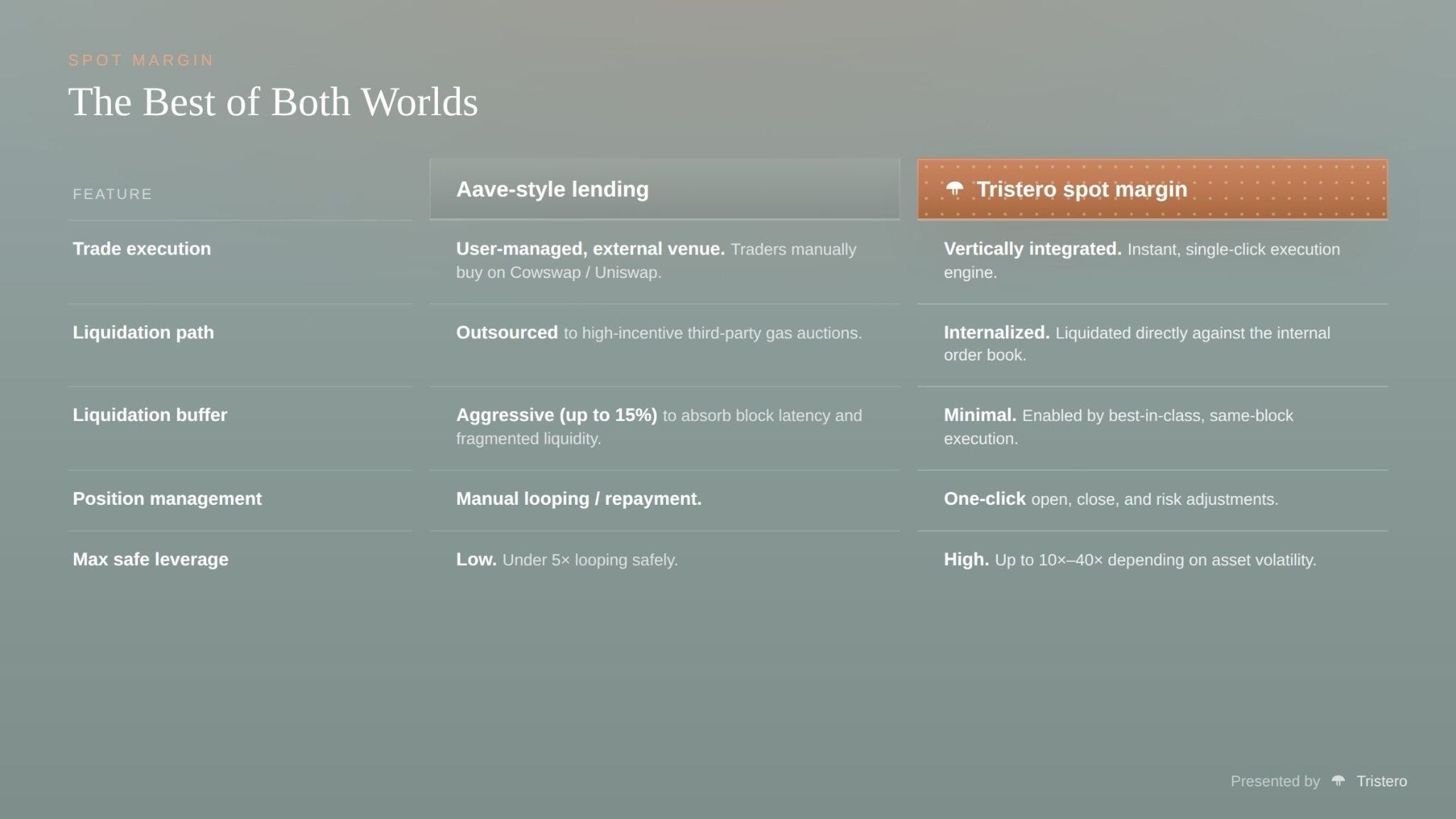
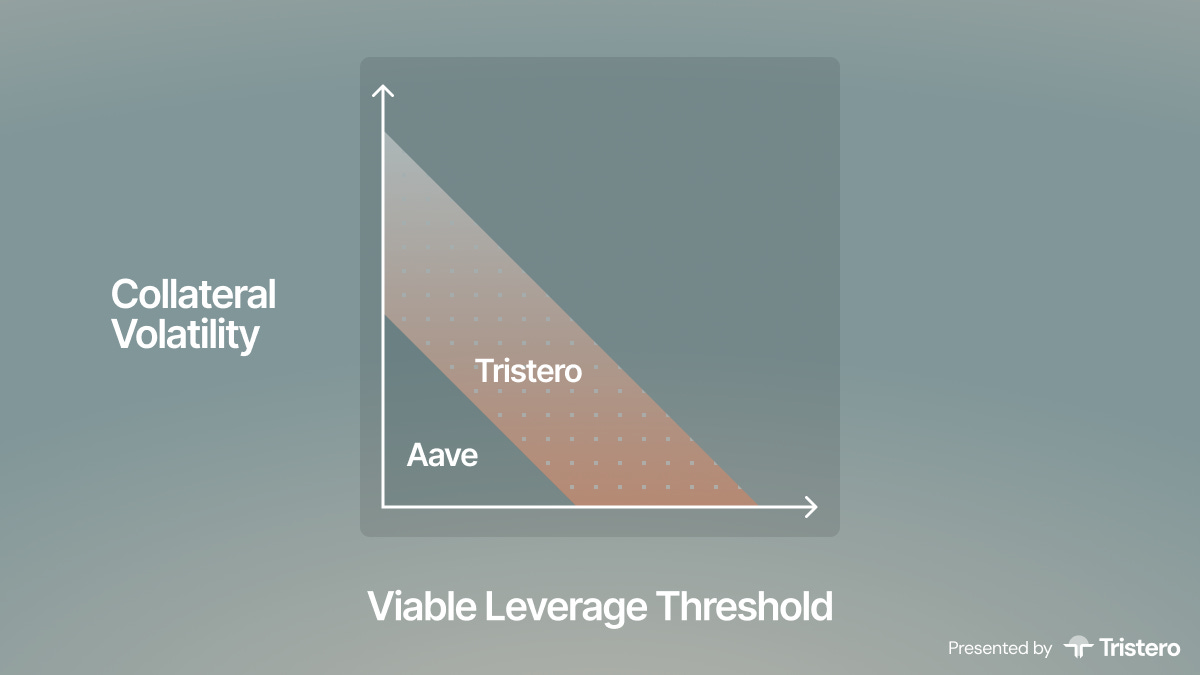
Tristero’s structural advantage over legacy DeFi models rests on two tightly coupled integrations:
Integrated Execution: In high-leverage trading, frictional costs (price impact, fees, and slippage) act as an immediate tax on entry and exit. Because these fees apply to your total levered exposure rather than your deposit, a 20x long scales a seemingly small 1% frictional cost into a 36% hit to your initial principal before the market even moves. Tristero aggregates all DeFi liquidity sources to compress these frictions to the absolute minimum.
Integrated Liquidation: Because legacy protocols cannot guarantee immediate execution, they over-correct by offering massive discounts to third-party liquidators at the borrower’s expense. Tristero internalizes this process. When a position breaches its liquidation threshold, the protocol unwinds it directly against its internal order book within the exact same block.
To prevent the internal order book from being overwhelmed during market-wide black swan events, Tristero pairs its localized liquidity with fallback cross-venue routing and robust external oracle networks. This ensures that localized price anomalies never trigger accidental liquidations. If a liquidation is necessary, the asset is wound down with minimal price impact, and any remaining excess equity is returned directly to the trader.
Up until now, crypto investors faced an economically irrational choice: bleed out slowly via a perp platform’s exorbitant funding rates, or risk instant annihilation from a lending protocol’s rigid liquidation buffers.
This structural flaw made long-term levered investing virtually impossible. On a multi-year timeline, it makes no sense to pay 15% annualized funding to maintain a directional thesis on an asset. By marrying the low interest rates of spot borrowing with industry-best onchain execution, Tristero introduces a critical financial primitive: capital-efficient spot margin. This changes the game for four core market participants:
Long-Term Investors: Until today, you had to choose between low, stable rates with highly restricted asset selection (Aave) or egregiously expensive funding (Hyperliquid). Now, you get low rates, high leverage, and a massive asset catalog.
Yield Seekers: On Tristero, you can use nearly any ERC-20 as collateral. This means net-new, predictable yield streams for passive depositors.
Arbitrage Desks: Quantitative shops running basis trade can use Tristero to execute the spot leg of their trades with near-zero friction. Capital efficiency on the spot side means they can compress perp funding rates more aggressively, pocketing higher yields while making perp markets healthier.
RWA Market Makers: Tristero supports margined longs and shorts on Real World Assets (RWAs)—collateral types that Aave cannot touch due to volatility and oracle constraints. If you have a thesis on what Apple or NVIDIA should be priced at over the weekend, you can now back it with capital-efficient leverage.
The ultimate impact of Tristero margin goes far beyond cheaper longs. When market participants have access to highly efficient, robust leverage, it unlocks a powerful liquidity flywheel across the entire DeFi ecosystem.
Currently, fragmented liquidity means assets frequently experience sharp, temporary price dislocations between different decentralized venues. Because Tristero integrates DeFi-wide liquidity aggregation into its core execution engine, arbitrageurs can deploy massive, levered capital in a single click to instantly smash those spreads. Better leverage means tighter, more efficient pricing across all of DeFi.
Companies like Ondo and XStocks are democratizing global finance by putting tokenized equities on-chain. However, American equity markets are only open for 30% of the calendar week. The other 70% of the time, these tokenized assets suffer from severe illiquidity because pricing them after-hours is incredibly risky.
Tristero changes this by replicating the hidden machinery of traditional finance.
In TradFi, retail platforms can offer robust 24/5 retail trading (via overnight alternative trading systems like Blue Ocean ATS) because their institutional market makers have access to Prime Brokerage portfolio margin. Desks can borrow capital cheaply to hold overnight stock inventory, safe in the knowledge that a temporary after-hours price gap won’t cause their prime broker to instantly seize and liquidate their assets at a predatory discount.
DeFi has completely lacked this institutional safety net. If a market maker tries to provision after-hours liquidity for tokenized Apple stock using an Aave-style stack, a thin-order-book oracle glitch would instantly trigger a public liquidation auction, wiping them out.
By providing market makers with capital-efficient spot margin that operates 24/7, Tristero gives them the exact same protection as a Wall Street prime brokerage account. They can continuously provision liquidity and absorb risk outside of standard US market hours without fear of predatory liquidation.
Ultimately, truly solving global asset access isn’t just about tokenizing a stock certificate; it’s about building the financial machinery that allows that asset to be safely traded, levered, and liquidated at 3:00 AM in Istanbul. Tristero is that machinery. It finally gives the borrower a fair deal, and in doing so, unlocks the future of on-chain liquidity.
You no longer have to choose between bleeding out slowly from Hyperliquid’s exorbitant funding rates or facing instant annihilation from Aave’s rigid liquidation buffers.
It’s time to trade on a platform built entirely for the borrower. Experience the future of capital-efficient, vertically integrated spot margin.
To celebrate the launch, we are giving early traders a head start. For a limited time, we’re offering $5,000 in fee-free margin trading.
👉 Visit Tristero.com to claim your $5k margin bonus and take control of your capital.
No posts
Comments
Nothing yet. Say the first thing.
Sign in to join the conversation.