
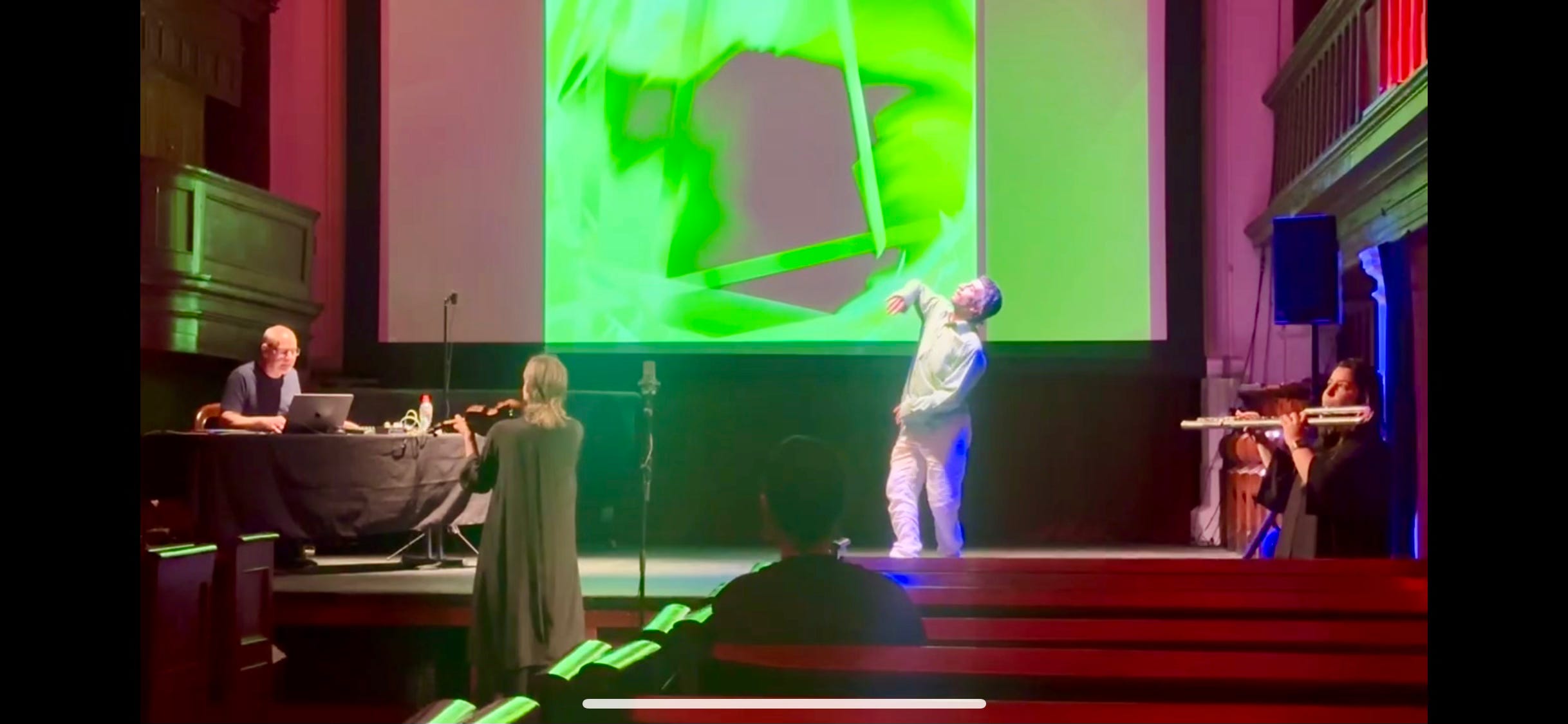
Fingerprints played at Triskel Christchurch as part of Cork Midsummer Festival, having premiered in Belfast’s The MAC. Supported by the Arts Council Northern Ireland, it was conceived as part of “ongoing collaborative research that explores drawing as a responsive system shaped by sound, movement and live performance. At its core is a custom-built computational drawing system that reacts in real time to acoustic instruments and gesture”.
That description risks driving people away, rather than the opposite.
As it was a fully improvised performance, I approached with some trepidation, fearing the kind of improvisation that is more about pushing an audience beyond their comfort limits rather than making music. I took a chance though, knowing that violinist Ioana Petcu-Colan and her brother, percussionist Alex Petcu, two Cork-born musicians at the top of their game and more often found on a classical music stage, would surely not be out to make me suffer needlessly. In fact, my eardrums were in safe hands with all four musicians, who each offered a great variety of colour, tone and expression and interesting interaction with each other.
I sat at the front, the better to take in the visuals which were heralded as being at the core of the show. On stage when we entered was artist Steve Meyfroidt sitting at his laptop stage right, with the big screen behind him and the dancer seated in darkness. From looking online at his account of the performance’s first iteration in Belfast, I now know his mics were already picking up ambient sound and translating it into a visual language which was beginning to make its mark on the screen, but I was too busy scoping out the arriving audience and being social to notice.
The performance proper began with Ioana Petcu-Colan performing solo from the hatch above the stage. A mysterious and warm line of music emerged that a moment later was represented on the screen by fairly random-looking marks that stayed there, drifting and fading very slowly to create a mesmerising evolving image. As the other musicians joined and left the soundscape from positions around the venue, sometimes melodic, sometimes percussive and rhythmic, their effects on the screen were noticeable, and I could see Steve was busy doing stuff in real time. What I struggled to perceive, though, was any relationship between the emotion or character of the music and the images appearing before us.
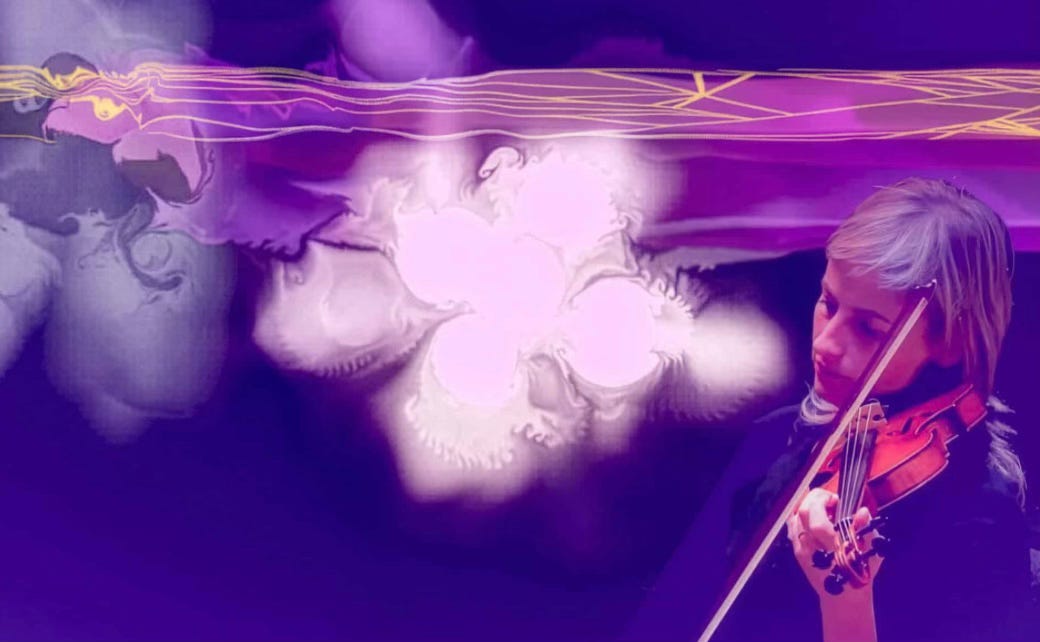
After a while the screen was really starting to annoy me. Music happens in the now – the trace of music we heard 20 seconds ago was still fading on the screen and it began to resemble little more than a gigantic screensaver.
When dancer Davide Marinelli emerged from the shadows I was grateful for something else to focus on and enjoyed his reassuringly human form, his gestural language and his facial expressions. His movements were clearly affecting the emerging artwork; something more organic had crept into the shapes onscreen, but again I couldn’t correlate them with the overall image. When he left the stage to move around the space I was enchanted instead by the incredible musicality of flautist Lina Andonovska duetting with Ioana Petcu-Colan for some time in front of the stage until I heard movement behind me and turned to find Marinelli dancing in the aisle.
The relief of turning my head away from the screen was almost shocking. I spent most of the rest of the performance looking anywhere but at the screen, which was easy with the musicians moving around the space. I particularly enjoyed watching Marinelli interact with trombonist Ross Lyness in the aisle with humour. When Marinelli returned to the stage I could see a sudden change in the visuals as sensors picked him up again, but I still found myself far more engaged by the musicians and dancer themselves than by the images they were co-creating.
There’s lots to enjoy in Fingerprints. The improvised music and dance worked really well but for me the developing technology has a way to go before it creates something that substantially relates to the music and gesture that generate it. There is a noticeable timelag between sound and image creation, which was distracting in itself. It’s a really interesting field to explore though, and no doubt some impressive images were created, but I can’t help wondering if the sounds of a busy train station, building site or hospital might make just as interesting images. In fact, I suspect it could make a fascinating installation in such a place.
Fingerprints was captivating from start to finish, and despite not being promoted as a family event, kept the attention of all present including several exceedingly well-behaved children (and no, they weren’t all mine). My kids shrugged and claimed to have no opinion afterwards, other than complaining about the timelag between sound and video. I think they were pretty impressed with the trombonist’s sound effects, though, when he played inches from their wide eyes, the little one’s hands clamped firmly over his ears.
No posts
Comments
Nothing yet. Say the first thing.
Sign in to join the conversation.