
I spent a large part of my childhood living in Germany in the 1980s and the two biggest fears I had were nuclear war and rabies. The Day After, War Games, When the Wind Blows and Terminator were just some of the terrifying films in that one memorable decade that highlighted the fragility of humanity against the might of the nuclear bomb. As a ten year old child I was always expecting to hear the sirens seconds before being instantly vaporised — not ideal, but still preferable to surviving the blast which would mean eating rats whilst your hair fell out in clumps.
Rabies was a big deal for me because it didn’t exist in my home country of England, but as we were living on a military base in northern Germany, where apparently foamy-mouthed hydrophobic dogs and foxes were lurking in every forest, the virus was a real concern. As children we were told about this mysterious and dramatic illness by our school teachers and parents and our young minds took from this two key things: Firstly, you would have to get an injection in your stomach with a really long needle that was about the thickness of a pencil (everyone seemed to have a friend of a friend who had experienced this horror) and secondly, even after an injection, you would probably die anyway. Even in the highly unlikely event of survival you would go on to eventually die of thirst because you would be terrified by a simple glass of water. It sounded nasty and led to a lot of discussion at school lunch break.
The nuclear war hasn’t happened, yet, and rabies has all but gone from most of Europe. However, in India rabies is still very much a big problem. In 2024 alone there were an incredible 3,700,000 reported dog bites and 54 reported deaths from rabies1 . When we chatted to folk in India about the dogs there the conversation almost always went one of two ways. The people were either happy to be around the dogs and found them to be good companions and enjoyed watching their antics, or they were terrified of being bitten and catching rabies and therefore hated them.
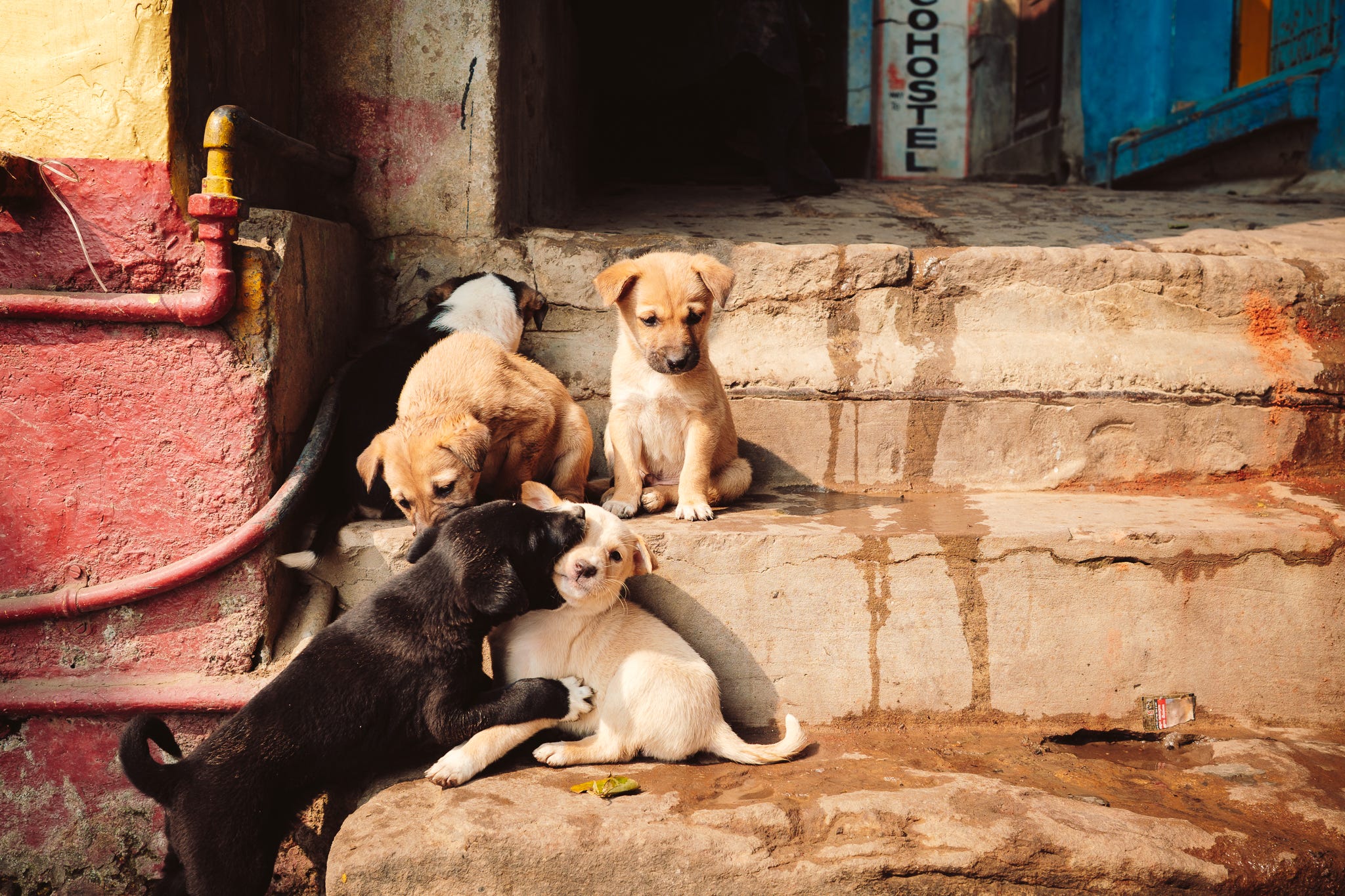
As much as I love dogs, including those in India of course, I have to admit that there really are far too many. The exact number varies but it is suggested to be around 15 million animals2. As I’ve mentioned in my project many times, you really don’t have to go far to find a dog in India. When you do spot one there is roughly a 50% chance it is a female who you can clearly see has had many, many litters of puppies in her life. If the dog you spot is a male it is most likely either asleep, or fighting with another dog in an effort to produce yet more offspring. Little puppies, such as the ones in the photograph above, are scattered in groups everywhere and death and sickness are obvious and heartbreaking.
With the enormous number of untrained and unrestrained feral dogs mixing with an even more enormous number of people it is hardly surprising that there are an equally large number of dog bites, and some of those bites will inevitably be from rabies infected dogs. While this may seem to be an insurmountable problem, however, all is not lost. The Rajasthan desert city of Jaipur has emerged as a leader in the treatment of the problems of dog numbers and rabies infections. In 2001 an animal charity called Help in Suffering launched the Animal Birth Control (ABC) & Rabies Control Programme3 .
A programme to sterilise and vaccinate neighbourhood dogs against rabies was established in Jaipur, India. Neighbourhood dogs were captured humanely, sterilised surgically, vaccinated against rabies and, when they had recovered, released where they had been caught. Between November 1994 and December 2002, 24,986 dogs were treated in this way. Direct observational surveys of the local dog population indicated that 65 per cent of the females were sterilised and vaccinated, and that the population declined by 28 per cent. The records of human cases of rabies seen in the main government hospital of the city between January 1992 and December 2002 showed that the number of cases had declined to zero in the programme area but increased in other areas.4
The problem now is figuring out a way of extending programs such as this one across an enormous and incredibly diverse country where people’s love for dogs varies as much as the wealth they have available to fund such projects. There are already signs of success though. India has now formally committed to eliminating dog-mediated rabies by 2030 under its national plan and many states and large cities have rejected mass culling in favour of the Jaipur model of sterilisation and vaccination.
Interestingly, in my own experience, I have noticed that the fear of death and disease does not always outweigh the Indian people’s love and compassion for their fellow creatures. I have witnessed several instances where they do their best to help sick and dying dogs, even though they have extremely limited resources. One day, in Jodhpur, some ladies had found a dead puppy in the road. They had taken the trouble to pick it up, place it carefully at the foot of a holy neem tree and had covered its head with a crisp packet as a sign of respect. A small gesture, but a sign of kindness and humanity all the same.

https://journals.sagepub.com/doi/10.1177/00258172251376869
https://indiadatamap.com/2025/10/30/estimate-of-stray-dog-population-in-india-2025/
https://helpinsuffering.org/about-us/#our-story
https://europepmc.org/article/MED/16980523
No posts
Comments
Nothing yet. Say the first thing.
Sign in to join the conversation.