
Nothing induces teacher eye-rolls faster than an administrator, workshop facilitator, or consultant invoking the importance of community. Right up there with “Find your why!” or “It’s for the kids!”, the phrase “It’s all about relationships!” is about as tired of a cliche as one can find in education. It’s not that the eye rollers disagree, but like many other parts of our profession, it is advice that has been reduced, repackaged, and resold back to us in bumper sticker form more times than we can count. Worse still, it’s advice that is often offered in lieu of real solutions to deeper structural problems, administrative issues, or funding shortfalls.
I promise this article isn’t about that. Nor is it a meditation on the very real power and importance of actually co-creating affirming communities alongside students and families (as opposed to just saying buzzwords about them). If you’re an educator interested in those things—and you should be—you’ll want to check out my friend Nawal Qarooni’s book: Nourishing Caregiver Collaborations.
Instead, I want to take this post in a very different direction than how most folks think and speak about communities and relationships in education circles. Specifically, I want to ask a question that I think gets far too little attention: what is the relationship between English teachers and the intellectual communities that actually shape the discipline we’re supposed to be teaching? And what happens to teachers—and by extension, their students—when that relationship is codified, commodified, and captured by out-of-touch functionaries and corporate interests?
First, if you’ll excuse me, I need to trot out some theory to clarify what I mean when I discuss the importance of communities and relationships to learning. While there are a number of versions of this concept, Lave and Wenger’s Community of Practice model is one of the more straightforward sociocultural theories of learning. According to Lave and Wenger, Communities of practice (CoP) are “groups of people who share a concern or a passion for something they do and learn how to do it better as they interact regularly” (Lave & Wenger, 1991, p. 1). This concept is as capacious as the human endeavors it theorizes. CoPs include documentary filmmakers debating innovative narrative techniques, medical residents reflecting on the complexities of clinical decision-making, and even groups of cos-playing superfans swapping costuming tips at a Comic-Con conference.
For a group to function as a genuine Community of Practice, however, it requires more than casual association or shared interest. According to Wenger’s framework, it must exhibit three essential characteristics: the Domain, Community, and Practice.
Domain: a defined area of knowledge and activity that establishes the group’s identity and distinguishes it from other social formations.
Community: the people participating within the domain who are engaged in sustained interaction, knowledge sharing, and relationship-building.
Practice: the repertoire of shared resources, methodologies, and tacit knowledge that members develop over time.
This video does a good job explaining what they are and why they’re relevant for education. It also raises an important question: how many English teachers feel like they are actually in one of these communities? Not in the watered-down, professional-development sense—not a “PLC” with a shared Google Drive, not a department meeting where we fiddle with rubrics or a committee beta testing the latest district mandated EdTech tool—but a genuine community of practice organized around the knowledge and inquiry of literary studies? From my vantage point, these pseudo-communities are infinitely more common than actual communities of practice. I know we have a lot of bigger problems right now, but that should concern us. It’s my firm belief that the proliferation of pseudo-communities, and the lack of rootedness in authentic intellectual communities, has become a structural condition that increasingly determines what teachers come to believe the discipline is.
So what does it actually look like to learn a discipline from within a community rather than from a scope and sequence? The CoP framework helps us see that truly learning an academic discipline is a “who/how/why?” question as well as a “what?” question. A person who memorizes a massive list of authors names, novels, plot points, facts about literary periods, etc. is not an expert in literary studies. They are a very narrowly prepared Jeopardy contestant. Of course, I’m not denying that becoming an expert requires learning the particular constellation of concepts and principles we’ve come to associate with the discipline. It also, however, requires knowing the particular social practices—ways of thinking, talking, valuing, acting, writing, reading, inquiring, arguing, and understanding—that produced those concepts and principles. That’s right my friends! English is not determined by your district’s curriculum guide or the Common Core standards. It is made and determined by the people who participate in it. Or as sociolinguist James Paul Gee puts it…
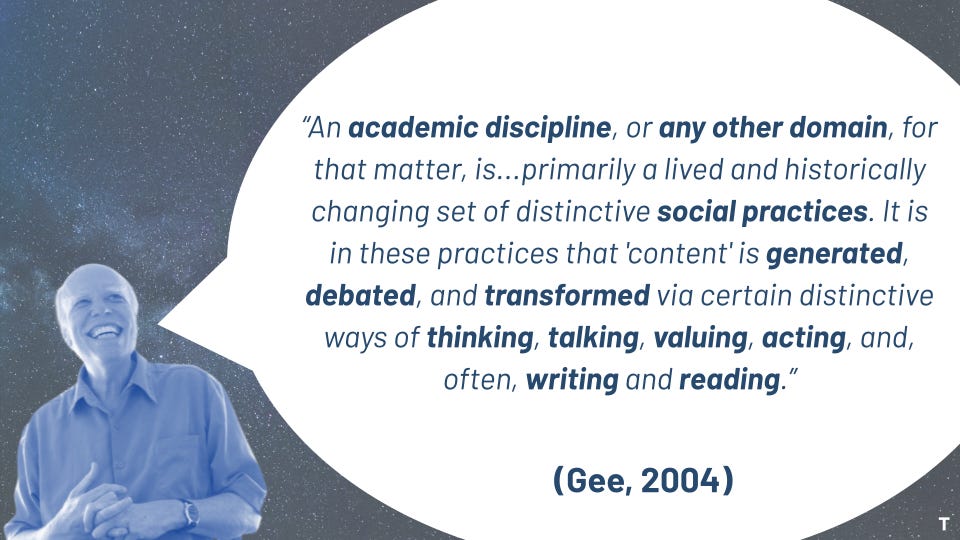
Let me give an example. A well prepared jeopardy contestant might know that the green light at the end of the dock in The Great Gatsby is a symbol for the unattainable nature of the American Dream. They might even know that some critical race scholars have theorized Gatsby might be a bi-racial character. A literary scholar might be aware of those facts, but they also know they don’t really have to give a shit about them if they’re pursuing a different interpretive angle. They understand that there isn’t a singular “correct” reading of a text (unless they’re E.D. Hirsch), rather that aesthetic forms, be they poetry, prose, or Pokémon cards, offer contested terrain for the discussion, debate, and interpretation of meaning.
Literary scholars also understand that the knowledge and practices they’re taking up to construct their argument have been shaped by the community in which and for which they are writing—that the success or failure of their argument will not be determined by a rubric printed from a PDF, but by the evaluation of fellow members of their field. Beyond that, they understand that their intellectual work, and the conversations that flow from it, is the very lifeblood of their community. It is the community. As Dan Sinykin and Johanna Winant argue in Close Reading in the 21st Century:
Close reading should entail risk. Everything valuable does. We encourage you to take seriously the task of standing between, and thinking with, two other people. Someone has invited you to think with them: whoever wrote the text under consideration. Allow something about the text to matter to you. Write about what matters to you. You enter the conversation in good faith and invite a third: your reader. Each makes themself vulnerable to misunderstanding. But the reward, if it works, is intellectual community.
This is a beautiful articulation of what it feels like to read and write in an environment guided by purpose and community, not test scores. It’s also an experience that too few high school English teachers, much less their students, are afforded. The reasons for their exclusion is going to require another much longer post, but while I know there are teachers who have built this type of intellectual community in their classrooms, none would say the systems we teach in are designed for it. I’ve written about the tension between “doing English” and “doing school” here, and my experiences teaching some English methods courses in an online MAT program suggests the disjuncture between the two is only getting worse.
So if disciplinary knowledge is produced, contested, and legitimated by communities of practitioners—and if the success of a literary argument is ultimately determined by the people you’re in conversation with—then what happens when teachers are cut off from those conversations entirely? For most English teachers, this isn’t a hypothetical. Participation in the discipline has been replaced by binders of alphanumerically coded standards and skills, assembled by administrators, policymakers, and corporations who have little to no relationship with the intellectual traditions they claim to represent. The attempt to externalize and codify what it means to “do English”—to render it legible for fidelity checks and quantifiable for accountability systems—is built from the same dehumanizing, managerial logic that treats teaching as a series of deliverables rather than a dynamic, living tradition.

Over time, this corporate simulacrum of English doesn’t just limit what teachers teach. It can fundamentally reshape what they think the discipline is. When your only sustained encounter with the discipline is so mediated by standards and pre-packaged curricula, it can become genuinely difficult to imagine it as anything else. Faculty debates about canonicity are replaced with state-mandated book lists guaranteed to maximize cultural capital. Text selections are determined by assessable skills, not thematic exploration or disciplinary coherence. The telos of our teaching is maximizing test scores, not pursuing human flourishing. The living, contested, communal nature of academic disciplines feel abstract and fuzzy—something that happens in universities, maybe, but is far removed from Tuesday’s lesson comparing direct and indirect forms of characterization or Friday’s test assessing students ability to find the main idea of non-fiction excerpts.
Worse still, once a discipline has been flattened into a set of standards, it becomes remarkably easy to package it as a product. Especially considering the lack of continuity and solidarity between K-12 English Education and Literary Studies means there is a gap in the market begging to be filled by rent-seeking corporations and “non-profits.” Enter HMH, College Board, and all the rest. They get a handful of professors to rubber stamp their programs, collate and quantify the academic disciplines they represent, slap a brand on it, and sell it back to the very teachers it was extracted from. Under these Corporations of Practice™, teachers are no longer participants within a dynamic intellectual tradition, they are curricular technicians optimizing for performance on tests that are designed by those very same companies.
To be clear, I am not against the creation of curriculum as such. In fact, it’s something I’ve co-authored a best selling book on and write about often on this Substack. I am, however, against it being created externally and imposed on teachers from above with no opportunities for involvement or collaboration. I am particularly against the ed-reform era ghouls and grifters who recycle the same tired, paternalistic think-pieces arguing that giving teachers curricular input and/or autonomy is too burdensome to bear. As if burnout comes from creation itself and not the alienating conditions of teachers’ labor—conditions that cohort of edu-pundits actively perpetuate and profit from. In short, I believe teachers need to seize the means of curricular production.
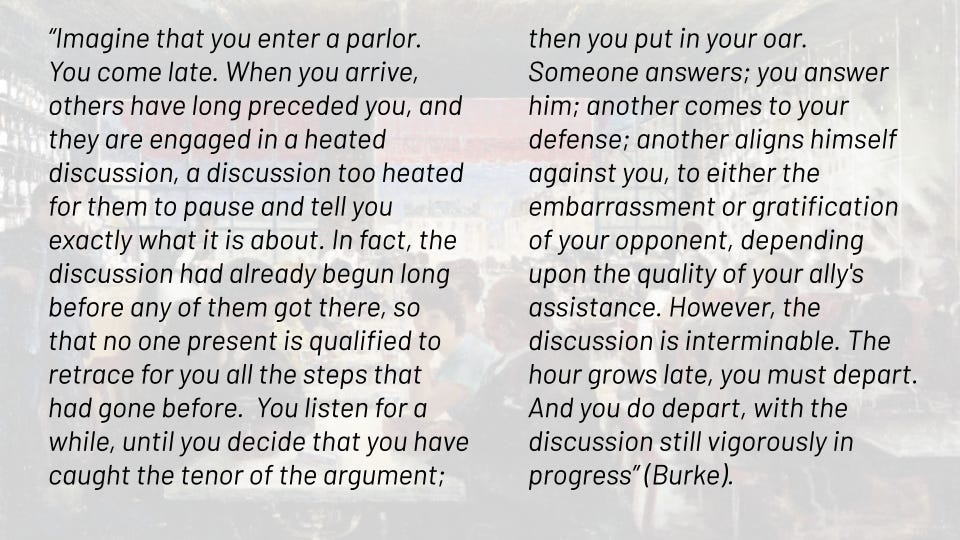
Without this revolution, the teachers in would-be intellectual communities are customers and the practices they share with their students are data points in need of optimizing. What remains is a domain defined not by its practitioners but by its vendors. For high school English teachers under this regime, the discipline is not Burkean parlor. It is not their intellectual inheritance. It is the intellectual property of the companies who control the tests and programs that dictate what and how they teach. Ultimately, it’s an enclosure of the discipline’s intellectual commons. The only way to access literary studies is to go through these intermediaries—or at least that’s how many educators feel.
I think this is why so many English teachers who are fully aware of AP’s problems still identify deeply with it. It’s not (always) ignorance or blind loyalty. For many, AP is the only thing that feels like a connection to the discipline beyond the narrow scope of their school or district. The only structure that puts them in contact—however mediated, however synthetic—with something that tries to package itself like a community of practice organized around literary and intellectual inquiry. Considering the lack of pathways to a sense of esteem and prestige in a profession severely lacking both, I’m sure many teachers would counter, “Well what else am I supposed to do?” It’s a fair question—but also reveals just how thoroughly College Board has colonized our imagination and eroded our control over the discipline. For more on this check out my conversation with Annie Abrams.
The good news is that authentic intellectual communities for teachers do exist. In addition to professional organizations like NCTE, MLA, AERA, etc. new, informal networks are also emerging, often in the very digital spaces our profession has a tendency to be suspicious of. As I discussed with Jeffrey Lawrence in my most recent episode of Conceptually Speaking, There is a growing number of academics, creators, and educators using newsletters, podcasts, video essays, and social media to engage in the kind of public scholarship and disciplinary conversation that used to be accessible only to those inside the ivory tower. The lines between academic, digital, and public literacies are blurring in ways that are messy, uneven, and not without their own serious problems—but also in ways that have real implications for how English teachers might reconnect with the living, breathing discipline I’ve been describing throughout this post. Not in ways that make us beholden to the academy or places us beneath literary professors in a prestige hierarchy, but in ways that reconnect us with the members of our discipline we've been siloed off from.
In fact, that’s a large part of what Becoming Literary and Conceptually Speaking are trying to be: a small contribution to a growing ecosystem of spaces where teachers, scholars, and anyone else who cares about literary studies can think together, argue productively, and participate in the kind of intellectual community that shouldn’t be a luxury. I’ll have much more to say about this in future posts. For now, I’ll just say that if we hope to rebuild our intellectual commons, we can’t rely on the people and companies who enclosed it. We need institutions. We need each other.
No posts
Comments
Nothing yet. Say the first thing.
Sign in to join the conversation.