
This post will be the first in a three or four part series translating, expanding, and tinkering with some frameworks and theories I’ll be sharing in a (rather delayed) special issue exploring the intersections between literary experience and digital literacies. This opening post runs on three vignettes—two of the fantasies that dominate how we talk about kids and reading, and a third, more realistic and hopeful one—with the argument tucked in between. Let’s start with a scene you’ll recognize.
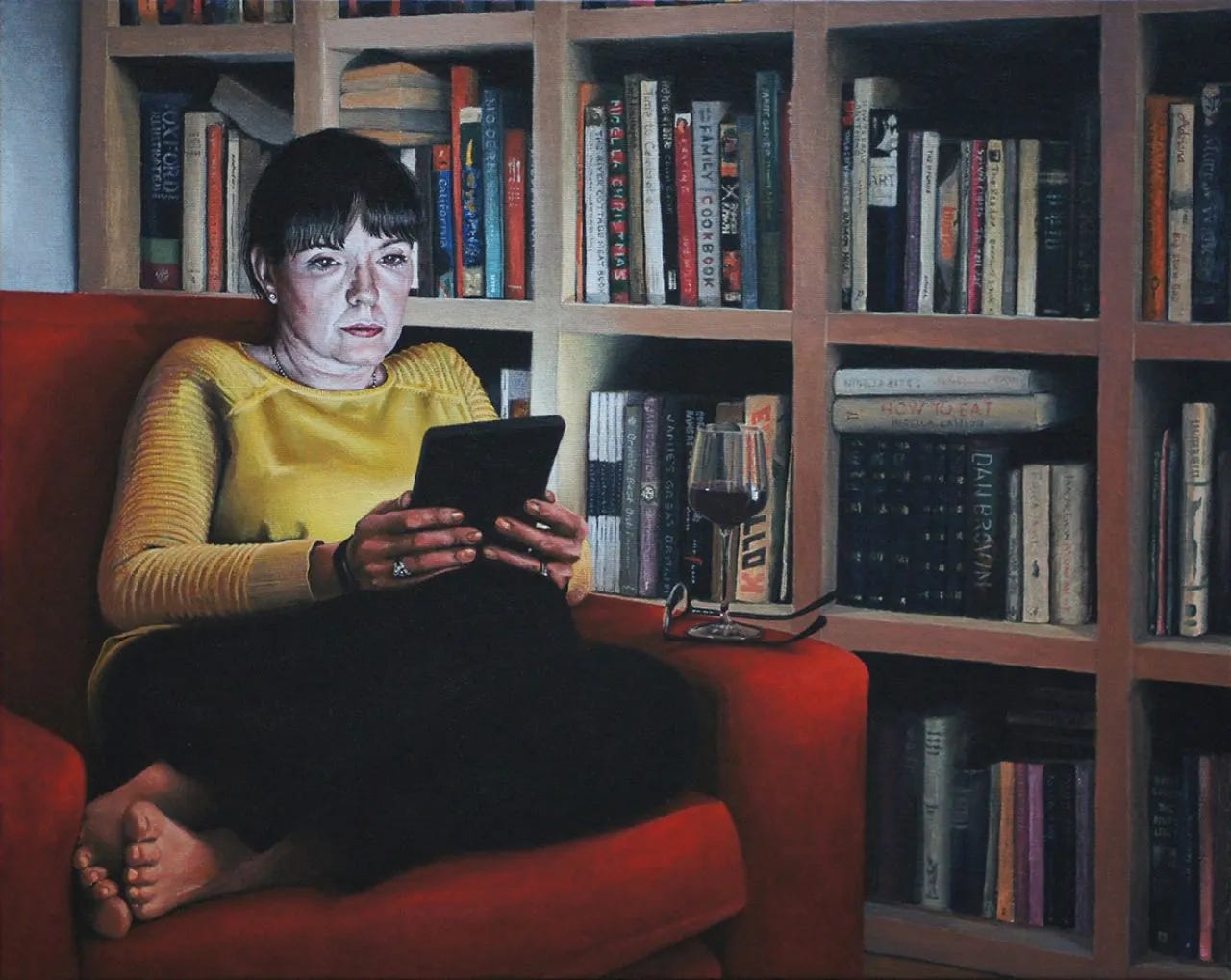
Imagine a student seated at a desk in their warmly lit room, poring over a book. Their eyes scan the page, absorbing Dickens’s winding syntax, Bronte’s withering witticisms, Whitman’s joyous cataloging, Douglass’s piercing rhetoric, Morrison’s haunting symbolism, or any number of other canonical authors brilliant prose. Their brilliance reaches across time and space, providing wisdom and aesthetic delight in equal measure. The room falls away. Their body dissolves. Time blurs. The book is a portal—an invitation to the candlelit parlors of Victorian England, or the damp deck of a doomed whaling ship, or the blinking lights of a distant space colony.
The student’s cell phone is nowhere to be found, consigned to a desk or nightstand somewhere out of view, forgotten as the young reader undergoes a transcendent narrative experience. They know full well that their literary journey requires every scrap of their attention—that their iPhone must be banished if they’re to have any hope of completing their scholarly seance. They know phones profane the space; that they are anathema to enlightenment. Reading, after all, is the ultimate form of humanistic discipline and its cultivation is not only an academic necessity, but a moral good in and of itself.
No one assigned this book. No teacher hovers at the periphery, no discussion looms the following period. No annotation is required (as that would certainly break the spell). No test or rubric waits to convert and quantify their wonder into a number that, in the aggregate, will come to determine their future. There is nothing instrumental about their reading. It is a purely aesthetic experience done for its own sake and for reasons that are purely their own. They read because they are human. They read because it is good. Most importantly—they read.
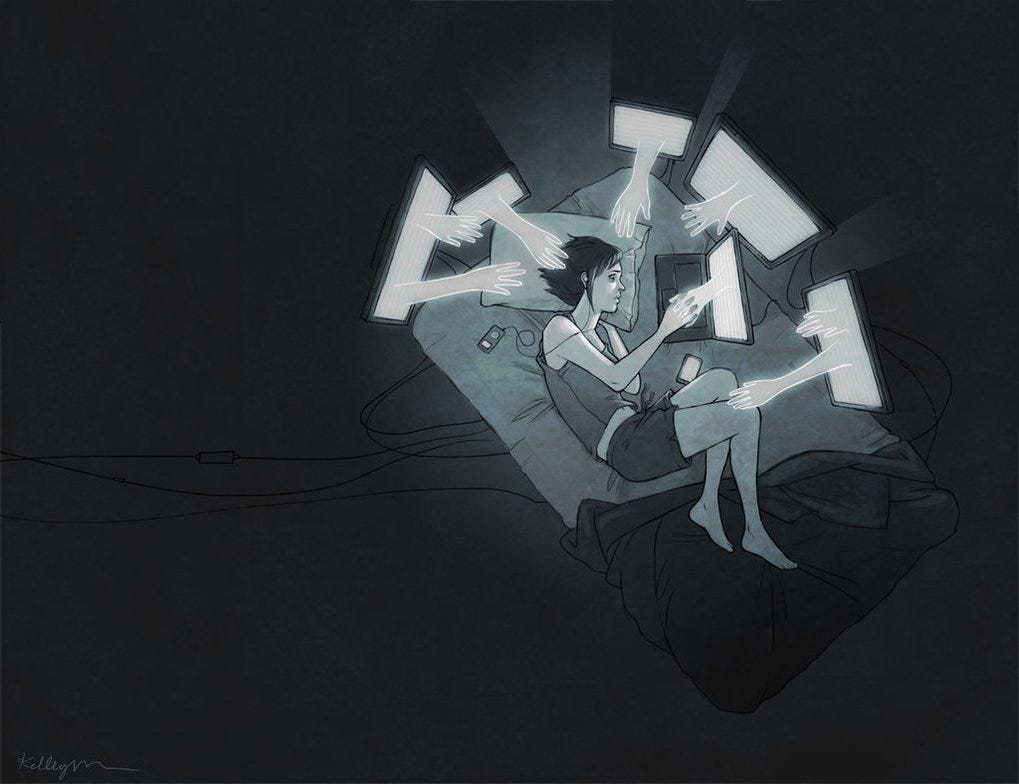
Imagine that same student seated at that same desk. The would-be reader swipes mindlessly on a glowing screen in an unlit room. The vampiric, blueish light washes over them, commanding they consume more, click more, scroll more, comment more, like more—always more. The screen does not open the door into other realities. It consumes this one. Its frictionless, glassy surface contains an endless ocean of distraction that carries away their attention in a riptide of notifications.
Their timeline contains no words, only a spectacle of images. Context has collapsed. The endless scroll of algorithmically curated short form content is perfectly calibrated to keep them swiping, but never enough to satiate the aching hunger for more content. Across the room, the student’s copies of War and Peace, Frankenstein, The Great Gatsby and countless other classics collect cobwebs, long ago abandoned for the twin siren calls of smartphones and social media. Dusty tomes simply can’t provide the instant gratification they seek. They are unrepentant members of a generation reliant on a constant dopamine drip to get through the tedium of their digitized lives. “Read a book?” they think. “Who has time for that?” They join the snickering chorus of “Okay, boomers!” when their elders warn them of their excess. They comfort themselves with memes deep fried in internet irony. Books are dead, they think. Reading is outmoded.
The student scrolls into the wee hours of the morning. And when the screen at last goes dark—the battery dead, or the eyes too heavy to continue—the would-be reader rises and sloughs themselves into bed; nothing in their hands or their heads. No sentence to carry off, no world to remember, no enlargements of the soul: only the dull residue of time spent and the endless itching sensation of their pocket-sized phantom limb.
Both of these scenes are seductive—one idealized, one catastrophized—and both are fantasies. As alluring as they are, as much as they might express our deepest fears and desires for student’s reading lives, neither has much to do with how students actually read in the digital age, particularly when it comes to the types of reading they do in school. Beyond just vibes or hunches, this argument is shaped by an emerging consensus from scholars (myself included) researching what’s been termed postdigital literacy—a term meant to capture the fact that adolescents’ reading lives are both digital and analog, unfolding simultaneously across a tangle of platforms, devices, and social contexts. Before going into more depth on postdigital literacy, however, I have a few very important disclaimers.
Firstly, postdigital literacy must be decoupled from the moral panic over our supposedly inevitable slide into a post-literate society. I strongly believe the fear we’re sliding toward a post-literate society rests on a category error collapsing three distinct but intertwined concepts into a single literacy crisis narrative.
Basic Literacy: Drawing on scholarship spanning fields from anthropology to sociolinguistics, literacy is the capacity to construct and negotiate meaning through whatever sign systems a culture uses to communicate. It is social and dynamic. To be literate is to take part in making meaning others can recognize. As research from new literacies studies articulates, it can look quite different depending on the discursive community in which it occurs. It also isn’t tied to any one medium. Literacy lives wherever meaning gets made—speech, print, image, code, etc.—and when the dominant media shift, literacy shifts in kind. To say we are in a literacy crisis is not entirely wrong, per say, but it does fail to grasp the nature of that crisis.
Print Epistimology: The epistemologies, culture, capacities, values, and social systems we have developed over the last few centuries through our mass production and consumption of the written word. Print literacy is one mode of literacy among many, including the oral cultures that came before it and the digital ones taking shape now. Print has dominated because it’s the form we grew up inside, which makes it easy to mistake for the whole of what literacy can be. Its hold on our imagination more of a matter of proximity than permanence. Protecting the benefits offered by print culture is of the utmost importance. It is, however, a necessary but insufficient condition for cultivating a citizenry able to understand its past, navigate its present, and build towards better social futures.
Literary Culture: What the humanities has built on top of that print infrastructure: a canon of works curated by literary and humanist scholars, a set of aesthetic sensibilities for perceiving how those works achieve their effects, and a repertoire of interpretive practices—close reading chief among them—for making sense of what a text is doing and why. It’s the most rarefied of the three, layered onto print the way print is layered onto literacy, and it’s the tradition most of us in English actually have in mind when folks accuse students of being “illiterate.” Like, I’m sorry op-ed-writing-professor(s)-who-will-remain-nameless, but claiming that students are “functionally illiterate” just because they aren't prepared to discuss Proust based on an assignment you've been using since the 1980s is a cop-out. They are very capable of decoding and generally comprehending words on the page. However, they very well might be illiterate in the discourse of literary studies. In which case I suggest you, ya know, teach them instead of lamenting their deficiencies in ways that both naturalize them and absolve yourself of any responsibility.
The panic blurs all three together, so that any decline in print and literary culture registers as the death of literacy as such—mistaking a change of address for an obituary. What’s actually happening is stranger and harder to see: meaning-making is expanding into a wider, weirder, and far more complex semiotic landscape than previously. I don’t have the space to flesh out all the damaging implications of collapsing these three distinct phenomena into a single literacy crisis but there is a strong case to be made that it has already led to a glut of reactionary policies, a proliferation of commercialized, top down curriculum programs, and the massive opportunity cost that comes with assuming improved phonics instruction (which I do support by the way!) is all we’ll need to solve the many issues plaguing the humanities.
Secondly, and I cannot stress this enough, I am not blindly celebrating this evolution. I am not a literacy accelerationist and, despite the distinctions I drew above, I think there is a major cause for alarm about the loss of both print and literary culture. Both are vital traditions ensuring a flourishing society and functioning democracy and we should fight like hell to preserve and renew them. Their unique ability to cultivate our capacity for sustained attention to complex arguments, critical inquiry about our shared history, and deep reading of empathy inducing narratives is the cornerstone upon which a strong liberal arts education is built. Nothing that I say in this article, or future articles in this series, is an argument against anyone who is a champion of these traditions. Hell, I consider myself to be a champion of these traditions and these posts to be a defense of their relevance! What I am trying to do is account for the ways they are already/might continue to evolve in our postdigital age.
Speaking of, the postdigital condition I hope to explore in these articles is, according to Petr Jandric, "hard to define; messy; unpredictable; digital and analogue; technological and non-technological"—at once "a rupture in our existing theories and their continuation". It is less a period than a stance: an acknowledgement that we cannot keep treating the digital as a separate country with rigid borders, a place you visit and then come home from. The boundary between online and offline, the scholarship argues, has become impossible to hold—not because one side swallowed the other—but because the two were never as separate as our overly spatialized metaphors pretended. Postdigital literacy does not refer to a bundle of fungible skills honed on EdTech platforms, social media apps, and learning management systems. Rather, it maps the rich repertoire of practices required to navigate a vast, interconnected ecosystem of discourse communities whose boundaries transcend both digital and physical space.
My hope is to share some ideas, both from my own research and the research of others, about how we can better navigate the collapse instead of ignoring it or embracing it. I’ll get more into the what, why, and how in future posts, but for now I’ll leave you with a final vignette attempting to paint a more positive and realistic vision for what productive forms of postdigital literacy might entail.
Imagine that same student seated at that same desk. They are poring over the same texts portrayed in the first vignette—Dickens, Morrison, Whitman, Douglass, Brontë. Only this time, they are not engaging with them in a vacuum. After a series of lessons modeling practices of close reading (borrowed from a book their teacher learned about on BlueSky, written by a collection of literary scholars), students are invited to take up the practices themselves, write a piece of literary criticism, and submit it to their school’s literary journal. The journal, which also houses the artwork, poetry, and prose students submit, is digitally curated and created, but eventually printed and distributed around the school.
After a period of sustained reading and annotation, the student has arrived on the contours of an argument they want to begin fleshing out. After some exploring, they discover a podcast of several literary scholars debating their own interpretations of the text—the kind of roundtable they’ve been trying to pull off for the honors podcast project they’re producing. They listen while doing the dishes between deep-dive reading sessions, pausing now and then to scribble notes in the margins of the notebook they’ve been using to record their burgeoning argument. One of the scholars, the one whose argument they most agree with, keeps using an unfamiliar word for the character’s psychological state in the final chapter of the novel. After going back and adding another layer of their own annotations to the chapter, they pull up an app their teacher recommended called Lit Theory. It was designed by a professor of postcolonial theory and literature whose lectures they’d listened to on YouTube for an earlier assignment.
The text description and video primer give the student enough confidence to include the word in their argument, with a few tweaks of their own. They open their laptop and pull up several other pieces of criticism to study how the writers structure and stage their claims—one of them paywalled, until a classmate drops the PDF into their group chat. It’s late by the time they rough out a draft, and they know the middle section still doesn’t hold the way they want it to. They email it to a few students in their class anyway, ahead of the peer-review workshop they’re running tomorrow. Before slinking into bed, their head still spinning from the ideas they encountered in their digital Burkean parlor, their face pulls into a half smile as they imagine how it will feel to hold the final product their hands on publication day.
In the next few posts, I want to show how this last scene becomes a reality. I know it can, because it’s a reasonably accurate picture of how my own classes run — when things go to plan, anyway. For now, I hope I’ve at least made the case that the “literacy crisis” discourse misnames what’s really happening, and offered a glimpse of what it looks like to take up digital tools in ways that renew print and literary culture instead of hollowing them out.
The rest of the series gets into the how, so subscribe if you want it. And in the meantime, I’d genuinely like to know where you land: are you seeing the wistful version, the dystopian one, or something closer to that third scene in your own classroom?
No posts
Comments
Nothing yet. Say the first thing.
Sign in to join the conversation.