
As a millennial, I have a complicated relationship with technology. At this point, it’s a trite observation that my age cohort sits at an interesting inflection point in the digital revolution: Millennials are the only generation old enough to remember life before the internet, but young enough to navigate it—and the digital culture it has produced—fluently. We grew up in an age that proudly declared history was over and a new dawn of techno-utopia was on the horizon. With a dial-up connection and access to my parents' home phone line I was able to talk soccer, debate politics, and play D&D PC games with nerds around the world. Fast forward a decade and the rise of the smart phones meant we could connect anywhere—talk, text, and game on the go. We could stream videos and download music and share cool apps that turned our devices into light sabers, scrabble boards, or tour guides. The world was at our fingertips and it would be better for it. For most millennials those early days of Web 2.0 and iPhone frenzy felt like magic—until they didn’t1.
It’s odd describing these “before times” to my Generation Z students; fellow digital natives who share millennials’ affinity for online culture, but who inherited it after “the fall.” After the like button. After algorithms. After Cambridge Analytica. After gamergate, the rise of the alt-right, and the election of Donald Trump. After Silicon Valley’s boy geniuses became Big Tech’s broligarchs. After the internet stopped being a place you visited and became the invisible architecture of our social reality. After all that, the old internet died—and a new internet rose in its place.
It’s honestly hard for some of my students to believe there was a time where the internet was not synonymous with misinformation, mental health crises, and corporate monopolies. They’re surprised at our naivety and optimism. At this point, I don’t blame them. Even as someone who not only embraces cringe millennial optimism, but actively celebrates it as a balm against the black-pilled nihilism of the 2020s, I wince thinking about my breathless anticipation for techno-utopia. I wasn’t a cultist, of course. I’d read too much Ray Bradbury to ignore the risks that accompany technological innovation. I took it as a given, however, that, much like history, the arc of technology was long but it bent towards educational justice. I suppose the jury is still out, but we’ve been trending in the wrong direction for some time.
I share these biographical details to situate my perspective on the state of educational technology in the year of our lord 2026—the longest year to ever year. I also think millennial’s relationship with digital technology follows a similar arc to its relationship to education; a relationship that began with the assumption we could use technology to learn and grow our human potential, but ended with the technology learning us to extract our data and grow their shareholder value.
Much like my media habits, politics, and cultural references my formative years as a pre-service and early career teacher were also shaped by the age of unbridled technological hype. While this post is my attempt to push back against certain aspects of current tech-lash discourse, my own relationship with technology has soured the last few years as well. Around the same time Silicon Valley bros were trading in their hoodies and Allbirds for Senate testimonies and superyachts, the EdTech™ industry was quietly negotiating its own makeover of our education system. Worse still, they did it while selling teachers on brand ambassadorships, silver bullet apps, and flashy conference keynotes. The goal of this post isn’t to recount that history, but if you’re interested in a deep dive, check out Audrey Watters public scholarship, Matt Seybold’s recent American Vandal episode, and works beyond education like Varoufakis’s Technofeudalism or Doctorow’s Enshitification.
Which brings me to our current moment and my state of confliction. Since AI exploded into our teaching lives, there has been a lot of discourse about the “why?” and “how?” of humanities teaching. To be clear, I agree with a lot of the conclusions I’ve seen. In many instances, the rise of EdTech reflects broader trends in education I am incredibly critical of—skill-ification, app-ification, MBA-ification, commodification, kitsch-ification, and all the other-ifications I’ve written about circulating in the discourse. Hell, my last post was all about the seething anger I feel towards the companies colonizing our academic imagination and monopolizing the means of curriculum. These trends are bad. I do not like them. I am, in no way shape or form writing this article as some sort of mealy-mouth apologia for EdTech.
I am nervous, however, about the rise of tech-lash inspired, synthetic, and schoolish pedagogies being framed as liberatory for the sole reason that they are analogue. I know there’s a lot of really garbage EdTech and skills based nonsense out there. I know it’s been pushed down teachers and professors throats long before AI. I know it’s easy to assume going analogue is a humanizing, pedagogically progressive move in and of itself—but it is not. RETVRN Pedagogy will not save us. We should not retreat into the nostalgic (recent) past and resuscitate synthetic, schoolish teaching methods and genres that were rightly on their way out pre-AI2. The only way out of the cultist/doomerist death spiral is through it.
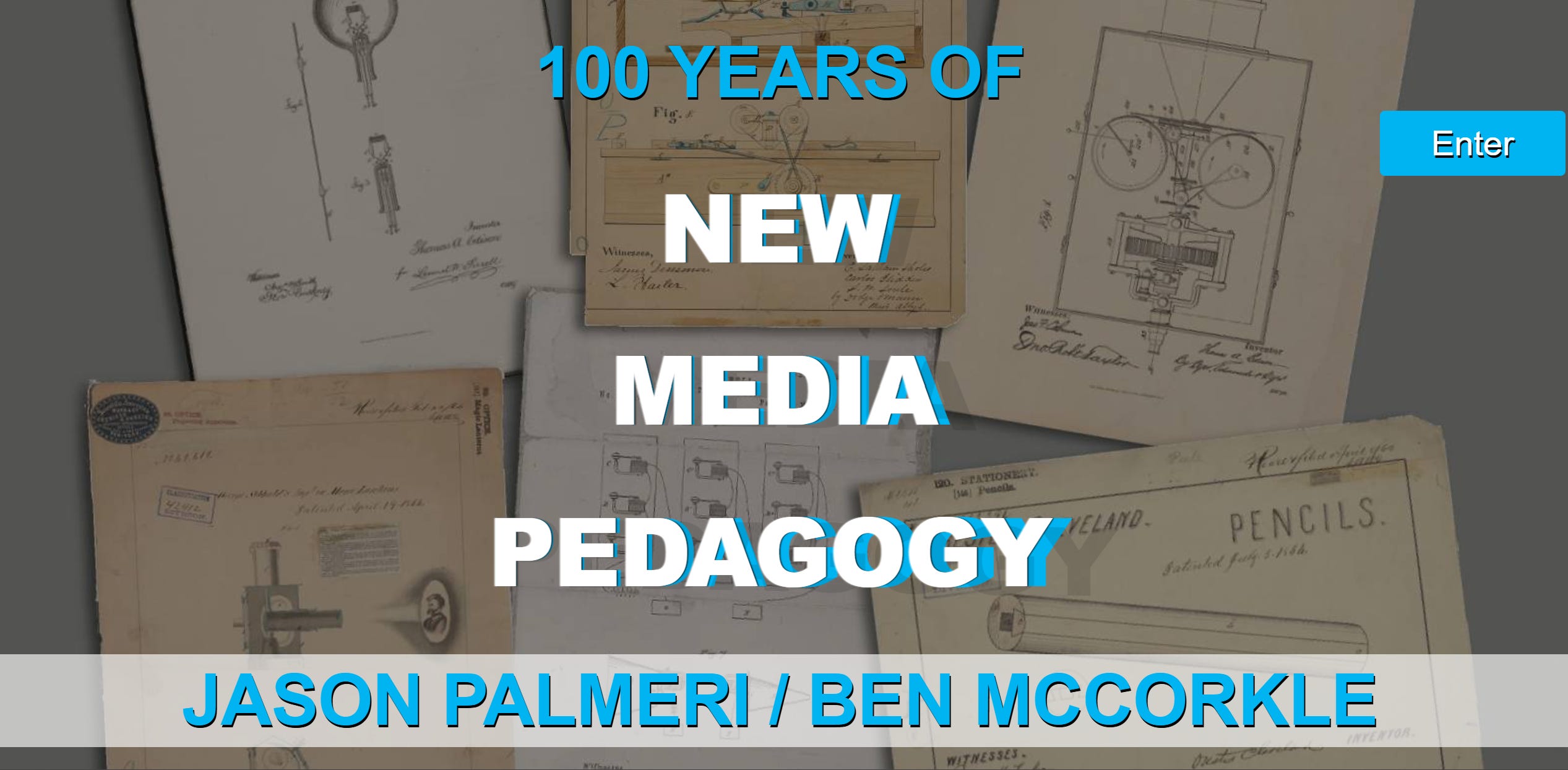
I have written on the risks much more extensively in a previous post, but I wanted to take this week’s article in a slightly different direction. I want to talk about what we mean when we talk about “technology” in the context of education and how the current discourse risks turning into a reactionary puritanism that could undo all of the progress that has been made through technology integration in schools. For the record, if you think the integration of technology and media into schools is a 21st-century phenomena, I recommend you check out J Palmeri’s and Ben McCorkle’s open access book 100 years of New Media Pedagogy.
I think a general skepticism towards all forms of technology in the classroom is a healthy thing. COVID’s rapid acceleration of tech adoption has had a lot of unforeseen externalities, one of which became an overreliance on screens in education. I’m guilty of it too. Since catching myself, I’ve returned to doing a lot more journal writing and note taking, whiteboard activities, and reading physical books/printed articles. Even at my most tech infused, my courses have always been rooted in dialogic forms of teaching and learning and it’s been good to see students appreciating more analogue activities. Basically, I believe it’s prudent for us to press pause on our post-COVID pivot to all technology all the time.
That being said, by grouping a very diverse and expansive suite of tools and affordances under the word “technology” we are conflating a lot of different things. So, I’m taking it upon myself to define, dictionary style, what I mean when I talk about #EdTech™ and what I’ll henceforth refer to as MADTech3.
#EdTech™ /ˈɛd.tɛk/ (noun)
Etymology: Clipping of “educational technology”; Hashtag denotes its entanglement with the rise of social media & SV; Trademark symbol denotes capture by venture capital, c. 2010s.
1. Any digital platform, application, or tool designed to automate, gamify, or otherwise digitize schoolish (see Blum, 2024) forms of rote learning—worksheets rendered as clickable quizzes, flashcards reimagined as streaks, reading comprehension reduced to multiple-choice dashboards. 2. Any ostensibly educational platform whose primary function is to serve as a data repository enabling corporate entities to surveil, track, and extract behavioral data from students and teachers, often under the guise of “personalization” or “learning analytics.” 3. colloq. The digital scaffolding of the commodified classroom; the infrastructure by which pedagogical decisions are quietly outsourced to engagement metrics and shareholder demands.
Usage: “The district spent $2 million on an #EdTech™ platform that is using our materials to train an AI model they might use to replace us.”
See also: Technofeudalism, enshitification, surveillance education
I think we all agree that this is bad. Nothing I say in this article is a defense of #EdTech. What I would like to issue a defense of, however, is MADTech4.
MADTech /mædˌtɛk/ (noun)
Etymology: Acronym, Media, Arts, and Design Technology; coined 2026 on my substack in opposition to #EdTech™.
1. The class of creative, generative, and production-oriented digital tools—video editors, digital audio workstations, podcast recording equipment, design software, digital whiteboards, image manipulation programs, film and media production suites—that enable students to compose, create, and publish artifacts belonging to the real genres and forms of contemporary cultural life. 2. Technology used by students as makers, rather than technology used on students as subjects; the instruments of multimodal composition, aesthetic inquiry, and public-facing production. 3. A pedagogical orientation that treats digital tools as extensions of human expressive capacity rather than as delivery mechanisms for pre-packaged content or vectors for data extraction.
Usage: “Her students used MADTech to produce a podcast series on local housing policy that was picked up by the town paper—try getting that from a Pear Deck.”
Distinguished from #EdTech™ in that MADTech produces artifacts while #EdTech™ produces data.
See also: multiliteracies, multimodality, aesthetic education, media studies
If we lump MADTech in with EdTech we risk preventing our students from engaging with forms of design, art, and media that allow for creative production rooted in cultures and communities outside of schoolish spaces; and I use school very purposefully, because even in academic and para-academic spaces there is a movement towards sharing and producing knowledge using podcasts, video essays, short-form content, webinars, and other digital forms. Through both my decade+ of teaching and range of academic publications, I have seen evidence that the synthesis of scholarly practices and MADTech can lead to incredibly powerful forms of learning and knowledge creation that not only foster interest in the humanities, but help students see themselves as part of its traditions. If you’re curious for examples of how my students have made video essays, podcasts, digital art, sculptures, documentaries, short films, screenplays, and more check out my previous Substack articles on multimodal composing.
By glibly rejecting MADTech as just another branch of #EdTech and doubling down on synthetic, schoolish forms like the five paragraph essay, the textbook, the worksheet, the memorized recitation, etc.5 we are giving up on positioning our classes as a space where students create and make things that have meaning to communities outside of school. Importantly, my bid for meaning is different than a call for utility. This is not another attempt to turn English courses into more “practical” sites of communication—to make the work that we do in the aesthetic humanities legible to employers and corporate recruiters. It is an attempt to repair the deracinated nature of English education—an issue that would persist even if every laptop vanished tomorrow—by connecting it to practices, genres, and forms that animate existing social, political, and academic contexts.
Thanks for reading Becoming Literary! This post is public so feel free to share it.
The case for MADTech is, in essence, a case for postdigital aesthetic education. The postdigital, as scholars like Petr Jandrić and Jennifer Rowsell have argued, names a condition rather than a distinct period—the point at which the distinction between online and offline, screen and page, digital and analogue becomes impossible to disentangle. If you’re skeptical, ask yourself how many articles about the importance of analogue reading and grass touching you’ve read on your iPhone. Consider how many people in your teacherly or scholarly network you first met online. Similarly, our students are not choosing between a book and a screen. They are composing, interpreting, and living across both at once, and an aesthetic education can and should account for that while also creating space for unmediated literary experiences, encounters, and conversations.
This requires forms of attention advocated for by education philosophers and scholars ranging from John Dewey to Maxine Greene to Louise Rosenblatt—the capacity to attend to a work in its fullness, its vividness, its vitality. Aesthetic form in this sense is expansive. It includes genre conventions and stylized punctuation, mise-en-scène and cinematography, tropes and textures and timing. Teaching students to adopt an aesthetic stance toward the full range of texts they encounter, and to produce artifacts that work within those forms, is not a betrayal of the literary tradition. It is that tradition, extended into the forms that animate contemporary cultural life. Does that sound naive? Maybe, but watch this work of art from Aidan Walker before you decide.
Is it a TikTok? Technically yes. Do I have issues with that platform? Hell yes. Does it feel a bit cringe to call a TikTok art? Definitely. BUT—what if we focused on the humanistic knowledge and literary forms required to produce this video? Poetry. Prose. Philosophy. America’s literary tradition. Eastern religion. Film. Music. Art. This video is a vehicle for the many aesthetic forms that preceded it. It is a medium for artistic expression and knowledge construction. It leans into the affordances of the digital while attempting to resist their immediacy.
This is what I am unwilling to surrender. Collapsing MADTech into #EdTech™ and retreating into the Blue Book, the five-paragraph essay, and the memorized recitation will not rescue the humanities from the forces hollowing them out. It will sever them from the genres through which contemporary meaning actually gets made. If we want students to see themselves as inheritors of and participants in the humanistic tradition, we must acknowledge those tools are no longer confined to the printed page. That they ever were is a fiction. That they might be again, or worse—that they risk being replaced by a school-ish simulacra, is a mistake we do not need to make.
In sum: Down with #EdTech™! Long live MadTech!
I think the euphoria I describe here partially explains the recent 2016 nostalgia trend on social media. Personally I think they should rewind another few years, but pre-election it’s not wrong to say that period could be seen as the zenith of tech-drunk millennial optimism.
There is a big difference between past approaches that have long been central to liberal arts education (Harkness, Socratic questioning, close reading, etc.) and decontextualized, schoolish approaches (multiple choice tests, timed blue book essays, etc.). I value the former and am critiquing the latter.
This coinage is offered with tongue firmly planted in cheek. It’s the best I could come up with at the moment, but feel free to offer alternatives!
#MADTech tools are not immune to #EdTech™ capture or bad pedagogy. Tools that offer creative affordances can still be extractive. A podcasting setup can be reduced to a recorded oral quiz or book report. Design software can become a vehicle for dumpster projects where students beautify shallow content. The creative affordances of a tool do not automatically produce creative pedagogy; any MADTech platform can be flattened into schoolish use if the surrounding assignment treats students as task-completers rather than designers of meaning. The categories describe what tools are for—and what they make possible—not a guarantee of how they will be used.
I fully acknowledge that, given the current constraints of our education system, these assessments have a proper time and place.
No posts
Comments
Nothing yet. Say the first thing.
Sign in to join the conversation.