

Let’s look at the cold, hard numbers that the critical minerals industry desperately tries to ignore.
In 2025:
92.5%: China’s share of global separated rare earth compounds.
91.5%: The total market value captured by just four elements—Praseodymium, Neodymium, Terbium, and Dysprosium—we call them the “Fabulous Four.”
The Catch: These four elements exist for one primary purpose: producing rare earth permanent magnets.
93%: China’s global market share in those exact permanent magnets.
The world’s actual dependence on Chinese rare earths does not lie with the “Fabulous Four”—a fact laid bare by global import statistics, where these four elements play a minuscule or entirely non-existent role. Instead, western reliance rests substantially on the other 8.5% of the global market value of all other separated rare earths.
Yet, no junior mining hopeful can credibly project feasibility without including the Fabulous Four. To monetise them, these hopefuls rely on a downstream value chain of dedicated rare earth metal makers.
The problem? Aside from two perennially loss-making entities operating with insignificant capacities, these dedicated western rare earth metal makers simply do not exist.
The entire western rare earth pipeline is building a castle in the sky, banking on virtually non-existent markets. Magnet hopefuls are betting on a ghost supply of western rare earth metals, while conveniently blindfolding themselves to another inconvenient truth: the other critical alloys required to actually manufacture these permanent magnets.
The sole and single exception from the above is Japan, who is 15 years ahead of the pack in terms of China dependency replacement, while the rest of the pack was either sleeping (US), or nursing politically convenient —yet entirely hopeless— pet projects, in combination with hosting thoroughly unproductive debating clubs (EU).
Japan has a pretty complete value chain in rare earths. Demand in Japan 2025, compared to 2024:
Yttrium: flat (offshore migration of Japanese users)
Europium: -16.7% (offshore migration of Japanese users)
Lanthanum: +16.1%
Cerium: +12.4%
Mischmetall: +8.4%
Samarium: flat
Neodymium/NdPr: +18.2% (Lynas)
Other rare earths: +10.2%
Outside China, Japan is the largest rare earth market by value and product variety. The rest of the rare earth world would be called “extras” in the movie business.
Chances of success may increase exponentially, if Japan would increase its footprint. Japan doesn’t, it is inward-looking.
For Japan to increase its footprint would require confidence in consistent policy outside of Japan. This is completely absent in the largest ex-China rare earth market by volume, the US. You simply can’t rely on the US, whose policies can change abruptly on impulsive social media posts, long past midnight.
But perhaps with the EU something could be worked out. The EU has put itself in a regulatory checkmate, because of its eagerness to please an impossibly environmentalist electorate. The EU needs external help, and that help can only be from Japan.
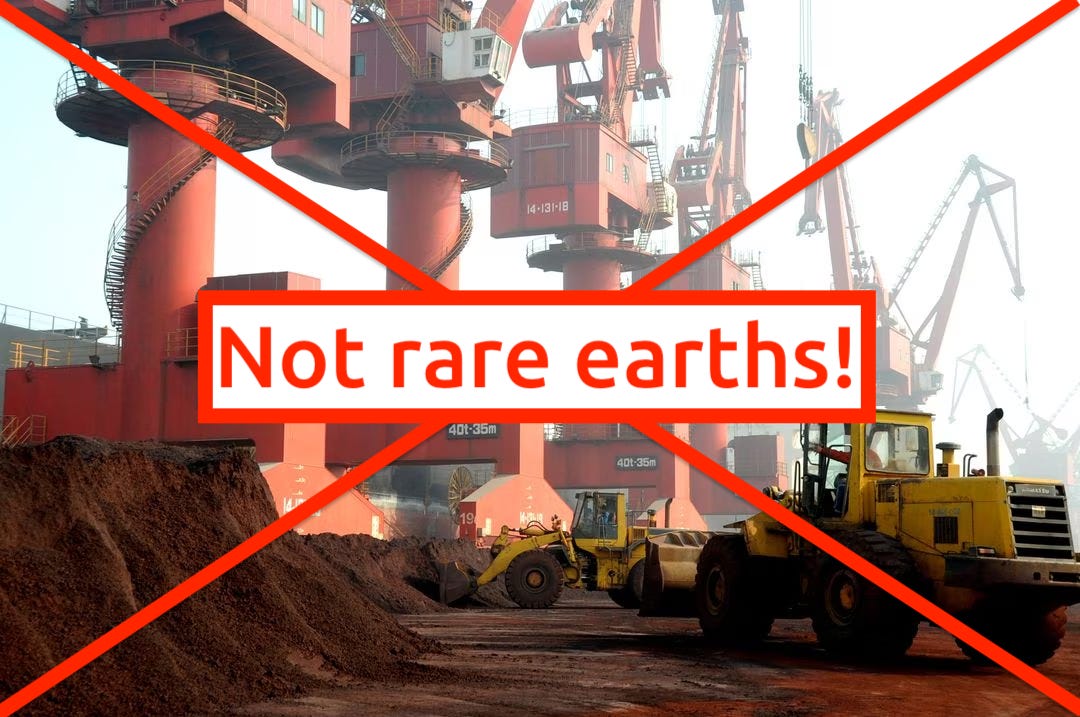
This image does not show rare earth.
It is a 16-years-old photo of heavy mineral sand (HMS), landed at Port Lianyungang, Jiangsu Province, China. HMS usually contains Ilmenite, Rutile, Leucoxene and Zircon. The former three as a resource of Titanium Dioxide (white pigment), the latter as a resource for ceramics.
Some —not all— heavy mineral sands may contain 0.5-2% of Monazite. This Monazite in turn may contain 20-50% of TREO. It is by no means the main component.
This, and some very similar images of anything but rare earths, is part of a continuously growing flow of pre-learning-curve write-ups and rare earth news reporting. Such images suggest to readers a millions of tons business, which HMS is, but rare earth isn’t.
Seaborne rare earths ore volume by and large is ca. 130,000 t per year and is typically shipped in 1,000 kgs bags, on pallets, in standard shipping containers.
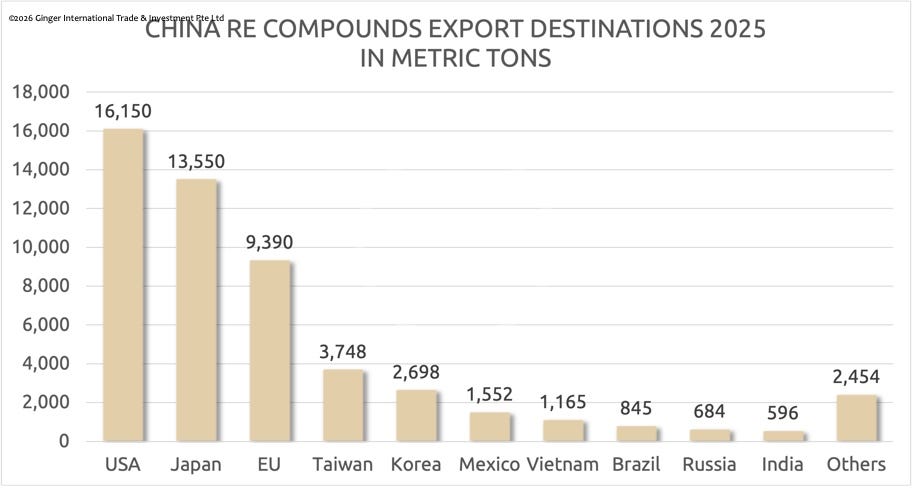
Yearly seaborne, ready-to-use, separated rare earths (ca. 60,000 t in ca. 45 varieties), or metals/alloys (ca. 11,000 t in ca. 10 varieties), come in packing according to the requirements of each specific rare earth product.
And, in our view, commodity is probably the very last category rare earths would qualify for in the West. The West does not even have rare earth industrial standards, a basic feature of commodity.
A much more appropriate image of rare earths one could find on Shin-Etsu’s rare earth website, if one was really interested in accurate reporting, instead of stirring up mindless hype.
Pananá and Pananã is not banana. These are two different rivers in Brazil. While the Pananá is a very large river, the Pananã is a much smaller river. Aclara’s water supply for the Carina Project, discussed in our previous issue, hinges on the smaller one, the Pananã.
The river is fed by the reservoir just downstream from the Peixe Angical Hydroelectric Power Plant on the Tocantins River. We deem Pananã River even more challenged than the wrongly cited Pananá River.
Sincere thanks to one of our attentive readers for pointing it out.
The US President was very eager to flatter the Chinese side in the vain hope for an Iran quick-fix. It did not happen. After lecturing on Taiwan — and thereby making US support for Taiwan part of China-US negotiations, adding acrimony — China sent the representatives of the current US administration home with a few tokens of esteem, smaller than anticipated.
The Taiwan issue is, at its core, a legacy conflict between two Chinese political parties—the Kuomintang (KMT) and the Chinese Communist Party (CCP)—both of whom historically laid claim to being the sole legitimate ruler of all China.
Today, both aspirations face deep credibility crises. The CCP lacks fundamental democratic legitimacy, while the KMT’s claim (which it officially abandoned in 2000) is undermined by the stark reality of Taiwan’s geographic and demographic size relative to the mainland.
Neither political party is likely to accept its own dissolution after an envisioned merger of the two nations. This is a deadlock.
Consequently, the best the people of Taiwan can realistically hope for is the perpetuation of “peaceful coexistence”, the status quo.
Therefore, Taiwan’s electorate behaves like a political pendulum: they swing toward independence-leaning candidates when they feel Beijing (and Beijing’s friendly Triads) breathing down their necks, and pivot back to the KMT when they feel pro-independence rhetoric is pushing the island too close to the brink of armed conflict.
Here one of many fine examples of democracy with Taiwan characteristics:
This presidential visit leaves three losers: The American people, the Chinese people and the rest of the world.
What we have seen here are two old men obsessed with old-age vanity and visions for a world that won’t be their’s, trying to patch up the legacy of their foolish mistakes, brushing aside all things that really matter.
Surrounded exclusively by submissive yes-men, they hold their respective nations hostage.
In an era defined by existential, transnational challenges—like artificial intelligence governance, climate displacement, and global economic fragility—how much runway is being wasted while aging leaders litigate twentieth-century grievances and personal legacies?
The issue of dual-use export licensing of rare earths (and other items) apparently was not comprehensively addressed in talks, neither the existing regulation of 4 April 2025, nor the pending regulation of 9 October 2025, scheduled for implementation 10 November 2026.
Why? The US-President needed all time of the visit and focus on a Chinese fix for his self-created mess in the Hormuz Strait. Any matter of importance had to take the backseat.
The US-Trade Representative dared to offer this on camera in Beijing, when asked about rare earth:
“Whenever we see an issue, we hear from specific companies, we engage with our Chinese counterparts and we find them to be constructive”
This is not even a bandaid. It is acceptance of not only the status-quo, but also acceptance of forthcoming China regulation on/before 10 November 2026.
A declaration of political bankruptcy.
Some defence groups want more time to comply with the prohibition on using Chinese samarium cobalt magnets and neodymium iron boron magnets for defence department contracts from January 1, according to four people familiar with the matter.
The Trump administration has worked at pace to inject billions of dollars into the US’s nascent rare earths industry, but China remains by far the dominant producer of rare earth elements, metals and magnets, with experts warning that building a fully developed alternative supply chain will take years.
So, here we are. Another declaration of bankruptcy.
What ever happened to the full-mouthed announcements of those, who deem themselves being God-sent solutions to the problem?
The administration in Washington engages in wild, directionless activity with no discernible remnants of strategy, action plan or expertise. Given the short “notice-period” such random approach is somewhat understandable, but a structured and disciplined approach may well be more fruitful
For example, the noisily announced Project Vault bases on something no dissimilar to a members-only golf club concept and does not even offer the very basics of what a national reserve should actually offer.
All this randomness is aided by activities of a in rare earth terms particularly counter-productive tribe, also known as Washington lobbyists. While lobbyism is a necessity for mature industries, for an industry not even in its infancy, it does more harm than good. We don’t suggest that lobbyists are generally irresponsible, in rare earth they simply don’t know any better. Consequently, today any executive, who can spell “rare earth” correctly, can buy a voice in Washington.
And politicians lend an ear, baring more professional approaches.
This is pretty broken.
Comments
Nothing yet. Say the first thing.
Sign in to join the conversation.