Critical Minerals Ministerial "Fact Sheet": Some Fact about Fact; Project Vault: Not a National Reserve, but a Golf Club; Frontier, BRE, St George and the lot.
We are delayed by multiple consulting projects and there for still owe the analysis of statistics numbers. We’re on it and almost done.
In 2025 China exported ~13% of its rare earth compounds output. But 67% of this were uneconomical lanthanum and cerium compounds. These two are dirt-cheap, because China screwed-up its rare earth supply-demand balance by its disproportional domestic consumption growth of “magnet rare earths.” Consequently La and Ce compounds prices, traditionally far above US$10/kg, fell into a bottomless pit and are US$1-2/kg now.
Also in 2025 exports of La and Ce grew, this time by 21% year-on-year. We estimate the proportional share of La and Ce in the West being more than 70% of total rare earth compound consumption. No-one likes to talk about it.
More of this in an upcoming statistics post.
As we anticipated, the elections in Japan became a full rebuff of China. The first time since World War II a party commands a ⅔ majority in the Lower House of Japan. A resounding endorsement of PM Takaichi’s tough China stance.
The exact opposite of what China had hoped to achieve.
In celebration Japan lost no time and swiftly detained another Chinese fishing boat in Japanese waters. And the reaction from Beijing is meek.
There is a big problem. Many applications of Chinese exporters for dual-use product export licenses are delayed and there are industries in the West that are more or less facing a shutdown owing to the supply-chain interruption.
For the removal of residual doubt, we estimate the direct and indirect economic impact of rare earths at ~10% of global GDP. Possibly higher.
We have consistently argued that rare earth elements are as remote from military applications as common steel and copper are. Same as in copper and steel, a considerable manufacturing chain lies between the rare earth products China exports and the eventual end-use.
There is no way for Beijing’s bureaucrats to establish beyond reasonable doubt that the export licensed rare earths would not end up in the military-industrial complex, no matter how diligent the license process may be. To license or not is eventually up to judgement of bureaucrats and directions from China’s politicians.
That is where the rules published on 9 October 2025 would kick-in, had they been implemented, extraterritorial application of Chinese law. Every single participant in the rare-earth-related manufacturing chain abroad would require a license from China to pass his Chinese rare earth based product to a third party customer.
While extremely tedious it would offer the degree of confidence underlings at China’s Ministry of Commerce would need in order to approve licenses swiftly. It would at least help maintaining a rudimentary civilian supply chain abroad.
Governments in Japan (the largest rare earth market outside China), US, EU, India and others have decided not to accept this.
For decades China has supplied its foreign customers with keenly priced rare earths of first class quality, produced at great detriment to China’s environment at measly profits, only to get accused of profiteering from a monopoly whenever prices went up, and likewise being accused of ruining nascent foreign rare earth projects when prices went down.
While not exactly being without fault, it would be conceivable if China’s leadership would be fed up with this silly game and do, what it had already announced in meetings with the EU in 2014: produce rare earths only for China’s domestic market.
It goes without saying that already 1998 China began making efforts in preventing global proliferation of rare earth know-how, faulted the foreign importers for the detrimental impact of China’s unruly domestic rare earth industry (whatever is going wrong in China must always be the fault of hostile foreign forces), and applied WTO incompatible export restrictions, which were struck-off by a WTO panel in 2014.
Those were the days when we still had a functional WTO. Now it has been crippled by the current US administration, which results in catch-as-catch-can international trade.
Western governments have understood that China’s core advantage lies in processing of critical minerals. This being so, it is incomprehensible why the focus is so much on underdeveloped or completely undeveloped resources then.
In terms of mining local resources there is the Fen deposit in EU affiliate Norway and there is the advanced Bear Lodge in the US. Both come with regular junior mining risks, but look quite promising - because also in rare earths Grade is King.
Japan, the only country outside China with a real rare earth value chain, has got Lynas. Because Lynas’ rare earth product programme is incomplete, Japan plans to suck rare-earth-bearing mud from the ocean floor, a resource of last resort.
India is going (again) at its beach sand monazite resources and has prohibited its only factory turning out separated, ready-to-use rare earth oxides from continuing exports.
At this time, in terms of resources, there is no real immediate need to go after undeveloped rare earth resources in you-can’t-get-there-from-here places at the end of the world, sometimes containing unworkable resources.
In 2025 China imported 170,000 t of rare earth raw materials. About a third of that is from the open market, available to any buyer. A fraction of that quantity would already be sufficient to get things rolling in western rare earths - if there was any real processing of primary rare earth resources.
Madeleine King, Minister of Resources, Australia:
“It would be good for the Europeans to get involved more actively rather than sitting back and admiring the problem – which has been deeply frustrating.”
“They understand the problem – whether they will act is another matter.”
In terms of rare earth the Europeans would probably respond:
We’ve acted on it. We’ve got two and will soon have three refineries, plus one at our affiliate, one metal maker and one rare earth permanent magnet maker.
We are ready for your rare earth raw material, as long as it is radionuclide-free; it is also cheaper to ship for Australia than radioactive product.
In rare earths, it is Australia’s turn.
Again a lot of pomp and fanfare from the current US administration. Deafening noise.
After having been abused by the current US administration, adding injury to insult, some 50 countries were now forced to pretend uniting behind what is basically a US cause.
Initiatives like critical minerals require trust, something the current US administration has carelessly gambled away, Atlantic City style.
Lemmings don’t exactly have a great track record for group decision-making.
EXIM’s critical minerals portfolio of authorized transactions includes:
$10 billion – Project Vault: Establishing the U.S. Strategic Critical Minerals Reserve to support domestic manufacturers and strengthen supply chain security
We discuss the envisioned “golf club” concept later in this post.
The Department of Energy also has launched additional funding and partnership opportunities in 2025, including:
$134 million for a Notice of Funding Opportunity (NOFO) to establish a Rare Earth Elements Demonstration Facility, strengthening domestic rare earth supply chains (NOFO December 1, 2025);
The NOFO notice says: Through this funding, DOE will support projects that demonstrate the commercial viability of recovering and refining REEs from unconventional feedstocks including mine tailings, e-waste, and other waste materials.
It can’t possibly be alien to the current US administration that for this type of resources commercial viability is the ultimate challenge. It is hardly ever overcome.
Considering the DoE’s NETL having put quite some effort into much derided “embargo technology” of extracting tiny content of rare earths from coal ash (you’ve got to burn millions of tons of coal first), we find the demand to “demonstrate the commercial viability” a bit of a tall order. In its report to congress about the NETL project the DoE then of course circumnavigated the feasibility question.
The Department of War
Vulcan Elements, $620 million debt committed, Nov 2025, North Carolina, crowded in $550 million of equity from private investors;
We had commented on Vulcan before. This is a start-up. The amount is utterly disproportional. What has Vulcan got, other than the confidence of the president’s son?
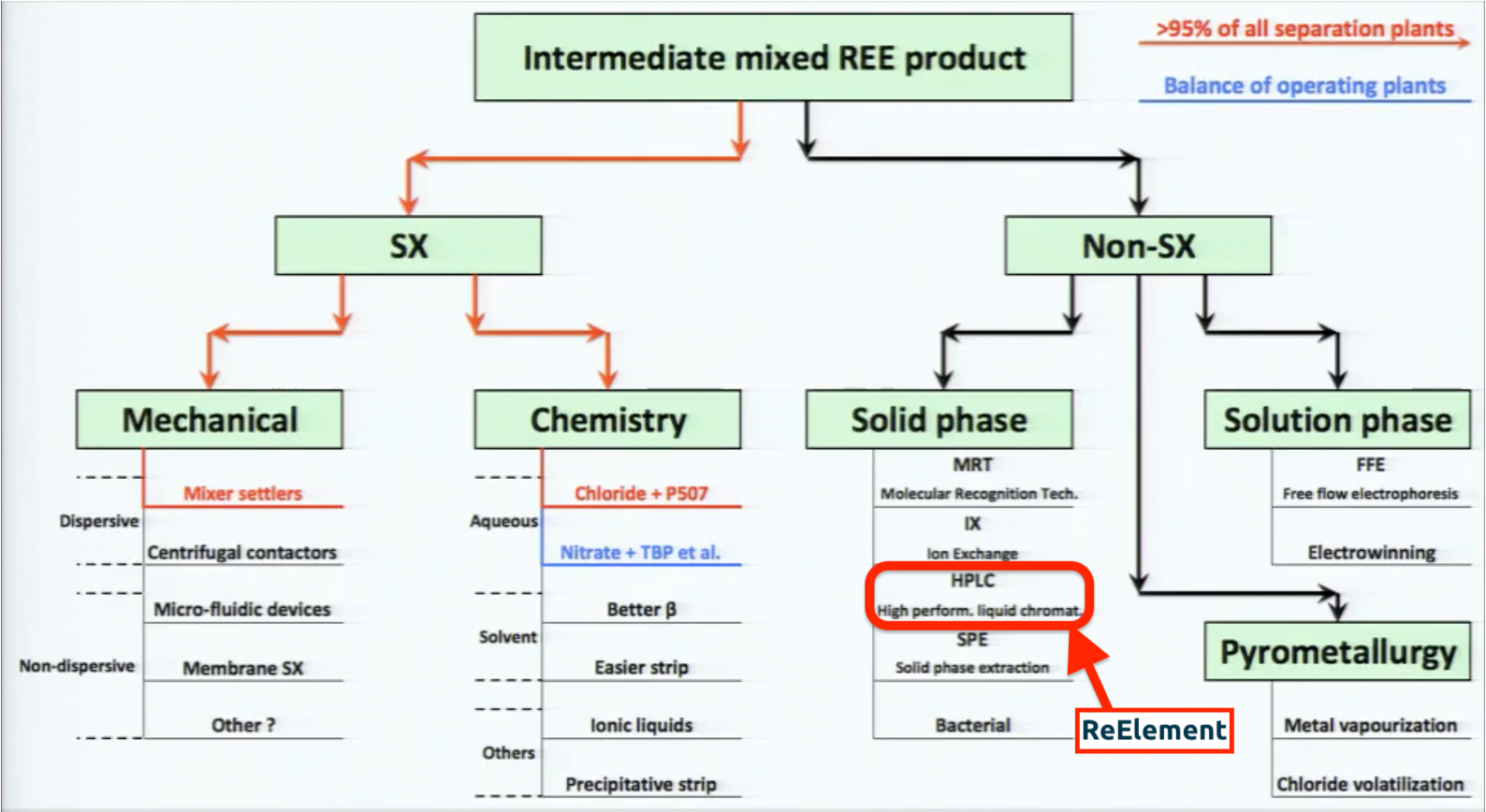
ReElement, $80 million debt committed, Nov 2025, Indiana, crowded in $200 million of equity from private investors;
We have commented on ReElement numerous times over the years. Essentially, the proprietary Ligand Assisted Displacement (LAD) Chromatography from Purdue University is a fringe process, so far untested at scale.
Also the selection of this project defies common sense.
Why: In view of the provenly working, industrial scale, open source, cascading solvent extraction process (SX), the West needs a new, creative, untested, potentially enormously expensive process as much as the American taxpayer needs a third shoulder.
Academic niceties we all can keep for later.
Source: John Goode (2016)
U.S. International Development Finance Corporation (DFC)
$75 million initial seed investment for critical minerals and strategic sectors in Ukraine that has mobilized another $75 million in non-U.S. government funding;
In terms of rare earths there are apatite resources in (former) Ukraine that may be used for phosphate fertiliser. The rare earth content typically is negligible and the resource area is anyway under Russian control. But this money certainly finds other good use in Ukraine. One might as well burn it right away for some heat.
$565 million for heavy and light rare earth extraction in Brazil;
This may refer to Serra Verde, a perennially challenged private project in Brazil by Denham Capital.
If Serra Verde should overcome their challenges, what does the West do with this product? There is only some small demand for mixed rare earth carbonate in the West, and only if it is radionuclide-free (reportedly one of Serra Verde’s “challenges,” btw).
We see a number of US government supported projects missing here, for example, to name just a few:
The ragingly successful “great deal” with the owners of Mountain Pass, whose operating loss exceeded revenue in Q3 2025, down from operating losses of “only” 62 cents per US$1 of revenue a year earlier.
Now, how does that look in terms of demonstrated commercial viability ?
In April 2025 the mine had to discontinue profitable rare earth ore shipments to China, because China had introduced high tariffs on this US product in response to “Liberation Day” tariffs of the current US administration (no, the dual-use license regulation on 7 rare earths of 4 April 2025 had nothing to do with the trade war. It has everything to do with actual rare earth demand of the US military industrial complex. The dual-use license regulations announced 9 October 2025 on additional 5 rare earths plus extraterritorial application of Chinese law, pending implementation, are trade war related).
The DoW tossing large amounts of money at a project to re-invent a dysfunctional and elsewhere long-abandoned rare earth separation process,
Pledging state-backed credit of more than 1.5 billion dollars towards a “mine to magnet” project that involves worthless assets, such as a resource that - according to the authoritative technical report - at the proposed mining rate would deplete in 9 days; unprofessionally disassembled, outdated, incomplete magnet making equipment, pretending to become a rare earth permanent magnet factory; a perpetually loss-making business with assets of US$12 mio, acquired at more than 10 times asset value.
Pledging large taxpayer credit at a Greenland resources that contain a deemed-to-be rare earth mineral which is provenly unsuitablefor producing separated, ready-to-use rare earth products. If one was clever and looking for proof of the unsuitability of eudialyte, one could refer to the outcome of the 2015-2020 EURARE project of the EU.
But why learn from others if you can bath in visions of uniiversal greatness? Why even consult anyone in the know?
Just how do they manage to overlook the glaring, crippling deficiencies of the projects the current US administration is throwing taxpayer money at?
We type it again slowly, so the Americans don’t miss it, because it is important:
There is no known rare earth resource in Greenland that can be used for producing separated, ready-to-use rare earth products. This is not an opinion, it is documented fact. And, yes, Grade is King.
Perhaps, going forward, the current US government would also like to avoid the perception that project support is tied to personal networks rather than to achieving strategic goals?
It starts as a silent movie. VP Vance has sound from minute 34:20. Whenever seeing him, we think of R.E.M. - Crush with Eyeliner. Emphatic words, trying hard to say something profound.
Vance’s description of the situation is superficially accurate, but it ignores underlying continuous developments and changes.
Just one example: Principally, the failure rate of junior miners traditionally is very high for reasons other than the presence of a bad actor. Begin with absolutely lousy grades, sometimes so low that they are close to natural abundance of rare earths.
The White House lawn may host higher grades of rare earths than several of the hotly, noisily promoted rare earth projects.
Anyway, we are certain that also low grades can somehow be made China’s fault.
Rubio’s comments are to the point. Wall Street has a history of pumping share prices of all companies who outsourced to China. The outsourcing CEOs were also celebrated as great visionaries. The current US situation is an entirely home-made problem. If you want things to work, keep Wall Street out of it.
Interestingly Rubio borrows on a socialist slogan from China: shared prosperity. Is Rubio perhaps secretly jockeying to become the next presidential candidate of the Republican Party?
The Japanese participant, Iwao Horii, a top-ranking bureaucrat, not an elected politician, unsurprisingly went about rare earths. Japanese bureaucrats tend to be much more competent than their fast-changing, elected superiors.
David Copley, the current US administration’s mineral guy, looks seriously grey, worn and tired. Juggling 57 minerals on behalf of a nation is a truly monumental task. What he describes as the US strategy is very reminiscent of China’s old and tired public-private investment pivot.
Copley actually leaves an impression of competence. Which then begs the question, how the current US administration’s support on rare earths can possibly end up with such hopeless projects?
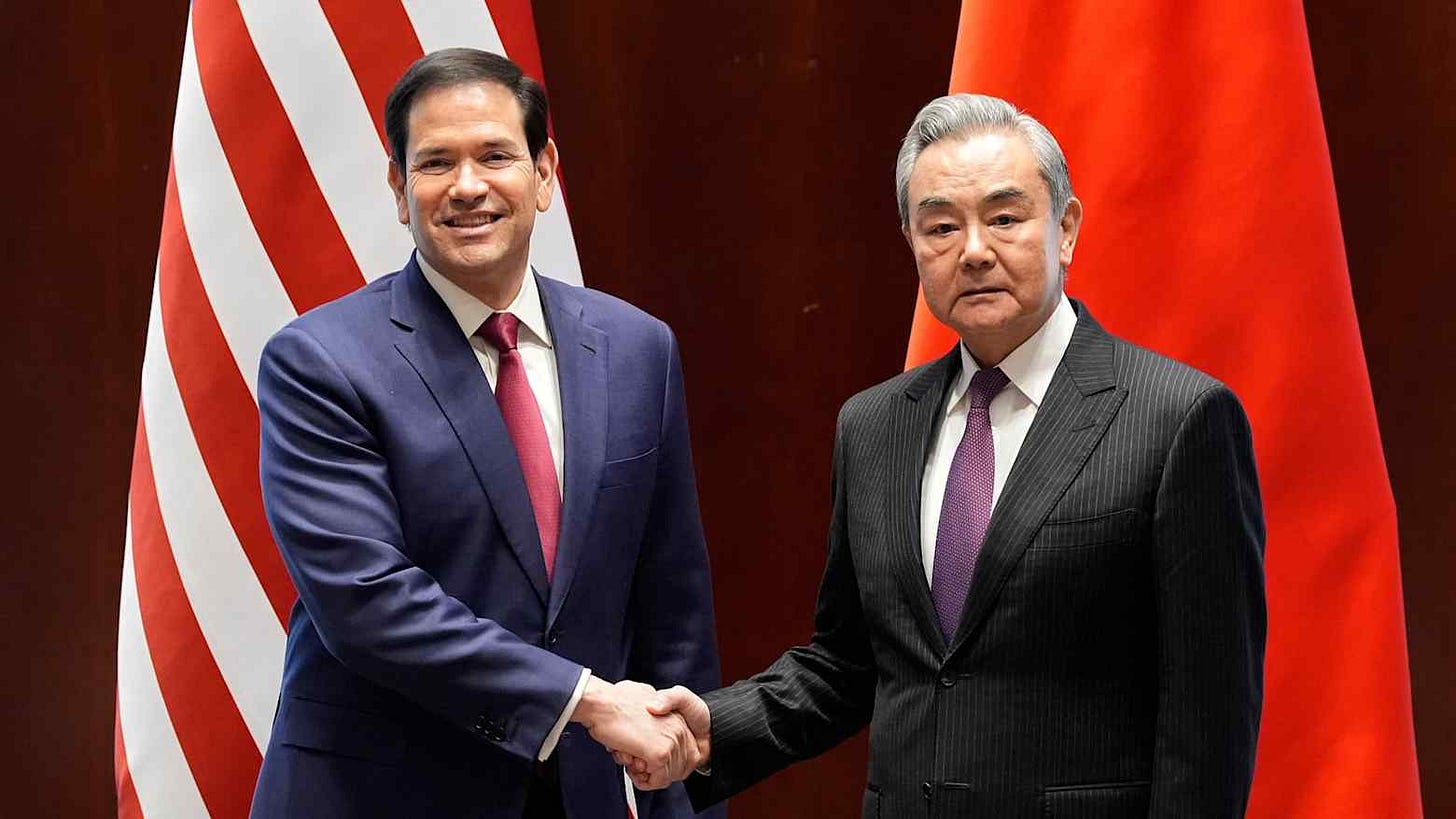
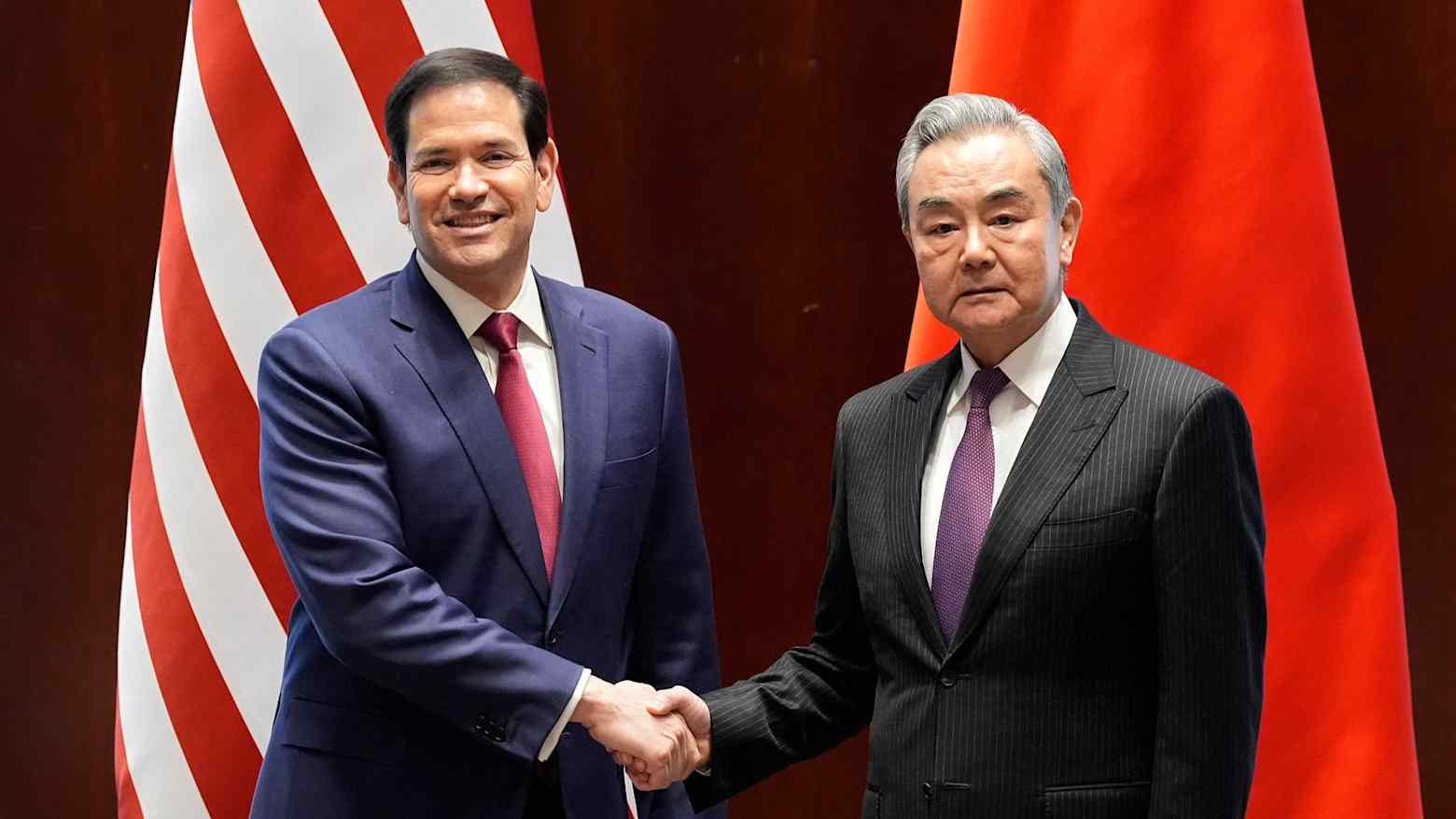
Rubio and Wang Yi in Munich. Wang Yi has aged a lot recently.
We should work together to implement the important consensus reached by the two heads of state and make 2026 a year in which China and the U.S. move toward mutual respect, peaceful coexistence, and win-win cooperation. Dialogue is better than confrontation, cooperation is better than conflict, and win-win is better than zero-sum.
This sounds very conciliatory. The correct translation of “win-win” still means “China wins twice.”
A few hours after the meeting between Wang Yi and U.S. Secretary of State Rubio, the U.S. Department of Defense released an updated 1260H list, adding 78 companies including Alibaba and BYD.
However, less than an hour later, the update disappeared.
Yet another 3-6 of the current US administration. But it does not end here.
However, some speculations from the U.S. side suggest it might just be a technical error, that companies like YMTC and CXMT, which weren’t supposed to be removed from the list, were taken off by mistake. Now it’s just a correction, and the revised list might be reissued next week.
Everyone does what they want, no one does what they should, but everyone joins the effort.
Spectacular!
Here China’s proposed National Reserve Law (direct link to the draft), open for public comments until 16 February 2026. A good guidance for anyone who considers a national reserve.
Article 15. Government reserve materials are generally procured through market-based methods, following the principles of fairness, impartiality, honesty, and trustworthiness which shall be upheld; special requirements shall be implemented in accordance with relevant national regulations….
In accordance with the needs of national security interests, the state may, in accordance with the law, expropriate the property of organisations and individuals.
Article 16. Government-reserved materials that are purchased and stored shall meet the relevant national standards and other quality requirements….
Article 17. Government procurement of reserve materials should actively broaden supply channels. For those projects with multiple suppliers, suppliers are typically invited through the issuance of a procurement announcement.
For procurement that can only be made from a limited number of suppliers, an invitation letter can be used.
The invitation is extended to specific qualified suppliers. This applies to suppliers with a monopolistic position.
The government shall not refuse to reasonably conclude government reserve procurement contracts in accordance with national procurement tasks.
Except for force majeure and other circumstances exempt from liability as stipulated by law or contract, those enterprises participating in reserves business shall not refuse or delay fulfilling government reserve contracts.
And so on. Pretty comprehensive. Perhaps someone wants to use it as a blueprint?
This law comes on the heels of China’s Mineral Resources Law, which took effect on 1 July 2025. Among other things it compels the state to hold reserves.
Project Vault is a public-private partnership that will buy and store critical minerals and rare earth elements. These include gallium and cobalt, which are essential for modern technology and defence equipment. It will combine $1.67 billion in private seed funding with another $10 billion from the US government’s Export-Import Bank.
Companies will make an initial commitment to buy materials later at a fixed inventory price. They will also pay some upfront fees. Based on these commitments, companies can give Project Vault a list of the materials they need. The project will then purchase and store those materials.
Manufacturers will pay a carrying cost that covers loan interest and storage expenses.
Companies will be allowed to use their stored materials as long as they replace what they take out. In case of a major supply disruption, firms will be able to access their entire stockpile, Bloomberg reported.
A key feature of the plan is that companies must agree to repurchase the same amount of materials in the future at the same price. The administration believes this will help reduce price volatility in the market.
Amvest Terraden write:
Project Vault reportedly attracted investor demand well in excess of initial expectations, reflecting confidence in the creditworthiness of participating manufacturers, the security provided by long-term purchase agreements, and the backing of the US export-credit agency.
Well, lemmings…..
Basically a national reserve should serve as
a buffer stock
economic stabilisation and price control tool
strategic deterrent against market manipulators and foreign coercion
Two principal features of a national reserve:
Guarantee supply to the national economy for a certain period
Stabilising price drops and smoothing price peaks
We say that for living up to its intended purpose a national reserve must be a sovereign and impartial institution.
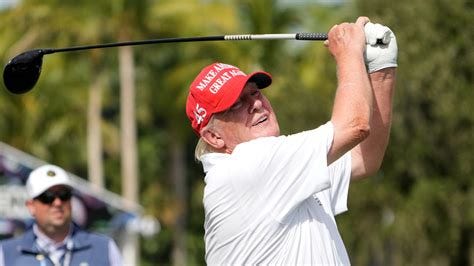
What the US is proposing here is something more like a members club. Like a golf club. It serves the members only.
Source: Palm Beach Post
The members club will be financed by public capital provided by the American taxpayer for which the members are supposed to pay interest. On top of that members are in for logistics expense like storage cost. If we understand the price part correctly, members also guarantee prices to the traders.
This scheme is like the pro-shop on a golf course. It keeps an inventory of tees and golf balls for members.
The difference with the proposed members club is that members are compelled to replace the tees and golf balls that they buy at the pro-shop.
They also pay the rent of the pro-shop and guarantee the margins of the pro-shop proprietor.
Among the current members of the club are General Motors, Stellantis, Boeing, Corning, GE Vernova and Google’s Alphabet.
With the exception of Corning, none of them uses rare earths.
Thus what is proposed here in terms of rare earths would be the equivalent of a steel-tube consumer buying pig-iron. Or a golf ball customer buying synthetic rubber.
Then there are traders Hartree Partners, Traxys North America and Mercuria Energy who don’t care what commodity they are flipping. They all lack basic competence in rare earths, which is effectively a specialty chemical business.
In terms of rare earths we don’t know why Hartree, Mercuria and Traxys should qualify as members of the club.
Mercuria and Hartree are large volume energy traders doing uncounted deals per day through hundreds of traders in large-scale commodities, with very limited capacity or patience for a tedious specialty chemical business. In a embarrassing display of fundamental rare earth incompetence, Traxys is the only rare earth hopeful on the planet that carries an extinct rare earth element in its product list.
We had the opportunity of touring a part of the Chinese national reserve of nonferrous metals, dates and location withheld. It was a huge area of warehouses and open-air storage.
At the time of visit the facilities were overloaded with copper and zinc. The copper cathodes in the warehouses had been stacked too high so that the warehouse floors had given way and sunken in by more than a metre. For something of this scale to happen the maximum floor-load must have been exceeded several times.
We understood from our visits that principally the Chinese reserve buys when prices are falling steeply and it auctions off adequate volumes to calm price peaks in the market. Whatever the market situation, there is always a basic quantity of inventory of each product, reach per product undisclosed.
This inventory is being rolled-over from time to time because of limited shelf-lives.
The inventory consists of the most common grades, no specialties. A one-fits-all approach that is reasonable, considering China’s market size.
In addition to this national reserve the Chinese state subsidises interest expense for reserve-like excess inventory at state-owned enterprises.
There are also (theoretical) production capacity reserves at major state-owned manufacturers.
Since summer of 2024 the national reserve must also contain a physical rare earth reserve. Years earlier the reserve had made some half-hearted, half-baked attempts of building up a rare earth inventory. But its bids had been too low, no sellers came forward, and there had also been uncertainties as to what quantities of what product and what grade to store.
The composition of the current rare earth reserve is unknown.
As described above, a national reserve law is in the pipeline.
As to the members club in the US and rare earths:
There are many different kinds of rare earth products, as variable as those of golf balls and of tees. Think of different shapes, colours, hardness, etc. So, what rare earths do the members club want to stockpile?
What purities for which product? A little bit of all, because they don’t know what they need?
Has there actually been any research at all into which rare earths exactly are really needed by the economy? Or has a product list been compiled by artificial intelligence, just like the “Freedom Day” tariff list, which so brilliantly included uninhabited islands and imposed the steepest tariffs on global export power houses like Lesotho?
Specifically for members Stellantis, GE Vernova and General Motors we would assume the target product actually is sintered rare earth permanent magnets, two conversion steps removed from what innocent rare-earth-virgin traders like to term rare earth commodities. All three club members require different shapes and sizes, different physical properties, different chemical compositions and perhaps also different coatings for their rare earth permanent magnets.
It is like one golf player requiring wooden tees and orange Bridgestone ‘distance’ golf balls, while the other may need plastic tees and white Dunlop ‘tour’ golf balls. Both use different golf clubs. There is no one-fits-all in engineered, finished sintered rare earth permanent magnets.
If the members of the club must pay interest and logistic cost, why don’t they just keep an excess stock by themselves, forget about the club and the privilege of feeding some traders? How about subsidised federal loans for excess inventory at end users instead of a members club?
Last but not least: just how does the presented members club concept help general market prices, if it is a members-only affair?
As a seasoned rare metals trader told us, the current timing is the worst possible time to set up a reserve. At this particular time a reserve would be expected to sell, not to buy.
He further remarked that what the US is setting off may become mindless hoarding by everyone & sundry on the doubtful assumption that this US members club should actually come alive.
We hear from China that reserve buying of commodities other than rare earths may increase in response to this US initiative.
An artificial shortage may ensue.
Whoever the apprentice may be, who has cooked-up this silly “golf club scheme”, should get fired.
A national reserve in rare earths must be much more sophisticated. It begins with knowing what the home market actually needs. Spoiler: at this time much hyped NdPr oxide is not among the products.
This is tiring. Lets move on.
The Chinese dual-use regulations for 7 rare earths cut out the middle man. By and large the efficient export supply chain of rare earth is being destroyed. It is being replaced by a bloated, totally inefficient, bureaucratic nightmare.
So far foreign importers and wholesalers placed comparatively large orders with Chinese exporters. The foreign importers would stock and distribute the different rare earths in often really small quantities to end users. We are talking also 10 kg to 100 kg lots to foreign end users in their respective countries. To laboratory consumable companies the quantities can even be smaller.
Consequently foreign end users must place their orders directly in China.
But also inside China the middle man is cut out. Chinese SME traders do not want to engage in the workload and frustration that comes along with the licensing and simply give-up the the relevant products. Also, in Xi’s China you don’t want to be known as aiding the class-enemy. Particularly not, if you are a private company - an unnamed arch enemy of Socialism with Chinese Characteristics in the New Era with Xi Jin Ping Thought.
This likely results in Chinese rare earth manufacturers being inundated with a flood of retail-sized orders, a business they are not geared for and have little desire to attend to.
It also leads to a flood of dual-use license applications for retail-sized quantities, something China’s Ministry of Commerce can’t handle, also because there are limits to automation - also in China AI is inherently “stupid,” so the process should require human judgement if or not a license application is credible.
Add to that the low limit for alloys of 0.1% of the supposedly dual-use product, and whatever residual sanity of the process is being wiped out.
We hear of license applications that needed more than half a year to get processed, whether positive or negative. That is not workable for anyone, anywhere.
The Chinese administration then resorts to giving out time- and quantity limited general licenses for exports to the large volume end users.
Arguably it is the large volume end users who, from a Chinese world-peace-keeping perspective, pose the highest circumvention risk, while the retail orders pose the lowest circumvention risk.
This being so, the high risk license applications get handled comparatively quickly, while the low risk applications are dragging on forever.
We would argue that the dual-use license system is highly ineffective in achieving its publicly advertised goal to further world peace by denying the class-enemy the supposed means for producing high-tech weaponry and ordnance.
As we said before, if one would want to assume that rare earths are of high relevance to ordnance and weapons, actually Chinese copper, steel, aluminium and all high steel alloys should also immediately fall under dual-use export licensing. They don’t, because the manufacturing chain is just too long to establish defense product relevance.
As we have proven, China does not classify rare earths according to their supposed potential for weapon production, even though the categories exist. It classifies rare earths as related to “other national security factors.” Whatever that may be.
On the 8th, Prime Minister Takaichi Sanae (President of the Liberal Democratic Party) appeared on a Nippon Broadcasting System program and expressed her intention to ask the US for cooperation in a government-led project to extract mud containing rare earth elements during her planned visit to the US in March.
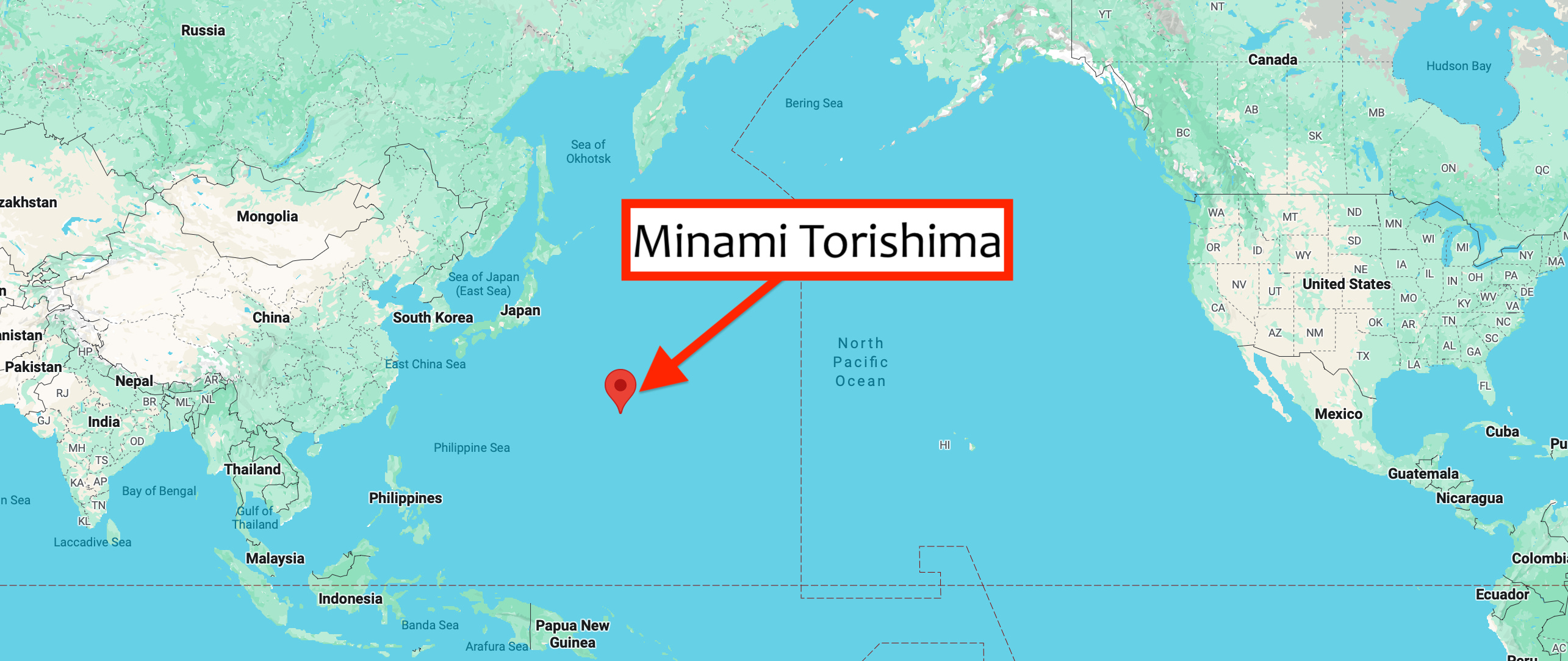
The Prime Minister cited the Japan Agency for Marine-Earth Science and Technology's successful extraction of rare earth mud from the deep seabed near Minamitorishima (Ogasawara Village, Tokyo), saying, "We would like the US to participate (in the project) and speed things up. We want the US to firmly commit to a 'free and open Indo-Pacific,' which is a major pillar of our diplomacy."
Clever move to pull the US deep into the Pacific Ocean by offering participation in an asset.
Source: Google Maps
The Japanese authorities said on Friday that they had seized a Chinese fishing boat sailing in waters off the coast of Nagasaki and detained its captain, adding to rising tensions between the two countries.
The Japanese fisheries agency said in a statement that officials had ordered the Chinese vessel, a trawler equipped with nets, to stop for an inspection around noon on Thursday after discovering it had entered Japan’s exclusive economic zone in the East China Sea. The vessel “refused to comply and fled,” according to the agency. The authorities then seized the boat, which had a crew of 11, including the 47-year-old captain, who was detained.
The episode, which took place off the coast of Nagasaki, near Japan’s Goto Islands, was the first time since 2022 that Japan had seized a Chinese fishing boat.
The boat seized on Thursday, called the Qiong Dong Yu 11998, is being treated as evidence and will be moved to the port of Nagasaki, the Japanese authorities said. Immigration officials will determine the fate of the vessel’s 10 crew members, the authorities said. They identified the captain, who was detained, as Zheng Nianli.
Chinese fishing trawlers deplete fishing grounds from Pakistan to Ecuador’s Galapagos marine reserve.
The “little blue men” on board of the trawlers are not really at fault.
Command of China’s state-owned fishing fleet used to rest with the “Fishing Small Group,” chaired by Xi Jin Ping himself. The small group seems to have since been integrated in a higher level commission.
China’s reaction is very, very mild:
At a news conference in Beijing on Friday, Lin Jian, a spokesman for the Chinese foreign ministry, called on Japan to “enforce the law impartially and protect the safety and legitimate rights and interests of the crew members.”
Guilty as charged?
When the Great White Hopes of the US mining industry are His Royal Litigiousness and the lesser scions of the Gutnick dynasty (or their “made men”) then you know you have hit bottom.


Comments
Nothing yet. Say the first thing.
Sign in to join the conversation.