
This past Saturday, August 8, marked one year of The Mains of Trenton — more than 200 posts tracking Trenton Water Works’ finances, water quality, and management, one document at a time. I can’t think of a more fitting way to open year two than this: a story in this morning’s Trentonian, and the receipts behind it laid out below. And if this work has been useful to you over the past year, I’m asking for a small anniversary gift — one that costs nothing and takes five minutes. Instructions at the end of this article.
If you landed here before reading my story in today’s Trentonian, start there first: Trenton Water Works faces growing risk of insolvency.
The article lays out the core problem: Trenton Water Works is at serious risk of insolvency, with limited options ahead—either seek state help or cut expenses. A newspaper story has length constraints; this post contains what didn’t fit: the documents, the spokesman’s email, and the supporting charts.
If you came from the article, welcome. Subscribe (free) so you don’t have to wait for the next crisis to read this kind of reporting.
On August 4, TWW spokesman Michael Walker answered my written questions. The Trentonian story quotes it; here you can read it in full:
Two redactions, noted on the document: an internal drafting note that TWW confirmed was included in error, and personal contact information. Everything else is exactly as sent.
Read it yourself, but three passages deserve attention. First, the contingency plan if the money runs short: ask the Department of Community Affairs for “an exception to access funds that are planned to be made available in the future” — TWW did not specify which funds — or “find a way to reduce expenses.” Second, the admission that TWW has not rerun its financial model to account for the October implementation delay, and won’t evaluate until “early 2027.” Third, the collections numbers, which we’ll get to, because they’re the quiet bombshell in this story.
Everything in the print story traces to one of these:
The TMF Report — Technical, Managerial, and Financial Capacity Evaluation, prepared for NJDEP by H2M Associates, January 2025. [LINK] Page 4-19 is where you’ll find, in a state-commissioned engineering report: “The Water Utility is on a pathway to insolvency.”
The Raftelis Six-Year Rate Study — Final Report, March 2026. The financial model behind the current rates, and the source of every projection in the print story.
Ordinance 26-001 — the rate ordinance adopted in February.
The Capital Improvement Plan, FY2024–2033 — TWW’s $763 million program.
TWW’s July 27 news release announcing October implementation.
My January post on how the rate structure was rebuilt between two Council meetings: TWW Rates: Saved at the Buzzer
Start with the projection at the center of the story. This is TWW’s own consultant’s forecast of the water fund’s year-end cash — with the rate increases:
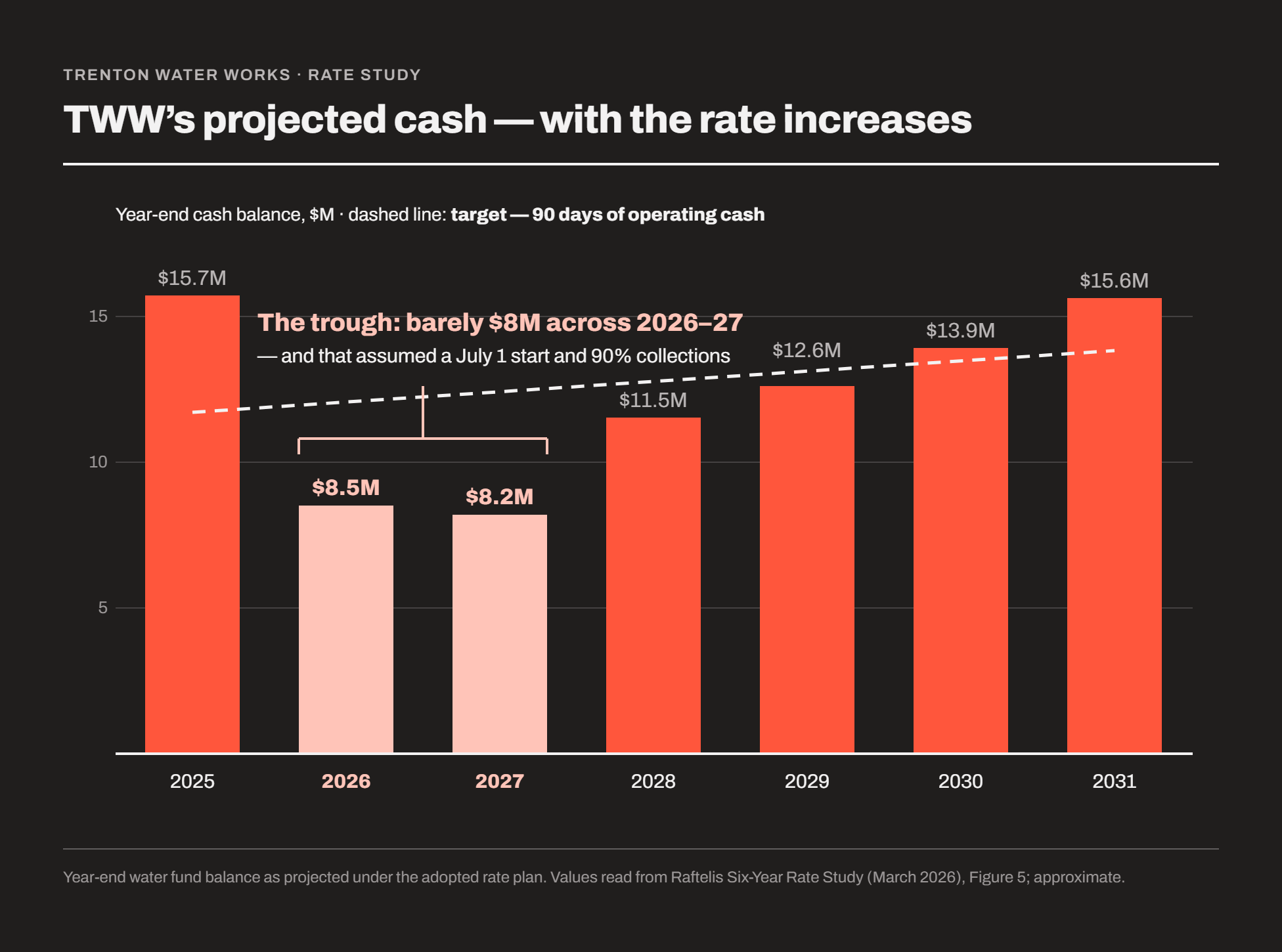
Two years scraping along at $8 million, against a target of roughly $12 million — and remember what this chart assumes: rates starting July 1 (they start October 2) and 90 percent collections. Which brings us to the next chart.
The print story had room for one year of collections data. Here’s the full trend Walker provided, against what the rate model assumes:
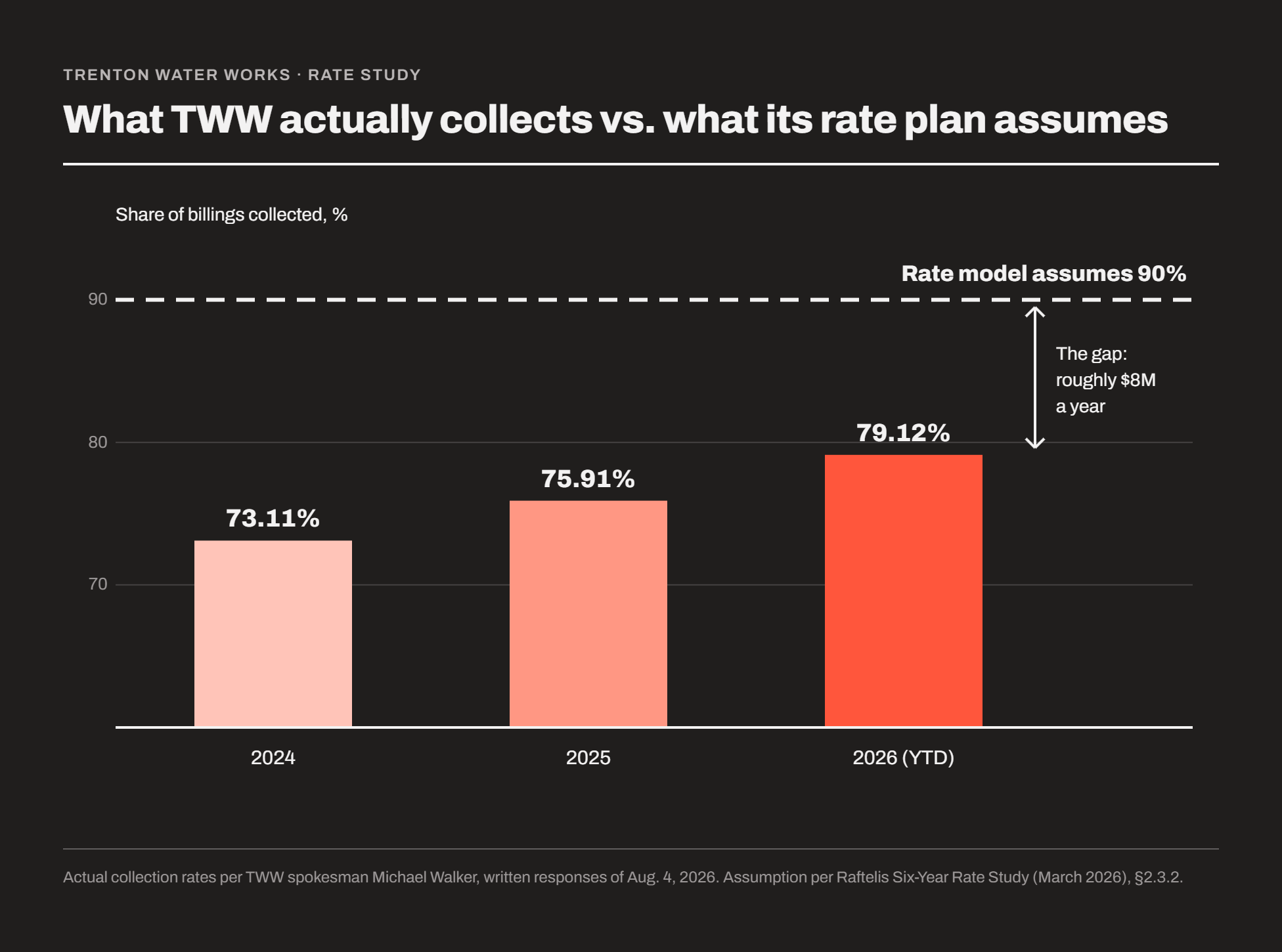
Credit where due: the trend is improving — six points in two years. Walker attributes it to more frequent customer communications, increased service terminations, and “more effective deployment of limited personnel.” But the model doesn’t assume improvement; it assumes 90 percent, now. Every year TWW collects in the high 70s instead, roughly $8 million the model counts on doesn’t arrive — more than the entire projected cash cushion at the trough. And the $9.7 million in delinquent collections the model assumed for 2025? TWW told me it “has not yet calculated” how much of that actually came in, because it can’t segregate delinquent collections from current ones.
None of this should have surprised anyone. The Trentonian story had room for one sentence from the state’s January 2025 capacity evaluation. Here is that sentence in the company it was written in, exactly as the DEP’s consultant wrote it on page 4-19:
The basic message that must become a priority for the utility’s economic survival is the need to reestablish customer accountability - this can only be accomplished by an aggressive and consistent delinquent account collection program culminating in the shut off of delinquent accounts after a 120 day delinquency, with the only exceptions being made for those customers who qualify for shut off protection under various State programs.
The Water Utility is on a pathway to insolvency.
— Technical, Managerial, and Financial Capacity Evaluation, H2M Associates for NJDEP, January 2025, p. 4-19
The same page presents what the consultant calls “startling data”: 120-day delinquencies had more than doubled since 2019, to $18.5 million across roughly 19,000 accounts. An engineering firm told the state, in plain language, that the utility’s survival depends on collections — eighteen months before Walker’s email put actual collections at 79 percent against a 90 percent assumption.
This is also why the September 1 resumption of shutoffs matters — Walker’s email calls the 75 days before the winter termination moratorium “essential for maintaining our progress.” And watch especially for the “more aggressive” use of tax sales the email floats — because we have already seen what that looks like.
Readers of this Substack will remember the December 15 lien sale — the event City Hall marketed as a “tax lien sale” that was, for thousands of families, a water bill lien sale under a more familiar name. The City put 6,755 liens up for sale — roughly 20 percent of all properties in Trenton. 2,554 of those properties owed no taxes at all; their only charges were water and sewer, with a median balance around $300 and more than 1,500 owing less than $250.
Three things about that sale bear directly on what Walker’s email is proposing.
The liens fell only on Trenton residents. The reason is buried on the City’s own customer-service page: in Trenton, water charges are assessed against the property, so unpaid bills become liens that can be sold to private investors at 18 percent interest. In the four townships, charges follow the customer — service can be shut off, but no lien ever touches the house. Suburban customers held roughly 39 percent of past-due TWW charges at the time, and faced no equivalent consequence. One water system, two sets of rules — and the harsher set applies to the city with the least ability to pay.
Residents got almost no real notice. The City’s public notice was 136 pages of unsearchable parcel IDs on an obscure state website, linked once in a news-alert feed next to a turkey giveaway — while the online payment portal was shut down for balances headed to sale. Many homeowners learned they were on the list only days before the auction, and often from the searchable database this Substack built rather than from the City.
Much of the debt wasn’t even theirs. Reader after reader reported liens for charges run up by a prior owner or tenant, years before they bought the house — including a homeowner who had paid every bill for five years and found a lien on the title anyway. Given what three state-commissioned reports say about TWW’s billing system — “billing errors drag on for many years without a formal mechanism of resolution,” estimated bills “reaching back over 10 years” — a lien process fed by that billing data inherits every one of its errors.
In the end, residents cleared 4,487 liens — two-thirds of the list — before the sale, a remarkable act of neighborhood self-defense against a process built to be missed. So when TWW’s spokesman says the utility is “considering more aggressively utilizing tax sales” to close its collections gap, read that with December in mind: as currently structured, that tool reaches only Trenton homeowners, runs on billing data the state’s own consultants call unreliable, and turns a $300 water balance into a cloud on a family’s title.
One more thing to know before we look at TWW’s budget: what the state’s consultant found when it examined the people and systems that produce these numbers. This passage, from page 4-1 of the same TMF report, is also a single continuous quote — the sentences run exactly this way in the original:
This is much too large an organization and financial operation to not have adequate accounting controls and management. Although the account clerks try to understand and work within the City’s appropriation accounting system, upon questioning they had no real understanding of the system or the rules and regulations governing governmental finance. Many Division heads expressed no knowledge of the budget status or the procurement and budgetary processes. Staff are complacent in their lacking knowledge and there is little to no emphasis on or encouragement to enhance their understanding of the financial system.
— TMF Report, §4.1, p. 4-1
And a page later:
It is strongly suspected that the current state of TWW’s financial and accounting personnel is not adequately trained or staffed to proficiently handle its budgeting, purchasing, and approvals processes.
— TMF Report, §4.2.1
Consider what that means for everything else in this post. The utility that says it will “identify costs we can keep at the current level or reduce if necessary” is the same utility whose account clerks, per the state’s consultant, “had no real understanding” of the accounting system they work in — and whose division heads couldn’t say where their budgets stood. The evaluation TWW plans to run in early 2027, at the moment its cash is thinnest, will be produced by that same financial operation. The Mayor’s own consultant, Steven Picco, found the budget officer position had sat unfilled for over a year; the state’s 360 Review found the City doesn’t keep its financial records to governmental accounting standards, its asset records “unavailable, piecemeal, or deemed unreliable.” Three reviews, three different clients, one verdict.
Now the budget itself. TWW must collect $66.1 million this year. Here’s how it’s spoken for:
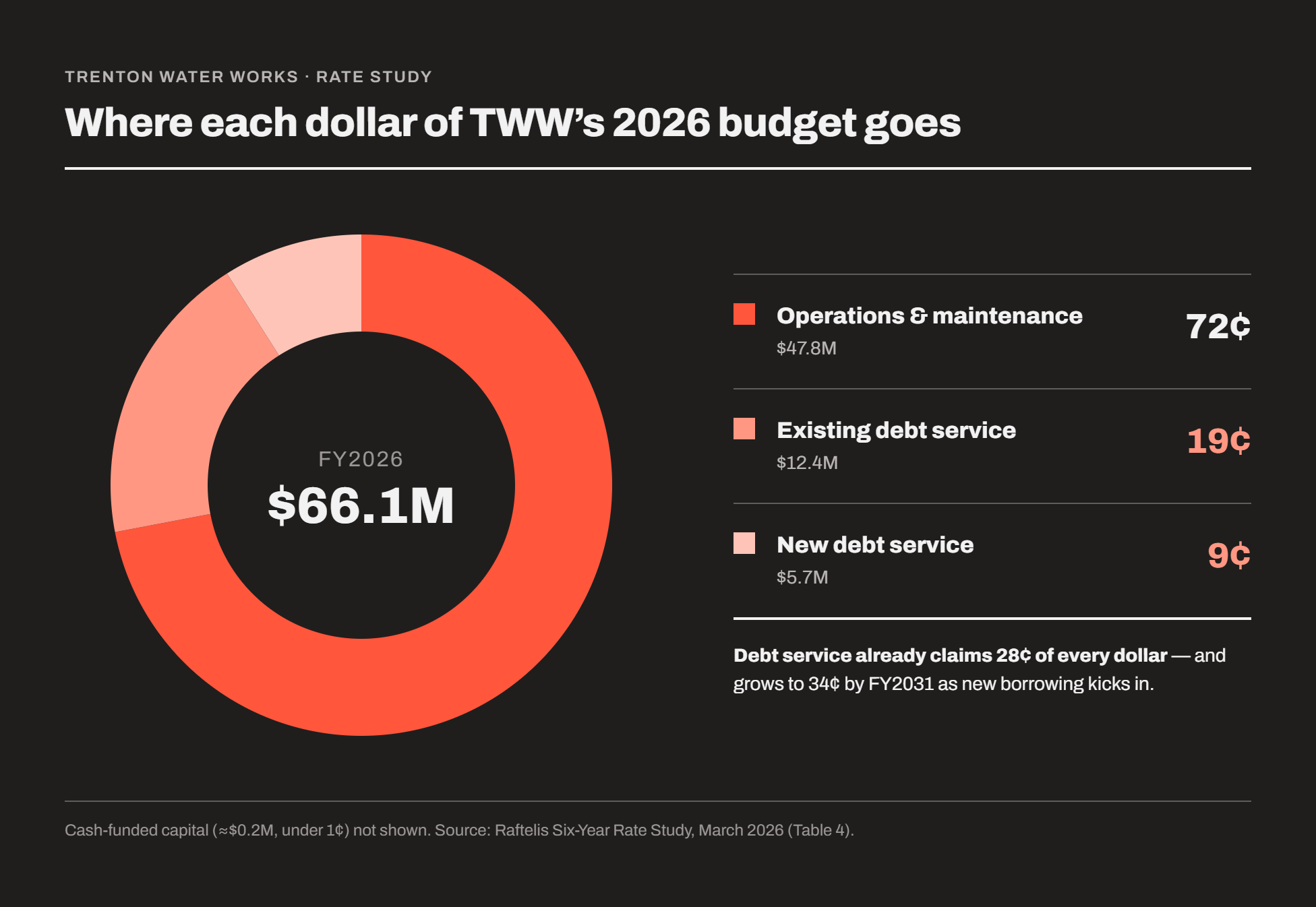
Twenty-eight cents of every dollar goes to debt service before a single pump turns. And that share only grows: new loan payments ramp from $5.7 million this year to $21.7 million by 2031 as TWW borrows toward the $763 million capital program. By 2031, debt takes 34 cents of every dollar. Loan payments are first in line, and they don’t shrink when revenues disappoint.
Walker’s second prong is cutting costs. Split the same dollar into what’s locked and what isn’t:
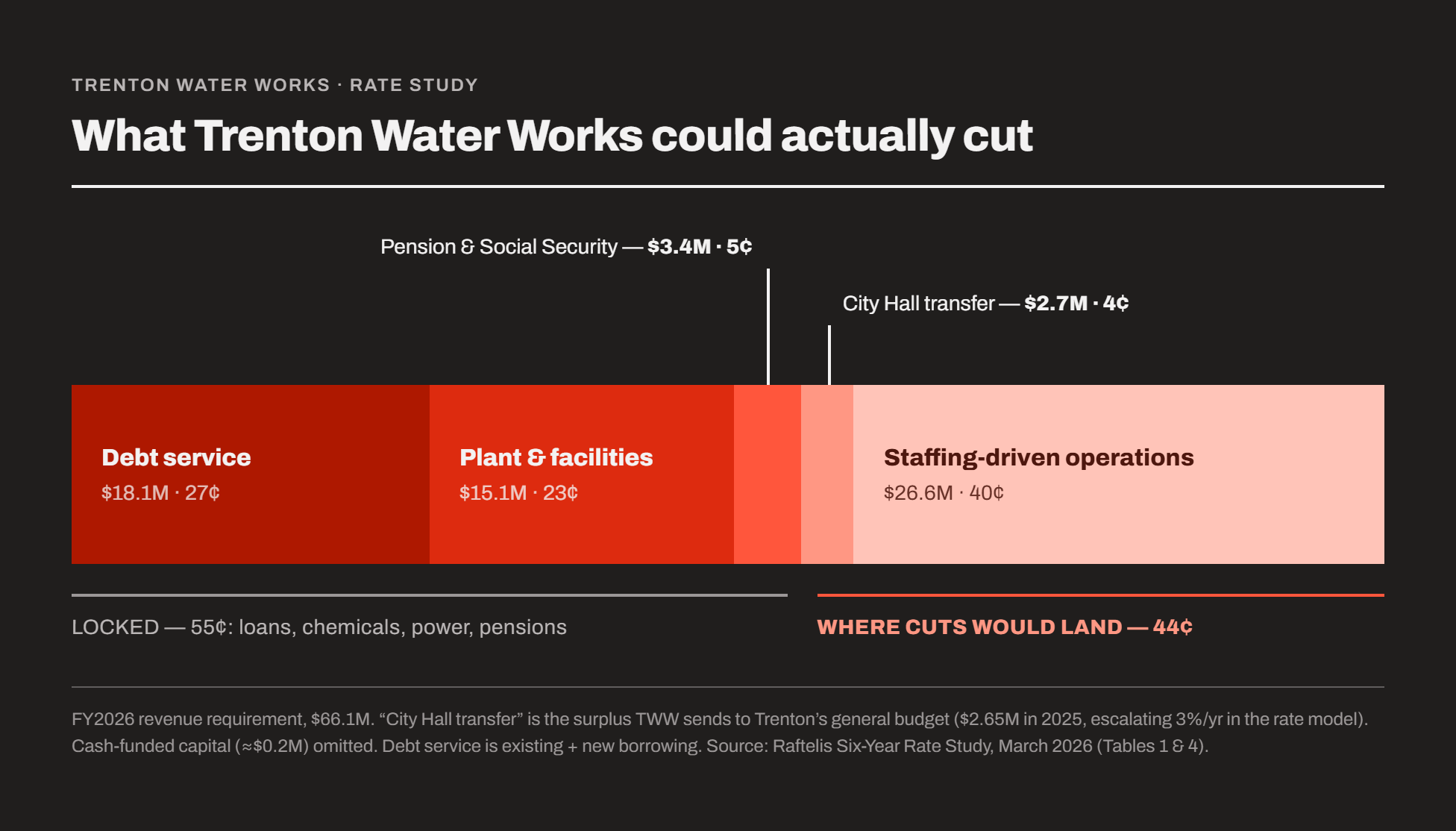
Start with the non-negotiable: debt service is contractual. Plant and facilities — the chemicals (including the orthophosphate that keeps lead out of your tap water), the electricity to move 27 million gallons a day, the emergency repairs a 200-year-old system generates on its own schedule — are driven by demand, not preference. Pensions and Social Security are statutory.
That leaves two things.
The City Hall transfer — 4 cents. The other genuinely discretionary line: the surplus TWW sends to Trenton’s general budget. $2.65 million in 2025, escalating 3 percent a year in the rate model — roughly $17 million over the six-year plan. This isn’t hidden; it sits in the Raftelis study’s revenue-requirement assumptions, which means every one of the 217,000 people TWW serves — including customers in Ewing, Hamilton, Lawrence, and Hopewell, who can’t vote for the Trenton officials who run the utility — pays a little of Trenton’s municipal budget with each water bill. If TWW ever faces the choice between laying off meter readers and forgoing this transfer, that decision will tell you exactly who the utility works for.
Staffing — 40 cents. Administration, finance, customer service, billing, meter readers, construction and maintenance crews, laboratory technicians. If TWW cuts in any serious way, this is where it lands, because it’s the only place it can land.
But understand what “cutting staff” would mean at this particular utility, because every report ever commissioned on TWW says the same thing: the problem is not too many employees — it’s too many empty desks. The state’s entire involvement in TWW began with vacancies. The February 2018 consent order rests on a 2017 assessment that found TWW “was operating with 68 vacancies, which represented 39% of the positions at TWW.” Seven years later, the state’s new TMF evaluation found the disease unchanged:
Unfilled positions at all employment levels, coupled with a lack of proper staff training and understanding of purpose, insufficient oversight, and lack of accountability has led to a culture of complacency across the organization.
— TMF Report, §6.1
And its consequences compounding:
Many vacancies exist within TWW organizational structure, with only some of these positions being funded by the City of Trenton. This lack of proper staffing leads to excessive overtime for the existing staff, ultimately increasing the likelihood of employee burnout.
— TMF Report, §6.1.2
The TMF describes the Chief Chemist and Environmental Engineer routinely covering licensed operators’ shifts because so few operators remain on staff, and cites “burnout caused by the high vacancy rate” as a reason TWW “struggles to retain competent, motivated staff.”
The Mayor’s own consultant said the same thing, division by division. In his September 2024 report, Steven Picco found the administration division carrying 11 vacancies against 52 filled positions and the budget officer’s chair empty “for over a year.” Engineering: “woefully understaffed for its statutory responsibilities,” with recruitment “hampered by a residency requirement that discourages qualified people from applying” — Picco recommended nearly doubling it. The laboratory — the people who certify your water is safe — twice, in one report: “understaffed and underequipped and must be addressed in the very near future,” and later, “woefully understaffed and underequipped… This should be considered a top priority not only of the division, but also of Trenton Water Works.” The treatment division, in his words, has been “hurt more than most by an ongoing policy of deferred maintenance, underfunding and inability to retain staff.”
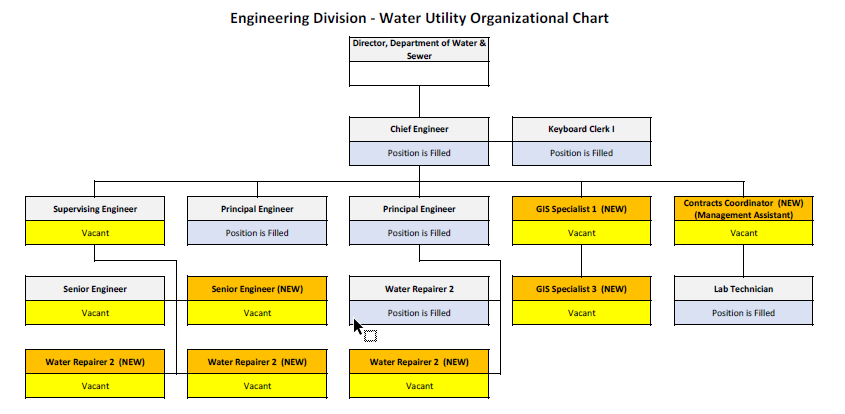
Read those verdicts next to Walker's email and you'll see the problem. The consultants hired to save TWW all prescribe hiring — Picco even notes a fully staffed engineering division would “provide a significant source of income” by handling billable development reviews. The functions a cut would hit — meter reading, billing, collections — are the exact functions whose failures created the revenue crisis, and the exact functions Walker credits for the recent collections improvement. Cut those people and you cut the revenue they bring in.
The biggest problem TWW has — and arguably the easiest one to fix — is filling its vacancies. The insolvency math may soon push the utility in exactly the opposite direction.
The last rate increase was adopted in October 2020. The TMF report’s verdict on it deserves quoting in full: “There is a concern that the existing rate billing structure does not fully conform with the revised 2020 rate structure since the available data does not show a comparable revenue increase.” Translation: TWW raised rates, and the money never verifiably showed up. The same report documents budgeted revenues missed in 2018, 2020, 2021, and 2023, reserves falling from $25 million to $6 million, and a recommended 5 percent increase in 2024 that was simply never adopted.
That’s the pattern the print story could only gesture at: TWW has never once executed a rate plan as designed. The current plan is already off script — three implementation delays and a collections rate 11 points below assumption — and the first bill hasn’t even gone out.
One more number from Walker’s email. The adopted rate schedule ends in 2031. The capital program runs to 2033, and the rate study funds only about $458 million of the $763 million total — leaving roughly $305 million, 40 percent of the program, in the two years after the last adopted increase. TWW’s plan for that? Per Walker: the current increases will cover “a portion” of it, TWW “has not calculated” the rest, and the increases would land “somewhere between 3% and 7% per year.” The rate increases you were told would fix TWW are, by TWW’s own description, the first installment.
One request: don’t wait to be surprised by your October bill. We built a calculator that tells you exactly what your bill will be under the new rate structure. Grab a recent bill, find your service (meter) size and your quarterly usage in CCF, and head over here:
Then, when the real bill arrives, compare. If what TWW charges you doesn’t match — especially if you have a 3/4-inch meter, which the ordinance prices at $103.74 per quarter even though TWW’s press release said $83.20 — I want to hear about it. That discrepancy is a story waiting for its first example.
That’s the story, and those are the receipts. Now the ask I promised at the top — two things, five minutes, in honor of one year of The Mains of Trenton.
First, share this. Not into the void — to a person. A neighbor, a business owner on your block, a friend or family member who gets a water bill from TWW, whether they’re in Trenton, Ewing, Hamilton, Lawrence, or Hopewell. The December lien sale proved what this community can do when accurate information moves through it: two-thirds of those liens were cleared before the auction because neighbors passed a link to neighbors. Every story on this Substack works the same way — it only protects the people it reaches.
Second, make your voice heard — literally. We built a tool for exactly this moment: the Make Your Voice Heard button below gives you contact information for every elected official who represents you, from your local council members to the governor’s office. The documents in this story belong to the public. The officials in that tool work for you. If what you read today concerns you — the October bills, the collections gap, the lien sale rules, the transfer to City Hall — tell one of them. A utility drifts toward the edge when nobody with power hears from the people paying for it.
Thank you for a remarkable first year. Year two starts now.
Comments
Nothing yet. Say the first thing.
Sign in to join the conversation.