
On Friday, 7 August Pakistan, Saudi Arabia, and Turkey signed the “Mecca Joint Force Agreement,” a mutual defense pact. Its most notable provision is similar to NATO’s Article 5, where an attack on any one of the three nations will be regarded as an attack on all three. This prompted the commentariat to immediately label the agreement as “Muslim NATO,” although it is otherwise not remotely similar.
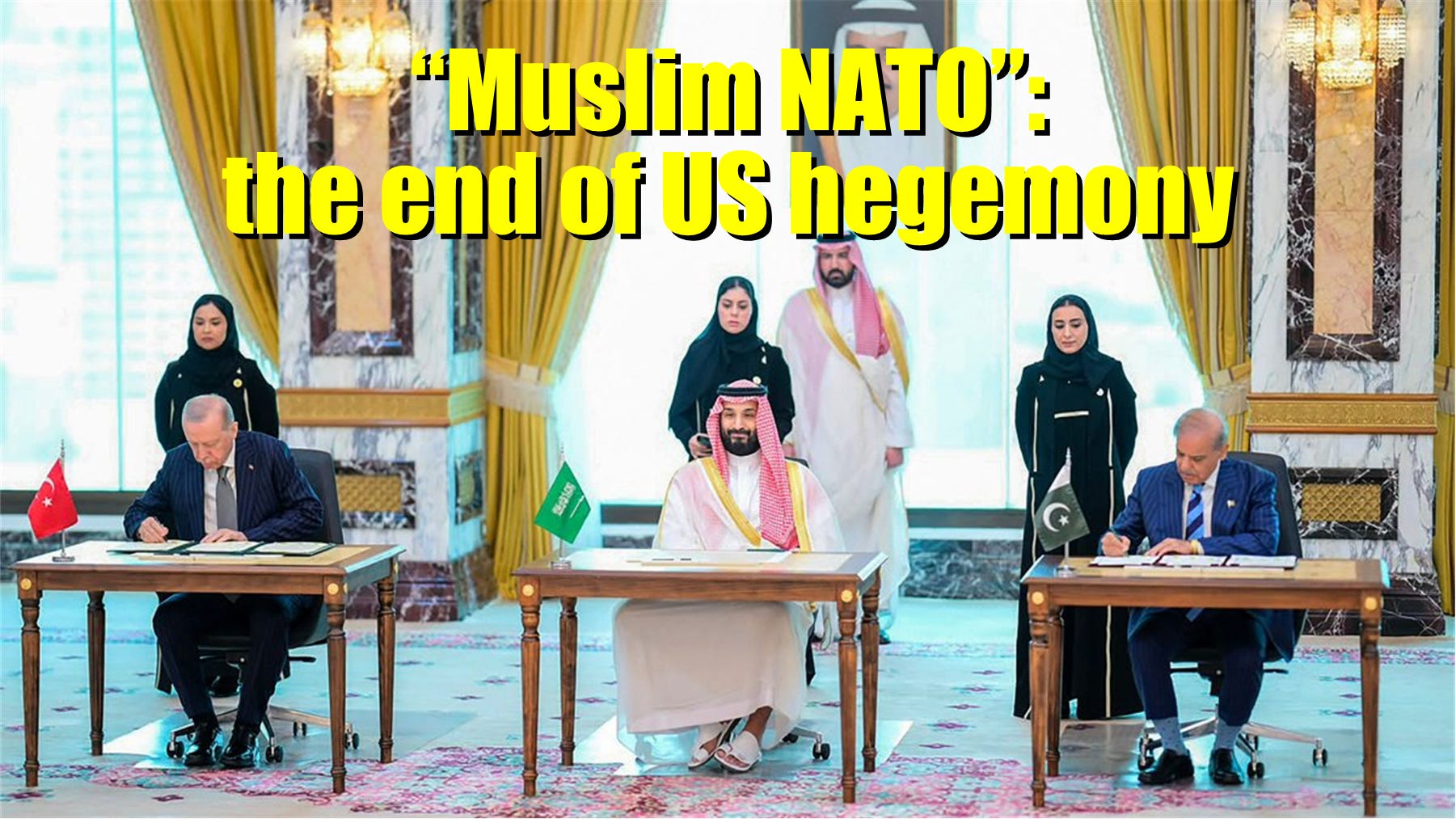
For one thing, the full text of the agreement has not been made public. Instead, we only have a brief joint statement by the three signatories:
“Guided by the longstanding historical ties among the three states, based on the enduring bonds of brotherhood and Islamic solidarity that unite them, and building upon their shared strategic interests and longstanding defense cooperation, HRH the Crown Prince, the President of Türkiye, and the Prime Minister of Pakistan signed the Makkah Joint Defence Agreement, reflecting the three states’ shared commitment to further strengthening their collective security and to promoting peace, security, and stability in the region and beyond, in pursuit of a secure and prosperous future.
The agreement is intended to strengthen collective deterrence against any act of aggression, and stipulates that any armed attack against any one of the three states shall be regarded as an attack against them all. It further provides for the enhancement of all aspects of defense cooperation among the three states.”
Furthermore, at least for now, the agreement doesn’t seem to foresee a formal organization, headquarters or any joint command structures. In spite of that, the agreement could prove to be one of the more consequential geopolitical developments to emerge from the current Middle Eastern crisis.
Given that all three signatories are, at least formally, allied with the United States, many analysts interpreted Friday’s announcement as a creation of a new alliance that would ultimately serve the interests of the United States in the Middle East, and by extension, represent a new bulwark for the defense of Israel. However, I believe that those interpretations will prove mistaken.
One thing all three of these nations have in common is that each has been threatened by Israel in the past. The Eretz Israel, or Greater Israel project has very significant territorial ambitions that include a very large chunk of Saudi Arabia. Here’s one the map of the Zionist leaders’s vision:
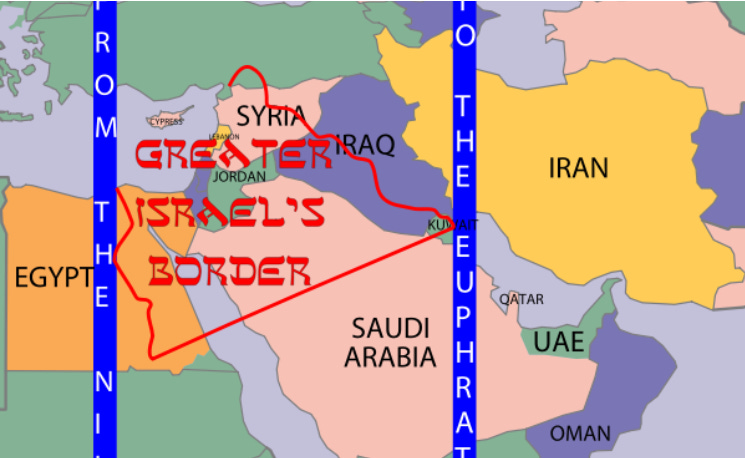
As we can see, Eretz Israel also includes a chunk of Turkey, and most of Syria, which Turkey regards as its own strategic sphere of influence. This has put Turkey in the crosshairs of Israeli officials’ escalating war rhetoric.
For example, Israeli Minister of Diaspora Affairs Amichai Chikli said that Israel should prepare for a possible future clash with Turkey, calling a naval encounter “not impossible” and something that “could happen even tomorrow morning.” Defense Minister Israel Katz explicitly warned Turkey against deepening its presence in Syria, and the former Prime Minister Naftali Bennett has called Turkey the “new Iran” and a strategic threat. Prime Minister Benjamin Netanyahu said that he takes President Erdogan’s anti-Israel statements “very seriously,” lobbied the Trump administration against selling F-35 aircraft to Turkey, saying it would destroy the regional power balance.
That “regional power balance” also set Pakistan in the Zionists’ crosshairs, and in this sense, Israel has already planned hostile actions against Pakistan in collaboration with its ally, India. Already in 2011, Benjamin Netanyahu made the following statement:
“... the greatest mission that we have is to prevent a militant Islamic regime from meeting up with nuclear weapons or from nuclear weapons meeting up with a militant Islamic regime. The first is called Iran. The second is called Pakistan. Because if these radical regimes have nuclear weapons, they will not obey the rules that have been obeyed in the last, almost seven decades.”
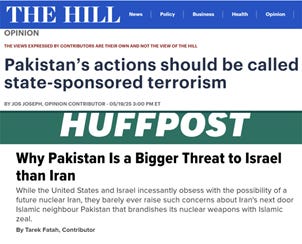
The plan to tame and declaw Pakistan is clearly a long-standing one, with full support from Zionist and Indian lobbies in Washington DC. The requisite accusations and war rhetoric have already been doing the rounds in popular media programs, including labelling Pakistan as a state sponsor of terrorism:
Indeed, the fear of an Islamic nation possessing a nuclear bomb is not a new thing: it is why Israel attacked Egypt in 1967 and Iraq in 1981.
In 1981, Israel developed a plan to strike Pakistan’s nuclear program. In this plan, India was supporting Israel by providing air bases where Israeli F16s and F15s could land and refuel before the strikes. The Indians named the plan “Operation Shakti” and Israeli pilots already began training for it.
However, Pakistan’s intelligence agency ISI found out about this and the country’s then ruler Zia ul-Haq reacted immediately, warning Israel that if they strike Pakistan’s nuclear facilities, Pakistan would strike Dimona. Ul-Haq also issued a warning to India. Facing the prospect of a wider war against Pakistan, India backed off. Without India’s help, there was no way for Israel to carry out the attack, so the plan was shelved.
A new & improved plan was in the works in 1998. At that time, the Pakistani government received an intelligence report that India and Israel were again planning to carry out a joint attack against the country’s nuclear facilities. Shamshad Ahmad (former Pakistani Foreign Secretary) explained the intelligence report they received:
“Sir, we have just received intelligence report that at an Indian airport, squadrons of Indian and Israeli air forces are positioned and are preparing for an attack on Pakistan’s nuclear installations in Balochistan. Then I called our Ambassador in New York, Ahmed Kamal.
I told him, go... on CNN and say that Pakistan has information that India and Israel are about to launch a joint attack on Pakistan. The Ambassador went live on CNN and it resulted in a good impact because if India and Israel had made such a plan, it would be called off by morning.”
As Israel’s most important non-Western ally, India has relied on a very close collaboration with Israeli intelligence to direct action against Pakistan. Particularly since its humiliation by the Pakistani Air Force during their brief confrontation in May 2025, India has been anxious to support the next Israeli attack against Pakistan.
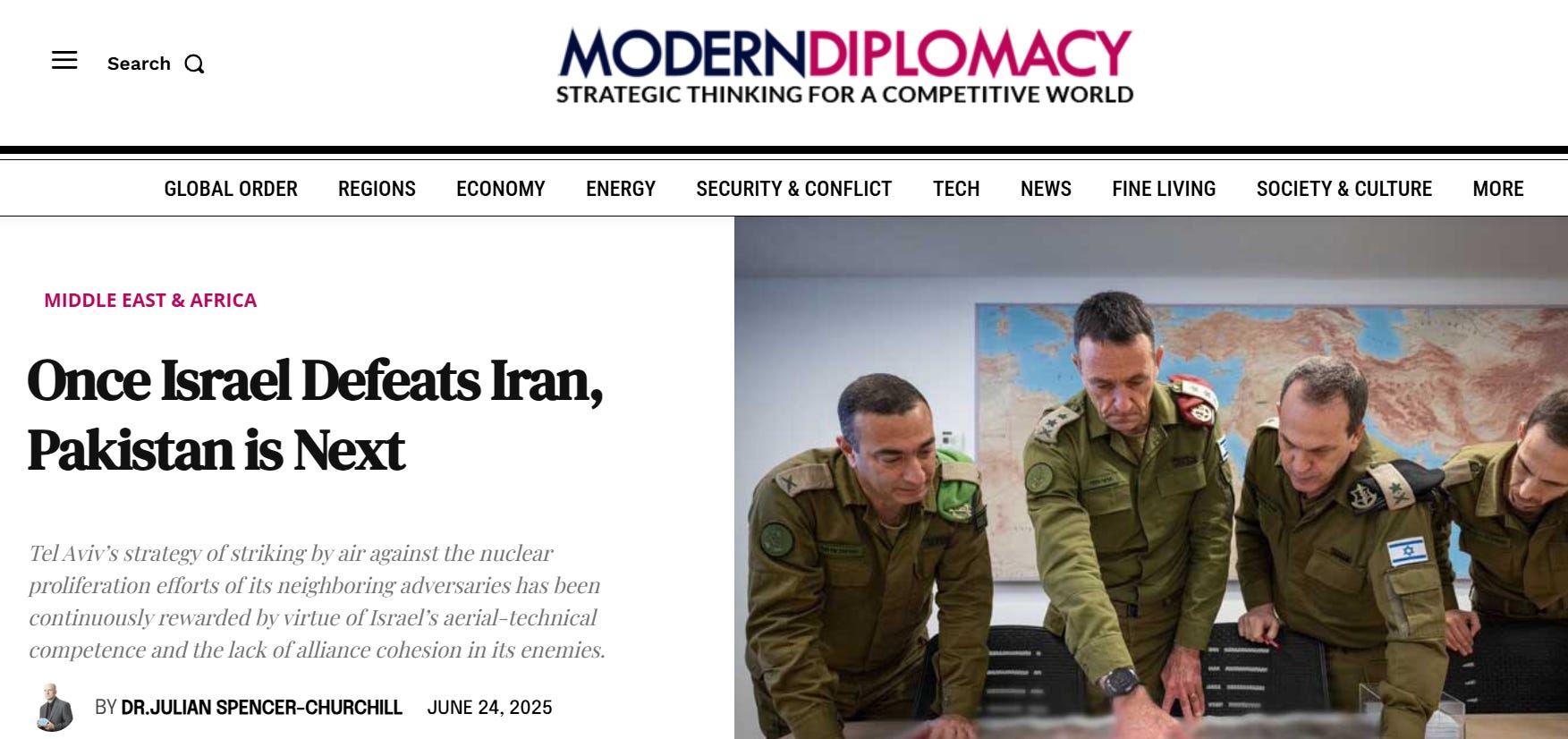
Last summer, Pakistani journalist Hamid Mir explained what brought this to world’s attention:
“Interestingly, the 12-days’ war [between Israel and Iran] exposed the plans of a new war: Israel and India against Pakistan. Now, the threat of a new war is hanging over South Asia. This threat is not just a flight of imagination.”
In view of all this, it would be hard to imagine why Pakistan, Saudi Arabia, or Turkey would come together to defend Israel. More likely, they would come together to protect themselves from Israel and its Western allies, including the US, UK, NATO, and also, in Pakistan’s case from India.
Judging by the statements from Thran and actions by the Ansarallah in Yemen, they clearly don’t seem to feel threatened by the new alliance. For example, just yesterday Yemen’s Ansarallah launched a drone strike on a Saudi Aramco refinery in Jazan, and followed up by striking at the Saudi-backed forces in Yemen’s Mocha port. This morning, Tehran issued an official statement on Mecca Joint Force Agreement.
Iran’s Foreign Ministry spokesman Esmaeil Baqaei called the pact a sign that regional countries are shifting away from relying on the US for security. He stressed Tehran’s perception that the treaty isn’t aimed against Iran, underscoring the deep historical and religious ties with Saudi Arabia, Turkey, and Pakistan.
I believe that Mr. Baqaei’s statement is correct. He didn’t mention that all three nations and Iran face the common threat and the same enemies. The new “Muslim NATO” signifies the redrawing of the power balance in the region and the emergence of a new security architecture that clearly has no use for either the US, UK, NATO, or Israel.
This view is corroborated by the conspicuous absence of any official statement regarding the Mecca agreement from the Trump administration, suggesting that they were neither consulted nor involved in forging the new defence pact. That silence indicates an embarrassment about being kept out of the loop on such momentous developments by their very allies. But what may be embarrassing to the US administration could be panic-inducing for Israel.
To learn more about TrendCompass reports please check our main TrendCompass web page. We encourage you to also have a read through our TrendCompass User Manual page. For U.S. investors: an investable, fully managed portfolio based on I-System TrendFollowing is available from our partner advisory (more about it here).

With Friday’s closing prices we have the following changes for the Key Markets portfolio:
Comments
Nothing yet. Say the first thing.
Sign in to join the conversation.