
Further to yesterday’s post, I wanted to revisit the suggestion by Yuval Aviv, “Mossad’s most dangerous assassin,” that the real government running the United States is its shadow government. I mentioned yesterday that I wasn’t sure how much of Aviv’s interview was true and how much false, but I tend to believe his assertions about the shadow government.
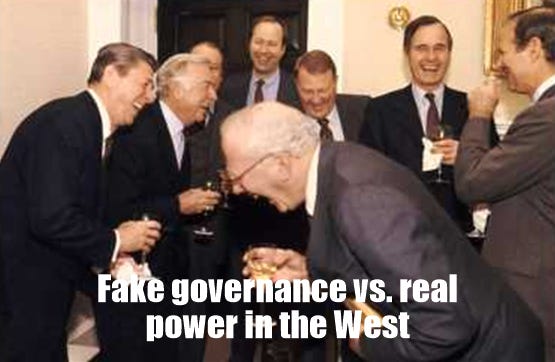
The existence of such a body could explain many seemingly incoherent, or inconsistent aspects about the way the United States is governed, among other things the fact that the American people consistently vote for anti-war candidates, but consistently get more forever wars.
In spite of this, the very existence of the shadow government (also referred to as the “secret government,” or the deep state) is usually dismissed as a silly conspiracy theory. But we knew - or should have know - of its existence for many decades now.
The research that I conducted for my twice banned book, “Grand Deception,” strongly suggested that there were two parallel structures of power in charge of policy in the United States and I suggested that understanding US role in the Russian tragedy of the 1990s, it was important to “distinguish between the legitimate US government and an illegal, parallel structure of power operating within it.”
The existence of this illegal, secret government came into view in the fall of 1986 when an American supply plane got shot down over Nicaragua, blowing open the Reagan administration’s illegal arms sales to Iran. This became the “Iran-Contra” affair.
A full congressional investigation was launched and its proceedings revealed for the first time the existence of a parallel structure of power operating within legitimate government structures. This network, also referred to as shadow government, deep state or the Enterprise, came out on record and could no longer be dismissed as mere conspiracy theory. In his special report titled “Secret Government,” journalist Bill Moyers described the organization as follows:
“An interlocking network of official functionaries, spies, mercenaries, ex-generals, profiteers and super-patriots who for a variety of motives operate outside of the legitimate institutions of government. Presidents have turned to them when they can’t win the support of the Congress or the people, creating that unsupervised power so feared by the framers of our constitution.”
Late Senator Daniel Inouye characterized it as “a shadowy government with its own air force, its own navy, its own fundraising mechanisms and the ability to pursue its own ideas of national interest, free from all checks and balances, and free from the law itself.”
At the time, it was clear that William Casey, Reagan’s election campaign manager and Director of Central Intelligence (DCI) since 1981 was the highest Reagan administration official directly associated with the parallel, shadow government. Casey was no ordinary government apparatchik. He was widely believed to be one of the most powerful men in Washington DC, with very close ties in the political, financial and intelligence circles. According to former US Government official Barbara Honegger, Casey was also the author of a famous quote that, “We’ll know our disinformation program is complete when everything the American public believes is false.”
During the Reagan administration, Casey was charged with the mandate “to build up C.I.A.’s ability to make military and political action outside the United States.” He was also the person who put forward as the Vice President the former CIA director and key Iran-Contras co-conspirator George H. W. Bush. Recall, our Mossad assassin Yuval Aviv explicitly named Bush as a senior member of the shadow government, which makes his that much more credible.
The fact that the Bushes were a prominent banking family and that George H. W. Bush’s father Prescott Bush funded Hitler and his Nazi war machine isn’t coincidental to history. As historian Ramsay MacMullen suggested, in order for us to interpret history correctly, we must understand the motivations of groups and individuals who shaped history. Once we establish who shaped history, we are a giant step closer to understanding their motivations and incentives, otherwise we might think it’s all somehow emanating from democracies along with sheer incompetence with no ulterior agenda.
But how did William Casey get into the shadow government? Who was he, and how did he get to be so powerful? Those questions are relevant as they might indicate the real source of power in the World. During World War II, Casey served with the Army Intelligence and the Office of Strategic Services (OSS, the predecessor of the CIA). The OSS was the US counterpart of the British Special Operations Executive (SOE), directed during World War II by Sir Charles Jocelyn Hambro.
In addition to being the head of Britain’s foreign intelligence, Hambro was also a prominent banker who sat as a director of the Bank of England from 1928 until his death in 1963. William Casey was Hambro’s protege and trainee along with others like Charles Kindelberger, Walt Rostow, and Robert Roosa. Like Hambro, Casey’s career also straddled government, intelligence and banking appointments.
Under President Ford, he served on the Foreign Intelligence Advisory Board, an executive committee of the U.S. intelligence community. During Nixon administration, he headed the Securities and Exchange Commission. After that post he took charge of the Export-Import Bank, and from 1976 to 1981 he was associated with the Rogers & Wells law firm which operated in New York and Washington.
The existence of a shadow government also explains why our oligarch class feel as passionately about “democracy.” Democracy gives us elected officials who, to paraphrase Yuval Aviv, entertain the people, attract media attention and put up an “entertaining” show while the serious players meet once or twice a month and decide to do what needs to be done. They know what’s best for the country and they’ve ways and means to get it done. Yuval Aviv was one of those means. That is, if he was telling the truth.
But the greatest enabler of the shadow government also deserves an honorable mention here: it’s the credulous, entertained public or, the “normies.” They prefer not to notice, readily embrace reassuring narratives and heap scorn on the loopy conspiracy theorists who - LOL - think that men meet in smoke-filled rooms and make decisions about launching pandemics, getting “rid of the poor people,” blowing up pipelines, starting wars or running “surprise, kill, vanish” operations.
Thomas Jefferson pointed out that the price of liberty is eternal vigilance. Hopefully that’s a lesson we can revisit and learn to actually be vigilant. The shadow government, not just in the United States but in many nations, is real. The Epstein conspiracy is also real, as are the many wars of choice fought around the world today, especially in resource rich regions that bankers prefer.
To learn more about TrendCompass reports please check our main TrendCompass web page. We encourage you to also have a read through our TrendCompass User Manual page. For U.S. investors: an investable, fully managed portfolio based on I-System TrendFollowing is available from our partner advisory (more about it here).

With yesterday’s closing prices we have the following changes for the Key Markets portfolio:
Comments
Nothing yet. Say the first thing.
Sign in to join the conversation.