
“The Search for Truth in a Reverent Spirit” (Outlook – December 1911)
Get ready for a deep dive into the mind of Theodore Roosevelt.
In the months leading up to the 1912 presidential election and the first state primaries for the Republican Party, Theodore Roosevelt kept an eclectic publishing routine. Along with many articles and speeches on nationalism, he wrote reviews about popular books and intellectual debates. One piece, published in the Outlook in the December 1911 issue, took on the intersection of religion and science. The scientific method displaced ancient metaphysical philosophy, but it could not displace the idea of God, religion, and the origin of humankind from philosophy. Many thinkers still relied on faith to define rationale.
In Roosevelt’s considerations of religion and science, he recognized the need to use the scientific method to understand physics, biology, and chemistry. In the piece, he dissects the philosophies of materialism and creationism through the ideas of Charles Darwin – the prevailing evolutionary theorist of his day. Darwin published On the Origin of Species in 1859, one year after Roosevelt’s birth. It became the singularly most important breakthrough for natural science and the social sciences.
When Roosevelt penned this article, he had considered evolutionary theory for more than thirty years. That made the essay a personal one for Roosevelt. He grappled with two sides of his own being: the spiritual and the scientific. In a response to leading thinkers of the day, Roosevelt sides with popular philosopher Henri Bergson and his writings on “creative evolution,” which makes a distinction between the measurable parts of life and those that necessarily cannot be measured. Time is Bergson’s best example. Lived time is entirely different from recorded time. An hour of pleasure passes swiftly whereas an hour of pain can last excruciatingly long. Roosevelt addresses Bergson’s point through the scientific advancements of Darwin’s evolutionary theories. He rejects “pure” genetic evolution as the basis for human progress. If everything was reduced to scientific evolution and the random fate of genetic material, there is no free will; there is no learning; there is no morality. Yet Roosevelt could not ignore the evidence of science, either. Genetics and human evolution certainly relied on the reproductive process.
Rather than choosing between materialism and spiritualism, Roosevelt adopted both in the same way that Bergson imagined time in two different ways. For Roosevelt, “nature” played a role in human evolution and “nurture” had its place in human learning and ingenuity. It is likely that this conclusion prompted him to change the title of the article from “The Search for Truth in Science and Religion” to “The Search for Truth in a Reverent Spirit.” This paradox, Roosevelt believed, had beguiled thinkers before him, during his time, and would continue to perplex the greatest minds long after he passed.
July has been a busy month inside the Theodore Roosevelt Center! We started off the month with a huge amount of activity thanks to all the celebrations surrounding July 4. Most notable on campus was the hugely successful production of Teddy and Alice, put on as a collaboration between the Blue Hawk Theater Guild, Badlands Opera Project, DSU Music, the Theodore Roosevelt Center, and other community partners. Dr. Hansard, Public Historian and Outreach Coordinator stepped out of the office to take the leading role as Theodore Roosevelt, while other members of the Theodore Roosevelt Center staff were able to support the performance through the creation of some exhibit cases and the sale of Theodore Roosevelt related merchandise during the performances. The month additionally saw increased visitors to our public gallery and exhibit, and it has been great to welcome so many visitors from the area and further abroad.
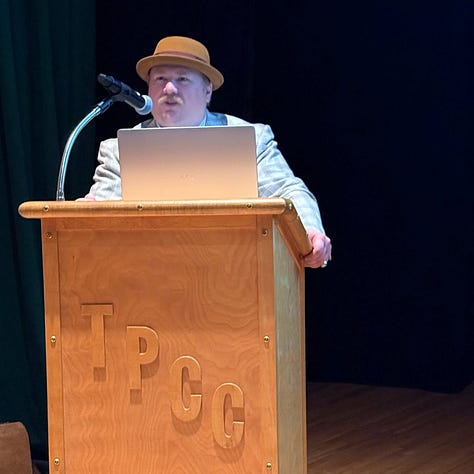
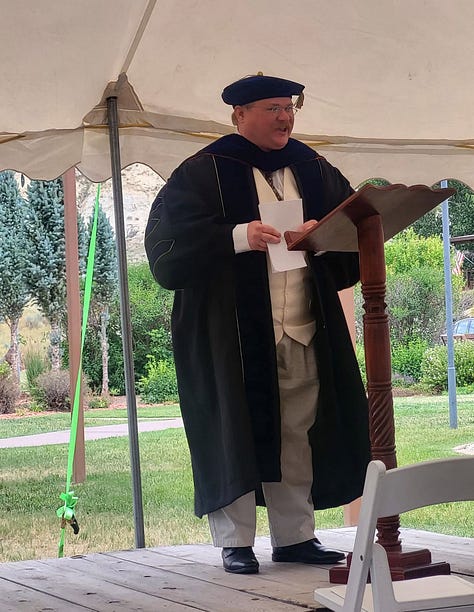
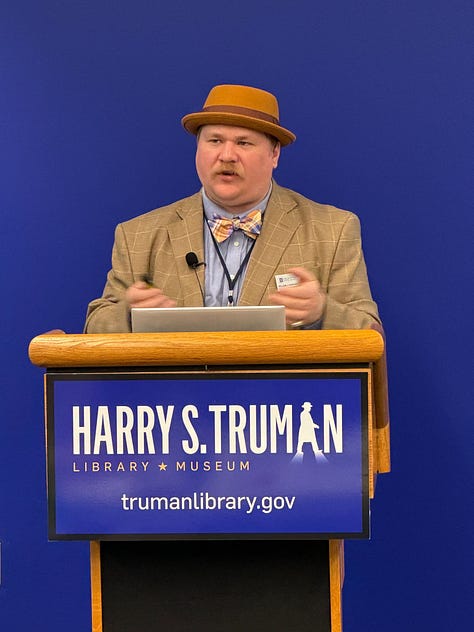
Dr. Hansard had a further busy month by representing the Theodore Roosevelt Center elsewhere in the nation as well, speaking at the Tannery Pond Community Center in New York state for their “Many Lives of Theodore Roosevelt” speaker series, the annual Badlands Chautauqua here in North Dakota, as well as at the Harry S. Truman Presidential Library and Museum’s MaryLou and John D. Turner Summer Teacher Conference Teacher’s Conference in Missouri.
Inside the TRC, we continue to work to gain better intellectual and physical control over our holdings, both newly donated collections and those that have accumulated over the history of the Center. Archivist Ally Hecht has undertaken an effort to bring the TRC’s physical archives in line, ensuring all paperwork and items are accounted for and moving records of our holdings into our digital library for internal preservation. We recently received a shipment of archival processing materials – boxes and folders – that we had been waiting on, and are looking forward to rehousing materials to more archivally-stable homes. As an additional part of this effort, we have begun catching up on our backlog of digitizing newly-donated materials, thanks in part to the work of DSU library employee Sarah Griffis. We hope to be able to add these to our digital library and catalog them in the near future so that we can share these interesting new collections with our audience.
Looking to our annual summer internship, now closing out the second of the three months they join us for, our cohort of interns continues to work well, guided largely by Ally Hecht and digital library cataloger Gemma Koontz. Most interns have been making good progress working through lists of items to catalog, giving them hands-on experience with item level cataloging. They have additionally been able to begin thinking about some digital humanities projects, which we hope to be able to share with you following the conclusion of the internship season. These planned projects range from improving the quality of some of the data in our digital library to conducting research and adding articles to our TR Encyclopedia, so we are looking forward to seeing what they produce.
This month we would also like to officially welcome a new staff member to the TRC Team. Rachel Lane has worked as a contractor with the TRC for the last several months, contributing her efforts and expertise to our Substack, among other areas. We have recently been able to have her join officially as a part-time researcher to continue helping the Center, and we’re delighted to be able to have her continue to support our efforts. Rachel’s arrival comes as Dr. Hansard prepares to move into a faculty role here at Dickinson State University. While many of his duties will shift towards teaching, he will continue to work with the TRC on its social media and public outreach efforts, for which we are thankful!
Comments
Nothing yet. Say the first thing.
Sign in to join the conversation.