
Welcome! This is The Quantum Stack. Created by a Travis L. Scholten, it brings clarity to the topic of quantum computing, with an aim to separate hype from reality, and help readers stay on top of trends and opportunities. To subscribe, click the button below.
Update 2024/12/26: Edited item 4 to add references.
Update 2024/12/28: Edited item 3 to add a company.
Next year marks the 100th year since quantum mechanics was discovered, a milestone commemorated by the United Nations as the “International Year of Quantum Science and Technology”. This context will likely factor into many announcements next year as enthusiasm about quantum technologies continues to ramp up.
Given this, I thought offering a few thoughts on what 2025 might bring would be fun. Though I caution you with an adage from Yogi Berra:
“It's tough to make predictions, especially about the future.”
In brief, the 5 things I think could feature in 2025 are:
The US National Quantum Initiative Act gets re-authorized.
“AI for Quantum” continues to gain steam.
Silicon-based qubits have their day in the sun.
More companies claim to have built logical qubits (and increased numbers thereof).
Quantum combinatorial optimization re-gains favor as an application.
Let’s take a look at each.
The original US National Quantum Initiative (NQI) Act spans 10 years, divided into two 5-year phases. With the first phase complete, USG has yet to authorize the second. As discussed in a previous article, quantum technologies have featured in other pieces of legislation during President Biden’s administration, and a few standalone bills have been brought forward. So USG hasn’t “forgotten” about quantum in that regard.
Last year the House’s Science, Space, and Technology Committee brought forward language for a re-authorization of the NQI; recently, the Senate’s Commerce, Science, and Transportation Committee has done the same. Given this – along with the general bipartisan support of quantum – a successful reauthorization seems likely.
That said, we’re about a month away from a President Trump 2.0 administration. From the political news I follow, a re-authorization seems more possible after the inauguration. While President Trump’s much-touted Department of Government Efficiency (DOGE) seems bent on cutting as much government spending as possible, I have to imagine going after basic research and deep/emerging tech is not very high on its priorities list. Further, President Trump signed NQI 1.0 into law, and assuming his science policy advisors maintain a consistent stance as in his previous Administration, continued support for quantum research appears a more plausible outcome, versus substantial detraction.
With all the buzz around AI this year, the question of how that topic intersects with quantum is getting raised more and more frequently. The concept of 'AI for quantum' holds more near-term promise than 'quantum for AI’, in my opinion. As such, quantum technology companies will likely find ways of bringing AI into their operations, products, and services.
Some prior examples of “AI for quantum” include using large language models as quantum programming assistants (IBM) or education chatbots (Strangeworks), and AI models as decoders for error correction (Google).
I suspect we’ll see more AI-powered user experiences on quantum computing platforms. For example, assistants to support debugging jobs submitted to platforms, choosing the best system to run a given job on, personalized learning pathways and tutors, etc.
A potential obstacle is whether these companies will have enough AI-capable talent to build and deploy these capabilities, and whether there are the right kinds of workflows and tools available for that talent to do so.
Over the past several years, different qubit modalities (types) have gained prominence and mindshare in the literature and press. Superconducting, trapped ions, and neutral atom qubits all experienced this (in roughly that order). For a refresher on the different modalities, see this previous article. 2025 could be a good year for silicon-based qubits.
Why? Several companies have made progress in making the leap from “lab to fab”. Increasingly, results obtained in academic labs (or one-off processes) are able to be replicated at scale using standard semiconductor manufacturing processes. This unlocks new ways for scaling this modality. Examples of “lab to fab” include:
Startup Equal1 has demonstrated the use of fab processes to create a chip.
Australian startup Diraq has shown that fab processes can yield devices with fairly competitive performance metrics.
French startup Quobly has partnered with a foundry to modify a standard process line for the purposes of building qubits.
Intel has written on using standard fab processes, and has published on using automated processes in the fab to screen chips and optimize their performance.
A factor which could accelerate this dynamic is efforts to re- or near-shore supply chains and capabilities for chip manufacturing:
As far as I can tell, building silicon-based quantum computers doesn’t require leading-edge process nodes and technologies, so the accelerative effect would come more from an increased availability of tools, production capacity, talent/know-how, etc.
Work around chips could stimulate downstream activity at university-based fabs, which can help with more rapid prototyping for these qubits and their design.
The DOD’s Microelectronics Commons program explicitly includes quantum technologies as a technology area it covers. While not specifically focused on quantum computing, the program is driving more collaboration between the semiconductor manufacturing and quantum technologies ecosystems.
Fault-tolerant quantum computing (FTQC) is required to run large-scale quantum circuits. (Here, large-scale means “acts on a lot of qubits, and has many, many operations”.) One way to build such a computer is to use quantum error correction (QEC): methods which, as the name implies, correct errors in a quantum computer. 2024 was a good year for demonstrating many pieces of QEC, with great results from e.g., Quantinuum, Atom Computing, Google, IBM Quantum, and Quera.
Many companies, both here in the US and abroad, are targeting the deployment of small-scale, error-corrected quantum computers by the end of this decade. Such computers won’t be capable of performing arbitrarily-long computations. So they aren’t, strictly speaking, fault tolerant. As such, demonstrations of QEC are likely to continue in 2025, especially as the research community and industry is beginning to pivot more towards QEC and FTQC.
However, as these announcements come out, be aware that what a logical qubit is – and what kinds of experiments validate you have one – aren’t yet standardized. Further, there’s a difference between someone saying “I have built X logical qubits” and “I have built X logical qubits, and can do non-trivial operations on them”. Most announcements are of the former type.
In 2025, I would encourage you to read with a just-healthy-enough bit of skepticism any announcements about realizing logical qubits. In addition, it’s important to note that having logical qubits is just 1 requirement of several for realizing QEC and FTQC. In my paper from earlier this year, my co-authors and I took a stab at describing what the “DiVincenzo Criteria” – the criteria necessary for a modality to be capable of realizing quantum computing – would look like in the era of QEC and FTQC:
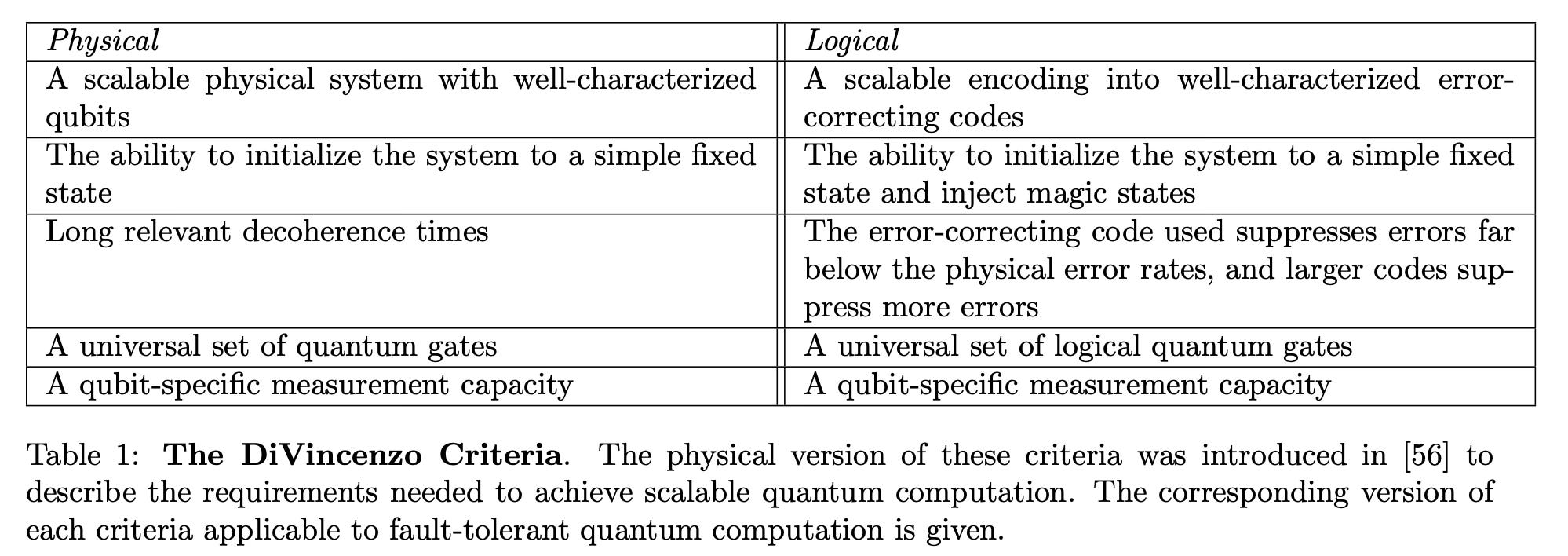
The purpose of sharing these is not to claim they are definitive (because they aren’t). Instead, it’s to emphasize that announcements about logical qubits tend to focus on some very narrow aspect of QEC, versus demonstrating all the pieces…at the same time…and in the same system. Of these 5 listed criteria, most announcements about realizing logical qubits would tend to fall into row 1 of the table above. Few are focused on realizing so-called magic states (one way to realize a universal gate set), or the other criteria. Hence the need for some skepticism at any announcements.
The popular media likes to describe quantum computers as “trying all possible solutions at the same time” (which it doesn’t!), and that naturally leads to questions about how quantum computers could accelerate combinatorial optimization problems. Examples of these problems include routing (e.g., Amazon Prime), logistics and shipping (e.g., loading bags in an aircraft), portfolio optimization (e.g., investment banking), resource allocation (e.g., mission planning, process flow scheduling), etc.
The research community’s relationship with this topic has had a love/hate dynamic. Classical methods do quite well for most problems, and most of the time, as long as some solution is produced, the problem is considered solved “well enough”. Over the past decade, particularly after the discovery of the “Quantum Approximate Optimization Algorithm” (QAOA), the back-and-forth about whether quantum could help with these sorts of problems has continued. However, it feels like quantum combinatorial optimization is a bit on the outs these days as an application area: the field has become much more interested in quantum simulation, or quantum + AI.
This said, I’m bullish for a couple of reasons:
There is at least 1 family of combinatorial optimization problems (“low autocorrelation binary sequences”) for which the best-known classical method has an exponential runtime, so any improvements (even heuristic) by quantum algorithms would be a benefit.
Recent work has shown rigorously that the QAOA can be used to achieve fairly impressive speedups in some problems.
There have been a couple of new, successful demonstrations on hardware of solving large-scale combinatorial optimization problems. While not “quantum advantage”, they do show how hardware improvements unlock new problem regimes, and also upend prevailing narratives that quantum computers aren’t “competitive”.
All 3 of these provide tailwinds in favor of using quantum computers. Given the ubiquity of combinatorial optimization problems, it seems to me some kind of “there” can be put “there” for them. Maybe DOGE would take an interest in this one….
2025 will likely be a banner year for quantum technologies broadly, and quantum computing in particular. The past several years have yielded much progress in hardware, software, applications. Further, the ability of end-users to explore or otherwise adopt this technology has increased as well. Together, these factors foreshadow a future where quantum computing is put to practical use. Sensible policies and prudent investments can help realize this future, by building on the momentum of the past several years and helping the research/industrial ecosystem grow and evolve in light of how the technology itself advances.
AI is an accelerant on the pace of this change. It is likely to be both an enabling technology for large-scale quantum computing, and a key piece of whatever “quantum workflows” look like in the future. So as buzz around AI heats up, interest in quantum may as well. From an end-user perspective, these two technologies should be viewed as simply tools in the problem-solving toolbox.
Amidst all this understandable excitement, taking a balanced view is important. There are many challenges which face the field in the coming years, especially as the race to build the world’s first error-corrected quantum computer continues to heat up. Beware the mania of logical qubits in that regard! Scaling out to the system complexity required to achieve this milestone is non-trivial, and each modality has its own obstacles to doing so. Whether they be scientific or engineering in nature, they do exist; announcements which present the realization of QEC as a fait accompli may have more going on than meets the eye.
Regardless of whether any of these predictions come to pass – though I’m fairly confident in 1, 2, and 4 – the spotlight shown on quantum technologies by the UN’s declaration should have an outsized influence on the interest in, and exploration of, quantum computing.
Here’s to 2025, the International Year of Quantum Science and Technology!
Was this article useful? Please share it.
P.S. In addition to The Quantum Stack, you can find me online here.
NOTE: All opinions and views expressed are my own, are not representative or indicative of those of my employer, and in no way are intended to indicate prospective business approaches, strategies, and/or opportunities.
(Especially true for this article!)
Copyright 2024 Travis L. Scholten
No posts
Comments
Nothing yet. Say the first thing.
Sign in to join the conversation.