
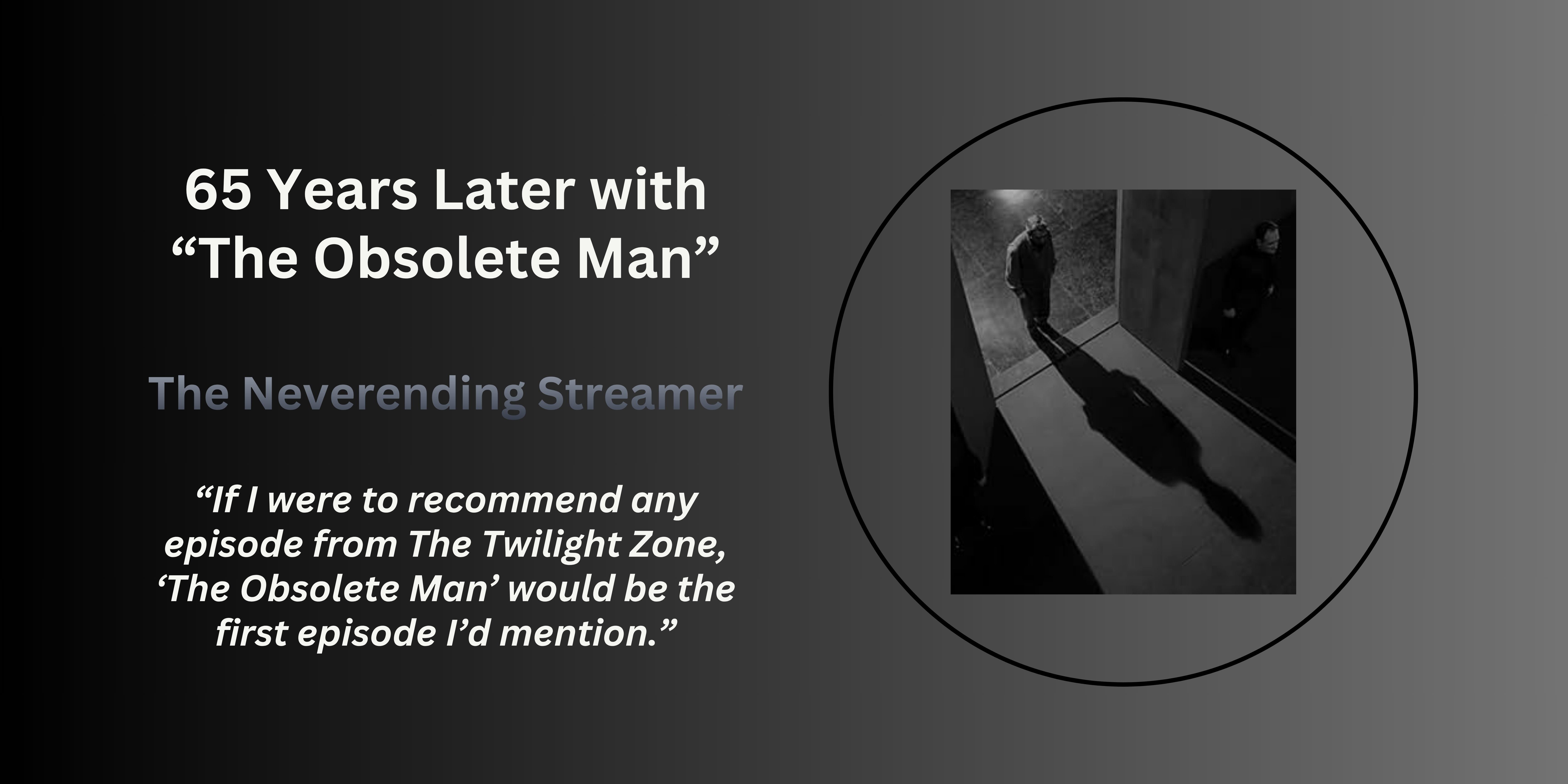
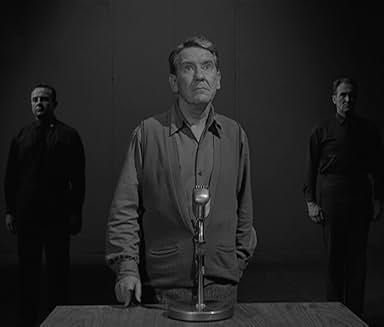
One of the most profound episodes of television aired in 1961 during the second season of The Twilight Zone. Episode 29, “The Obsolete Man,” thrusts viewers into a hearing of the State where they judge whether people are useful or obsolete. The Chancellor (played by Fritz Weaver) yells at Romney Wordsworth (played by Burgess Meredith) who admits that he’s a librarian. Such a prominent role in society, clearly, but in the depths of The Twilight Zone, it is obvious that there are no more books, so that means there are no more librarians.
“The Obsolete Man” is a devastating glimpse into a totalitarian government where people are assigned value, and if your value is determined to be “outdated” or “proven” to not exist, then that very person should not exist any longer. The Chancellor spews over a microphone, embellishing his rants against Romney to all who listen, undermining his very life as nothing more than a vacuum sucking up all of the air.
“No man is obsolete…I am a human being. I exist. And if I speak one thought aloud, that thought lives even after I’m shoveled into my grave.” – Romney Wordsworth
Despite the determination to prove there is worth in him, that God exists despite the State saying it does not, Romney is sentenced to death. The “leniency” of this State court allows him to choose how he will die, and at what time, as long as it happens within 48 hours. Facing death, and the cruel demagogue who has laid down the sentence after a belittling tirade, Romney asks for an assassin to kill him, but only he and this assassin will know how Romney is to die.
The Chancellor agrees, and after a request to be seen, he visits Romney’s room where he’s lived for several decades. To be so boastful, the Chancellor tells the librarian how it’s okay to cry or plead for his life. Cameras are watching, of course, so it’s important for the world to see how miserable and obsolete he truly is; however, after entering the room, Romney locks the door, trapping them both inside to the fateful explosion from a bomb set by the assassin, which will happen in under an hour.
“The Obsolete Man” highlights the depravity of those in power choosing who has value and who does not. What the State says is the only thing that matters, regardless of any truth lacking behind such statements. The librarian was seen as an idiocy; a fallacy to consider oneself in such an occupation that’s been long-since dead. What’s worse is the fact that the Chancellor believes that individuals like Hitler and Stalin didn’t go far enough during their time in power. Older people who hold onto the past, thus understanding history, are eliminated.
“And people like yourself – they can perform no useful function for the State, so we put an end to them.” Such immoral codes will never see beyond the scope of their power. Those in such roles as the Chancellor do not bother themselves with understanding right and wrong, good versus evil; no, it’s simply put – their way or death. It’s a damning story, further emphasized by the fact that the Chancellor eventually pleads for his life, stating “In the name of God, let me out!” So, Romney does just that.
And then the Chancellor is brought in front of the State, who announce he’s been removed from his position after being determined he, too, is obsolete. He begs. He tries to run. But the former Chancellor is swarmed by the masses in the room and carried out to meet his death. In the end, the narrator of The Twilight Zone gives an earnest account of what it means to be a diabolical State.
“The Chancellor, the late Chancellor, was only partly correct. He was obsolete, but so is the state, the entity he worshiped. Any state, any entity, any ideology that fails to recognize the worth, the dignity, the rights of man, that state is obsolete.” – Rod Sterling
If I were to recommend any episode from The Twilight Zone, “The Obsolete Man” would be the first episode I’d mention. The performances by the two lead characters are impactful, highlighting how one person faces an unyielding autocratic State, while that very corruption delights in punishing others – until they come face-to-face with those same punishments.
The message of this episode is quite clear: People are not simply commodities that can be extinguished when they’re deemed to no longer have value. All people are human beings, and with that existence, comes meaning and certainty that no one person or group or government should ever undermine that person’s worth.
“I am a human being.” Such a simple statement, yet, one we still find necessary to say in this day and age.
No posts
Comments
Nothing yet. Say the first thing.
Sign in to join the conversation.