
by Travis Hedge Coke
“When she was three years old, Jenny tried to pick up a pot of boiling water on the kitchen stove. All she remembers of that experience is a sense of shock, then a scalding pain that just would not go away.”
When Spitfire and the Troublemakers (aka Spitfire, aka Codename: Spitfire) begins, the old cisgendered heterosexual white American male has thirteen seconds to live. He does not survive past page two, killed for his experimental exoskeletal toolkit.
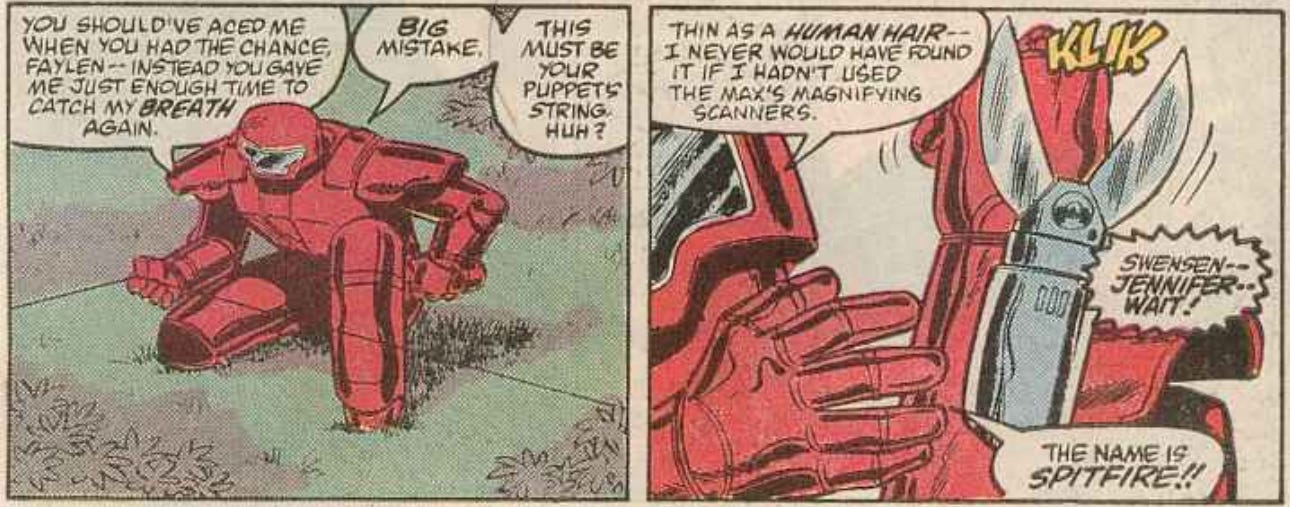
Spitfire was not planned as an exploration of organization failure of minoritized inclusion. It was probably never the intention of the various collaborators who made the thirteen issue comic to make a hard statement on women in STEM, racism in higher education, American economic disparity, diversity in the military-industrial complex, or a post-Revenge of the Nerds, pre-Sneakers look at weaponized nerdery.
The comic changed some of its talent, from pencilers, writers, to inkers and colorists nearly every issue. The general direction and the supporting cast fluctuate more than once, with post-Spitfire appearances by central perspective, Jenny Swensen, taking a distinctly unique look.
Spitfire is neither a tight, nor tightly-plotted comic book series, and there is no attempt by succeeding writers or inkers to adhere to the politics or taste of their predecessors. Work for hire, it created new characters in a new situation and then spent 1986 to 87 servicing them on behalf of Marvel Comics, for an imprint and shared world called New Universe, intended to celebrate Marvel’s then twenty-fifth anniversary (counting from the 1961 unification under Jack Kirby and Stan Lee). So loose, we yet do not know who drew one of the covers.
The titular Spitfire is a mining device militarized against its creator’s will, named in tribute of his daughter. But, Spitfire, as an identity, can never only be Jennifer Swensen. She will never be good enough, be enough, to warrant it in the eyes of others. The device is named for her, by her father, and she is its first and finest pilot, but she has to share the limelight, first, with her students, then with divergent militarization, and finally as only co-head of the Spitfire division which will work with the MAX technologies, home-owned and foreign-stolen.
Created by Elliot R Brown and Jack Morelli, Spitfire was originated by Gerry Conway and Herb Trimpe in the first issue’s story, suitably called, Beginnings. Following the murder of Doctor Karl Swensen during a laboratory theft, Beginnings features the Troubleshooters, a group of students at the Massachusetts Institute of Technology in the style of comic book kid gangs and their Bad News Bears/Goonies cinema equivalent. Young adults, the age of the average university student, they nonetheless came with a pronounced immaturity. This is not, given context, a flaw or a misstep, but central to their acting as the immediate window into the situation for the readership, largely children, and highlights their outsider nature, compared to the entrenched figures like Dr Swensen (which cost him his life) and his daughter, Professor Jennifer Swensen (which cost her both her father and her career).
Halfway through Beginnings, Trimpe and his inkers have given Pr Swensen a look of “anger,” as it is called by her martial arts instructor, that is locked down and on the surface sedate. Her eyes are nearly closed, her mouth is closest and loose. She also acknowledges her anger, but still, it does not show.
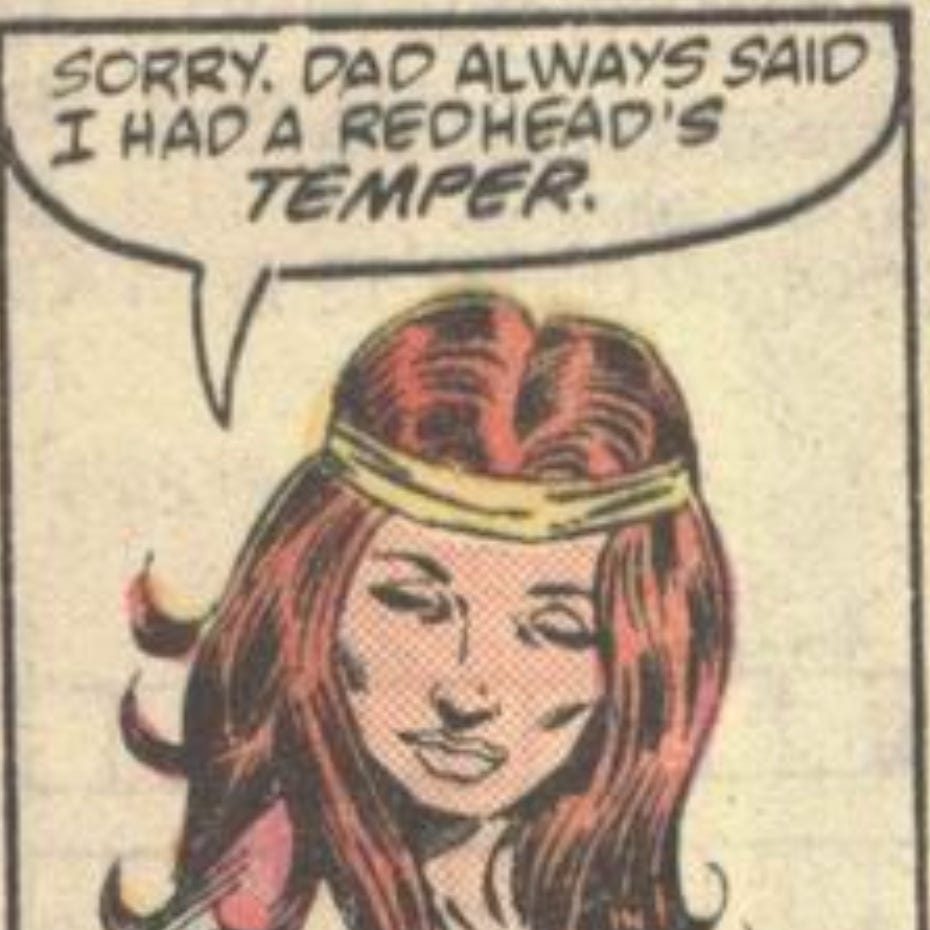
This is the look of anger in someone who has had years’ practice in sublimating her emotions for the sake of others. In the middle 1980s, less than eight percent of the total faculty at MIT were women. Jenny Swensen notes stereotypes of women with red hair almost as soon as she has appeared in the comic, and this is another aspect of typing by others which seems to have affected her self-presentation. Canonically five foot ten inches tall, Swensen routinely is positioned in panels, regardless of artist, so that her head is lower than those of almost all men, but she also frequently ducks her head or rounds her shoulders, as well, bringing down her height in a different way.
“The first time I was thrown off a horse, it was a pony on my father’s farm in Vermont,” opens issue #10 of Spitfire, by Cary Bates, Marshall Rogers, et al, continuing, “I was 6 years old. I cried”
In that first issue, Pr Jensen’s father dies, but for the entire thirteen issues, she lives under his specter which remains. It is not that Trimpe, Dave Hoover, Todd McFarlane, Marshall Rogers, or Sandy Plunkett conspired to copy one from the next a body language fraught with visual characterization, but the character, nonetheless, accrues.
The Troubleshooters, who will be removed halfway through the series, form a group protagonist secondary to Swensen, and the students make up a composite of misfit studentry; a butch (Black) woman whose friends are (white) guys, the sloppily-dressed slacker, the rough neighborhood nerd (Italian), the one who is bookish and bespectacled. Their version of pranks and activism all come under the purview of, “hacks.”
While Jensen stands as emblematic of outliers in teaching staff, the students represent types which are often disenfranchised or simply pushed out of academe and science. Even her father’s project, for which he is murdered, explicitly privileges him above people like his daughter, in that it is the “Man-Amplified-eXperiment.”
An advertisement for the title-change to Codename: Spitfire features a group photograph of three figures, two in white coats, two in suits, three men and one woman, standing before a chalkboard with equations. Only the woman is circled, and below the photograph, in the ad, is a pistol.
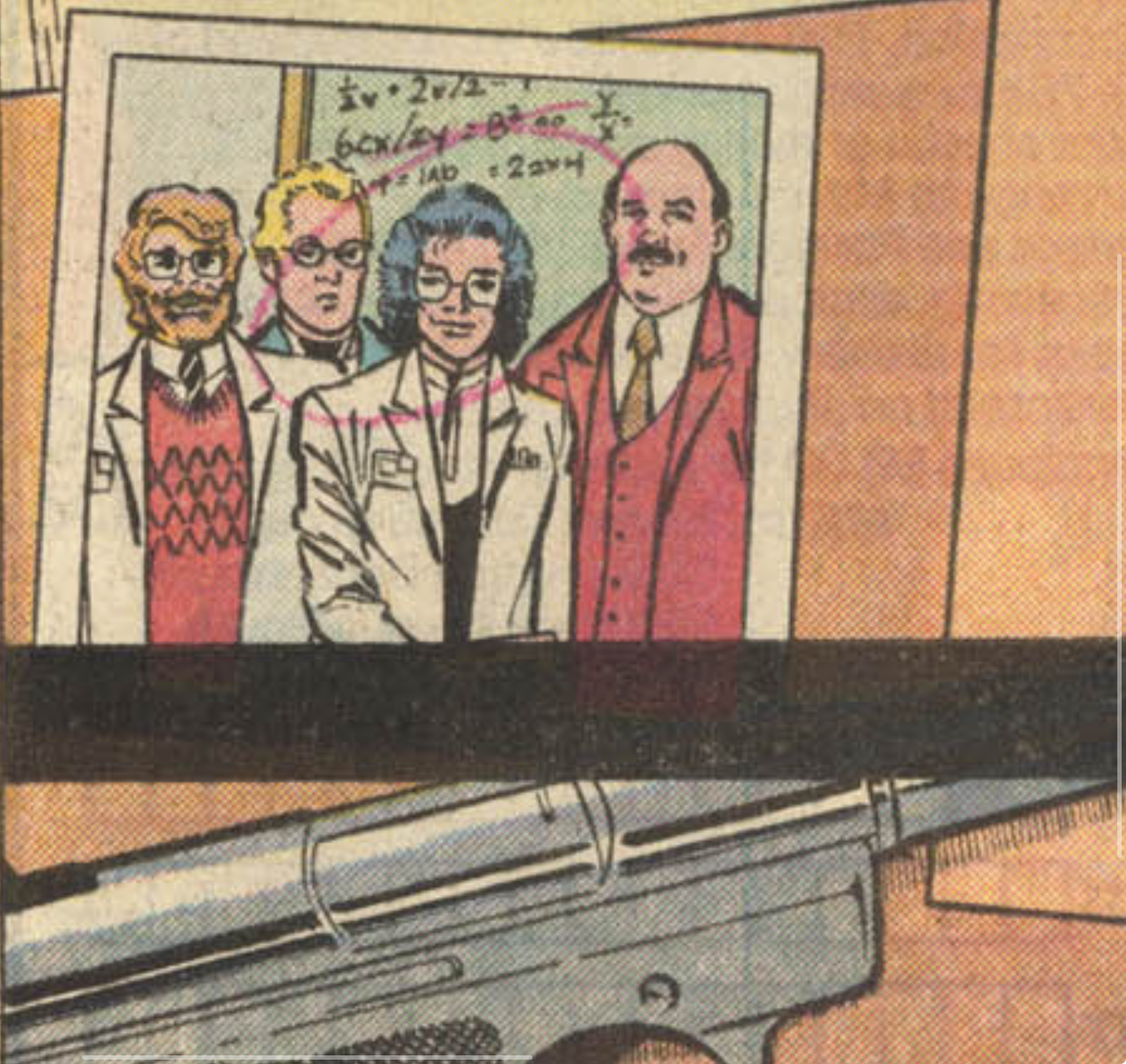
The students express themselves via their hacks, and by over-demonstrating their bona fides, including transfiguring the famous bottles of beer countdown song to begin with a googolplex (misspelled, however, in the dialogue, as “googleplex”) Their pranks and minor criminal actions are not the push of anarchists or usurpers of power, but by those who feel they are a rudderless ship. They challenge their professor and prod her back into the authority she by all rights already has, when she is asked by one of the group speaking for all, “Are you taking charge or do we do it by ourselves?”
Even when they dislike her, the Troubleshooters push themselves back into immaturity by framing her as the adult’s adult. As one says, “Jenny Swensen isn’t my friend… she’s my teacher.”
The student outlier amongst the student outliers is the Black woman.
Swensen is expected to dorm mother the adult-children as well as be their professor even outside the range of their Institute, and when it comes to things like cooking, you can guess who holds the slotted spoon.
Swensen’s unintentional dismount or bare hands on a pot with boiling contents are far in her past, but they hang on her like the ghost of Dad. Like the dismissiveness of having “a redhead’s temper,” being a “Ms,” or a “Miss,” a “little girl,” “my girl.”
Swensen has to repeatedly ask men to step back, to acknowledge her as a person and for her rank, even for a US senator to stop touching her.
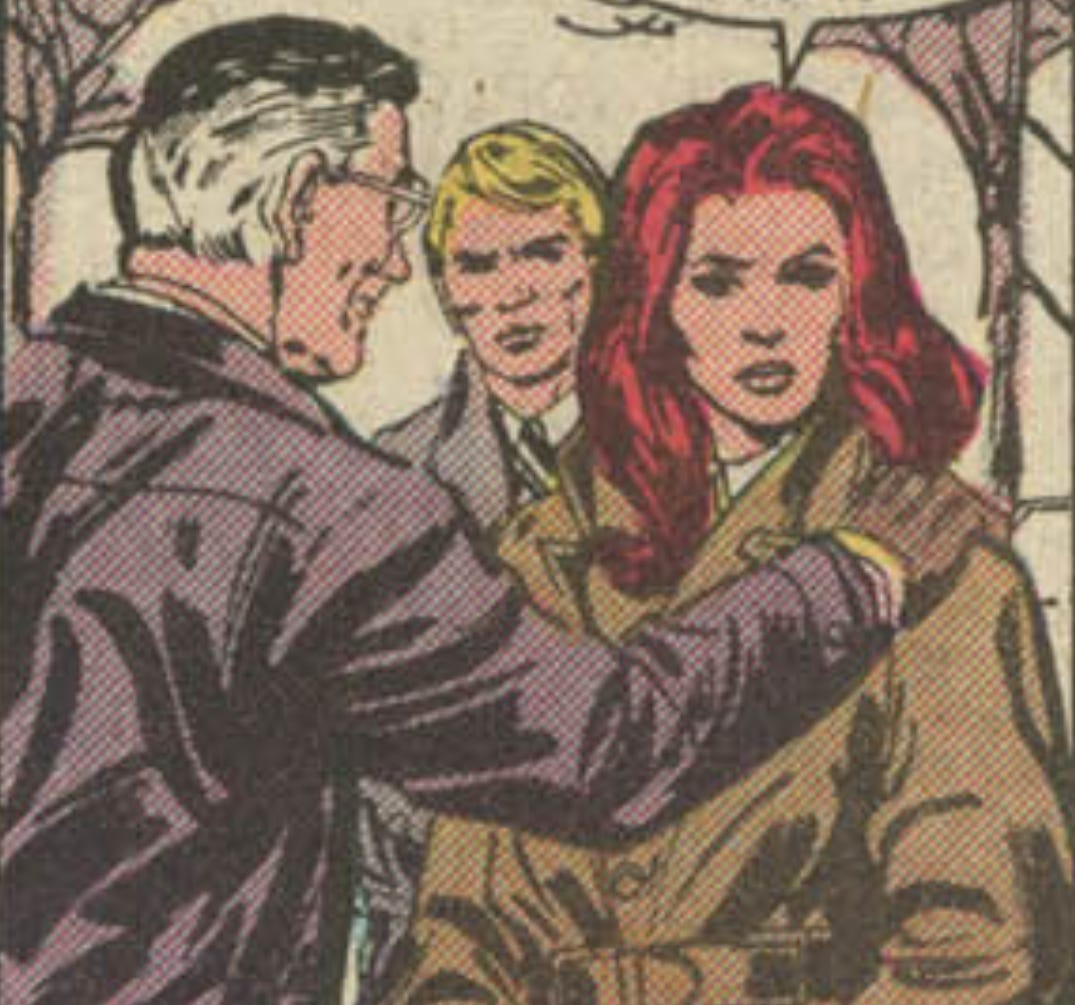
Swensen has to specify, and to remind men, that it is not “Ms” but “Professor.”
Acknowledging her as professor, as their professor, is an insidious, yet common way for the MIT students to disempower Professor Swensen and bring her down to their level or drudgery beneath them.
In this, Swensen is much like the Spitfire and other MAX devices: subject to the world.
The MAX II device, Spitfire, almost overheats as soon as it has first been used, barely continuing to function in real life combat. Spitfire is outfitted not with direct weapons but construction tools, but any substantial construction or mining tool can be weaponized. People can and will play soldier with anything.
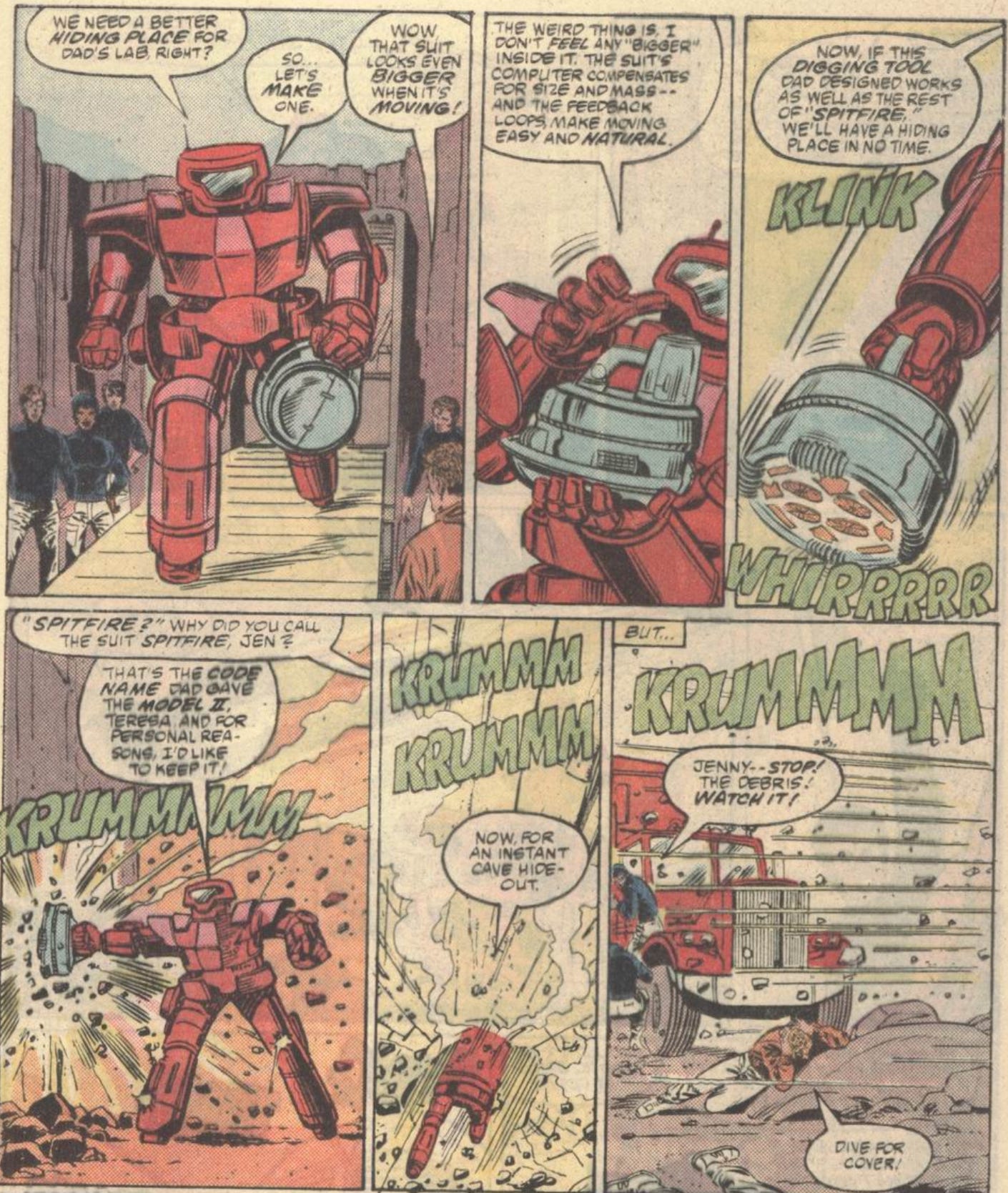
The MAX-based “strong arms” require mounting to a back brace which takes the weight and pressure the human wearer/user would be incapable of, but even other Troubleshooters know it is unlikely to work effectively. The MAX technology is subject to weight distribution and stress limits Government agents and MIT students, regardless, respond to the MAX technology as something to play with.
Minor damage can render a piece of technology completely useless or fantastically unreliable. MAX is subject to environmental hazards including unanticipated shifts in density of materials confronted, scale adjustment, electrical disruption, signal corruption, even permeability by liquids and gasses, including skunk thiols as they discover when sprayed by a wild animal hiding in the field.
The MAX technology is compared to “some kid’s science project,” to toy lines, model kits. The Troubleshooters, true to their inner-kid-nature, show off their modified model ship to their professor, who is more admiring than other adults in the room.
Spitfire is a comic which leaves the difference between a hacker and a cracker implicit, perhaps too precise for the children in the audience to worry over or general knowledge enough for the adults anticipated that it goes unacknowledged. HALOing, on the other hand, is explained in dialogue both for Swensen and for us. Through its thirteen issues the comic finds an uneven and unreliable balance of inside baseball and learning curve.
Politics ricochet from lampoon to cartoon, most often resembling what would become the civics of Iron Man movies twenty years later. Swensen implicitly knows her role, though, in every dynamic, every scenario, as the little gal. She is, in all things, an agent, not the agency.
When Swensen’s old flame, Bernie Strazcynski tells her that, “the system works,” she is behind bars, framed for murder, and he is literally wagging his finger at her chastising her for having an “attitude.”
Swensen does agree, in her way. She tells him, “Yeah,” but adds, “for whom?”
Swensen is both denied tenure and fired from MIT after being found innocent of all crimes, reasons ungiven, but she does not fight it. Swensen does not even question it or ask for reasons.
We can believe that Swensen has anger, that she has strong emotions, as we can believe she is capable, intelligent, strong and respectable, but she, herself, tends to buckle and not show it to the world more than she will stand her ground. She lives in a world which neither respects nor supports a woman who does stand, though.
She thinks to herself how her father once said, “We can’t control what life throws our way. But we can control the way we react to life’s adversities.” She is then immediately after kidnapped, rendered unconscious, and then forced to fight a man who is both sadist and masochist, a man who is not “nearly as fast as [she] — above for below the neck,” but a man who is built sturdier and who embraces pain and adversity.
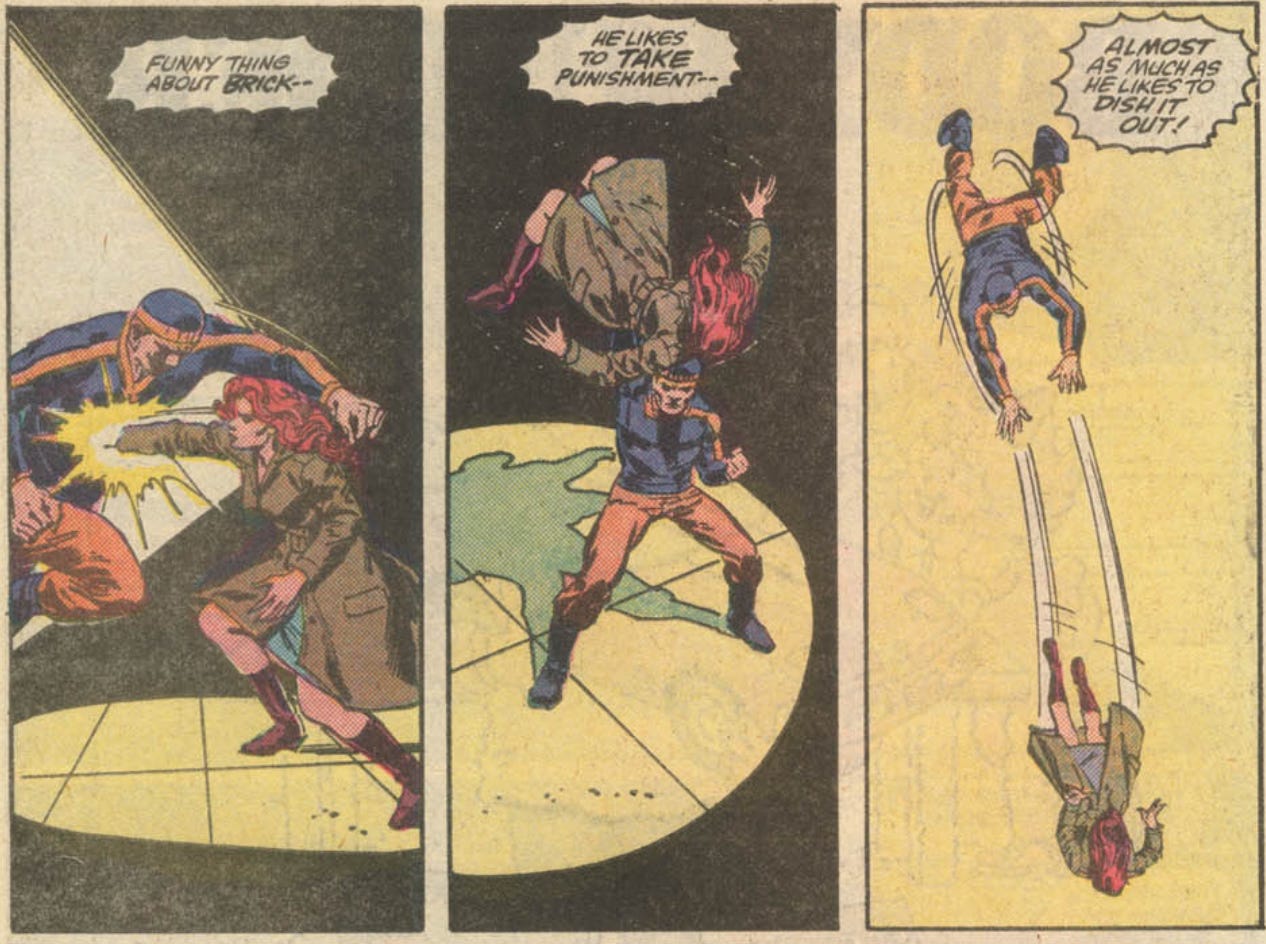
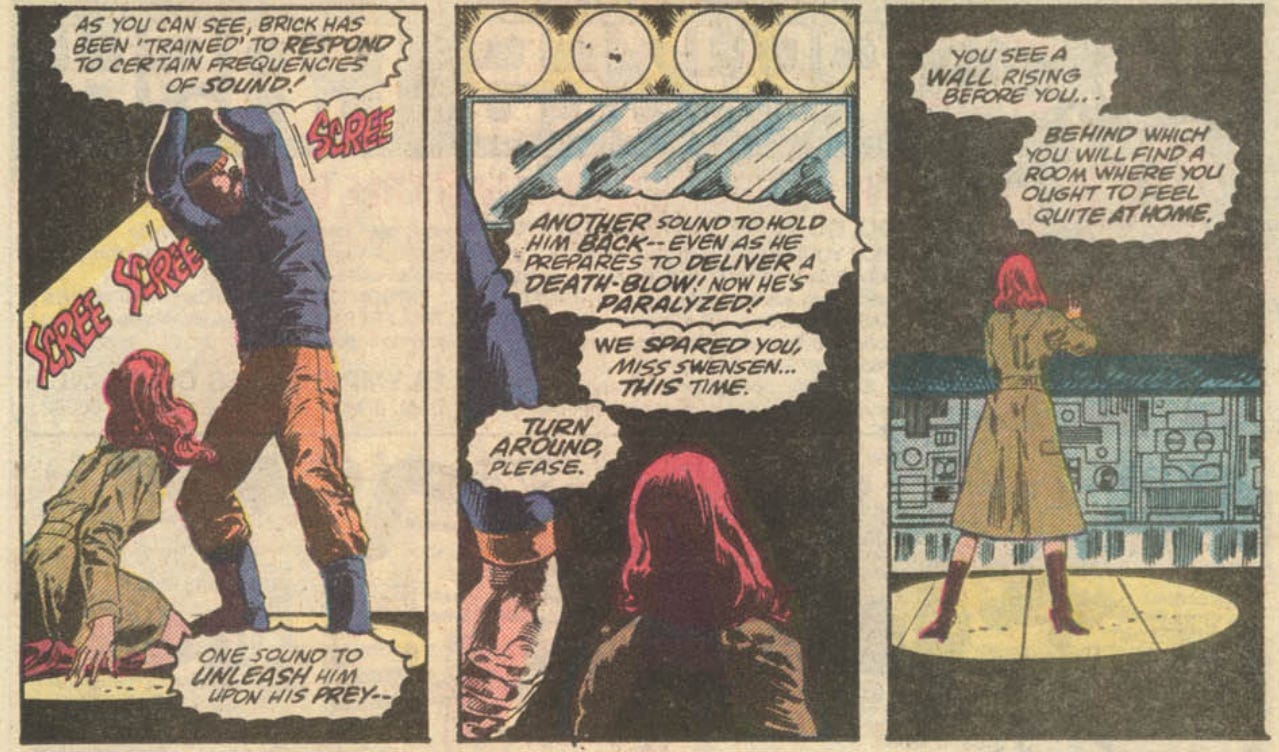
Brick, though, as much as he might seem to have superior coping and functioning skills to Swensen’s, is little mor than a trained dog, paralyzed by a whistle, called to action by a signal, part of a mechanistic ploy to convince Swensen she is easily cowed, a trick pony trotted out for diversity, a wash out.
Swensen is tormented and belittled by terrorists, political enclaves, old boys’ clubs, the United States government, the Law, jealous students, university administration, colleagues, scientists, foreign powers, police, journalists, men in general and the occasional pick-me woman.
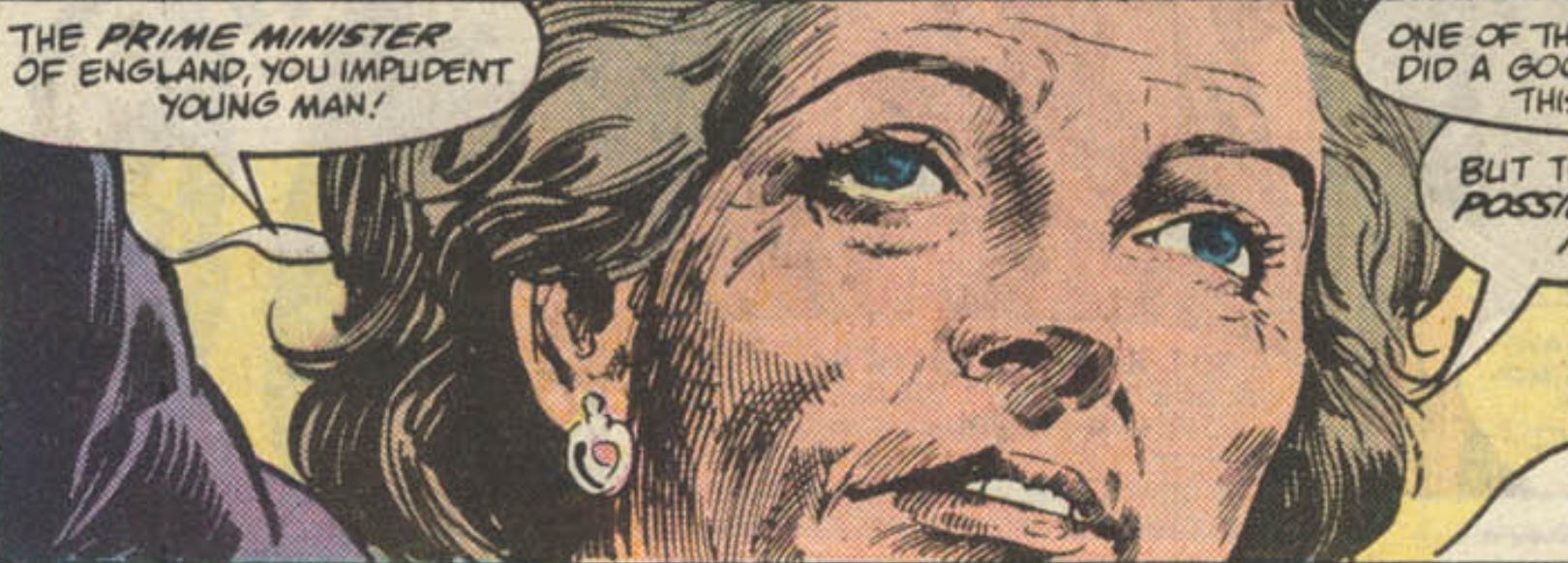
Being thanked and pardoned by Margaret Thatcher is literally a nightmare for Swensen. For how many women in 1986, one wonders.
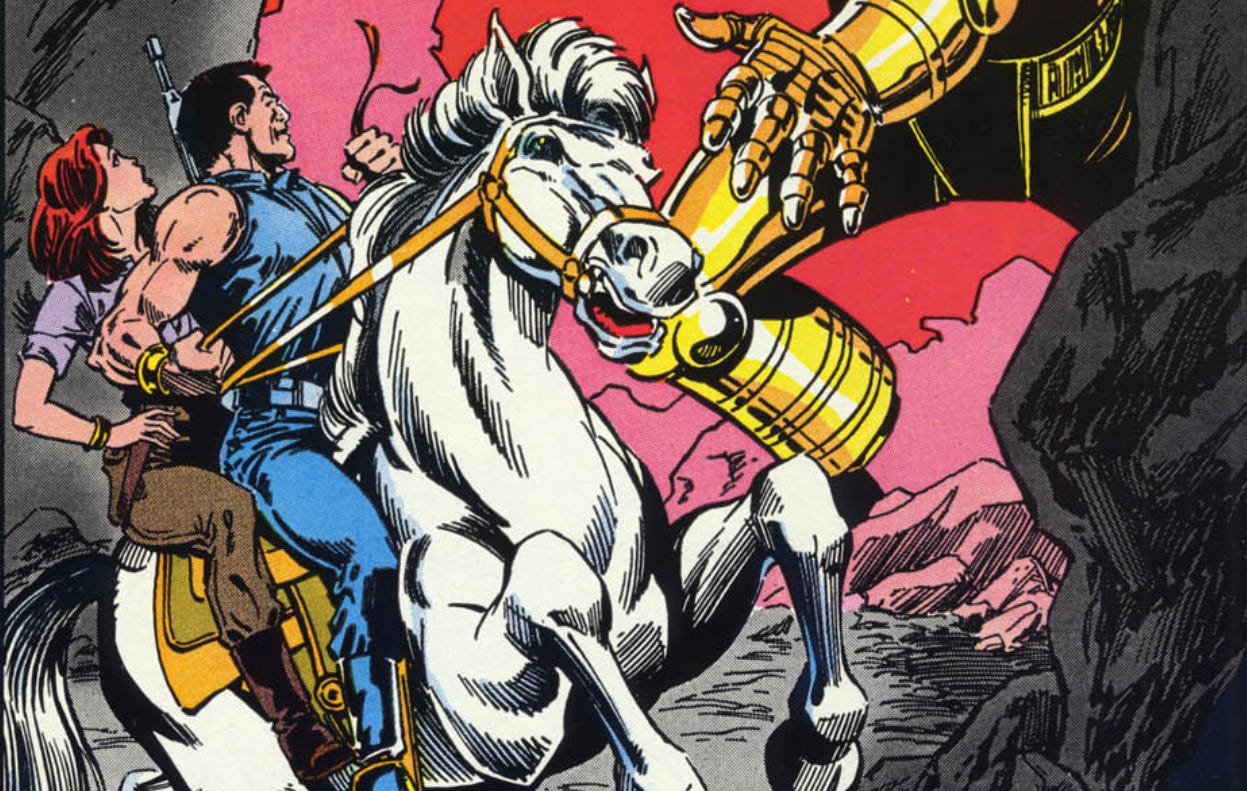
It should come as no surprise, however, to find Jenny Swensen’s first outing as an intelligencer is as the pillion rider, arms around the waist of a veteran male agent who holds the reins to their white horse.
In Afghanistan, a land and people being used both by the Soviet Union and the United States as a disposable and dispensable testing ground for experiments, war games, and what amount to political jokes, Swensen seems to see herself reflected on a national scale. She falls, in this, directly into being pingponged between actors as well as the back of the horse.
Swensen is presented with facades and bluffs by strong arms, law enforcement, military, intelligence, lying youth, blustering sharpshooters, even a golden private airplane with an expansive library and a loaded minibar. Her boss as an espionage agent, Roth, is concerned with fooling her, with goading her to respond to certain criteria, and to that end who better to be that boss than the soft-eyed, reasonable older man with silver short-cropped hair, a tight Windsor knot, and an unlit pipe gently in his mouth? Even his necktie’s color and pattern (kudos, Bob Sharen and Alan Kupperberg), brown with yellow dots, evokes a kind of casual earthiness, a little autumn kindness.
It is with some symbolism (though perhaps no feather in the cap of the colorist) that in the next issue, the two thrown spies are ejected not from a white horse, but one whose color is black.
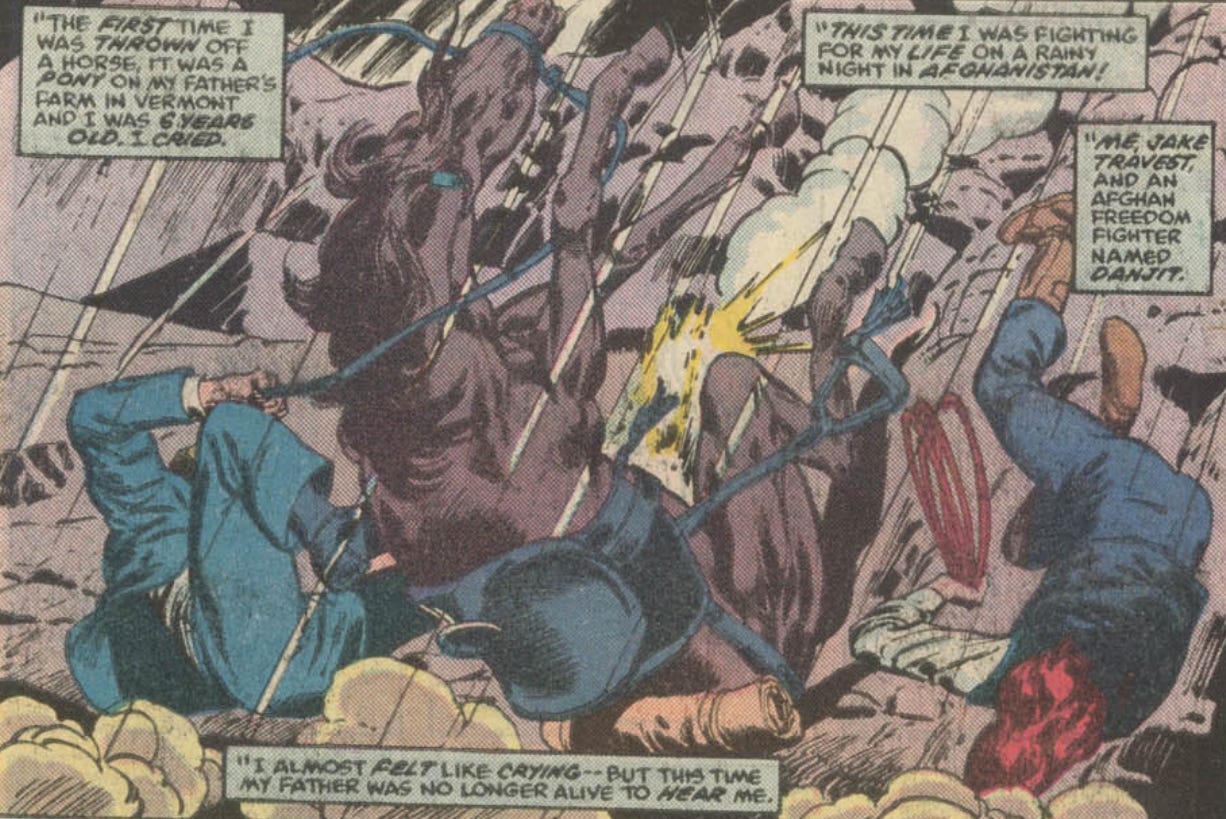
Swensen’s intelligence partner, Jake Travest, is described by her as “level-headed” and “mellow,” as well as, “downright frightening,” and “a mean-tempered, vicious sadist.”
Travest is consistently treated, however, as level and professional by anyone else, and soon Swensen follows suit.
From Afghanistan, Swensen is shipped to Nicaragua wherein a mishmash elements present a visual transfiguration of the Vietnam War to the War on Drugs in the American cultural psyche. Seeing her co-head, Travest, frightened by unexpected birds, stumbling in undergrowth, she that he, “looks like a little boy playing soldier,” and he explicitly is, but she immediately counters herself, reminding herself that, “he’s a pro,” implicitly cutting herself down as the greenhorn on the mission.
Swensen is injured in the mission, but recovered. Her partner, Travest, is left behind. Swensen not only blames herself above her government or agency, but goes in autonomously, full Rambo, to recover this prisoner of war where there is no war.
Swensen’s first real enemy in the comic, the killer of her father and purloiner and perverter of his work, is killed just as we are given our first look into his past, how he had bought a large home in an upscale neighborhood when he joined a secret society and thought of it and its staff as a refuge, just before he is killed.
Arun Bahkti, a mercenary, demands everyone refer to him as “Steel Hawk,” despite how melodramatic and childish it seems to those he works with or confronts. Bahkti, too, is distancing himself from how he is read by society, how he is read professionally and at home, to become something else. His frustration with the injury to his leg caused by Swensen turns from casual misogyny and physical difficulty to targeted hate and self-loathing. Steel Hawk is Mr Furious, in the movie, Mystery Men, claiming his secret identity is Dirk “Dark” Phoenix, or every guy you saw at a club who insists everyone calls him Snake, Dragon, Dark Lord, or Shadow’s Flame.
All the men in Spitfire as as out of step with their social image, and many act out far more than Jennifer Swensen, in an attempt to somewhat take the reins, claim their title, stand their ground, name themselves, yet the social order within the comic means they are permitted, even to absurdity, where she can and will be cut off and pushed out of her own being.
The Troubleshooters fade from the series once their polyagonist Huey Dewey and Louie parity is broken by individuated pangs of self-conflict. Travest can give himself that name. People have to call Steel Hawk, Steel Hawk.
Writer of issue #12, Ghost in the Machine, Len Kaminski, will embrace the build-up around Swensen’s father issues and sense of self-worthlessness, with supporting cast directly telling her that she knows why she keeps trying to communicate with difficult, distant, dismissive men, before she goes full-bore into a memory of her father being just that, and then comes to believe her father has encoded himself into the Spitfire device, at the end of the issue effectively re-killing him.
Half a dozen issues to prove her dad was murdered. A handful of stories proving she did not kill his murderer. Then, our hero and protagonist pulls the plug.
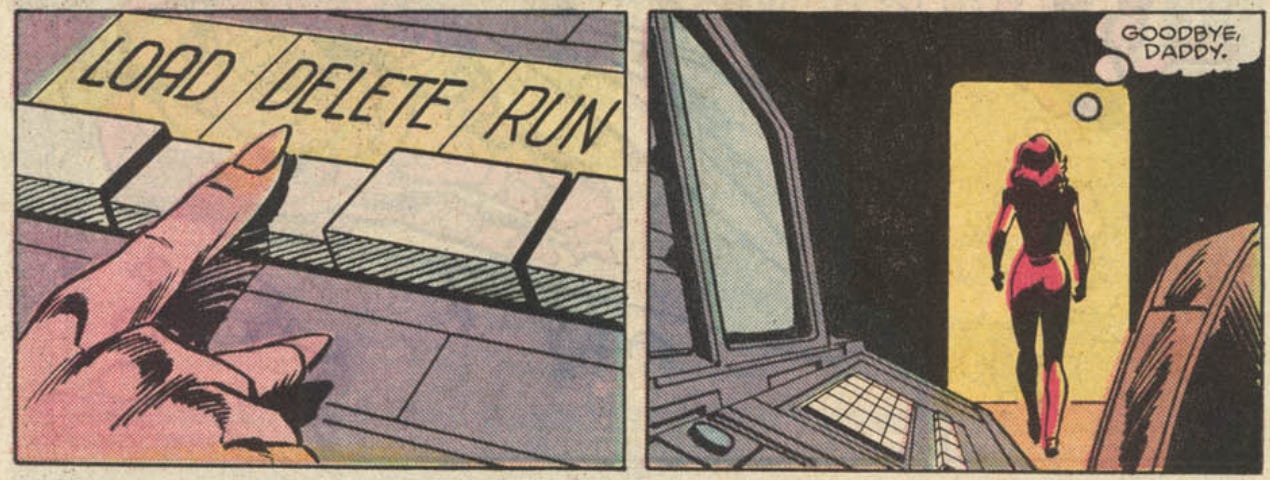
In her final issue, Swensen is reduced in the guise of promotion, still operating for the CIA, but now with an actual scientist tasked to her. Even the comic has, like her chair at MIT, displaced her and devalorized her expertise.
In her final panels, for once (and it is such a rare once) showing full upset, Swensen blasts away at the technology they could recover from an enemy, on the basis that the technology is “dehumanizing.”
Of course, there is a man there to tell her that, “no matter what label you put on it […] you already are part of the whole stinking mess!”
It is this lashing out, one of her rare firm stands, which, “concludes the adventures of Spitfire,” but Jenny Swensen will return in another New Universe title, not long for powered armors and government work, first as a member of a commune who move to New York City, and then as the second of Earth’s official tight costumes and all superheroes.

Explore the books at my store. Fiction, nonfiction, queer, political. Free or pay-what-you-want.
And, get ready for The Starry Field: A Gathering of New Two-Spirit and Indigequeer Poetry featuring a surly disconcerting selection of poems by yours truly, in faith and service. Coming soon!

No posts
Comments
Nothing yet. Say the first thing.
Sign in to join the conversation.