
by Travis Hedge Coke
The recent Star Trek series, Starfleet Academy was both not militaristic and full of familiar white characters enough and too queer and Black for a certain kind of person, some of whom used their websites not just fund by actually solicit on LinkedIn for haters. One character, a young, gay, out Klingon studying medicine, named Jay-Den Kraag was so upsetting to these people that they would create AI videos in which a likeness of Michael Dorn as Worf would gaybash a sobbing Jay-Den.
Michael Dorn, in his own youth, was sent through conversion therapy, and naturally, would never voluntarily participate in such a scene or portrayal, nor condone this kind of satire by people who do not know what satire is. Who would? It’s bullshit.
This use of generative AI deprives people of agency regarding their own likeness, and naturally, some of these videos have a distinctly homoerotic edge to them, as the more homophobic haters get the more their own repressed sensibilities seem to come out.
Over in superhero comics, we have a long tradition of this sort of repression and (“It’s just jokes; jokes!”) joking. While the comics, themselves, have not always been sensitive or sensible in their portrayal or handling or sexual assault, trust the audience to take up any slack when it comes to atrociousness and make the worst of things. We all grew up with Batman assaulting or raping Robin jokes. Marvel and DC joint published one, just recently, and it was not even a good one. Various events in comics are misremembered so that rapes are understood to exist which canonically did not happen while those assaults which have are pilloried as silly, insulting, emasculating or secretly super-fun.
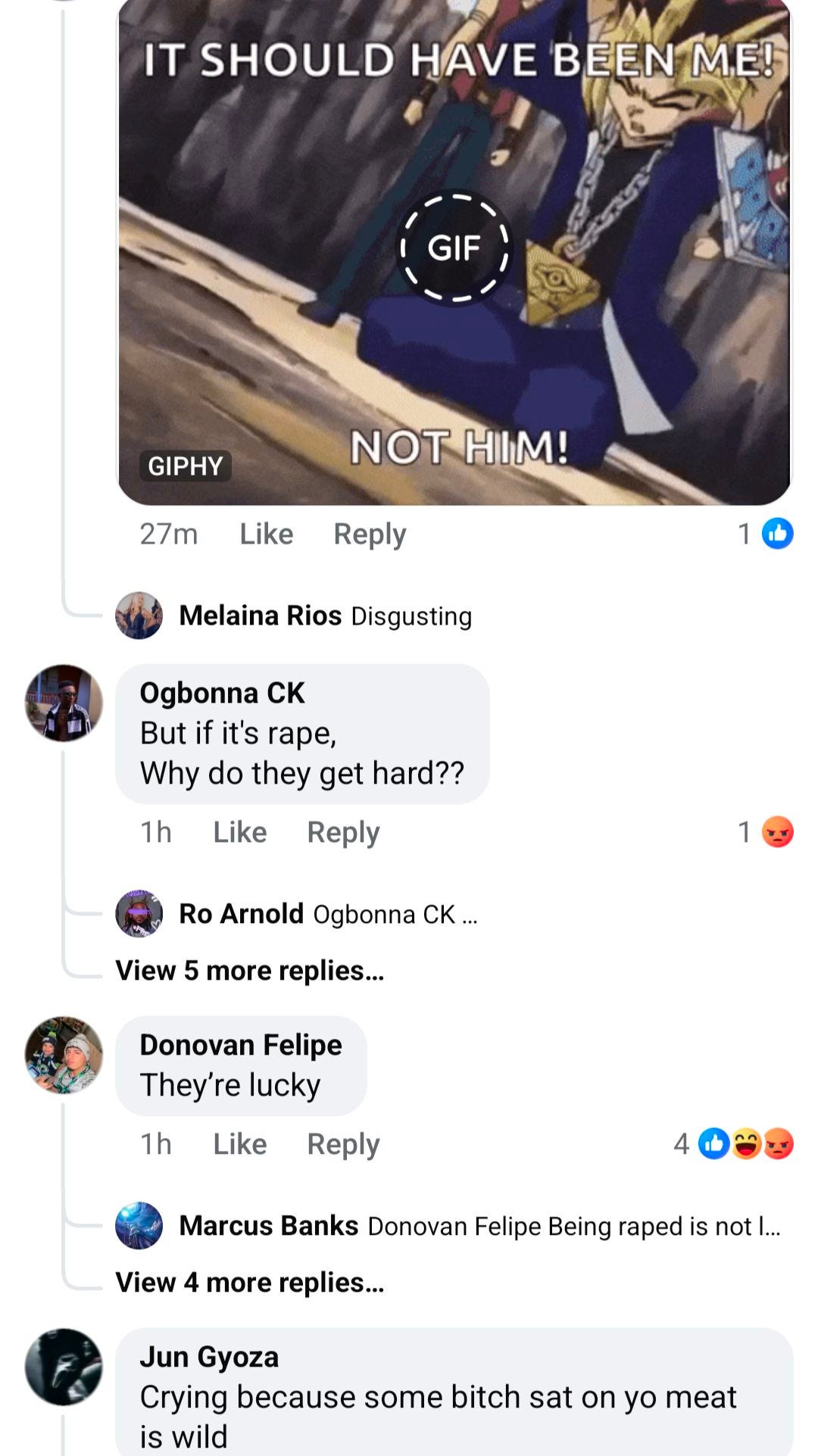
If you belong to more than two comics groups on Facebook, for example, you are likely to see content reassessing rape as favorable, funny, and/or desired.
Batman is canonically a sexual assault survivor, having been abused in his childhood by the headmaster of a private school he was briefly sent to. The former Robin, now called Nightwing, and once acrobat child Dick Grayson, was raped on a rooftop by a complicated vigilante who he then immediately felt responsibility for as he tried to justify his assault and unable to even be sure if he did or did not say the word, “Stop.” Batman’s assault can be seen as the reason he is so quick to torpedo any serious romances and defensively blamed the mother of his son-by-blood, Damian, and insist she must have drugged him .
Both of these are flawed portrayals, and mine a flawed analysis, but they are not laughable or concerned with humiliating or criticizing the victims or the audience.
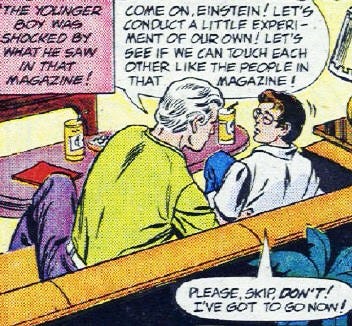
In 1984, a comic book was published which showed Spider-Man telling a boy who had just been sexually abused that he, as a shy, nerdy youth whose parents were dead, was befriended by a college-age man who sexually abused and propositioned him. Since that release, it has been a constant source of humor, lending itself to jokes about Peter Parker’s uncle also abusing him (he canonically did not), about Peter being gay, Peter liking it.
That 1984 comic was a public service announcement giveaway book to help children understand they are neither alone nor at fault. That is the comic that some people cannot handle at all without making of it a rape joke, a laugh at children abused.
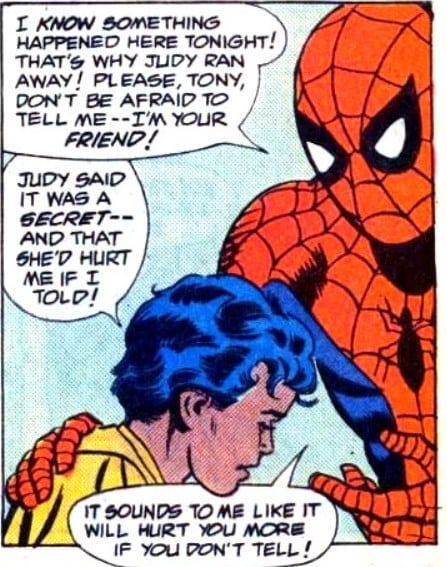
Jims Salicrup and Mooney do not treat their part of the comic, Spider-Man and Power Pack, as a joke, or make the assault into an operative meta-gag. In eight pages they show a variety of abuses from sexual blackmail to gaslighting by adults to bullies just knocking over a kid their own age. The art by Mooney, Esposito, and Feduniewicz uses techniques like a sudden closeup to give the feeling of physical threat, body language and facial expressions to imply violence, without ever bringing into the comic anything explicit.
The need of adults who find themselves part of the audience to make jokes derives from their own nervousness, their own anxiety over the content and the reality of sexual assault. That they are unconcerned with undoing the good of a public service comic for children is perhaps overshadowed by the frequency with which doing so is specifically part of their humor, part of their agenda.
The systematic dismantling of MeToo and the deflection funded by Jeffrey Epstein and parties which pushed hate and blame towards trans existence where it may have been focused on their rapes and trafficking of children are different from these desperate and common rape jokes only in the amount of money put into them. This closeness may be illustrated easily enough with Epstein’s own subscription to bog standard Boomer-esque humor mailing lists fraught with this humor.
The writer of the storyline in which Nightwing was raped and his somewhat-editorially-redirected recovery from being assaulted has apologized since the monthly issues were published for, at the time, not qualifying the assault as rape. It is, of course, rape, and I do not know Devin Grayson believed it not to be or if she was toeing a line on behalf of the publisher. Part of being outside and looking in is knowing that even if you are peeping through a window, a bug on the glass can hide a lot on the other side.
Nightwing was emotionally destroyed, his closest living relatives murdered, his home taken away, his romantic partnership ended by deceit, fired from his job, exhausted, emotionally blackmailed, under constant threat, physically injured, including a bullet wound, underfed, sleeping rough, and drugged when he was taken advantage of by someone he badly wanted to trust.
His responses to the rape, in-story, absolutely ring true as responses to rape, whether or not Grayson understood at the time that she was writing a story about rape. Nightwing is numb, stunned, self-doubting, self-hating, trying both not to let others know he let this happen to him but to not somehow weaken or cheapen those close to him by association. He spends days or weeks traveling with his rapist, trying to talk to her, to make sense of it, to show her better ways to be and help her out of whatever messed up psychology may have forced her hand to become a sexually-abusive murderer.
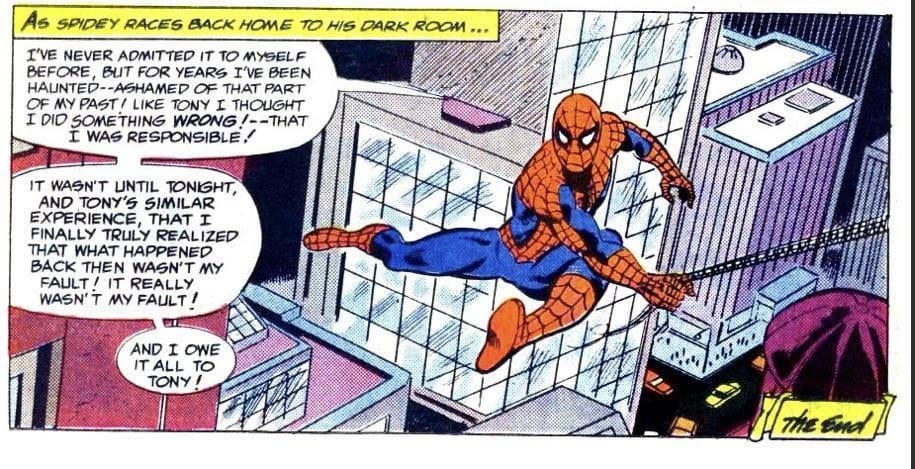
The Spider-Man comic by Mooney and Salicrup shows an adult who was abused as a child, and as that adult, with time between, realizing that sharing his story can help other children, that it can ease the guilt and self-recrimination of other victims. Nightwing, in his story, is still in he early stages of processing and cannot fathom that responsibility is not burying the assault or repairing his relationship with the rapist, but healing himself and helping others.
Batman’s childhood abuse occurs in a storyline called Gothic, by Klaus Janson and Grant Morrison, and demonstrates for us how no one really processed the trauma very well, with Bruce “Batman” Wayne nearly unable to face it except in dreams and speculation, whilst it killed some of the other children. In order to be Batman, as well as to be a functioning adult Bruce Wayne, he has to sublimate this kind of trauma in favor of the cleaner and more heroic-seeming murder of his parents in front of him. Something less people are going to treat as emasculating.
There is a great deal more to say on this topic, and to discuss, but we are not doing it here. The comic Elven, a spin-off a child-empowerment superhero comic written by a later-convicted pedophile, featuring a young boy who sexually harasses adult women and a young raped girl who transforms into an increasingly eroticized bikini-clad warrior woman. The Black Cat miniseries written by Kevin Smith dealing with chronic sexual assaults, justification, and victim-blaming. The later-convicted pedophile who drew a comic for DC in which not-Marilyn-Manson is both an actual demon and pursued by children in a way which takes cues from the romantic stalker genre. Fanart. Lots of fanart.
We could talk for ages. But, some of you would make jokes.
No posts
Comments
Nothing yet. Say the first thing.
Sign in to join the conversation.