
Each of us prepared for this in our own way. I did deep knee bends and hurdler stretches while the guy next to me, wearing a red soccer jersey, ran in place with his knees high, shoes slapping against the worn cobblestones. Another man, with shoulder-length hair and an athletic build, leaned casually against the wall, smoking a cigarette and blowing perfect smoke rings into the cool morning air. He looked utterly relaxed. He had obviously done this before.
Around us, thousands of runners filled the narrow street, nearly all dressed in white with red pañuelos tied around their necks. Some laughed too loudly. Others stood alone, staring downhill toward Santo Domingo. I saw a young man make the sign of the cross. Someone farther up the street began singing, and several others joined in before the song dissolved into scattered applause and nervous shouting.
The buildings rose close on either side of us, their balconies crowded with spectators leaning over iron railings. Every window seemed to contain a face. The air smelled of cigarette smoke, sweat, damp stone, and beer that had been spilled during the long night of partying before.
In just a few minutes, six giant bulls would be released into the streets of Pamplona, and we’d all run for our lives.
I’d thought about this moment for years. I’d watched countless videos and reread Hemingway’s The Sun Also Rises just a few days earlier. I studied the course the way a surveyor studies a jobsite, memorizing where the pavement changed from cobblestones to asphalt to brick. I noted every trip hazard, every curb, and every doorway I could dive into if things went sideways.
The night before, I’d walked the route, stopping at each corner and imagining where the bulls might drift wide or where the crowd might become compressed. I studied the wooden barricades, the shop entrances, and the narrow gaps where an injured runner might disappear from the path. I had converted the street into lines, distances, surfaces, and escape routes. It was the only way I knew to make the impossible seem manageable.
But nothing prepared me for it until I was standing in the middle of it.
At exactly eight o’clock, a rocket split the morning sky and shattered the nervous chatter.
The game was on.
Instantly, time stopped behaving normally. Seconds stretched into minutes. The crowd fell into a strange stillness as thousands of us waited for the bulls.
I’d chosen a starting position about one hundred meters below Plaza Consistorial. From there I looked downhill toward Santo Domingo, where the bulls would appear only moments later. I could see runners turning their heads, scanning the street behind them for the first sign of movement. No one wanted to start too early and waste their legs. No one wanted to wait too long and be swallowed by the herd.
The anticipation was almost unbearable. My mouth had gone dry, and my heart was beating hard enough that I could feel it in my throat. Every muscle in my body was wound tight, waiting for something my mind could not yet see.
Then I heard them.
The sound of hooves striking stone echoed through the narrow streets long before I saw them. It began as a distant rumble, low and indistinct, then grew louder with astonishing speed. A wave of shouting rolled uphill, ricocheting off centuries-old buildings. The sound moved toward us like a storm passing through a canyon.
Every plan I’d made disappeared beneath the thunder of hooves. The map I’d carried in my head vanished. There was no strategy left, only instinct and the next step.
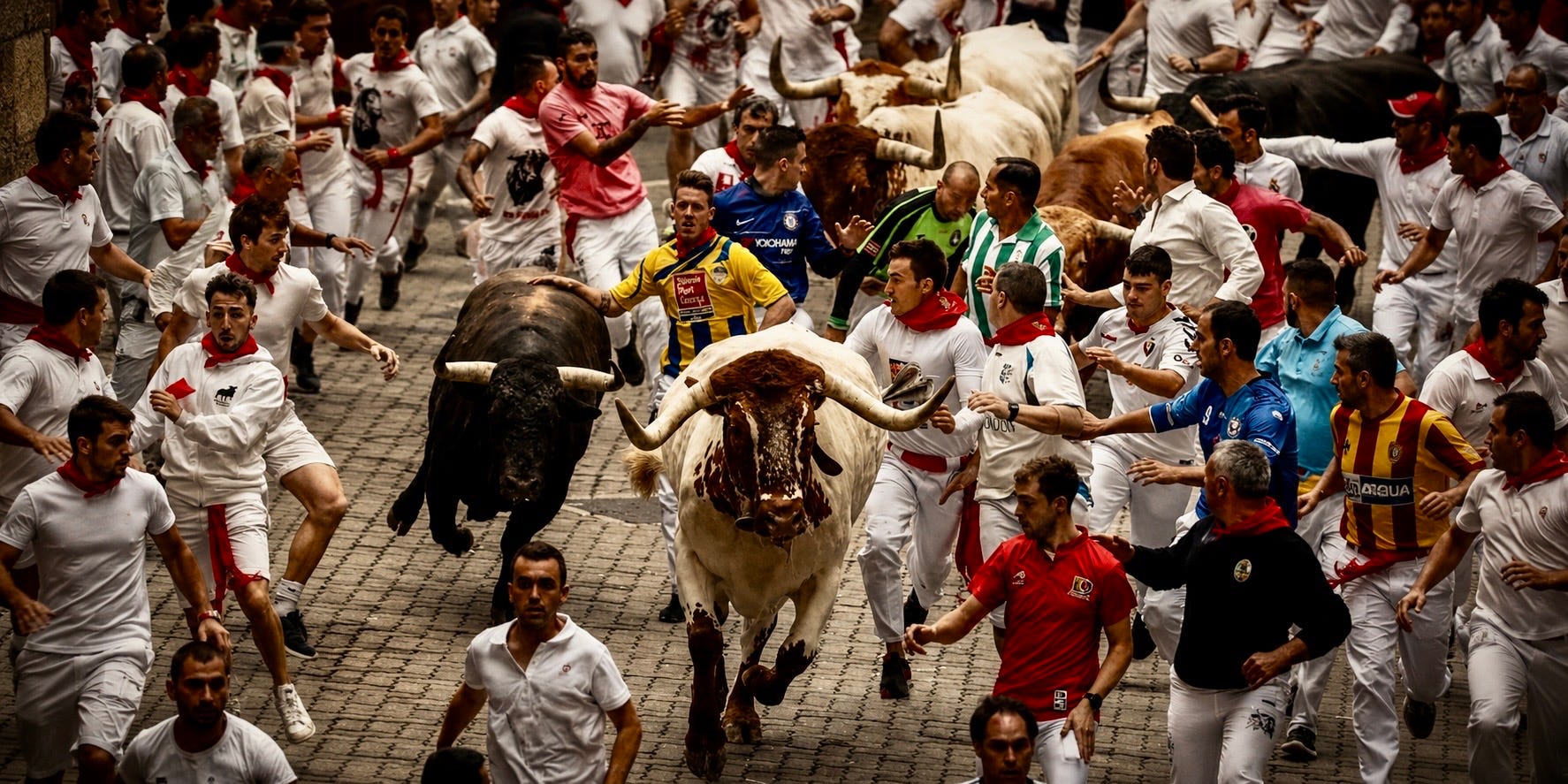
Then they rounded the corner and charged uphill toward us like a freight train. In an instant, everyone began to sprint.
I was swept into a sea of mozos, dressed in white with red pañuelos around their necks and red fajas cinched around their waists. The crowd surged north, and I was caught in a raging human river. Like a leaf carried in floodwater, I stopped deciding where to go and simply went.
I’d expected a straight-line sprint, like a track athlete exploding from the blocks. Instead, it felt like a running back searching for daylight. I dodged, weaved, and sidestepped runners who stumbled, collided, or suddenly changed direction. Elbows crashed into ribs. Shoes clipped my heels. Bodies appeared in front of me without warning and vanished just as quickly.
Someone behind me grabbed my pañuelo, jerking me backward until the slipknot did exactly what it had been designed to do and released. It disappeared into the crowd, and I never saw it again.
By the time the bulls reached us, I’d made it to Plaza Consistorial. The street opened into the square, and the morning sun poured between the buildings, blinding me for a heartbeat as I rounded the corner.
Then they were there.
Six massive animals exploded past no more than six feet away.
They were larger than they had ever appeared on video. Their shoulders rose above the runners around them, and their horns swept through the crowd at chest height. The ground trembled beneath my feet. Their hooves hammered the stone with a sound that I felt as much as heard. Their breath came in violent bursts. Muscles rippled beneath dark hides slick with sweat, their curved horns rising and falling above the sea of white shirts as they drove forward with terrifying purpose.
One bull turned its head slightly as it passed, and for a fraction of a second I saw the black curve of its eye and the pale point of its horn. There was no anger in the animal; no malice, only tremendous speed and power. It was simply moving forward, and anything in its path had to move with it or be destroyed.
A runner beside me pressed himself against the wooden barrier. Another scaled it, jumping to safety on the other side. The street had become a blur of horns, white clothing, red pañuelos, and open mouths.
Then they were gone.
The silence they left behind lasted less than a second, but it felt enormous. For a moment I wondered if I’d actually seen all of them.
People shouted in Spanish. “¿Cuántos?”
Then someone answered. “¡Seis!” All six bulls had passed.
I took off again, sprinting behind the herd toward the Plaza de Toros. The crowd compressed, then stretched apart as we raced through the final section. The bulls were somewhere ahead of us, hidden behind the moving wall of runners, but I could still hear their hooves and the roar of the crowd inside the arena.
My legs were beginning to feel heavy. My lungs burned, and each breath scraped against the back of my throat. Still, I ran. The entrance to the arena seemed to narrow as hundreds of men fought to reach it at once.
I reached the gate just as it slammed shut behind the last bull with a deep metallic boom that echoed through the stadium.
It was over.
I stood in the middle of the street, my chest heaving, my heart pounding so hard I could hear it in my ears. My mouth tasted of dust and metal. Sweat ran into my eyes, and my hands were trembling. I could feel the blood moving through my veins.
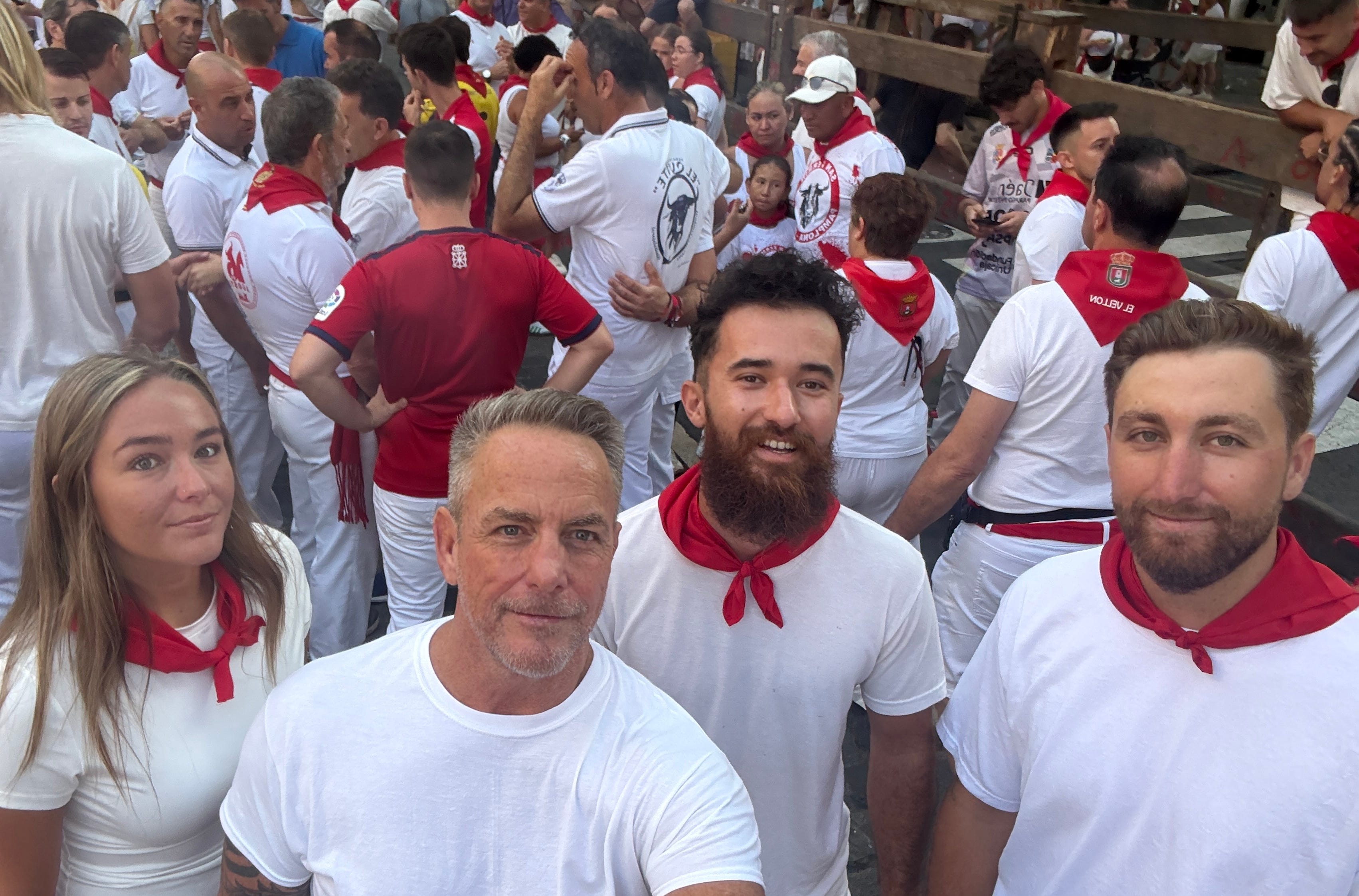
Around me, grown men hugged. Some laughed uncontrollably. Others bent forward with their hands on their knees, trying to catch their breath. One runner stood with his back against a wall, staring at nothing, his face drained of color. Farther down the street, medics pushed through the crowd toward someone lying on the pavement.
In that moment, I wasn’t thinking about Hemingway or about danger. I wasn’t thinking about making it back home. I wanted to memorize what it felt like to be completely and undeniably alive.
Standing there, I finally understood why people return to Pamplona year after year. It isn’t because they’re chasing danger. It’s because moments like these are incredibly rare. We mostly move through life on autopilot. Each day blends into the next in a blur of routine. But in moments like these, time stands still.
For two minutes and thirty seconds, nothing else in the world existed; no bills, no politics, no deadlines, no yesterday, and no tomorrow. There was no room for regret or anticipation, only the street beneath my feet, bodies surging forward, six bulls coming from behind, and one wild beating heart.
As I walked back toward Plaza de Castillo, Pamplona was already returning to normal. Café owners rolled tables onto the sidewalks. Street sweepers sprayed water across the cobblestones, washing away cigarette butts, spilled beer, and any evidence of the morning’s run.
Tourists wandered toward breakfast as if nothing extraordinary had happened there only a few minutes earlier. Waiters arranged chairs beneath umbrellas. A delivery truck eased slowly through a side street. Somewhere nearby, church bells began to ring.
I looked back toward Plaza Consistorial. The street was almost empty now, washed clean and shining beneath the morning sun. It seemed impossible that such violence and confusion had passed through it only moments before.
Before my breathing had even returned to normal, I was already replaying the run, trying to understand what I had done right and where I might have stayed closer to the bulls. I wondered whether I had started too soon, whether I should have waited another few seconds, and whether there was a better position farther up the course.
I was already wondering where I’d start next year.
I smiled. Somehow, I already knew I’d be back.
Comments
Nothing yet. Say the first thing.
Sign in to join the conversation.