
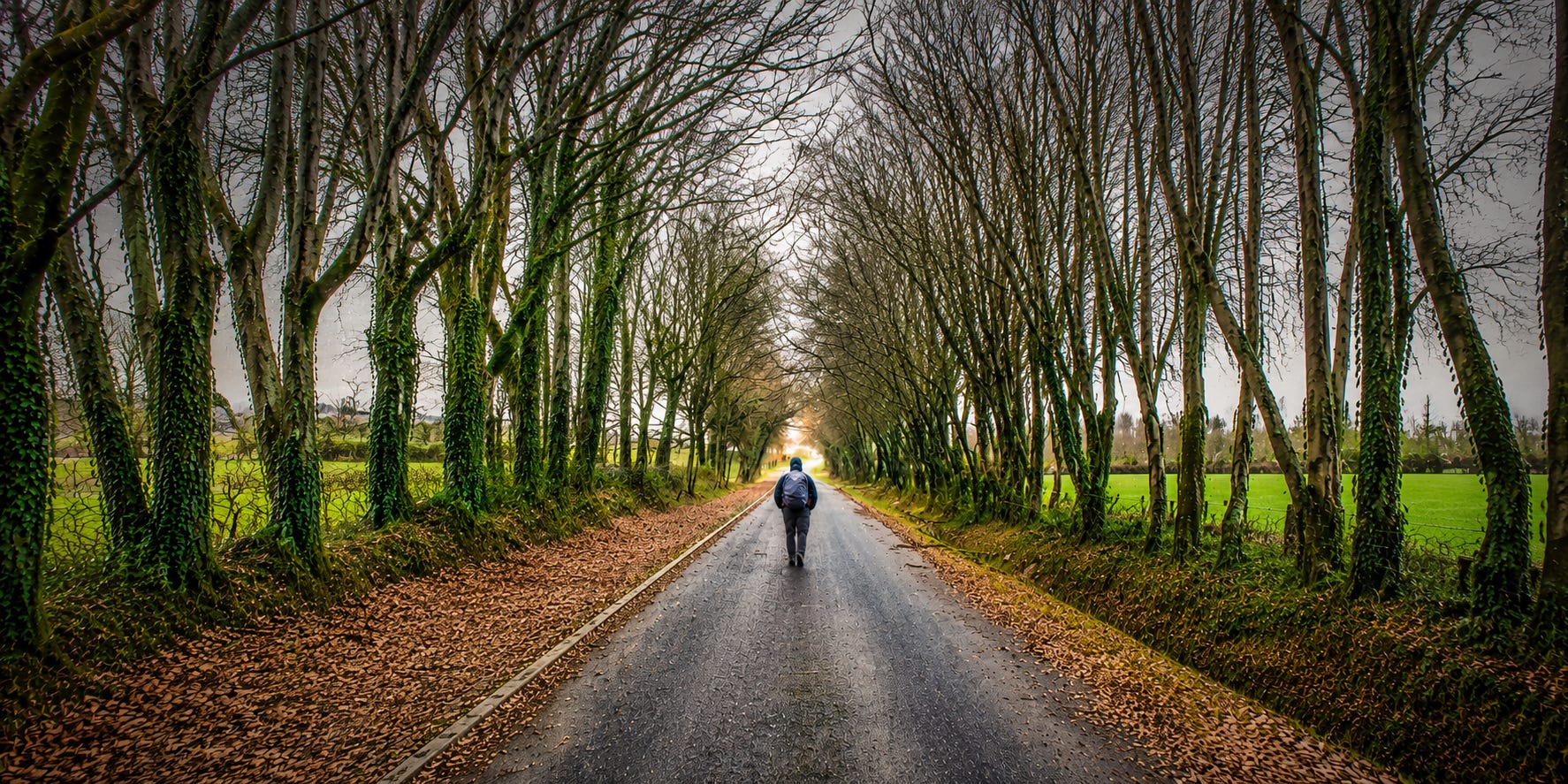
Three days of rain had turned the Camino into a muddy mess. Water flowed through deep ruts carved into the trail, forcing me to leap across them in hopes of keeping my shoes dry, though it was mostly a losing battle. Before long, cold water seeped through my socks, and I found myself wishing I had brought hiking boots instead.
As the trail descended into the valley below, rows of farmland stretched into the distance. Each parcel was divided by low walls of stacked stone that seemed to mark invisible boundaries between one life and the next. Rustic homes, their roofs covered in moss, stood quietly among the fields while smoke drifted lazily from chimneys and dissolved into the morning fog. Everything felt old, ancient even, as though life here had changed very little in hundreds of years.
In one of the fields, I spotted a farmer mending a barbed-wire fence. He wore a wide-brimmed hat that shielded his shoulders from the rain, while nearby, a skinny gray horse stood patiently in the grass, reins hanging loose as it grazed without concern. The farmer looked up as I passed, raised his hand, and called out, “Buen Camino!”
“Gracias,” I replied.
At the bottom of the valley, the River Celeiro cut across the landscape, swollen from days of rain and flowed near the top of its banks. The Camino followed the river for a short distance before crossing over the Ponte da Áspera, a bridge dating back to the 13th century, built from dark slabs of slate and supported by granite arches polished smooth by centuries of weather and footsteps. I stopped halfway across and rested my hands on the cold stone wall, watching brown water churn through the arches below as it wound its way through reeds and disappeared toward the sea.
I stood there for a long moment watching the current. That’s just like life, I thought. We all make our own slow journey toward the ocean, and none of us knows when it will end.
I wondered how things were back home, whether the people I loved were okay, and whether the burdens I carried had somehow grown lighter in my absence. Then I said a quiet prayer and continued walking.
The trail climbed steadily into rolling hills lined with barren birch trees, their pale trunks rising from a carpet of wet leaves that made every step uncertain. My legs burned as the incline steepened, and with each mile, my backpack seemed to grow heavier.
Before the trip, I had convinced myself that I was prepared for for the journey. Back home, I walked a couple of miles each day through my Southern California neighborhood and imagined I was training for Spain. I had read books about the Camino, watched documentaries, and convinced myself I knew what to expect.
I didn’t.
Already, my body ached, and it was only the first day of walking. Lack of sleep had begun catching up with me as well. Since leaving home nearly three days earlier, I had barely slept, and no matter how exhausted I felt, I could not seem to get more than a few hours each night. More than anything, I found myself looking forward to the end of the day, not for any sense of accomplishment, but simply for the chance to rest.
At the top of a long climb, the trail gave way to a narrow paved road marked by a scallop-shell marker pointing me forward. For the first time all day, I found myself enjoying the solitude. There were no sounds except for the steady patter of rain and the rhythm of my footsteps against the asphalt, so I entertained myself by singing old Waylon Jennings songs into the empty countryside.
Then I heard the engine.
A black Mercedes sedan came barreling around a bend in the road. I stepped toward the shoulder, expecting the driver to slow down, but if anything, he seemed to accelerate. At the last second, I jumped into the ravine beside the road, cold water rushing over the tops of my waterproof shoes and soaking my socks completely. The Mercedes disappeared around the bend without hesitation. I stood there dripping wet and furious, raising my middle finger toward a driver who never even noticed me.
For the next several kilometers, I followed scallop-shell markers set into concrete posts along the trail. Many of them were covered in handwritten messages left behind by earlier pilgrims: “Jesus loves you,” “Live a life worth living,” and “Life is a game. Don’t be afraid.” One marker read, “Jesus is the way,” though someone had crossed out the word “the” and replaced it with “your.” Apparently, not everyone walked the Camino for the same reason.
They say that every pilgrim walks their own Camino and experiences it differently; they also say you should arrive with no expectations. But I had expectations. A few weeks earlier, standing alone in my kitchen at three in the morning, I had quietly made a deal with myself: If God wouldn’t come to me, then I would go to Him. I could not think of a better place to look.
Yet halfway through my first day of walking, there had been nothing but silence. No revelation, no unmistakable sign, and no sudden clarity -- only rain, mud, aching legs, and the quiet rhythm of my own thoughts.
As the trail descended into an open valley, I heard music somewhere in the distance. At first, I assumed it was coming from a radio, but as I rounded a bend I saw a woman walking toward me from an intersecting trail. She looked to be around thirty years old and wore an old burgundy sweater that hung loosely from her shoulders. Damp black hair spilled from beneath her hood, and an enormous backpack rose above her shoulders, far larger than seemed possible for someone her size. She was singing, not quietly to herself, but fully and unapologetically, as though she had forgotten the rest of the world existed.
As we grew closer, I realized the song was in Spanish. She swung her arms in wide animated motions, almost like a conductor moving to music only she could hear. I expected her to stop when she noticed me, or at least grow embarrassed. She didn’t. She simply smiled. “Buen Camino,” she said as she passed.
“Buen Camino.”
Her pace was faster than mine, and within moments she had begun pulling away down the trail, still singing. I watched as she stopped beside a gnarled oak tree near the edge of the road, placed the palm of her hand against the trunk, lowered her head for a moment, and stood perfectly still. Then she said something softly in Spanish that I could not understand. Then she turned and continued down the trail, singing as though she carried no burdens at all.
I stood there watching her disappear into the mist and found myself strangely moved by the encounter. What a way to live, I thought. Totally in the moment, with no worries about tomorrow and no regrets about yesterday. For a brief moment, I wished I knew how to live like that.
By now, the Camino had begun to feel repetitive. The trail climbed a wooded hill only to wind back down into another narrow valley, where an old stone bridge crossed a creek swollen from the rain. After a while, I began to wonder if I was somehow walking in circles, as though the road had quietly circled back on itself and decided to test my patience.
I had planned to reach Palas de Rei by nightfall, but my pace was slow -- less than four kilometers an hour -- and hunger was beginning to settle into my bones. Each time I passed through a village, I searched for a café or market, but just like my first night in Sarria, everything seemed deserted. Windows were shuttered, streets stood empty, and the occasional barking dog was often the only sign that anyone still lived there.
By early afternoon, I was famished.
When the Camino crossed a paved highway, I noticed a cluster of buildings in the distance. Although I was exhausted, I decided it was worth investigating. As I approached, I spotted a stone building with a weathered hand-painted sign above the entrance that read Cafe.
Outside, a line of walking sticks leaned against the wall like abandoned rifles. I felt an immediate wave of relief.
Inside, the room smelled of wood smoke, wet wool, and damp clothing. A fire crackled in the hearth, filling the small café with warmth, while several pilgrims sat quietly at scattered tables drying gloves, rubbing sore feet, and sipping beer as steam rose from their jackets.
I dropped my backpack beside a chair near the fireplace and eased myself into the seat. Pulling off my shoes, I placed them near the hearth and watched steam slowly rise from my soaked socks. “Can I have a menu?” I asked the woman behind the bar.
“No comprender,” she replied.
I was surprised. With her blonde hair and green eyes, she looked more English than Spanish. I tried again. “Lunche?” I asked, rubbing my stomach.
She shook her head. “No.” The disappointment hit me hard.
At that point, hunger had stopped being an inconvenience and had become something physical. My hands had begun to shake, and I could feel my energy slipping away. “Uno cerveza, por favor,” I said. She poured me a beer and slid it across the bar.
At the far end of the counter, I noticed a container filled with muffins. I pointed toward them. “Dos muffins, por favor?” She smiled and nodded.
Back at my table, I sipped my beer while the warmth of the fire slowly worked its way back into my body. Outside, rain tapped softly against the windows, and wet jackets hung drying near the entrance. For the first time all day, I stopped moving, and when I finally stopped moving, my thoughts returned home.
I thought about the people I loved, the burdens they carried, and the helpless feeling of being unable to fix things that seemed broken. For days, I had been carrying around questions I could not seem to shake, so I pulled out my journal and began writing a letter to God.
Dear God, where are You? I call out, but my prayers seem to disappear into silence. Why do you seem absent when the people I love need you the most? In the Bible, You moved mountains, healed the broken, and made yourself known, yet now You feel so quiet. I’ve had faith in You my whole life. Maybe somewhere along the way, You lost faith in me.
Please watch over the people I love, heal what is broken, give us strength when we feel weak, and hope when we cannot see the road ahead. Amen.
I closed my journal and sat quietly by the fire, listening to the low hum of conversation around me. At one table, a group of American pilgrims laughed while replaying the disasters of the day; nearby, an older French couple sat close together, speaking softly over glasses of wine.
Then I noticed someone familiar. At the table behind me sat the singing woman from the trail. She was laughing with a small group of Spanish-speaking pilgrims, a beer in her hand, while beside her sat a handsome young man with blonde hair and blue eyes who spoke fluent Spanish. What an amazing place, I thought.
I ordered another beer and settled deeper into the warmth of the fire. At home, I would have been reaching for my phone -- checking emails, returning calls, and mentally drifting somewhere else while pretending to be present. Here, there was nowhere else to be, and for once I was content simply to sit still.
Eventually, the group behind me began gathering their things. The blonde-haired young man hoisted an enormous backpack onto his shoulders, and I could not help myself. “Wow,” I said. “That’s a huge backpack.”
He smiled. “I have all my camping and cooking gear in here,” he replied in heavily accented English.
“How long have you been walking?”
“The Camino? About a month,” he said. “But I’ve been hitchhiking around Spain for almost three.” He extended his hand. “My name is Noah.”
I laughed quietly to myself at the coincidence. My oldest son is named Noah. That’s amazing,” I said. “I wish I could disappear for that long.”
“I wanted to learn Spanish,” he said. “So I saved my money and decided to spend a year here.” Then he motioned toward the singing woman. “She’s helping me learn — Her name is Lourdes. We’ve been traveling together for about three weeks.” She smiled in my direction and raised her beer slightly in greeting.
I smiled back. What a life, I thought. To wake each morning with nowhere to be except wherever the road decided to take you, with no deadlines, no obligations, and no responsibilities waiting back home; only movement, conversation, and the freedom to follow curiosity wherever it led. I envied them, not because they were young, but because they seemed so fully present in their lives. Then again, maybe that was part of why I had come to Spain. To remember how to live that way myself.
Eventually, I finished my beer, laced up my damp shoes, and shouldered my pack. Outside, the rain was still falling, so I pulled up my hood and stepped back onto the Camino.
Comments
Nothing yet. Say the first thing.
Sign in to join the conversation.