
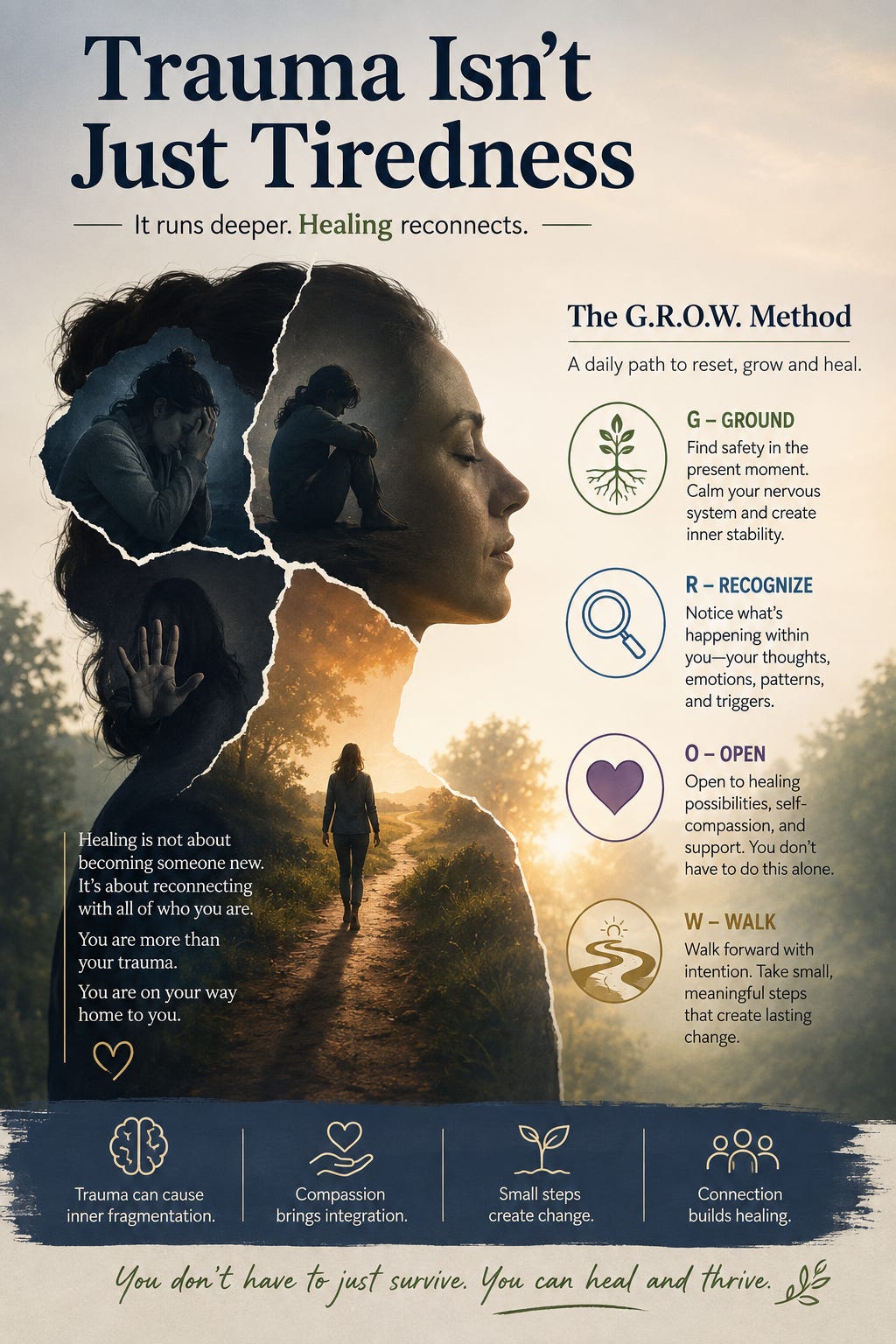
Why healing requires more than rest
A client sat across from me last week and said the thing I hear almost every day now: “I’m just so tired.”
I used to take that at face value. Sometimes it really is that simple — a bad week, a sleepless night, a body that needs eight hours instead of five. Rest fixes that kind of tired.
But there’s another kind of tired I’ve learned to listen for. It’s the exhaustion of a nervous system that’s been scanning for danger so long it forgot how to stop. It’s the fatigue of carrying memories that never got fully processed, of holding yourself together while some part of you is still living like the threat never ended.
That isn’t laziness. It isn’t weakness. And no amount of sleep touches it, because sleep was never the problem.
Trauma has a way of splitting us into pieces. Part of you wants to move forward. Another part is still standing guard. One part knows, logically, that you’re safe now — another reacts like it’s happening all over again.
I hear versions of this constantly: “I feel like I’m on autopilot.” “I don’t even know who I am anymore.” Nothing is wrong with you when you feel that way. Your nervous system did exactly what it was built to do. It kept you alive.
The work isn’t to erase those protective parts, as much as we might want to. It’s to sit down with them, figure out what they’ve been trying to do for you all this time, and let them know they don’t have to carry it alone anymore.
It’s not rest. It’s reconnection — learning to notice what’s happening inside you without immediately reaching for judgment. It’s helping your body find enough safety that it can start setting down patterns it no longer needs.
I built the G.R.O.W. Method because I kept watching people try to heal through sheer willpower, and watching that fail. Healing isn’t simple, but it does tend to move through small, repeatable steps rather than one big breakthrough.
Here’s how it plays out. A client of mine — I’ll call her Sarah — gets a short message from her supervisor: “Can we meet this afternoon?”
Her chest tightens before she’s even finished reading it. Heart racing. Thoughts already three steps ahead: I’m in trouble. I’m going to lose my job. I’ve disappointed everyone again.
Nothing has happened yet. But her body remembers years of criticism she never fully moved past, and it doesn’t know the difference between then and now.
This time, instead of spiraling, she runs through G.R.O.W.
Ground. She puts both feet flat on the floor, takes a few slow breaths, feels the chair holding her up. I’m here. I’m safe. This is today, not the past.
Recognize. She names what’s happening instead of believing it outright. My body thinks it’s in danger. This feels familiar, but familiar isn’t the same as true.
Open. Instead of scolding herself for being anxious, she tries something gentler. Of course I’m scared — my nervous system is trying to protect me. I don’t have to fight myself on top of everything else.
Walk forward. She picks one small next step. She writes back, “Absolutely, I’ll see you this afternoon,” and takes a short walk before the meeting instead of spending four hours bracing for disaster.
The meeting turns out to be about a new project. Nothing terrible happens. But something does happen — she caught the old pattern before it ran the whole day for her. That’s what healing looks like most of the time. Not a breakthrough. A pause that worked.
Get this G.R.O.W. Method daily practice worksheet in our Trauma Champions community when you become a paid member. Use this and other healing practices and tools (over $1000 value) when you join…see you there!
Healing rarely shows up in dramatic moments. It shows up in the ordinary ones — when you pause instead of panic, notice instead of numb, get curious instead of critical.
That’s really all the G.R.O.W. Method is: a way to practice those ordinary moments on purpose, one at a time, until they start to add up.
A question worth sitting with: Where have you mistaken trauma for “just being tired”? What might shift if you got curious about what your nervous system is protecting, instead of blaming yourself for being worn out?
I’d love to hear what comes up for you in the comments — and if this found you at the right moment, pass it along to someone who might need to hear that healing isn’t about trying harder. It’s about learning a different way through.
Paid members can download this Daily Practice: “Transforming Trauma Tiredness” immediately! Join our Trauma Champions Community to get this G.R.O.W. practice today.
Go to our Skool community link or DM to be added as a member if you are a subscriber to this newsletter or the Skool community page > https://www.skool.com/trauma-champions-9057/about
Go to the classroom navigation on the menu.
Go to the Daily Practices for this tool and many others!
Email me if you have any problems: rehuxley@gmail.com or DM me.
No posts
Comments
Nothing yet. Say the first thing.
Sign in to join the conversation.