

Despite shield laws, sanctuary state status, and specific protections for trans and gender nonconforming (TGNC) people, Illinois is still facing a stark reduction in access to gender affirming care and targeted attacks against trans youth rights across the state.
Shield laws were originally created to protect abortion providers, those associated with abortion providers, patients, and people helping the patient from prosecution when they provided an abortion and related care to patients living in states where that care is criminalized (reproductiverights.org). More recently, states like Illinois, have created shield laws to protect providers of Gender Affirming Care as well as people travelling into the state to access that care. Shield laws also protect private medical information, bans professional discipline, and civil liability from out-of-state investigations (Williams Institute, Illinois Shield Law Fact Sheet).
For example, someone from a neighboring state such as Indiana or Iowa, which have enacted laws criminalizing gender affirming care for minors, may choose to travel into Illinois to receive care. Without shield laws in place, the providers of gender affirming care in Illinois could be subject to anti-gender affirming care laws in the states where their patients reside, leading to possible extradition and prosecution. With shield laws, that provider is free to practice safe, proven, life saving gender affirming care for anyone that comes to them without fear of persecution.
Like shield laws, the status of a sanctuary city or state was originally created to protect another group, in this case immigrants. Traditionally a sanctuary city or state does not cooperate with national enforcement of immigration law (Wikipedia). In Illinois, this has been expanded to include refusing to cooperate with federal enforcement of any laws criminalizing transgender people as an identity or criminalizing gender affirming care.
As a sanctuary state, Illinois is making a promise to transgender and gender nonconforming (TGNC) people in the state that they are safer in Illinois and that Illinois will work to protect them.
Many of those protections are detailed in the Illinois Human Rights Act where civil rights protections are granted for transgender, nonbinary, and gender nonconforming people in employment, housing, finances, and “places of public accommodation” such as healthcare and schools. In Illinois, people of all gender identities are protected from discrimination, harassment, and retaliation. Even repeated intentional misgendering is considered harassment and could be protected under the Illinois Human Rights Act.
It is important that Illinois included ‘gender nonconforming’ as part of its Human Rights Act as the protections apply more broadly than just to people who identify as transgender or nonbinary. Gender nonconforming can include things like women wearing pants or men being the stay-at-home parent. Including gender nonconformance helps to bolster the federal protections under Title VII, Title IX, and the Equal Pay Act.
Despite laws protecting TGNC people from discrimination, major medical institutions are choosing to stop providing the same care to TGNC people that they actively continue to provide to cisgender people.
A cisgender child can be prescribed puberty blockers (a medication that delays the onset of puberty) due to early-onset puberty causing mental and emotional distress, while a TGNC child going through the puberty of their gender assigned at birth and is experiencing even severe mental and emotional distress is unable to be prescribed the same medication. This is discrimination.
A cisgender boy experiencing Gynecomastia (an increase in the amount of breast gland tissue in boys or men) can receive surgery to reduce the size of their chest to reduce mental and emotional distress, but a transgender boy is denied the same care simply because of their gender assigned at birth regardless of the level of their dysphoria and distress. This is discrimination.
Without clear definitions of the restrictions that the current administration seeks against gender affirming care, some providers are even pulling their mental health care. Without guidelines, simple acts like using a new name, getting a new haircut, or shopping for new clothes can be classified as gender affirming care that would be illegal IF the current administration were able to pass their laws restricting gender affirming care.
Institutions throughout Illinois have chosen capitulation, and have chosen to pre-comply. Lurie Children’s Hospital led this by removing gender affirming surgical care after the first executive orders were released, pre-complying with the administration’s demands and cancelling appointments for surgical care even on the same day of the procedure, regardless of the harm they caused their patients. Because puberty blocker implants are considered surgical care, both implantation and removal of existing implants were impacted.
Since Lurie, Illinois has seen other major institutions pulling back their gender affirming care programs, reducing their services offered, or increasing age limits for treatments. Without access to gender affirming care including blockers and HRT, young TGNC people are forced to go through a psychologically traumatizing puberty in line with their assigned gender at birth and inconsistent with their identity. Furthering the trauma, these medical institutions are not providing referrals for continued care or mental health support for those who have lost their care. Trans Up Front IL has seen a drastic increase in reports of suicidal ideation, suicide attempts, and deaths by suicide directly related to the sudden pullback of care.
While Illinois has protections baked into the Illinois Human Rights Act, those protections are only so strong as the enforcement of them. The Illinois Attorney General (AG) has so far refused to pursue any action against those institutions. Instead, the AG has sided with the medical institutions, stating that they are essentially between a rock and a hard place due to the threatened federal restrictions that have not yet been enshrined into law.
Are they, though? As State Rep Kelly Cassidy says, “Executive orders are vibes, not laws.” Executive orders cannot be enforced. There are no current federal laws banning gender affirming care for minors. If a law is eventually passed, it could not be enforced retroactively. Medicare and Medicaid funds are not able to be withheld from institutions based on them providing gender affirming care.
In discussions with CEO’s of major hospital systems, they like to use analogies such as “cutting off the arm to save the body.” The arm in this case is trans and gender nonconforming children. The arm is medical care that is recommended and backed by American Academy of Pediatrics, the American Medical Association, and the American Psychological Association. Medical care that is shown to dramatically lower the rate of suicide in TGNC youth.
Without action enforcing the state’s Human Rights Act, Illinois is becoming a state where gender affirming care is a privilege that can only be accessed by those who are able to find a private provider, can afford to pay for care out of pocket, and may require travelling hours to find care. Trans Up Front is maintaining a comprehensive Gender Affirming Care referral network in order to connect patients with providers. The few remaining providers of gender affirming care in the state are working hard to make space for the new onslaught of patients left stranded by their previous providers.
If you are aware of a school that is not following the Illinois Human Rights Act and Guidance from the Illinois State Board of Education file a report!
If you or your child have been discriminated against based on gender identity (or any other protected identity), file a report with the state’s Attorney General. English, Spanish, Polish, Chinese, Chinese simplified. While they have not pursued action yet, the more reports they get filed, the harder it is going to be for them to overlook them.
Unsure if your situation warrants reporting, need assistance reporting, or want to become more involved in the fight against discrimination in Illinois? Contact Trans Up Front to schedule an intake appointment, review your situation, and receive a warm hand-off to the right organization to take on your case.
If you are a parent of a TGNC youth who needs support, join our TUF CHAT virtual support group.
If you are a TGNC educator or are an educator who supports TGNC youth, join our TUF Educators network.
If you or your child has lost access to gender affirming care, contact our Gender Affirming Care Navigation Program for a referral.
Want to get involved in standing up for the rights of TGNC youth and young adults in Illinois? Sign up to volunteer, join a committee, or donate.
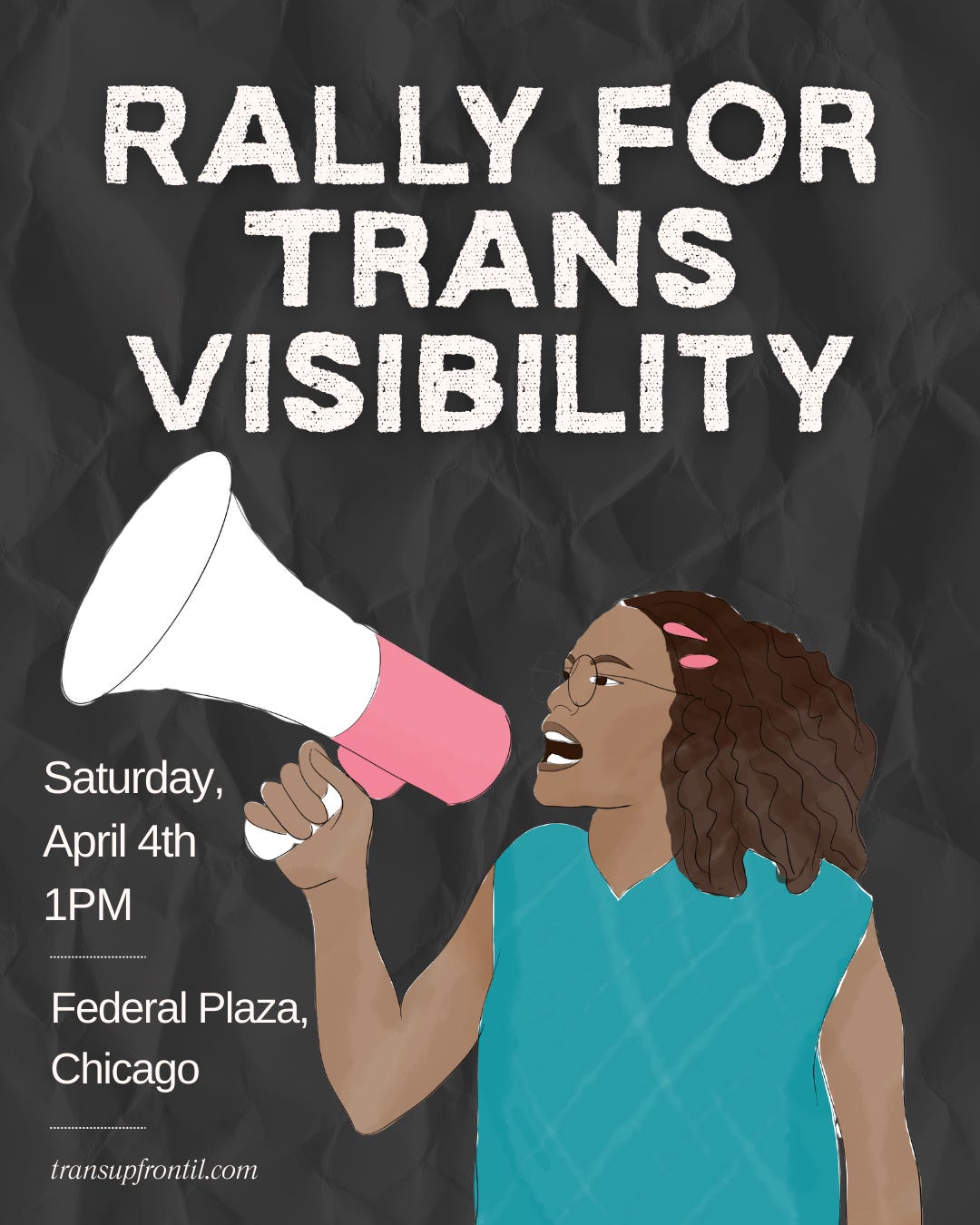
Want to show up for TGNC youth and young adults, be vocal and visible in your support and join us for our next Rally for Trans Visibility on Saturday!
Comments
Nothing yet. Say the first thing.
Sign in to join the conversation.