
Dear Readers,
As the days grow shorter and summer crawls to and end, our team at Transpositions is looking back at the rich range of articles we’ve published since reentering the online world in May. As a brand new editorial team, we hoped that our first call for submissions—A World Ablaze—might yield a few thoughtful pieces. We were therefore thrilled with the abundance of submissions received—not just with the quantity of pieces, but with the breadth and depth of quality therein.
In her famous epistolary novel Gilead, Marilynne Robinson’s protagonist John Ames writes in his Pentecost sermon that ‘The Lord breathes on this poor gray ember of Creation, and it turns to radiance—for a moment or a year or the span of a life.’1 This vision, he implies, is always partial: something eventually recedes, and, in perceiving the world, ‘no one would know it had anything to do with fire, or light’. Yet at the end of his life, Ames affirms that, despite—or perhaps because of—this double vision, everywhere has potential to ‘shine like transfiguration.’ ‘You don’t have to bring a thing to it’, he says, ‘except a little willingness to see.’
With a similar approach to Pentecost in mind, we asked writers to consider the many connotations of this liturgical feast: images of fiery revelation, meeting places between Creator and created, spaces where something fresh is bodied forth, where embers are (re-)kindled, vision is transformed, something transcendent is poured out, or sites of destruction are revived. The articles chosen for publication bear witness to the multifaceted nature of interpreting such an expansive event. Our writers focused on themes of fire’s purification or destruction, tensions of darkness and light, or transfiguration and revelation. In reading, we’ve been reminded afresh of the prismatic nature of Pentecost: how its descent enlivens humankind with the presence of God, allowing wholly redemptive Light to be flung across the earth through manifold expressions. The art we study affirms, reveals, or simply interrogates this reality—and these articles attest to that very fact.
You can read all articles from our summer theme on our website, or enjoy our reflections on individual articles below.
Browse Our Articles: A World Ablaze
In the literary corner, our very own Christina Eickenroht writes about a recurring motif in Dostoevsky’s Crime and Punishment, Demons, and The Brothers Karamazov, wherein Mary Magdalene figures are transfigured to Madonna archetypes—a transformation closely accompanied by fiery imagery. Similarly, Sophie Burkhardt dives into George MacDonald’s Princess stories to examine great-great Grandmother’s purging rosefire: a fire that will ‘consume the evil, false nature built up within a person so that his or her true childlike nature can shine forth.’
Connecting Hebrew scripture to Jewish poetry, Yong Li Wong explores how the very body of the prophet in Hayyim Nachman Bialik’s ‘Be-‘ir haharegah’ (‘In the City of Slaughter’) acts as a meeting place between Creator and created, by which the body of the prophet ‘can deliver a message more powerfully than verbalised verses,’ though the poem does not meet a redemptive end. And José Rama Domínguez explores Tolkien’s creation account as ‘a fire that lights other fires’, arguing that Tolkien’s own mythmaking calls us to become mythmakers and sub-creators ourselves.
A natural implication of any theophany, this theme incited submissions on the interplay of God’s presence and absence. Our own Ellie DuHadway Goings analyses Andrew Wyeth’s 1989 painting Pentecost to investigate how Wyeth redeploys Pentecostal imagery and terminology to illustrate God’s absence in an encounter with death. Thematically similar—but shifting mediums—in ‘Our God Is (Not?) a Consuming Fire’, Maxwell Bennett presents The Prince of Egypt’s burning bush as God’s self-revelation, ‘generative through its enmeshing of absence and presence, hiding and revealing.’ Both Goings and Bennett engage the philosophy of Martin Heidegger to show how artworks can facilitate ontological encounters with the realities of life and death.
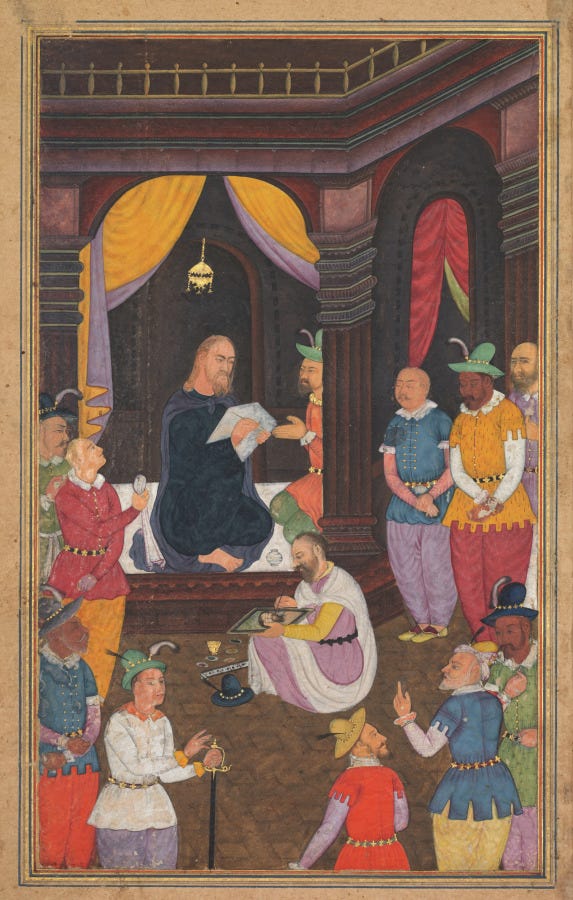
Exploring the realm of pictorial representations of the Pentecost event, Lydia Kelliney brings the reader through a visual exegesis of the Descent of the Holy Spirit icon, revealing how the entire story of the Christ-event can be contained in a single image, while Bailey Hindmarsh offers a thorough cultural and historical analysis of the Mirror of Holiness manuscript, commissioned in Mughal India to ‘assimilate the gospel stories into a shared visual spirituality,’ offering a new historical dimension to the Great Commission.

Maria Marijke Huisman contributed our issue’s book review, evaluating Charles Taylor’s Cosmic Connections: Poetry in the Age of Disenchantment (Harvard University Press, 2024). Huisman deftly analyses the effectiveness of Taylor’s philosophical thesis around Romantic poetry—that the Romantic poets create ‘an “interspace” between the “ontological” and “psychological”’ to reconnect the reader to the cosmos, as a response to a felt sense of disenchantment. Benjamin Shute, a practicing violinist on gut-string period instruments, contributed an artist’s reflection to our issue, offering insights on how his musical practice informs theological meditation and reflection on Pentecostal imagery, ‘of rushing wind and flame.’ To Shute, the vocation of musician is one of a herald to the unitive, transformative, and generative work of the Holy Spirit, which answers the human longing to move beyond oneself and encounter something greater.
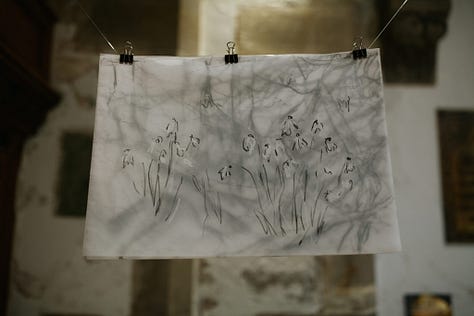
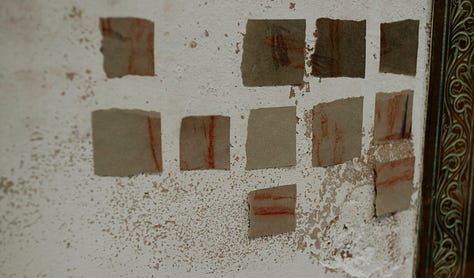
And for expressions of the visual arts local to our St Andrews community, our summer publications included two reflections on Transept’s annual art exhibit, Immaterial Evidence. Local artist Dan Drage reflected on Hans-Georg Gadamer’s theory of play as an ontological structure for approaching art to showcase the works presented in Immaterial Evidence, positing that ‘if we accept with Gadamer that “genuine reception and experience of a work of art can exist only for one who ‘plays along’”, the works and events presented as part of Immaterial Evidence offered ample opportunity.’ C. M. Howell described the exhibition as a ‘“fragile space” where the immaterial presses against the visible without collapsing into it,’ the resistance of needing proof opening up a new path for encountering mystery.

Howell also contributed ‘A House for Prometheus,’ a visual analysis of architect Louis Kahn’s works and the theme of radiant fire as wound, which ‘does not merely preserve the past; it transfigures the past into possibility.’ Continuing with theological and philosophical engagements with architecture, Josh Larsen’s ‘Bosco Verticale: Eden Imagined, Unfulfilled, and Unfolding’ posits Stefano Boeri’s work of architecture as revealing an eschatological longing for the new Eden, whilst also reckoning with the ways this vision remains somewhat unfulfilled.
The themes of Pentecost we’ve been exploring through this issue can bring about transfigured sight, helping readers see signs of creation and re-creation in the wider world. Along these lines, Kathleen Behrend calls for a redemptive imagination around the fashion industry through a lens of eco-theology, following the life cycle of a garment in the circular fashion world as one that contains echoes of resurrection. Micah Rickard likewise explores Clint Bentley’s Train Dreams (2025) ecologically and poetically, focussing on the paradox of horror and beauty in the natural world, with all ‘its fragility and danger.’
We are grateful to our many contributors, and eager to continue tilling the ground of our journal in its new iteration. In the coming weeks, our team will be gearing up for a special fall series. In partnership with Art as Revelation—a project here at the University of St Andrews, funded by the Templeton Trust—we’ll be sharing essays from a recent conference titled ‘Religion from the Outside: Christian Symbolism in Non-Christian Art’.
Want to write for us in the future? We’ll be sharing our next call for submissions in November. In the meantime, don’t hesitate to reach out. We’d love to hear from you.
Transpositions is a publication of the Institute for Theology, Imagination, and the Arts at the University of St Andrews. Here are some ways you can stay involved with the work we’re doing:
➤ Learn more about ITIA
➤ Write an article or a book review for us
➤ Follow us on Instagram, Facebook, and X
Gilead, Marilynne Robinson (Harper Perennial, 2004), 245.
No posts
Comments
Nothing yet. Say the first thing.
Sign in to join the conversation.