
Hello and welcome.
This year’s World Cup has been as dramatic as expected (or more?), and we’re marking the occasion by bringing you a special edition of the Dispatch with non-English football stories sent to us from our contributing editors, Instagram followers and via our Translator Mag Hotline.
Keep reading for summaries of stories about one of Spain’s star players told through vignettes of his youth, why Arab solidarity endures on the pitch (and evaporates off of it), and how the so-called ‘King’ of FIFA maintains his millions.
We’ll continue to share the best coverage of the World Cup beyond the Anglosphere on our Instagram, so please feel free to send us your favourites for a chance to be featured!
Now, to the Dispatches.


An anachronous highlights reel of the young Spanish footballer, told through six scenes.
Panenka, a Spanish football culture publication with a strong cultural and realpolitik bent, guest spots in Gatopardo, a Mexico City-based narrative journalism platform, and marks their first-ever collaboration.
The article, which translates to “Lamine Yamal in the School Yard” by Marcel Beltran, is an anachronous highlights reel of the young Spanish footballer’s life.
It kicks off with a flashback to a decisive Barça game, where the writer questions, with palpable awe, wonder and admiration, how it is possible for someone barely an adult to visibly enjoy that kind of pressure. Scene two partly answers the question: the 18-year-old plays well because of his youth, not despite it. The most plausible reason Beltran proposes is that, to play football well, “you need to be all class and no modesty. And to not have forgotten your childhood”.
A shift in pace reveals a turn towards the sociopolitical, and Yamal’s origin story. Those familiar with him will know his ritual of facing the camera and gesturing the number 304 with his hands: a tribute to his neighbourhood postcode of Rocafonda in Mataró, about 30 km northeast of Barcelona.
Born in 2007 to an Equatoguinean mother and a Moroccan father, Lamine Yamal becomes a prism through which we view a wave of immigrants from South America and Africa moving to an impoverished neighbourhood previously populated by a Spanish (not Catalan) working class. It was in 2014 that he was spotted by a talent scout and taken to La Masia, Barça’s famed training academy.
We skip forward to a match during which Islamophobic chants are directed towards a rival team. Yamal, unprompted, speaks out against it as a “Spanish Muslim” on his 45-million-follower-strong Instagram account. The fearlessness he displays on the pitch apparently echoes in real life. Jumping ahead, he is now in full celebration mode with the Barça team in an open-top double-decker bus on a victory tour of Barcelona, having just topped La Liga in May 2026. Yamal chooses to wave a Palestinian flag amid ongoing attacks on Gaza. Hours later, he posts it on Instagram, attracting criticism from the Israeli Defence Minister. Spanish President Pedro Sánchez, however, applauds his actions. “He only expressed the solidarity for Palestine that millions of Spaniards feel. One more reason to be proud of him.” Yamal, Beltran reminds us, “knows exactly what’s up.”
The final scene: a photo. The unlikely meeting of two football not-yet-legends, and a rare occasion where truth is stranger than AI. It is 2007. The Barça Foundation collaborates with UNICEF to raise funds for families in need. Yamal’s family, who stand to benefit from the fund, enter a competition to take part in a photo campaign and win. Months old, he is handed to a 20-year-old promising striker who bathes him. His name: Lionel Messi.
The article, while a tribute to the teenage prodigy, is also a compelling insight into modern-day Spain. Self-aware, social media-savvy, pro-Palestine and Muslim, Yamal holds too many uncomfortable truths for an increasingly right-wing-voting Spain. His detractors call him cocky and brash, but Beltran chalks this up to bravado in the age of social media. Success is no longer attributed to hard work, but rather self-belief. Quoting from an article in El País, in the new world order, to be number one, you need to believe you are first. “Or at least seem like you do.” Yamal, it seems, understands this perfectly.

The original article ‘Lamine Yamal en el patio de la escuela’ was first co-published in Spanish by Marcel Beltran for Panenka and Gatopardo on June 19, 2026.
Panenka is a Spanish football culture publication that focuses on stories that don’t get covered by mainstream media. Mexico City-based Gatopardo describes itself as the most influential narrative journalism publication in Latin America.
Summary by Farida Álvarez Fetouhi
Thanks for reading Translator! This post is public so feel free to share it.

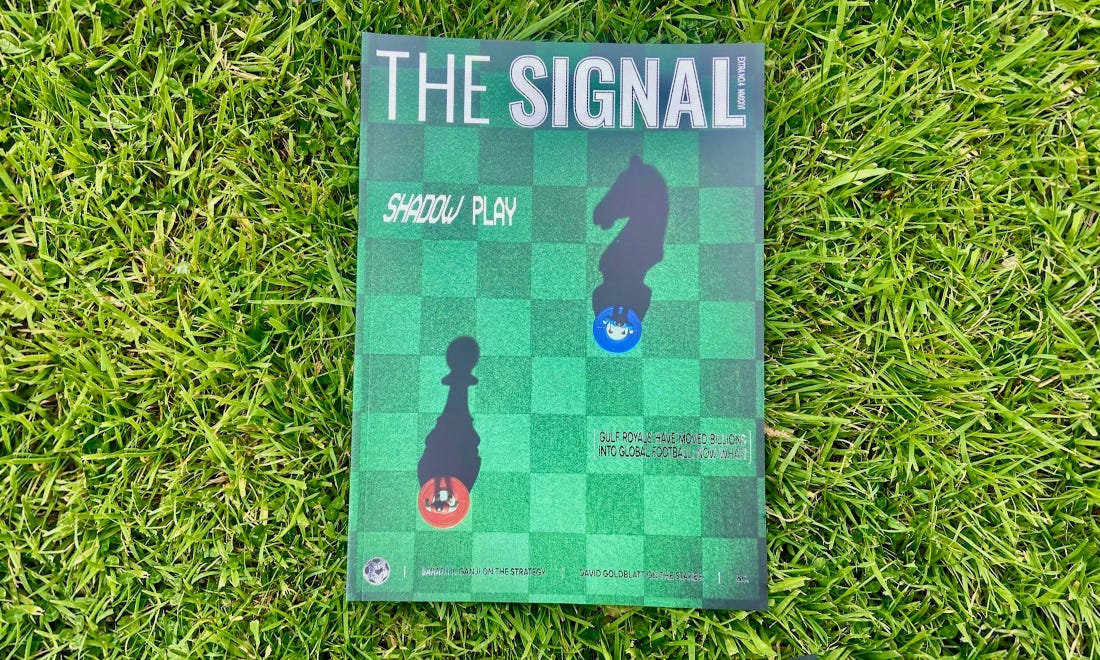
Gulf royals have moved billions into global football. Now what?
Read Shadow Play, a new, limited-run print magazine from The Signal about football and dictators.
On sale now in the U.K. and select markets globally.
Palestinian poet and physician Amer Badran explores why solidarity feels elusive everywhere except on the pitch
Every World Cup, millions of Arabs rally behind national teams that are not their own. A Moroccan victory is celebrated in Kuwait. Palestinians cheer for Jordan. Iraq’s flag flies from cafés in Syria, while Tunisians and Qataris share balconies and streets decorated with each other’s colours. For a few weeks, national borders seem to blur.
Badran begins with an intentional “glass half full” perspective, highlighting the fact that eight of the 48 qualifying countries are Arab, representing more than a third of all Arab states. Given the wars, conflicts, political instability, and limited sporting infrastructure that affect many countries in the region, he argues, this is a remarkable achievement. But representation in numbers is just the start. What interests him more is the unifying identity and joy that football provokes – and why it often evaporates with the final whistle.
His essay rejects the idea that Arabs rally behind each qualifying team for its chances of winning, or because it acts as an ambassador for the region. Instead, he suggests that football offers something politics can no longer offer: a safe space for collective belonging.
Supporting another Arab country’s football team comes at virtually no personal cost, he writes. Similar displays of solidarity in politics, however, can carry serious consequences. Badran imagines young people waving the flag of another Arab state or cheering one of its political leaders in the streets. The image feels almost absurd today, he writes, and in some countries could even invite accusations of undermining national security or serving foreign interests. Yet nobody would think twice about the same people hanging the flag of another Arab nation, or even England, outside their homes during the World Cup.
While politics demands that people define themselves through parties, doctrines, or competing national interests, football demands none of these. It offers joy, disappointment and anticipation – universal feelings that are strongest when shared. Because those emotions are expressed through the language, he argues, Arabic itself becomes the thread connecting millions of strangers watching the same match, celebrating the same goal or lamenting the same defeat.
The essay stops short of romanticizing this fleeting unity. Once the tournament ends, this sense of unity dissolves, replaced by the divisions that shape everyday political life. But what if these feelings captured the attention of political and intellectual elites off the pitch? If millions of people can experience a shared emotional identity, however temporary, perhaps it points to a different way of imagining community, one built not on ideology or power, but on language, collective feeling and the simple desire to celebrate together.
The original article ‘لماذا-يسهل-علينا-أن-نكون-عربا-في-المونديال’ was published in Arabic by Amer Badran for Raseef22 on June 20, 2026.
Raseef22 is an independent digital media platform based in Lebanon.
Summary by Cendrella Azar
Thanks for reading Translator! This post is public so feel free to share it.

A Swiss investigation into FIFA President Gianni Infantino’s pursuit of power through expansion
Arguably, the most powerful man on the pitch in this year’s World Cup is Gianni Infantino, president of FIFA, the world football’s governing body. At the opening ceremony on June 11 in Mexico City, actress Salma Hayek wore gloves as she handed him the trophy. Infantino took it with bare hands. And a lot of cash passes through those hands, according to an investigation by a team of Swiss journalists at Neue Zürcher Zeitung (NZZ).
After all, the World Cup is a giant money-making machine, and Infantino (referred to in the piece as “King Gianni”) has been at the helm since 2016. Asked by journalists about exorbitant ticket prices in this year’s tournament, he shrugged them off with a nod to French singer Édith Piaf: “I regret nothing.” He similarly dismissed criticisms around the US’s denial of entry to Somali referee Omar Artan, telling people to “chill”.
But some of the press has been less forgiving: NZZ cites a piece in The Independent which likens one of his speeches to Trump-style provocations, and called it a “shambolic start” to the World Cup. In typical Swiss fashion, the piece is more a reconstruction of facts as opposed to a scandalous report.
Under Infantino’s leadership, far more so than with his predecessors, the World Cup is a celebration of money more than anything else. This year’s tournament is expected to generate around US$13 billion for the association – double what it was eight years ago. According to the article, a key driver is the tournament’s expansion to 48 teams, creating more matches and, in turn, more revenue from ticket sales.
But some people have refused to take part in the most expensive World Cup in history. In apparent protest, Mexican president Claudia Sheinbaum skipped the opening ceremony, giving her ticket instead to a 21-year-old Indigenous woman. New York City mayor Zohran Mamdani bought 1,000 discounted tickets at US$50 apiece, distributed through a lottery. As for the US opening match against Paraguay, even his close ally and billionaire president Donald Trump said he wouldn’t pay for a ticket.
Infantino’s philosophy is simple: extract every dollar possible. Yet, as NZZ notes, he comes from humble origins. The son of an Italian working-class family in Switzerland, he dreamed of becoming a footballer. Instead, he studied law, became secretary general of UEFA, European football’s governing body, and quickly climbed to the top of FIFA.
Infantino is known for his erratic arrogance and political power games. Last year, he made the FIFA Congress in Paraguay wait for three hours while he travelled in the Gulf states with a Trump delegation. In 2022, he delivered a now infamous speech in Qatar in which he criticised the Western media for “hypocrisy” in its coverage of the country’s human rights record. In between dramatic pauses, he declared: “Today … I feel Arab, I feel African, I feel gay,” before explaining that he understands “what it means to be discriminated and bullied as a foreigner in a foreign country.”
A seasoned diplomat, Infantino sits comfortably unchallenged in the football universe, despite the controversy and criticism that surrounds him.
Part of this could be due to his expansion of the FIFA Forward programme, a grant scheme for national football associations to which he has allocated US$2.25 billion this year. He has also significantly increased World Cup prize money: the champions will now receive US$50 million, with a total of US$871 million distributed through programme – almost double the figure of the last World Cup.
Meanwhile, federations largely remain silent – NZZ says it reached out to various African federations for their views on ticket prices, and not a single one responded.
Next year, Infantino will run for re-election, and he looks set to maintain his reign over the sport.
The original article ‘Die Fussball-WM findet im Land des ungezügelten Kapitalismus statt. Dort vermarktet Infantino den Fussball grenzenlos’ was published in German by Dominic Wirth, Peter B. Birrer, Benedikt Koller and Stefan Osterhaus for NZZ on June 14, 2026.
NZZ is a leading Swiss newspaper.
Summary by Isabel Jacobs
Thanks for reading Translator! This post is public so feel free to share it.

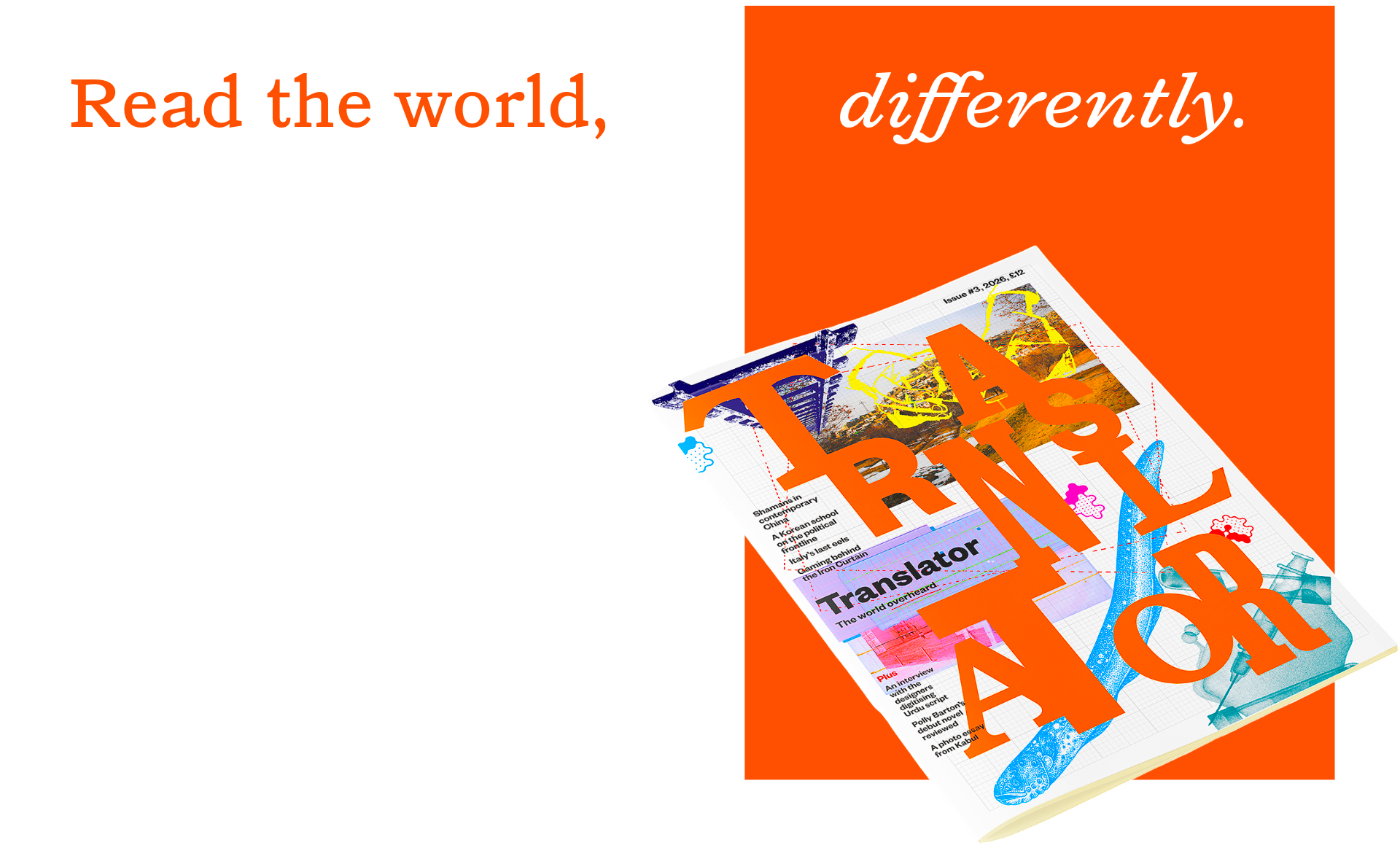
Support Translator to continue translating and publishing long-form reportage and journalism from beyond the Anglosphere by purchasing your copy of Issue #3 here.
No posts
Comments
Nothing yet. Say the first thing.
Sign in to join the conversation.