
Hello and welcome to the Dispatch.
Thank you to all that joined us at our recent sold-out Wine and Words event in London. It was wonderful to meet more of our community while enjoying wine paired with various readings from each issue of Translator magazine.
Contributing editor Nishita Jha shared some particularly powerful words about India’s recent youth protests – the largest in recent memory. Last week, the education minister stepped down, marking a major victory in the demands of the country’s youth. In case you missed it, we’ve published Nishita’s full reading here.
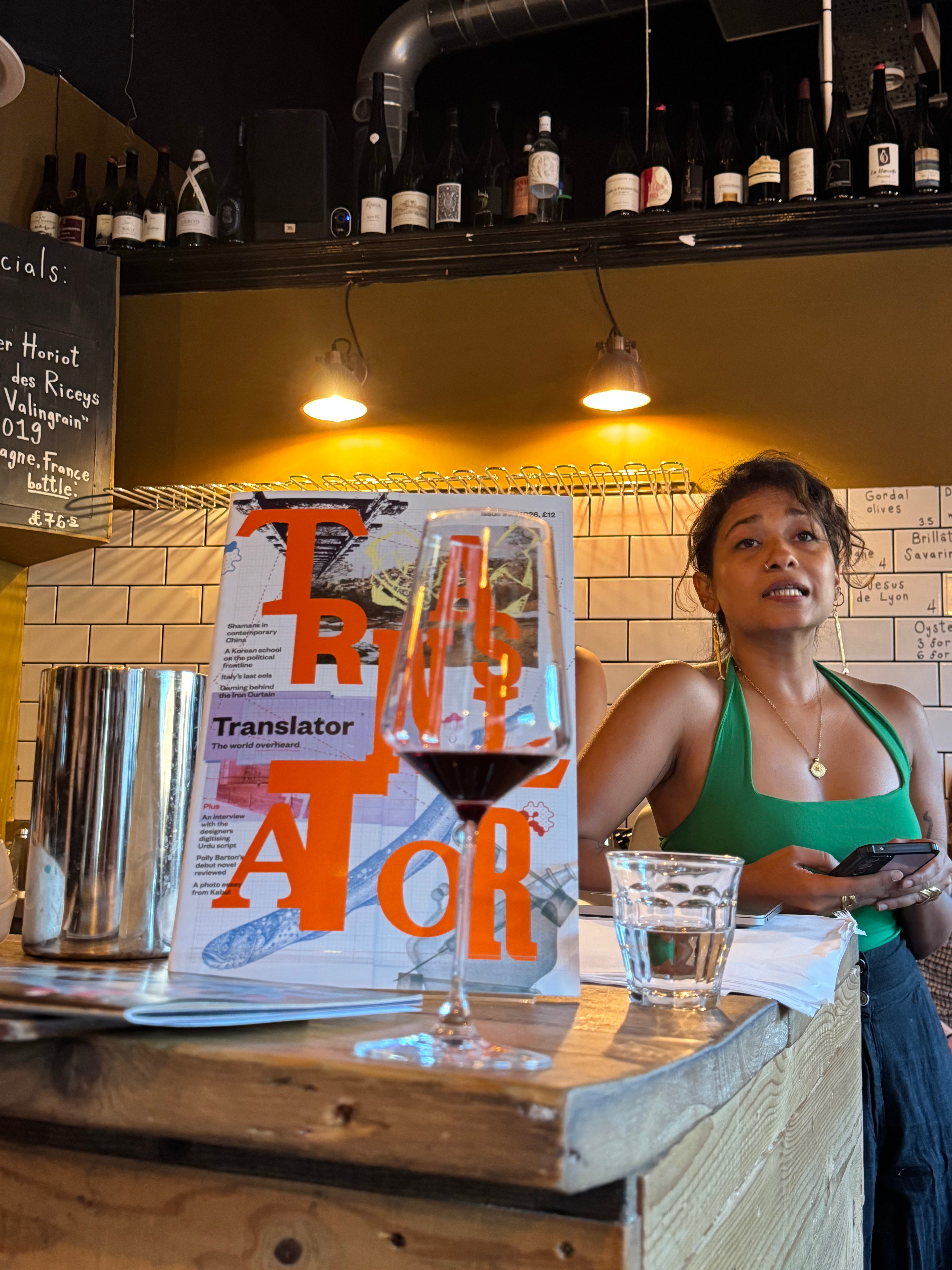
We’ll be hosting more Wine and Words events in the coming months so stayed tuned for more! In the meantime, please save the date for our end of summer party on Wednesday September 9 at the October Gallery in London. We’ll have readings from our forthcoming print issue, alongside details and special offers on our new membership offering. Join us to eat, drink and celebrate the world of journalism with a community of people who are interested in breaking free from their monolithic media bubbles. Details to come!
Now, on to the Dispatch, with stories from Pakistan, Georgia and Indonesia.


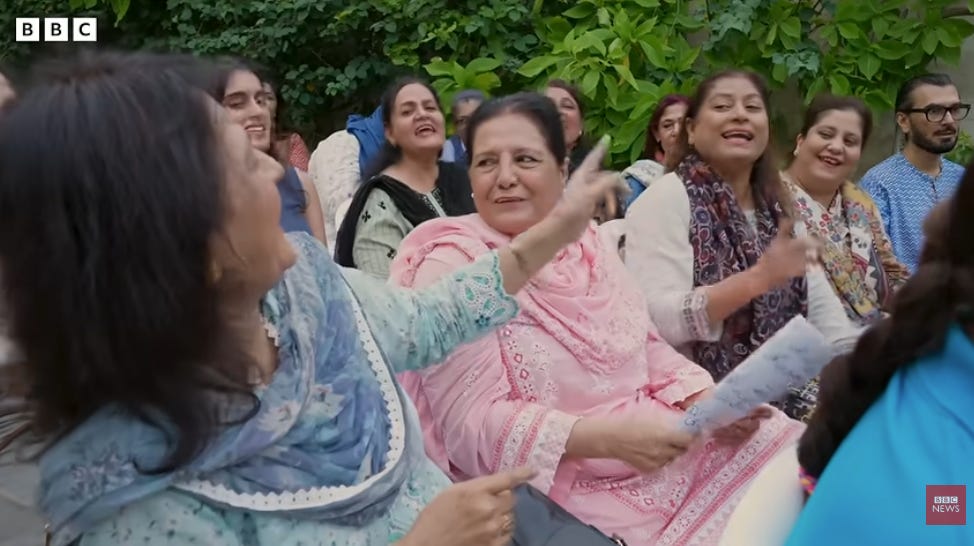
How a group of women finds joy and nostalgia in the crowded capital
“We are all bathroom singers here,” says Sehr, one of the women at a gathering called Sing Along Karachi, in a video story published by BBC Urdu last month. The group comes together once a month in Karachi, Pakistan, to sing. Sehr laughs as she describes the group as amateurs. But because they’re a chorus, no one feels singled out or nervous that they don’t have the vocal chops to be part of such a group.
The “Sing Along family”, as one of the members calls them, comprises mostly of women. They meet in a simple open-air space, surrounded by bougainvillea, champa (frangipani) and other lush green plants. Accompanied by a small band with a tabla, keyboards and harmonium, they sing a mix of classical Indian and Pakistani songs, as well as popular wedding and celebration songs.
The group is the “baby” of Afshan Ahmed, who first held such gatherings at her office at a cultural centre. When she retired in 2007, her daughter encouraged her to keep the tradition going and offered a space where people could meet. It is entirely free and open to the public, though it tends to attract older women. Younger generations might find this a novelty; recent Instagram reels have praised the approach to “slow living”. But for the older crowd, the gathering is a much-needed source of joy.
“This is therapy for me,” says Fareeha, another singer. During the two hour session, she is “unreachable” by family, and her phone is switched off. People sing and dance with abandon here; every gathering ends with a dhamal, an ecstatic dance often performed at shrines, accompanied by a frenzied drum or dhol beat – and there is little fear of being judged. “We’re too old for that now!” Fareeha says.
One of the group members describes the gathering as a “mehfil”, which has lovely festive connotations. She says she feels this kind of singing and dancing is a throwback to the days before Pakistani weddings were taken over by professionally choreographed group dances to thumping Bollywood mashups, and hired bands and singers entertained the guests.
There is a dearth of truly communal spaces in Karachi, particularly for older Pakistanis. DJ sets at upmarket cafes, raves or concerts are for a certain kind of young (and moneyed) crowd. That’s why Sing Along Karachi is an important physical space for the pursuit of joy.
“We have fulfilled all our responsibilities,” says Fareeha. “Now it is our time to live.”

The original video ‘Sing along & dance to blow your worries away, a unique musical gathering in Karachi’ was first published in Urdu by BBC Urdu on July 9, 2026.
Summary by Sanam Maher
Thanks for reading Translator! This post is public so feel free to share it.

“Hate speech” offenders now face heavy fines – but the victims aren’t who you’d expect
Georgians who use Facebook to blow off steam now have to watch their language. The Caucasus nation’s leadership has deployed a police squad to scroll through social media – primarily Facebook – in search of comments that cross the line from political criticism into outright profanity. But the reality isn’t so clear cut.
Officially, the squad carries the Orwellian title of the Department for Combating Hate Speech. Unofficially, it has earned a satirical moniker: the Ministry of Scrolling.
Established on June 1, this tiny, 10-person task force has been actively reporting cases of Facebook rudeness to the courts, resulting in hefty fines for offenders. The Georgian service of Radio Free Europe/Radio Liberty (RFE/RL) reported that since June 20, the department’s referrals have resulted in legal proceedings against six critical journalists, four opposition politicians, and nine anti-government activists.
Fines range from 3,000 to 6,000 lari (approx. US$1,100-2,300) – a steep price to pay for cursing online in a country where the average monthly salary is around US$830.
In a move that’s widely seen as an escalation in the state’s crackdown on dissent, the squad’s primary job appears to be shielding political elites – specifically the ruling dynasty of billionaire oligarch Bidzina Ivanishvili – from public opprobrium. Based on the department’s referrals, courts in Tbilisi fined two citizens in June for insulting the oligarch’s son, Bera, on Facebook.
Founder of the ruling Georgian Dream party, Ivanishvili has governed Georgia as its formal or informal leader for 14 years, appointing and dismissing top officials at his whim. The past two years have seen widespread protests against his rule, to which the government responded by progressively tightening restrictions on freedom of expression and assembly.
The work of this new Facebook police stems from legislation passed two years ago that made offensive language directed at politicians punishable by law. Now, with a dedicated squad feeding cases directly to the judiciary, the legal machinery is moving at full speed.
The squad targets more than just direct insult: prominent local TV host Vakho Sanaia was fined for a sarcastic Facebook post in which he ironically asked commenters not to call the parliament speaker a “- - ck” as that is illegal in Georgia these days. He was fined 6,000 lari (approx. US$2,300).
In a further twist of irony, the court fined a citizen for making unflattering comments about Sanaia himself. The journalist publicly defended the user who insulted him, arguing that citizens should be free to post whatever they wish. Under current Georgian law, however, an injured party is not required to file a complaint—a referral from the “Ministry of Scrolling” is all it takes.
“This is hypocrisy,” the TV host told RFE/RL, arguing that the government is merely trying to create a façade of political neutrality by volunteering to “protect” occasional opposition figures and critical journalists.
Human rights watchdogs have strongly condemned both the “Ministry of Scrolling” and the laws that allow it to prosecute speech without a victim’s consent. The introduction of this police squad “constitutes yet another alarming example of the growing and systematic restriction of freedom of speech and expression in the country,” wrote Tbilisi-based Social Justice Center.
This summary draws upon several original sources as linked above, primarily from the Georgian Service of Radio Free Europe/Radio Liberty in July 2026.
Summary by Giorgi Lomsadze
Thanks for reading Translator! This post is public so feel free to share it.
Indonesian women’s rights groups demand better protections against misogyny and harassment for livestream hosts
When TikTok’s e-commerce platform launched in 2021, Indonesia became one of its biggest markets. Even after a temporary ban in 2023, TikTok live shopping
today is ubiquitous. But these livestreams, usually hosted by women, have
become a cesspool of harassment and misogyny.
In a feature for Konde.co, Indonesian writer Dulce Maria Bella Natalie highlights the mental and physical toll on women sellers, who can talk live on camera for hours at a time to describe their products and answer an influx of customer questions.
TikTok live hosting is a growing career path for young people in Indonesia, where unemployment remains a major economic challenge. A 2025 study by Tokopedia analyzed over 786,000 vacancies, of which more than 10,000 were specifically for TikTok live hosting.
But the job is far from easy. Live hosts often work long hours to reach sky-high sales targets. TikTok’s poor comment moderating means hosts regularly see unfiltered harassment and hate speech on their pages. This includes inappropriate insults and comments about the host’s body, which can escalate to violent and sexual remarks that in some cases have led to online stalking and doxing.
Several TikTok live hosts recounted these experiences at a conference held in May by Perempuan Mahardhika, an organisation that supports female students and workers across Indonesia. Gig economy researcher Anindya Desi Wulansari says female hosts need to grapple with the gendered dynamics of an unpredictable algorithm while holding users’ limited attention spans to maximize sales.
“With technology, it’s easy [for companies] to focus on the numbers to determine
output. But what should be the responsibility of the company [sales] now lies
in the hands of the hosts,” she said.
Live hosts also have to maintain a reputable image for the online store by keeping a smile and friendly demeanour, despite the constant harassment and unstable income.
Groups like Perempuan Mahardhika can help workers find community in a dehumanising industry, and share ideas about how to protect and advocate for themselves. But there is much to be done.
The experiences of Indonesia’s female TikTok live hosts are a reminder that
misogyny persists online – and that further protections are needed to create
safer working conditions for women. Digital misogyny shouldn’t be synonymous
with content creation.
Dulce ends her piece by commending the resilience of the women hosting these livestreams, and argues that internet safety for digital workers needs to be addressed by corporations and governments alike.
The original article, ‘Di Balik Maraknya Tren Live Shopping, Ada Pelecehan
Terhadap Host Live’ was first published in Indonesian by Dulce Maria Bella Natalie in Konde.co on June 12, 2026.
Konde.co is an Indonesian publication that highlights the perspectives of
women, with an emphasis on marginalized communities and intersectionality.
Summary by Anggi Pande
Thanks for reading Translator! This post is public so feel free to share it.
Thanks for reading this week’s Dispatch! Let us know what you thought of the stories in the comments below – and please do get in touch with other suggestions for pieces you’d like us to summarise.
We’ll be back next week.
Translator


Support Translator to continue translating and publishing long-form reportage and journalism from beyond the Anglosphere by purchasing your copy of Issue #3 here.
No posts
Comments
Nothing yet. Say the first thing.
Sign in to join the conversation.