
A few years ago, I found myself at a crossroads searching for a more thoughtful approach to my work. I had spent the better part of the last fifteen years providing coaching to teams from Canadian nonprofits, government ministries, charities, and social purpose organisations looking to leverage social innovation tools to improve performance, and achieve greater social impact. Through Garrow&Evoy, the social enterprise I co-founded with Stephanie Garrow, we have worked with over 250 organisations, one organisation at a time, helping social purpose leaders to clarify their organisation’s outcomes and obtain the support that they need to be able to achieve positive change and transformation. We have worked from coast-to-coast with organisations of all sizes, in French and English, from grassroots to pan-Canadian, touching all sectors of society: Education, Employment, Climate, Health, Poverty, Community Development, Culture.1 I have done my share of impact-focused, capacity-building, strategy development work.2 This work has benefits, providing more strategic clarity, bringing teams together around shared intentions and common purposes. It also strengthens the underlying fabric of the community sector as a whole, weaving together individual leadership skills, innovative practices, organisational resilience, and promoting collaboration within complex socio-ecological systems.
After fifteen years on this particular path, I felt like something else was needed. I could feel a questioning set in and I asked myself “Is this working?” Although, I recognized the value of the work, I also knew that it did not adequately support the implementation phase3, nor did it explicitly foster building bridges towards more regenerative and caring ways of living together, both in neighbourhoods and workplaces. Finally, and most significantly, there was a blind spot with respect to power dynamics inherent within the institutions and systems in which these practices were occurring. The extractive and exploitative underpinnings of these systems create a context in which many of us feel distanced from the lifeways of our ancestors, leading to a dissociation from a wider cosmology that uproots practices from deeper traditions and beliefs. Without addressing these issues specifically, patterns of harm and oppression would continue to weigh down strategic decision-making.

This set me adrift. I wondered what to do next? I considered the work of people who engaged in deep-seated change efforts a vital resource. The people I have worked with over the years, including myself, often have to contend with significant medium- and long-term consequences: Lack of recognition, surveillance, violence, fatigue and exhaustion, and a pervasive lack of resources that hinders commitment and the pursuit of meaningful impact. In her book “Hospicing Modernity”, Vanessa Machado de Oliveira Andreotti summarized the predicament this way:
“Modernity is keeping us in an immature state; and there is a need for a political practice of healing, of radical tenderness, that can enable us to step up, to grow up, and to show up differently. This involves unlearning our learned ways: of thinking and imagining; of sensing and feeling; of relating to one another, the earth, and the cosmos; of facing life, fear, pain, loss, and death.”
This is work at a deep roots level. A call to nurture life, and enrich the soil from which change can flourish. Like the mycelium, this deep rooted practice delves into alternative ways of knowing, doing, and being by embracing heart-centered and spirit-driven wisdom that is intuitive, embodied, and life-affirming. It posits itself in opposition to an extractive and exploitative dominant culture. I believe that to truly transform systems, we must do the inner work.
Centering inner work and healing practices is a cornerstone of systems change, and I would argue that it cannot occur without it. It creates the inner spaciousness and supports the external conditions for systems transformation to occur. While there’s certainly no one-size-fits-all approach to inner work, it can be linked to collective healing practices which cross historical, cultural and geographic boundaries. Important characteristics of inner work include:
Honouring and welcoming the cultural traditions, identities, and languages of all people affected by or participating in social change processes.
Introducing embodiment practices like dancing, singing, meditation, Qigong, and somatic work to help participants reconnect to their physicality and regulate their nervous systems.
Centralizing horizontal, relational practices, such as healing circles, that encourage empathic listening and reduce power imbalances.
Mindfulness and other consciousness-cultivating practices to strengthen people’s awareness of and capacity to host their own and others’ activated states.
Reconnecting to nature and its healing power as a foundational part of the process.
Stepping into the power of telling and owning one’s story and bearing witness to others’ stories.
Imbuing the process with sacredness through rituals, such as making a traditional offering or blessing, reading a spiritual text or poem, acknowledging ancestors and previous generations, or sharing traditional legends and stories.
Certain practices have deep roots and long ancestries, drawing on traditions communities have preserved and practiced for thousands of years. In the global north, however, they tend to be less frequent in the context of mainstream social change efforts, which rarely prioritize, financially support, nor consistently incorporate inner work and collective healing practices with intention and skill. This is because leaders and funders tend to view them as irrelevant/inappropriate/trivial/unnecessary (choose your adjective), and unrelated to achieving their articulated outcomes, or not a good use of time when it comes to solving the problem at hand. Mostly, I think, this work is sidelined because it remains deeply uncomfortable and potentially disruptive.
The Knowing/Doing Gap
In a statement that summarizes the global north’s predicament, Professor Otto Scharmer states:
“We are unable to effectively tackle the world’s adaptive problems, like sustainable development, in part because we lack the individual and collective inner capabilities and skills to do so. What we are facing in our time of global disruption, is not a lack of knowledge, but rather the inability to turn that knowledge into the change we need to see in the world.”
Scharmer refers to this as the knowing/doing gap; we know what the problem is and what we should be doing about it, but we aren’t doing it. Instead, he calls for a radical change in focus and the need to cultivate our skills of deep listening and self-reflection, and I would add healing, which can allow us to connect to the emerging future and welcome a shift in ourselves and our identities.
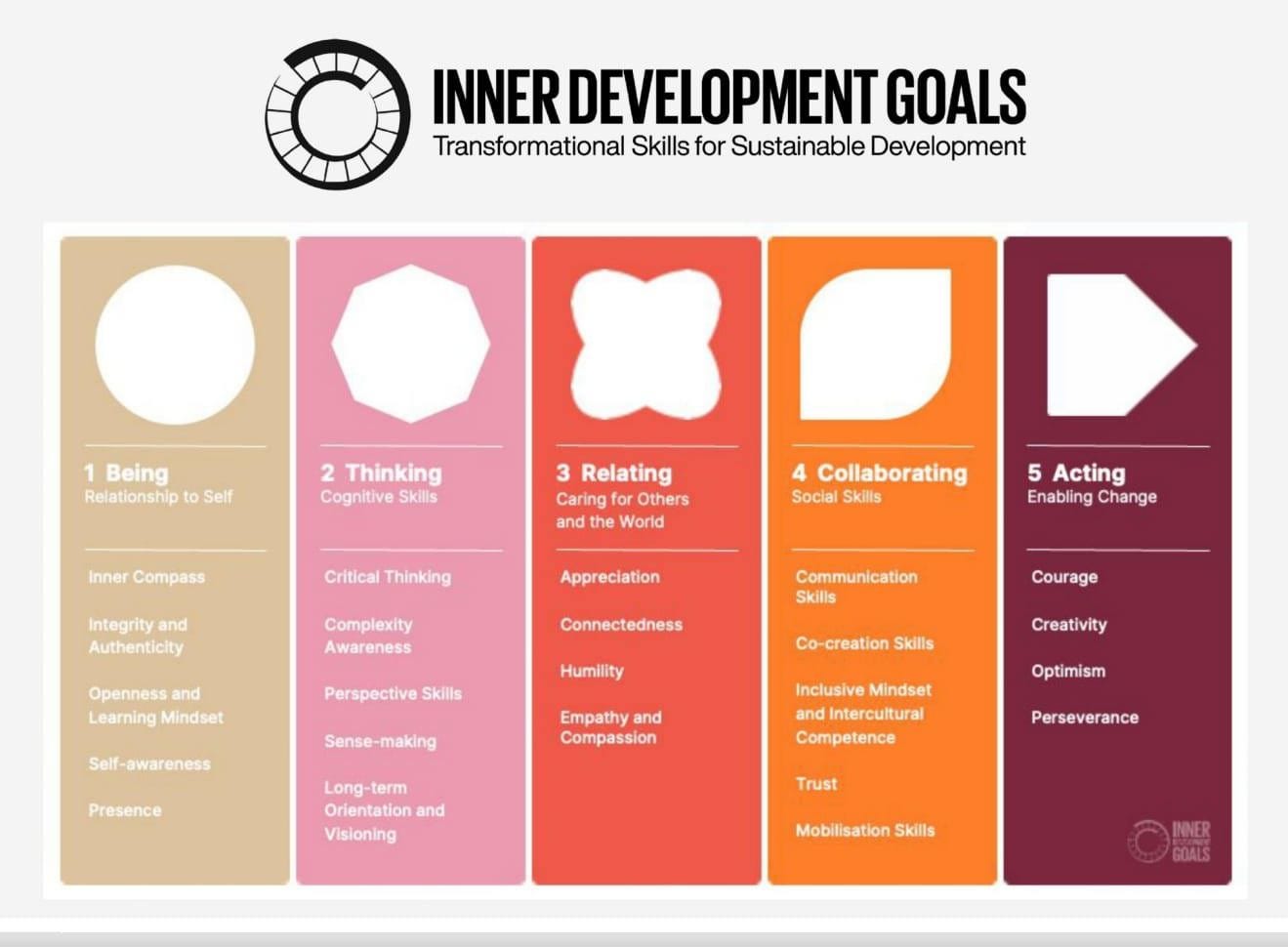
Inner work and healing approaches have continued to be present within many communities, including First Nations and BIPOC communities. Peoples’ ongoing engagement and adaptation of these practices has led to their infiltration into social change efforts in the global north. A notable example of this is the United Nations adoption of the Inner Development Goals Framework, that simplifies a complex field of human development to help identify, understand, communicate, develop and integrate the inner skills needed for sustainable development.
So this is the work…or at least the part I want to continue to explore. Doing the deep spiritual and cultural work to generate a container that is emergent, and cultivate it into something that can feed and nourish and give life again. Fostering a space that deepens practice, with imagination and creativity. Building relationships with people, where I can share some of my experiences, and learn from theirs. Looking beyond what I already know, going to the edge and looking out, knowing there are other ways of being to learn from, and, as Mohawk Author and Seedkeeper Rowan White states “growing us into humans that are worth descending from; and becoming responsible ancestors and descendants, by reclaiming and recovering our agency in defining what it means to live a good life.”4
Stephanie Garrow and I are celebrating 15 years of community building and have established that we have worked across 10 provinces, in 14 of the 17 regions of Québec, and 17 out of the 18 boroughs in Montreal, where we are based.
Doing my part to maintain modernity on life support, mostly through soft reforms, as Vanessa Machado de Oliveira Andreotti has argued convincingly in her book Hospicing Modernity: Facing Humanity’s Wrongs and the Implications for Social Activism, 2021.
Robin Corey, a fellow Innoweave coach, and amazing facilitator, infamously said that if building a theory of change was at the heart of our practice, it frequently lacked the “legs” to move it into durable and sustained action.
“Seeds, Grief, and Memory with Rowan White,” Becoming the People Podcast with Prentis Hemphill, 24 May, 2021.
Comments
Nothing yet. Say the first thing.
Sign in to join the conversation.