
New York City's congestion charge is working as well as could be imagined. Even minor downsides aren't materializing. Yet the long, exhausting path to this success highlights an anger-inducing reality: hundreds of millions of people in cities worldwide will spend the next decade sitting in car exhaust, waiting for their chance to experience the miracle of congestion pricing.
As the co-founder of a congestion pricing startup1, I’ve met ambitious, big-city transportation officials, all anxiously following New York's example, confidently stating "We’re going to be the second city!" But without a fundamentally changed playbook, each will run into a similar morass of delays, controversy, and uncertainty. It would be shocking to see one additional U.S. city launch a congestion pricing system before 2030.
New York's congestion pricing experience followed the pattern from London and Stockholm: public opinion cratered just before launch. Now, six months in, congestion pricing is becoming normalized, accepted reality. The conventional wisdom from advocates and the public sector: We just need leaders with iron stomachs who can stand firm during the predictable blowback, then reap the rewards.
But that prognosis is both too simple and insufficient. Because for every London or Stockholm success, there are at least two failures in congestion pricing's invisible graveyard. The blind acceptance of the congestion pricing status quo persists, with required years of study, tenuous approval, and a single monumental launch—the same treatment as the largest public works projects. Newer technologies and associated approaches enable a genuine alternative.
New York's Plain Bagel approach—the infrastructure-heavy, all-or-nothing model copied from London and Stockholm—has created a rigid system that's either fully operational or in limbo. This binary constraint isn't accidental; it's baked into the underlying technology and procedural framework that have been adopted, uncontested.
It's worth remembering that from a tech perspective, "gold standard" systems are at this point quite old. London’s launched in 2003 and Stockholm's finalized in 2007. The Palm Pilot and Blackberry technology-era they rely on—camera-based license plate readers and RFID tags—were once cutting edge. That license plate-reading tech is now surpassed by smartphone apps that catch bike lane blockers, and megastores like Best Buy deploy millions of paper-thin tags to track inventory.
The cameras may be cheaper today, but the labor to install and maintain them, the digging and running of wires, and the inefficient backoffices still add up to nine-figure costs, often in perpetuity. Whether it's Chicago, LA, Boston, or San Francisco that steps up next, their leaders will first face sticker shock at the costs of launching & running a standard congestion pricing system, then realize they’ll need to sell their constituents on the sky-high tolls required to make it all pencil out. And unlike New York, most cities don't have that ideal island geography making a ringed cordon toll straightforward.

Pre-Abundance, the evocative everything bagel metaphor—of progressive jurisdictions’ attempts to perfect the combination of policies, regulations, and incentives—always felt incomplete. That bagel is not static, sitting on a plate; it's being pushed up a mountainside through the collective Sisyphean efforts of public servants and publicly-minded individuals and institutions.
Too often, and despite the best intentions of many, the path up the mountain proves too treacherous and the bagel fails to reach the top. But rather than locking in that progress, current procedural realities send the bagel tumbling down to the valley floor. Perhaps one day, a different group of high-minded individuals will prepare a new, perfect bagel and attempt the ascent again. Hopefully the path has not been made steeper or longer in the interim.
The solution to too drawn out, policy longshots isn't hoping for saner politics or braver leaders—it's better technology and process. While cities keep attempting the same expensive, all-or-nothing approach that doomed previous efforts, proven alternatives flip the script. Instead of betting everything on a single perfect launch, cities can build incrementally on digital foundations that turn each step into sustainable progress.
In Congestion Pricing Part 2, I highlighted the City’s underappreciated taxi & ride-hail fee. Even better examples of infrastructure-light approaches demonstrate the ability to serve as a digital and policy foundation. Rather than deploying hundreds of millions of dollars of sensors, steel, and mainframes, these systems leverage standardized and distributed technologies in vehicles:
Europe's EETS scheme collects tolls on long-haul trucks, spanning 16 nations and exceeding over €10 billion annually. It eschews physical toll booths for satellite-based2 tracking of freight along public highways and across borders.
States like Utah are deploying mileage-based road-usage fees that let EVs pay their gas tax-equivalent through GPS and telematics onboard vehicles.
An infrastructure-light approach inspired by these examples promises cost reductions of an order of magnitude. It also opens up an opportunity to disambiguate the standard "Congestion Pricing" construct from its benefits: fewer discretionary car trips, reduced pollution, consistent transit funding, reliable trip times, and optimized deliveries.
Agile is no longer cutting-edge software delivery methodology, but it remains avant garde in government; slowly disseminated by USDS at the federal level before that agency's recent transmogrification. Unlike the old-school approach of attempting to define all requirements upfront, agile iterates through building and refining core features incrementally. Agile’s most high-profile government success was the successful launch the FBI’s Sentinel program ahead of schedule and under budget, following two separate failures spanning nine years.

The beauty of applying agile to a digital congestion pricing foundation means policy can ship like software. Rather than the two distinct summits of the 2019 ride-hail surcharge and the congestion zone entry fee finally turned on in 2025, New York could have bridged the deployments with a continuous progression:
Year 1: Reduced surcharge for EVs on Air Quality Alert days
Year 2: $1 parcel delivery fee targeting the largest fleets (Amazon, UPS, FedEx)
Year 3: Surcharge zone expansion to Upper Manhattan and Downtown Brooklyn
Year 4: Off-hour truck delivery discounts
Each tweak entrenches and sustains momentum, creating plateaus instead of cliffs. The policy and program specifics aren't crucial, but the digital infrastructure undergirding them is, as is the continued progress enabled by that infrastructure.
Lightweight digital deployments and agile cycles aren’t panaceas, but they can help flatten the daunting inclines facing ambitious policy. The comparison between Infrastructure-Heavy and Digital-First is stark across the dimensions that matter:
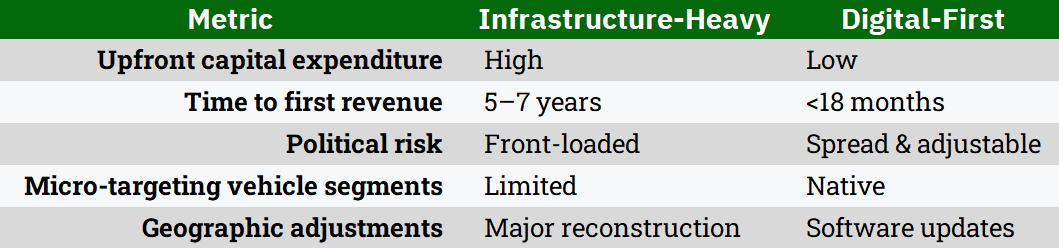
The real prize isn't just making congestion pricing cheaper and faster to deploy—though it does that spectacularly—it is creating a nimble technological foundation that makes the next dozen improvements and tweaks easy and obvious. This is how digital transformation is supposed to work: robust and flexible underlying infrastructure ensures each new capability is incremental, not a massive undertaking. For cities, this collapses the barriers to innovation; leaders need only be competent at adopting proven digital tools, not transportation policy heroes.
The great irony of holding up London as the congestion pricing model is that it ignores the heroic governance work that made the program possible. Britain established Transport for London as a precursor to congestion pricing, fully integrating all transportation systems under mayoral authority—from curbs to buses to Underground operations. This unified control enabled a coordinated launch with enhanced transit service from day one, and is why London's mayor can deploy a £200 million Ultra-Low Emission Zone with no revenue guarantees, but definite, massive air quality benefits.
Restructuring governments may seem more daunting than the usual strategy of sustaining effort and waiting for the alignment of heroic leadership and perfect politics. But without major reforms to today's infrastructure and procedural hurdles, NYC will remain a lonely pioneer.
The better alternative is to start building on digital foundations today. The digital approach changes everything: cheaper, faster, iterative, and politically sustainable. By flattening the incline through better technology and agile processes, we don't just help the second city—we help the fiftieth.
That's how cities break the Sisyphean cycle and finally deliver congestion pricing at scale.
The startup was on the runner up team for the delivery of congestion pricing in New York.
It primarily uses the European GALILEO constellation for Global Navigation Satellite System (GNSS), rather than GPS
Comments
Nothing yet. Say the first thing.
Sign in to join the conversation.