
I’m often asked what the first thing companies should do when shifting into transformation guiding. I used to answer, “Encapsulate your experiences”. I no longer think that’s true!
To remind you of encapsulation, here’s what I wrote about it on p. 92 as the core framework of chapter 4, “Shifting from Experiences to Transformations”:
So what does it take to turn transformative experiences into transformations? How do you guide aspirants in “bringing home” what they did, what they learned, how they grew? And how do you make it last? By encapsulating the experience with three activities: preparation beforehand, reflection afterward, and integration on an ongoing basis, as seen in figure 4-1.
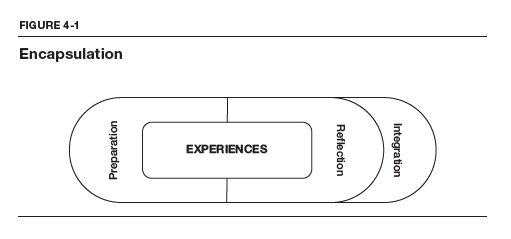
You can go to that chapter to learn the details of what encapsulation entails, but I’ll also mention it is the most academically researched and proven-to-work concept in the entire book. (See endnote 4-26.) I also just checked and I mentioned the concept 49 times in its pages!
Here is paragraph from one of those pages (166) where I emphasize its importance:
For those who stage experiences today, seek to shift up the successive levels of experiences from merely memorable to truly transformative. Remember that encapsulation is the key to progressing to that level, and for many guests it’s all that is required to do so. This will allow you to create greater economic value from your current offerings, and then to unequivocally get into the transformation business through the middle or even top segment of the Delta Model as your guests turns into aspirants.
And it does remain the key to shifting from experiences to transformations, but it is not the first thing you should do once you determine to make that shift.
I’ve been asked that question on a number of the many (so many!) podcasts I’ve done since the book came out, and I surprised myself by switching my answer from encapsulation to what I think is more important and the best place to start: uncover your meaningful purpose.
Uncovering your meaningful purpose is what every business should do!
And that’s because unless you already have one, it’s what every business should do next!
I wrote about having a meaningful purpose in chapter 5, “Staging Transformative Experiences”, the chapter that took the key elements of experience staging from The Experience Economy – robust, cohesive, personal, and dramatic – and updated them from their original focus on merely memorable experiences to truly transformative ones.
Regarding that second element, staging cohesive experiences, I introduced the concept of theme-ing, coming up with “the organizing principle of the experience, your intention for everything you design and stage, serving as a two-edged sword for determining what is in the experience and – perhaps even more important – what is out” (p. 100). I closed that discussion with the exemplar Heartland Health, which embraced as its meta-theme the three-word phrase “Live Life Well”, which caused it to change its name to Mosaic Lifecare.
Meaningful purpose is taking the theme of an experience up to the level of the entire organization
I then took it to the next level in the sub-section on “From meta-themes to meaningful purpose” (pp. 102-107), introducing the concept this way:
For Mosaic Life Care, since its meta-theme of Live Life Well encompassed the entire enterprise, it became the enterprise’s meaningful purpose. This is the corporate raison d’être, the enterprise’s reason for existence, why the business exists beyond making money, with profit being the measure of how well an enterprise fulfills its purpose. As Jim Gilmore and I wrote in our book Authenticity: What Consumers Really Want, a sense of purpose “gives work meaning, defines why the enterprise is more than an accumulation of processes and an aggregation of employees, and points workers toward a common goal.”
Purpose brings together the interests of employer, employees, and customers while defining the company’s overarching intention. It guides, inspires, and unifies those affiliated with, contributing to, and impacted by the enterprise. And purpose manifests outwardly through your economic offerings, cohesively aligning them around why and how you create economic value. Your meaningful purpose should be inspirational, aspirational, and timeless, providing ongoing stability internally even as everything else shifts around you externally.
Again, every business should have a meaningful purpose.
Do you know what the purpose of your business is, beyond making a buck?
Comments
Nothing yet. Say the first thing.
Sign in to join the conversation.