

Andy Kessler is my second-favorite columnist in The Wall Street Journal. (With no offense intended, #1 is Holman Jenkins who just has this eye for smelling out the absurdity of popular opinion in the world of business and then calling it out.)
Mr. Kessler (we’ve interacted a few times via email, but haven’t met so don’t feel comfortable calling him Andy....) has a technology and investment background and spends “everyday sniffing out what comes next” as he puts it in his WSJ bio above.
What he sniffed out in his July 20, 2026 column was understanding the difference between healthcare and sick care via the company Atria Health and Research Institute. The company declares it is “on a mission to accelerate a global shift from reactive sick care to proactive, preventive health care”, exemplified by Kessler quoting Alan Tisch, its cofounder and CEO as saying:
“This system isn’t scaling, so split healthcare and sick care into two systems: one of them reactive care covered by employer and government, the other one a prevention allowance – a 20% allocation. . . . Consumers choose where they spend it.”
The columnist then adds his own list of possibilities: “At-home genetic or blood tests. Prenuvo body scans. Ro. Wearables. Amazon’s One Medical. Artificial intelligence over time can peruse the data, find patterns and change the interpretation and action layers.”
Why this post? Health & wellbeing affects everyone on a very personal level
I know just two weeks ago I wrote another post on learning from healthcare, but in addition to the timeliness of this WSJ column out last week, health & wellbeing is one of the four spheres of transformation, and it therefore affects everyone on a very personal level. I for one am going through some physical therapy on a balky hip, trying to prevent it from ballooning into, say, a hip replacement. That’s a piece of the sick care industry I would really rather avoid.
Here’s what I wrote as the definition of this sphere on p. 40 of the book:
HEALTH & WELL-BEING: This sphere encompasses all of health care, including hospitals, clinics, doctors, pharmaceuticals, medical devices, and everything else—not just transformations themselves but commodities, goods, services, and experiences—involved in the diagnosis, treatment, and care people need to deal with, recover from, and even prevent illnesses, injuries, or conditions. It also includes activities having nothing to do with illnesses or injuries but contributing to the ongoing condition of people across factors physical and mental, emotional and social, things tied to life quality and contentment. Such well-being offerings that facilitate human flourishing—although often sold as experiences, not transformations—include spas, fitness centers, classes, therapists, coaches, and mind-body practices such as meditation, mindfulness, yoga, and tai chi.
So Atria isn’t about wellbeing but rather is splitting the health component into the constituents of one, treating illness, injury, etc., and two, preventing, as much as possible, the need for such treatment.
Splitting healthcare into two components: treatment and prevention
How does the company do it? Not by being a concierge medicine outfit, a great health innovation that Tisch nonetheless competitively denigrates: “What concierge doctors delivered was their cellphone number and lower wait times. So you basically are paying thousands or tens of thousands today to get the same thing that you had in 1990 for free.” Rather, Atria is a “a precision-based approach to preventive medicine and longevity” that, as CEO Tisch says to columnist Kessler:
“I have $25 million worth of imaging equipment here in New York.” Atria’s fees cover “all imaging, labs, 15 medical subspecialties from internal medicine, cardiology, neurology, gynecology, endocrinology, GI, pulmonology, medical dermatology, pediatrics, geriatrics, emergency medicine, as well as lifestyle, nutrition, sleep, exercise, physiology, functional medicine, and naturopathic medicine, as well as gerotherapeutics, all in one place. We need to build something that is going to change healthcare long term.”
That’s an impressive list, even if I had to look up those last two items….
With guiding being the economic function of transformation, I was also impressed in discovering that every Atria member has a personal “Chief Medical Officer” (corresponding, more or less, to how adventure travel guide G Adventures assigns a “Chief Experience Officer” to every guest party).
One of the models in The Experience Economy that I never found a place to bring into The Transformation Economy was this insurance progression of economic value:
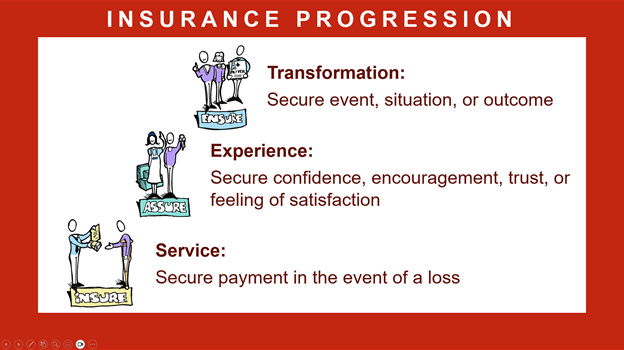
I just love how the terms insure, assure, ensure fit together so perfectly with the shift from services to experiences to transformations.
The terms insure, assure, ensure perfectly describe the shift from services to experiences to transformations
While it came out of the insurance industry, I have often used it with healthcare companies to point out that no one wants to interact with the healthcare system; they would much prefer to have such organizations work to ensure that they remain healthy (and have wellbeing). That’s exactly what Atria is doing, including with its strong attention to longevity.
Atria currently has locations in New York, Palm Beach, and Los Angeles (Beverly Hills, actually) and as you might imagine charges a pretty penny for its transformation offering – $100,000 membership fee plus $60,000/year according to The New York Post – so it is geared to the very wealthy.
The wealthy subsidize the development of new economic offerings for the masses
Understand, though, that what the wealthy have always done is subsidize the development of new economic offerings of all stripes, which companies then figure out (at least since the Industrial Revolution) how to bring down to the masses. Without the wealthy being willing to buy very expensive, craft-built cars beginning in the late 1890s Henry Ford would not have the wealth to develop the system of Mass Production. Thanks to that innovation, by the 1920s the middle class could afford new cars. The same thing happened with appliances and all manner of physical goods, as well as services such as limousines begetting Uber, and experiences such as elaborate safaris developing into G Adventures.
I have no doubt that transformations such as what Atria and the longevity movement are doing will eventually reach down to the masses. Kessler even cites Amazon One Medical, where the company famous for wringing costs out systems bought a concierge practice and turning it into lower-cost on-demand healthcare, of both the sick care and the preventative kind.
Joe
© 2026 B. Joseph Pine II
No posts
Comments
Nothing yet. Say the first thing.
Sign in to join the conversation.