
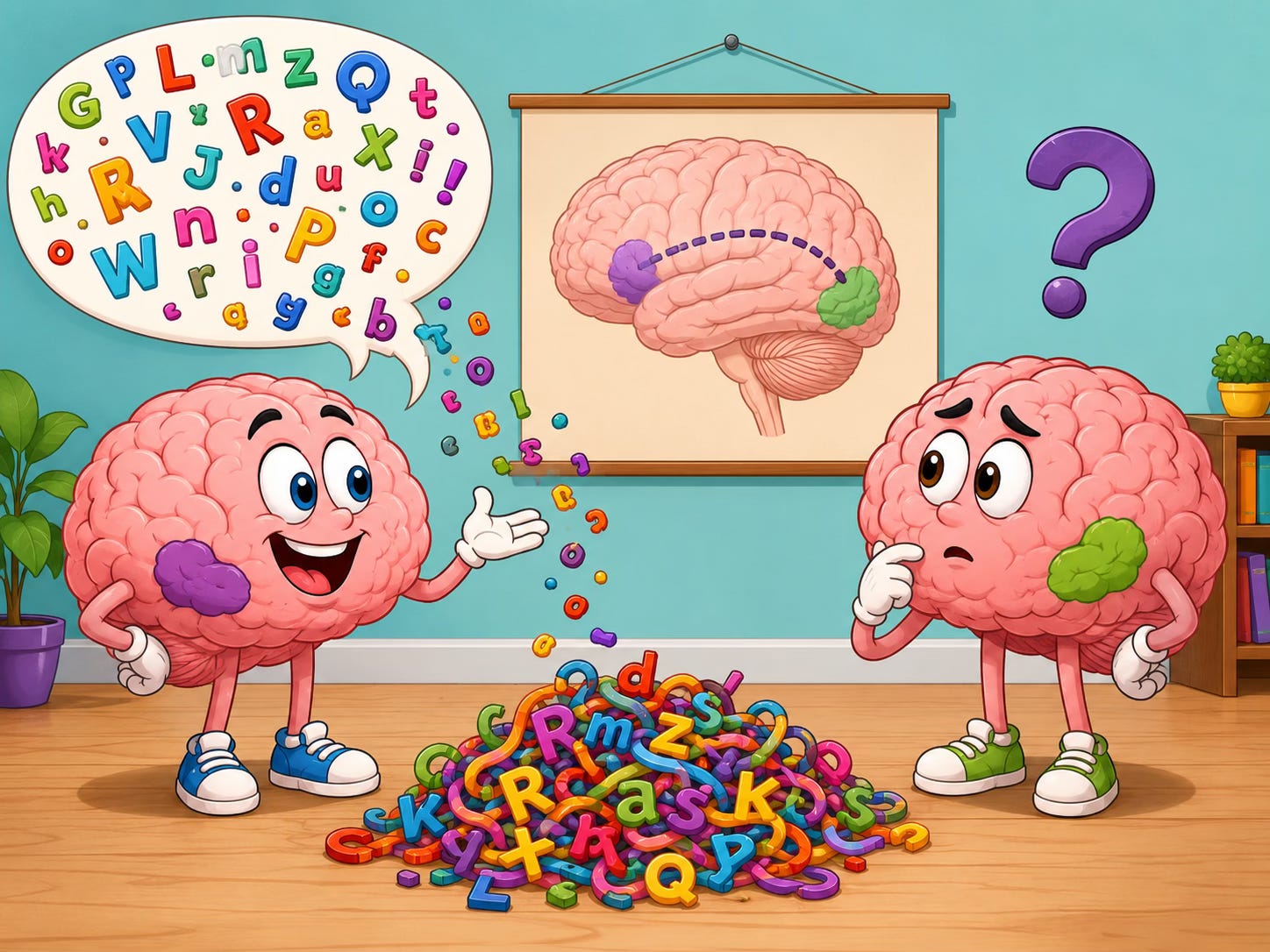
Welcome to Fantastic Voyage, where we explore the brain one region at a time. (New here? Start with What’s Hiding Inside That Three-Pound Lump Between Your Ears? for the big picture, or jump right in.)
Imagine sitting across from a patient who sounds perfectly normal. The speech is fluent and melodic, delivered with confidence. The rhythm of conversation is right. The grammar sounds roughly intact. But the words themselves make no sense. The patient might say “headman” when they mean president, or “treen” when they mean nothing at all. You ask a question and get a confident stream of syllables that almost sounds like English but dissolves the moment you try to follow it.
The strangest part is that the patient has no idea anything is wrong. Ask them to repeat what they just said and they repeat it confidently, errors and all. They may become anxious or even paranoid, not because they know their speech is broken but because nobody around them seems to understand perfectly clear language.
This is Wernicke’s aphasia. And it is the mirror image of the condition we met in Why Some Stroke Patients Can Sing Happy Birthday But Cannot Ask for Water.
In Why Some Stroke Patients Can Sing Happy Birthday But Cannot Ask for Water, we visited Broca’s area in the frontal lobe, the region that assembles speech for production. Patients with damage to Broca’s area largely understand what they hear but cannot get words out. They know what they want to say and are often painfully aware they cannot say it.
In 1874, a 26-year-old German physician named Karl Wernicke described the opposite problem. His patient could speak with ease but could not comprehend language. The critical lesion was not in the frontal lobe. It was in the posterior part of the left temporal lobe, in a region now called Wernicke’s area, sitting in Brodmann’s area 22. This region is surrounded by the auditory cortex, the part of the brain that processes raw sound, and by association areas that combine auditory input with information from other senses.
Wernicke realized he was looking at the other half of a circuit. Broca’s area builds the motor plan for speech. Wernicke’s area processes the incoming sound of language and associates it with meaning. The two regions are connected by a thick bundle of nerve fibers called the arcuate fasciculus, which runs beneath the cortex between them. Damage Broca’s area and the patient understands but cannot speak. Damage Wernicke’s area and the patient speaks but cannot understand. Wernicke even predicted a third type of breakdown. Sever the connection between the two areas and the patient should be able to speak and understand, but would scramble words in between. He was right. That condition, called conduction aphasia, was later confirmed.
At 26, Wernicke had mapped the basic architecture of the brain’s language circuit.
What makes Wernicke’s aphasia so different from Broca’s aphasia is not just the location of the damage. It is the experience. Broca’s patients struggle visibly. Their speech is slow and effortful, every word a struggle. But the words they do produce are usually the right ones. Wernicke’s patients have the opposite problem. The speech flows easily, but it is filled with the wrong words (called paraphasias) and with invented words (called neologisms) that the patient produces with complete confidence.
The contrast extends beyond speech. A patient with Broca’s aphasia will know something is wrong and may become depressed. A patient with Wernicke’s aphasia may be anxious, agitated, or even euphoric, with no awareness that their language has collapsed.
The modern view of Wernicke’s area is more nuanced than the original model. Researchers now understand that language does not live in just two boxes connected by a cable. About 96 percent of people process language primarily in the left hemisphere, but the work is distributed across a large network of cortical and subcortical regions. Wernicke’s area is part of a processor that matches speech sounds to meanings, but it works alongside areas handling grammar and attention as well as conceptual knowledge. The circuit is far more complex than Wernicke imagined. But the basic insight holds. One part of the brain builds language. Another part decodes it. And when the decoder breaks, the speaker does not even know.
Next up in Fantastic Voyage, we leave the temporal lobe and head to the back of the brain. The occipital lobe processes nearly everything you see, and when it is damaged, a patient who is completely blind may still dodge an obstacle in the hallway without knowing how or why.
References
Kandel ER, Schwartz JH, Jessell TM. Principles of Neural Science, 4th ed. McGraw-Hill, 2000. Chapters 1 and 59.
Wernicke C. Der aphasische Symptomencomplex: eine psychologische Studie auf anatomischer Basis. Cohn und Weigert, Breslau, 1874.
No posts
Comments
Nothing yet. Say the first thing.
Sign in to join the conversation.