
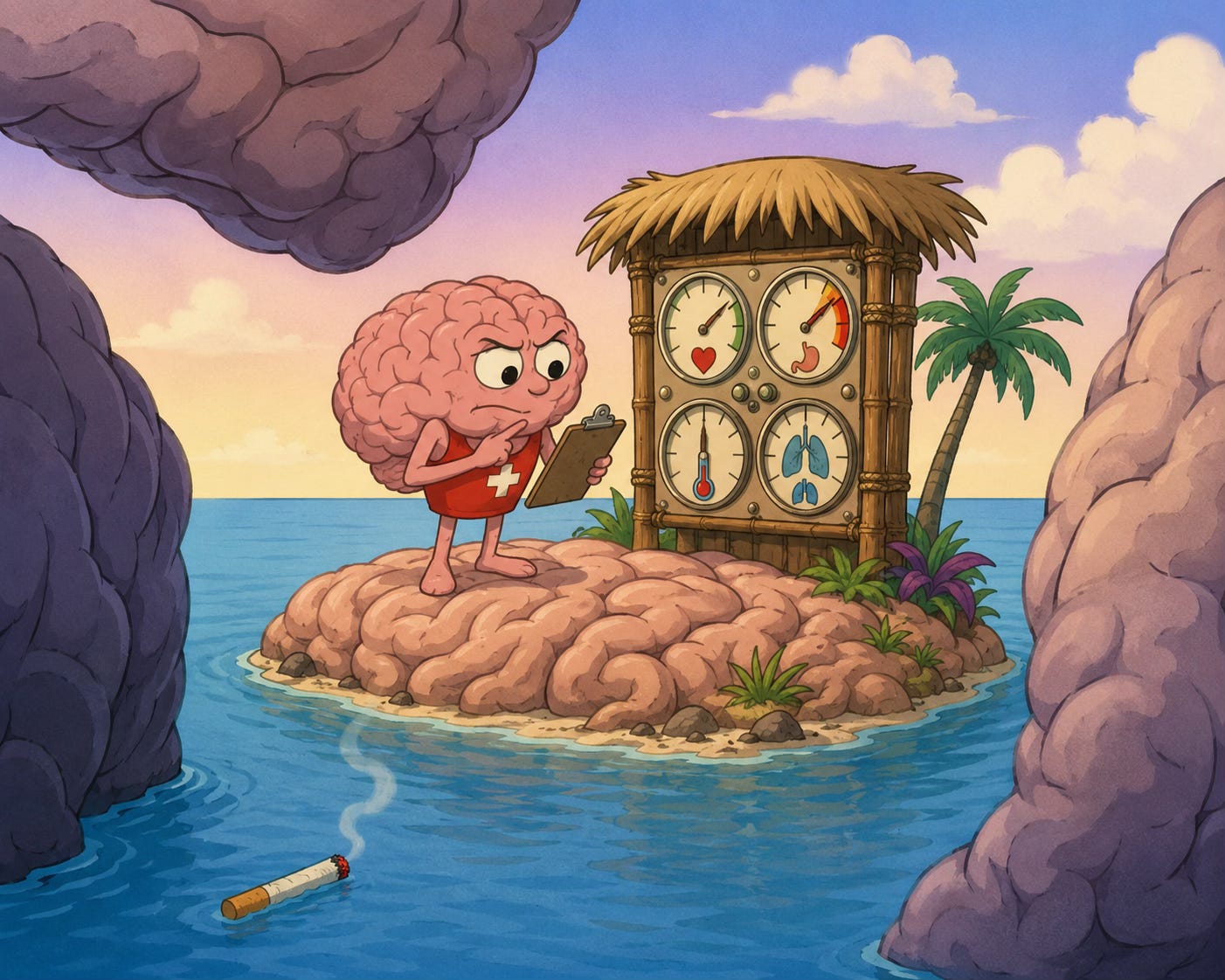
A man smoked for decades. Then part of his brain was destroyed, and the next morning he felt nothing. No craving, no withdrawal, no need for patches or willpower or a twelve-step program. The desire for a cigarette had simply stopped existing, as if someone had unplugged a machine he did not know was running.
He was one of nineteen patients in a study published in 2007. The damage was to a region you cannot see on the surface of the brain. To find it, you would have to peel back the frontal lobe, then the parietal lobe, then the temporal lobe and look inside the lateral sulcus, the deep groove running along each hemisphere. Tucked underneath all three, like a piece of flooring hidden beneath three walls, sits a small island of cortex called the insula.
The name means “island” in Latin. In an earlier article, we looked at how the amygdala generates fear by sending alarm signals down to the hypothalamus and brainstem. The insula works in the opposite direction. It reads signals coming up from the body.
The insula is the part of the brain that knows what is happening inside you. Your heart rate, your breathing, how full your stomach is, whether you are too warm or too cold, the pressure in your bladder. All of this information travels from your organs to the brainstem, up through a relay station in the thalamus, and lands in the insula. The posterior portion receives the raw data. The anterior portion assembles those signals into something you actually feel.
That is why a neuroscientist named A.D. Craig proposed in 2002 that the anterior insula is the foundation of interoception, the conscious sense of your body’s condition. When you say “I feel sick” or “I feel hungry” or “something is wrong but I do not know what,” you are reporting what your insula is telling you.
The insula’s oldest job is taste. Neurons in the anterior insula respond when you eat something, and the region sits right next to the part of the cortex that processes touch on your tongue. If something tastes rotten, the rejection starts here. Taste was the first clue that this region had a deeper role in how the brain evaluates what is safe and what is dangerous.
In 2000, researchers described a patient who had damage to his left insula and the tissue next to it. He could still identify other emotions in a photograph. What he could not do was recognize disgust. He also reported feeling less disgust himself.
Three years later, a brain-imaging study showed why. The same patch of anterior insula that lit up when a person inhaled a foul smell also lit up when that person watched someone else make a disgusted face. Your brain uses the same hardware to feel revulsion and to read it in another person. Damage the hardware and you lose both abilities at once. The feeling of disgust and the recognition of disgust in someone else are not two separate functions. They are the same function running once.
Nicotine addiction is not maintained only by reward circuits. It is also maintained by the body’s memory of what smoking feels like. The warmth in the throat, the head rush, the fading of tension. The insula holds a running record of those sensations. When a smoker craves a cigarette, part of what drives that craving is the insula replaying what the body expects to feel.
When the insula is destroyed, that record disappears. The patients in the study did not white-knuckle their way through withdrawal. They stopped having the addiction, the way you would stop hearing a radio station if the antenna came down.
The researchers studied sixty-nine patients with brain damage who had been smokers. Nineteen had damage that included the insula, and those nineteen were far more likely to have quit immediately after their injury, without relapse and without any lingering urge.
The insula sits physically apart from the brain’s outer surface, and it operates at a level most of us never think about. You do not decide to feel your heartbeat. You do not choose to notice that you are getting nauseous. The insula monitors all of it, assembles a picture of what is happening inside your body, and delivers the result as a feeling you cannot ignore.
Next, we move to the region that receives some of the insula’s most important reports and decides what to do about them. It sits in the fold above the corpus callosum, and when it is damaged, patients stop caring about anything at all.
References
Kandel ER, Schwartz JH, Jessell TM. Principles of Neural Science, 4th ed. McGraw-Hill, 2000. Chapters 17, 32, and 49.
Naqvi NH, Rudrauf D, Damasio H, Bechara A. Damage to the insula disrupts addiction to cigarette smoking. Science. 2007;315(5811):531-534. doi:10.1126/science.1135926
Craig AD. How do you feel? Interoception: the sense of the physiological condition of the body. Nat Rev Neurosci. 2002;3(8):655-666. doi:10.1038/nrn894
Calder AJ, Keane J, Manes F, Antoun N, Young AW. Impaired recognition and experience of disgust following brain injury. Nat Neurosci. 2000;3(11):1077-1078. doi:10.1038/80586
Wicker B, Keysers C, Plailly J, Royet JP, Gallese V, Rizzolatti G. Both of us disgusted in My insula: the common neural basis of seeing and feeling disgust. Neuron. 2003;40(3):655-664. doi:10.1016/s0896-6273(03)00679-2
No posts
Comments
Nothing yet. Say the first thing.
Sign in to join the conversation.