
Welcome to Fantastic Voyage, where we explore the brain one region at a time. (New here? Start with [What’s Hiding Inside That Three-Pound Lump Between Your Ears?] for the big picture, or jump right in.)
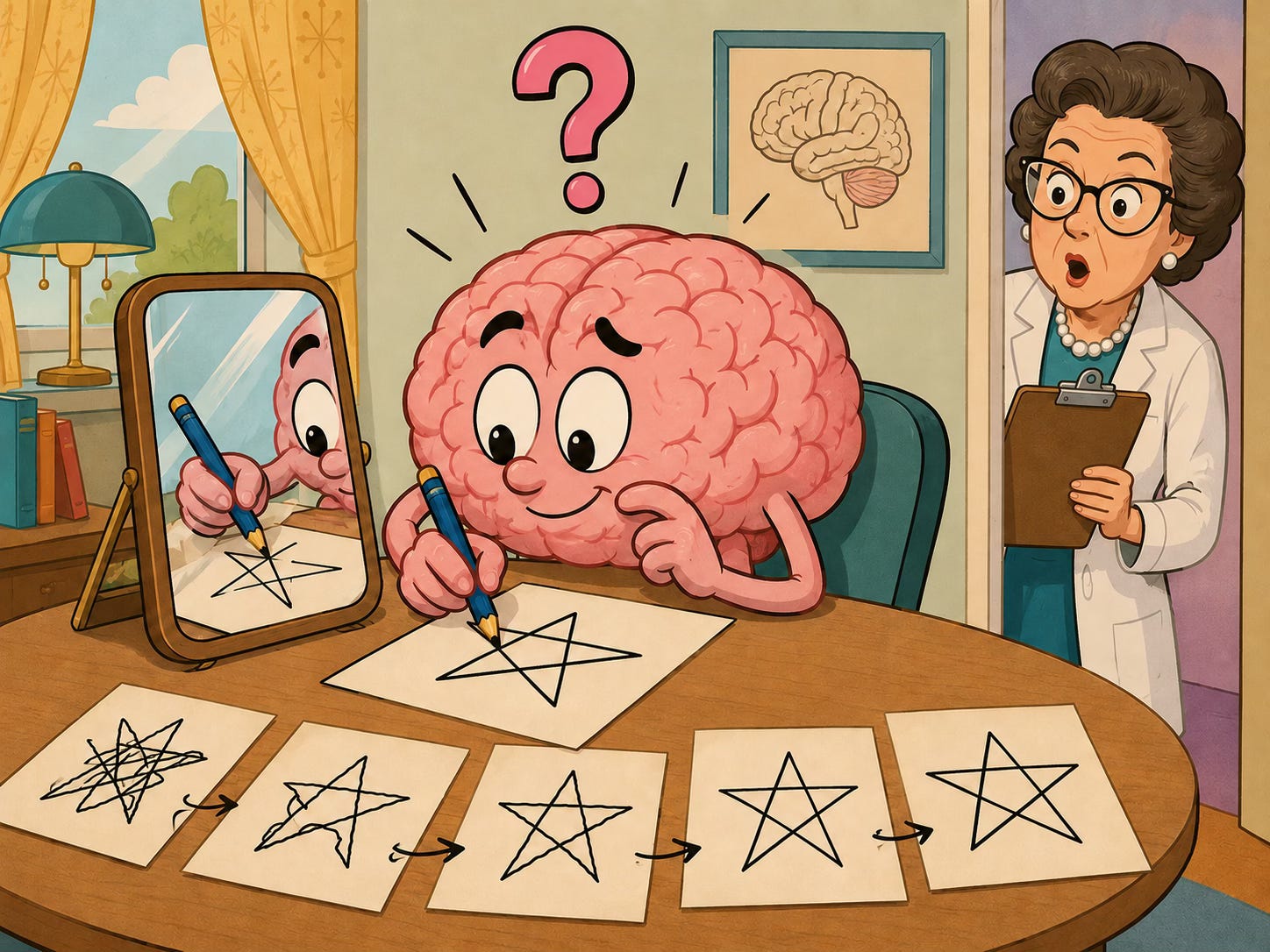
In 1962, a man sat at a table and traced the outline of a star. The catch was that he could only see his hand and the star reflected in a mirror, which reverses everything. Moving left looks like moving right. Pulling the pencil toward you looks like pushing it away.
He was terrible at it on day one. By day three, he drew the star almost flawlessly, his hand gliding through the reversed world without a single error. His improvement tracked perfectly with what any healthy person would show after three days of practice.
Then the researcher, Brenda Milner, asked him about the task. He had no memory of doing it. Not on day two, not on day three. As far as he was concerned, each session was the first time he had ever picked up the pencil. When Milner showed him the results, he stared at his own perfect performance and said, “Well, this is strange. I thought it would be difficult, but it seems I’ve done rather well.”
His name, unknown to the public until after his death in 2008, was Henry Molaison. The medical literature knew him only as H.M. Nine years earlier, in 1953, a neurosurgeon named William Beecher Scoville had removed structures from both sides of Henry’s brain in an attempt to stop his devastating epileptic seizures. Among the tissue Scoville suctioned out was the hippocampus.
The hippocampus is a curved, elongated structure buried in the medial temporal lobe, one on each side of the brain. Its name comes from the Greek word for seahorse, because early anatomists thought its shape resembled one. You have two hippocampi, each only a few centimeters long, tucked deep beneath the outer surface of the cortex.
The hippocampus does not store your memories. That was one of the revelations of Henry’s case. Instead, it acts as a processing dock where new experiences are received and gradually transferred to the cerebral cortex for permanent storage. The cortex is the vast warehouse. The hippocampus is the loading bay. Without the loading bay, new shipments pile up at the door and vanish.
After Scoville’s surgery, Henry’s seizures improved dramatically. But the removal of both hippocampi left him unable to convert new experiences into lasting memories. He could hold a phone number in his head for many minutes through sheer repetition, but the moment he was distracted, it vanished. He could not remember people he met after the operation, even those he saw regularly for years. For several years, Milner visited him on an almost monthly basis. Every single time, Henry greeted her as a complete stranger.
Yet his old memories were largely intact. He remembered his childhood and the neighborhood where he grew up. His language was normal, his IQ unchanged. The surgery had not damaged his mind. It had severed the mechanism that fed new information into the long-term storage system.
The mirror-tracing experiment revealed something neuroscience had not expected. Henry could not remember doing the task, but his hands remembered how to do it. His brain was still capable of learning new motor skills without creating a conscious record of having learned them.
This finding cracked open the entire field. It proved that the brain has at least two separate memory systems. One handles facts and events, the kind of memory you use when you recall a birthday or recognize a face. Scientists call this explicit memory, and it depends on the hippocampus. The other handles skills and habits, the kind of memory your body uses when you ride a bicycle or type without looking. This is implicit memory, and it does not need the hippocampus at all. It relies on other structures, including the cerebellum and the basal ganglia.
Henry lived for 55 years after his surgery, trapped in a permanent present tense. He was studied more extensively than any other patient in the history of neuroscience. When he died in 2008 at the age of 82, his real name was revealed for the first time. His brain was preserved in 2,401 ultrathin sections for future research, a final contribution from a man who could never remember making one.
Next, we stay in the temporal lobe and visit the hippocampus’s next-door neighbor. This almond-shaped cluster of neurons is the reason your heart pounds when you hear footsteps behind you in the dark, and one woman who lost it on both sides discovered she was physically incapable of feeling afraid.
References
Kandel ER, Schwartz JH, Jessell TM. Principles of Neural Science, 4th ed. McGraw-Hill, 2000. Chapter 62.
SCOVILLE WB, MILNER B. Loss of recent memory after bilateral hippocampal lesions. J Neurol Neurosurg Psychiatry. 1957;20(1):11-21. doi:10.1136/jnnp.20.1.11
Milner B. Memory disorders accompanying bilateral hippocampal lesions. In: Physiology of the Hippocampus. Paris: CNRS, 1962: 257-272.
Annese J, Schenker-Ahmed NM, Bartsch H, et al. Postmortem examination of patient H.M.'s brain based on histological sectioning and digital 3D reconstruction. Nat Commun. 2014;5:3122. doi:10.1038/ncomms4122
No posts
Comments
Nothing yet. Say the first thing.
Sign in to join the conversation.