
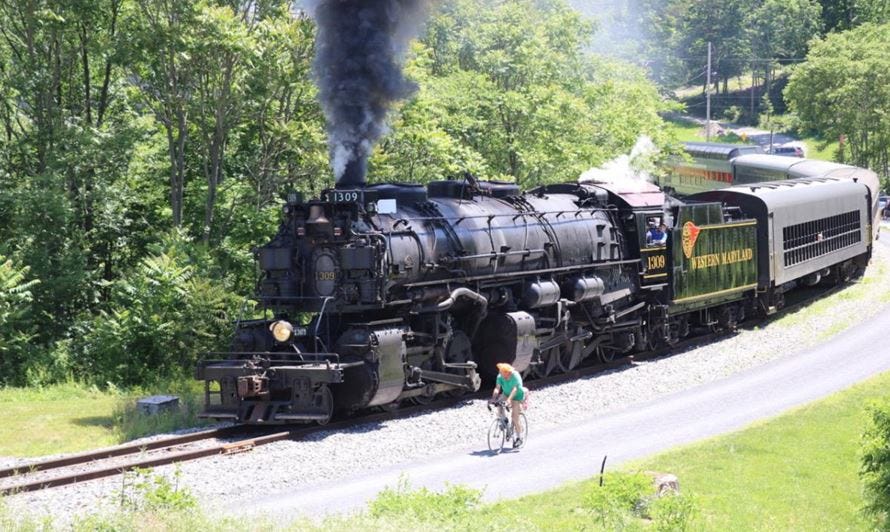
If you take the train to New York from Wassaic, you’ll know that the Harlem Line ends there in a yard. You may also have noticed as you stand on the platform that there is a paved path heading north on the opposite side of the track. That is the beginning of the Harlem Valley Rail Trail, which the Harlem Valley Rail Trail Association (www.hvrt.org) hopes will eventually extend 46 miles, all the way to Chatham, NY.
Across the country, many passenger train lines went out of business during the early 1970s (we’ll write that story another time). A movement began, Rails to Trails, with the aim of using those routes for recreational trails. This was a sensible step: making the corridors useful and keeping them intact for possible future transportation uses. “Rail trails” have become a popular feature in many communities, in the United States and in Europe, for walking, rollerblading, and cycling.
When the Train Campaign began in 2011, rail trails would come up occasionally. People would ask about the old railroad station in Chatham, NY, for example, and whether the train line from Wassaic couldn’t be extended on the old route via Hillsdale. They would ask if the Housatonic Berkshire Line to Pittsfield might be extended to North Adams.
At the Train Campaign, we took note, and we had the same questions. But we always got the same adamant response, a flat negative. It’s rails or trails, we were told. Take your choice, but it’s one or the other. Once there’s a trail, there’s no going back to rail service.
Guess what? That official dictum is not true.
We first got an inkling that there were other ways to approach this subject at a Train Campaign pop-up meeting in Sheffield, MA in February 2018. Two of our steering committee members met Dan Bolognani from the Upper Housatonic Valley National Heritage Area. He told them about efforts to promote trails in northwestern Connecticut and introduced us to Tom Sexton, Northeast Regional Director for the Rails to Trails Conservancy, a national nonprofit organization.
In 2019, Tom spoke at a Train Campaign event in Great Barrington. We learned that rails and trails are not pieces in a zero sum game. There are 350 rails-with-trails in the US, and nearly a thousand miles of rails-with-trails. Tom showed photographs of people jogging, cycling, and walking next to freight, passenger, and light-rail lines. He explained the economic, security, environmental, and social benefits of combining rails and trails, and went over the challenges as well.
While there are challenges, there are ways to overcome them, with many working examples. It was clear from the audience’s questions that this story struck a chord: recreational trails fit with the character and ethos of the Berkshires, and of course offer a chance to bring people to beautiful spots that are otherwise inaccessible.
Railroads benefit, too, from a security perspective. Most railroad fatalities are the result of people walking on the track. But if there is a path, people use it and not the tracks. There have been only two fatalities on rails with trails, a remarkable safety record (one was the direct result of using headphones that entirely blocked train warning signals).
At that meeting, we discussed ways to map particular stretches of our region that might be suitable for trails. We’ll be talking to the BRPC and town planners about this, and setting up a group to look at this addition to the plan for restored passenger service on the Housatonic Berkshire Line.
One important benefit of rails-with-trails is that trails can make it far easier for people to get to train stations without driving. By prioritizing trails as part of passenger services in the Berkshires and western Connecticut, we could reduce the need for parking at stations. If you can easily ride a bike and lock it up securely, you may well choose to leave your car at home. In fact, we met two people in the audience who routinely ride their bikes to Wassaic from the Berkshires to get a train to New York.
It’s also worth noting that there is federal funding for rails-with-trails.
Here’s the podcast we recorded with Tom Sexton, at Spotify. And take a look at the video below, as well as the Shenandoah Rail Corridor initiative.
By joining us, you are championing a vision for a greener and more connected region, committed to investing in innovative, practical transportation solutions. Let’s take a step towards a more interconnected, sustainable future.

It’s easy to donate. Just click here to join the Train Campaign! We use Donorbox and can accept Google Pay, Apple Pay, Stripe, and PayPal. Old-fashioned checks and even ACH bank transfers are also fine!
The Train Campaign is a project of the Barrington Institute, a 501(c)(3) charitable organization, EIN 20-1670260. All contributions are tax deductible. Your support makes it possible for our volunteers to do these things:
keep you up to date on policy developments and make it easy to contact legislators* provide regular updates about new train and transport projects
extend our outreach to business and government leaders across the region
create a series of podcasts so you can listen to rail experts & get updates
All content in Train Time is shared under a Creative Commons License (CC BY-NC-ND):
Attribution (BY) – Always credit the author and Train Time as the original creator with a tag or link to https://traintime.substack.com.
Non-Commercial (NC) – Content cannot be used for commercial purposes.
No Derivatives (ND) – Content may not be modified, adapted, or repurposed.
Comments
Nothing yet. Say the first thing.
Sign in to join the conversation.