
Welcome to my series, Disability Unfiltered, where I’ll be highlighting other disabled voices on Substack.
My goal for this series is to publish guest posts from others with disabilities to build community, raise awareness about what it’s truly like to live with various disabilities, and increase authentic disability representation across Substack.
I hope you’ll join me in highlighting the love, loss, pain, fear, beauty, strength, and perseverance of the disabled experience.
“Ecologies of Rupture: Learning from Chronic Illness During the Minneapolis ICE Occupation” by Sophia Manolis
I.
My foot burned throughout the Minneapolis ICE occupation. In November, when the raids occurred every Tuesday like doomsday clockwork, the pulsating fire between my third and fourth right toes became impossible to ignore. The heat had built slowly for a year: first numbness, then nagging discomfort, then teeth-gritting inferno.
Alarm bells rang outside my body, too. As the number of ICE officers in Minneapolis climbed from 200, to 1000, to 3000 in January, daily rhythms were submerged in choreographies of hypervigilance. A constant echo of whistles, paired with the uncertainty of was that real? Or just conjured by my brain. Waking up to the sound of flash bangs—CRACK! ringggg—and rushing to my window, sleep crust blurring my eyes, to see them tackle a man mere feet from my front stoop. Driving down Lake Street to see them drag another man into the black SUV with tinted windows, the ghost of the kids we just dropped off at daycare still present in the carseats at our backs. And the ghost of their voices, cooing on repeat: Mama! Papa! followed by our shaky attempts at reassurance: Yes, we’ll see Mama and Papa soon.
Simultaneously, managing my body was(is) like a part-time job. It wasn’t just my burning foot. I have chronic migraines, osteoporosis, a host of health complications accumulated since age 14. So if ever something new comes up, they send me through a merry-go-round of doctors and lab tests. They argued back and forth. Is the fire in your nervous system connected to the fire in your foot? They found a neuroma—an inflamed nerve at the site of the burning—and decided: your pain is just mechanical. The next week: no, it’s more than that. Maybe it’s also your circulation issues, and the abnormally high antibodies indicating your 90% likelihood of developing scleroderma. Oh but wait! it was a false positive! The machine tested wrong. Maybe it’s the adenoma in your pituitary—you know, that could turn into a tumor someday. Okay, we’ve exhausted all the other options, it’s time for you to get surgery. Except, we forgot to test your thyroid—and now we’ve found it’s underactive, your antibodies are attacking it—that could be why you’re experiencing such frequent fatigue and viral infections! But it could also be your mental health. You’re still in therapy, right? Okay, well, there’s not much else we can do to help you.
My body is an ecology of rupture—and so are the lands I live on. I know this to be true the day my mom drove me home from the appointment with the steroid injections, and we were blocked by a caravan of men with shiny pistols trying to enter the front gate of the urban reservation, Little Earth. Their target was an indigenous man painting houses. A crowd surrounded them, fiery with anger, but ICE didn’t back down until a white woman confronted one of them: “How could you arrest him?! This is HIS LAND!” Skepticism colored the edges of the man’s eyes. “This is a reservation?” “YES!” she replied, “That’s what they’ve all been saying!” and she gestured to the crowd of mostly Little Earth residents. He shrugged, sheepishness hidden by the shadow of his mask. “Well, you know, that’s what they all say.”
It’s no coincidence that Whipple, the detention center where they hide the people they steal, is located 2.6 miles from Bdote: the sacred origin place of the Dakota people. It’s no coincidence that Whipple is located inside Fort Snelling, the military base turned concentration camp which inhumanely imprisoned 1600 Dakota women and children after the U.S.-Dakota War of 1862. This land, these waters, remember the violence. And this is what so many people of this land have been saying for years: None of this is new.
It’s easy to simplify the stories we tell about the problems and solutions of these times: If only Trump wasn’t in office spewing lies. If only I found the proper care, I could conquer the chronic illness dragon and be healed. But underneath the comforting crutch of intellectualization, the material world is neverendingly unstable. Maybe one of the most fragile stories we’re fed is modernity’s promise of health and wellness as a place we can optimize our way into. How healthy can our collective be if our dreams of health are entrapped by economies dependent upon exploitation? When mass violence fuels hungry supply chains in the Congo and Sudan, no matter who is U.S. President?
Living with chronic illness positioned my survival in opposition to modernity’s tenets: rationalization, self-improvement, the 24-hour clock. It necessitates the fumbling, unsexy labor of learning companionship with pain. Now, I wonder how these lessons can expand my presence with the land: the layers of history, stories underneath the story, and ever-shifting ecology that cannot be contained.
“Love is ultimately truth-telling…as the truth begins to disrupt our narratives about what is. To tell the truth about something means that, often, our hearts will have to break.” - Lama Rod Owens*
II.
I don’t always tell the truth. I lie to myself when my foot throbs during the dance class and I push through: it’s not that bad. I lie when I’m slow with residual pain the next morning, but I’m scheduled to work a 9-hour day. Fake it till you make it was one of my most useful survival skills as a kid; now it’s hard to kick the habit. As I push aside the viscous fatigue accumulating in life’s edges, I assure myself, I’ll rest up eventually.
But the truth always comes out, no matter how inconvenient. One day, I hit my limit at the dance studio and spend the remainder of the class on the floor heavy with grief. What if I have to stop dancing? Dance is one of my greatest joys, became my lifeline the year my life was upended by chronic migraines. But where it was once empowering, it’s now intensifying my pain.
On my back, I tip my head towards the ceiling and close my eyes. The discomfort of stillness is palpable in the antsy twitch of my fingers. I steady through the rhythm of my breath, channel my inhales into each vertebrae of my spine. I wonder: what might happen if I let go of everything I think I know about dance? What might I discover about how my body—in its current adaptation—wants to move?
Weeks later, my friend gives me a set of double-layered knee pads. I think they’re the kind soccer players wear: first layer made from hard plastic, second from thick foam. After pulling them on the shining wooden floor feels frictionless against my bodyweight, and I can slither around the studio like a snake. I am learning to dance on my knees, I tell anyone who asks.
At first, knee dancing feels clunky and awkward. I fixate on the limiting story of confinement to the floor. But I challenge myself to go slower: to believe there could be a world of movement patterns outside the scope of my conditioned imagination.
How would I move if dancing became a practice of listening?
I keep breathing. I breathe into my skin, the woven sinew of my muscles, the flexible collagen in my bones. If I go deep enough, can I feel the way my ligaments knit together? If I’m quiet enough, can I hear my joints creak? Maybe there are conversations woven through my anatomy deeper than conditioning can reach.
In medical exam rooms, they try to measure your pain so they can diagnose it. Like the day they tested my ability to walk for six minutes, but I could only do three, so they put me in a wheelchair. I fought back tears while they stared at me blankly. They filed my numbers while my heart burst at its seams, and my tears became another data point in the record.
But you can’t measure pain when it’s your dance partner. In the dance, my pain gets to take up space and tell its own story. The story lives in the hurt, yes, but also in the spaces in between. It lives in the questions birthed in the carnality of rupture. It lives in the wander of my attention from the swollen nerve to the swirl in my heart to the slow roll of my diaphragm. And it lives in the pleasure: of circling my neck, stretching sore muscles, spinning on my kneepads like I’m a kid discovering my body’s rotational potential for the first time.
I am no longer interested in a politics of diagnostics. I am interested in a politics of intimacy: with the cyclical wounding, the ripples of impact, and the possibilities that arise from the act of witnessing.
It’s summer now in Minneapolis; the frozen violence of winter long melted into the forgotten recesses of mainstream news. In the park near my house, shiny cottonwood leaves dance over blankets of grass, kids play in the pool, and neighbors greet each other hello. 2.5 miles away the Mississippi flows steady, metabolizing grief.
In my free time, I sit in the park under a bough of cedar trees just above the parking lot where ICE unleashed their tear gas and flash bangs. I wonder if the trees remember how the sound broke the frozen air. I wonder where the trauma made the soil tremble.
I wonder where choreographies of hypervigilance still live: The spike of fear sparked by the still-present echo of whistles. The veil of mistrust coloring the edges of the mutual aid meeting. The heart tightening when police alerts vibrate warnings on rectangular screens.
I wonder about the deadpan faces in the cars that race by the new graffiti—WE ARE HUMAN ALSO—behind the encampment under the Cedar Avenue underpass. I wonder if they notice the cracks spreading through the pillars of concrete.
I wonder what is possible now in this city that wasn’t possible six months ago. How can our truth-telling invite us to relate?
Back in the park, the cedar tree breathes deep breaths. Listen, it tells me. And I let myself fall, again, to the ground.
*This quote is from a talk delivered by Buddhist minister Lama Rod Owens called Liberation Through Pleasure: A Spiritual Abolition Exploration of Love, Eroticism, and Freedom from Suffering
About the Author
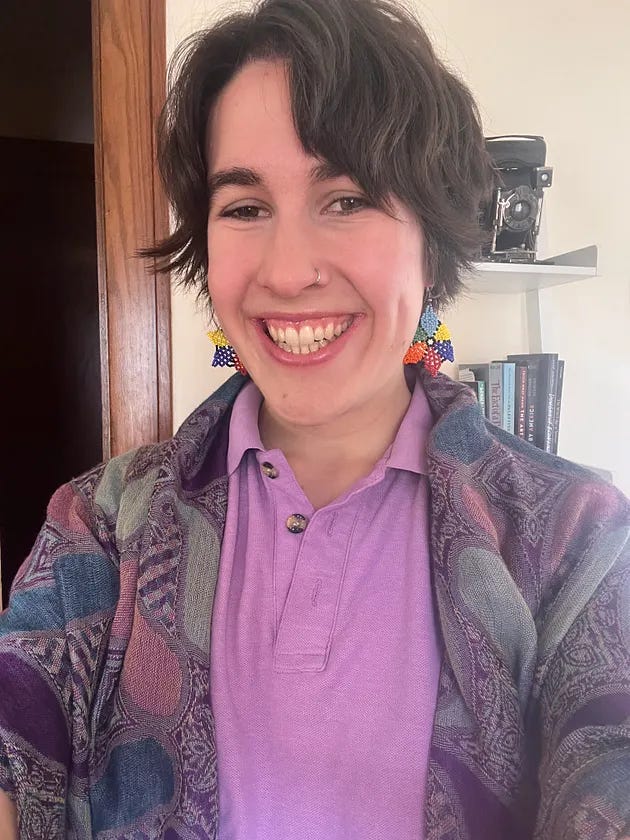
Sophia Manolis (they/them) is first and foremost a human committed to honoring the wisdom of their body, supporting movements for healing and economic justice, and learning from ecology. They live on ancestral and current Dakota homelands in Minneapolis, MN, where they facilitate outdoor education for youth on local waterways. In their free time, you can usually find them writing, dancing, playing music or sitting in the park!
If you enjoyed this post, I hope you will share it, comment, and hit the like button. Please also consider becoming a free or paid subscriber to Trailblazing with CP and Sophia’s Substack. Your free or paid subscription helps Sophia and I continue to promote disability awareness and inclusion.
No posts
Comments
Nothing yet. Say the first thing.
Sign in to join the conversation.