
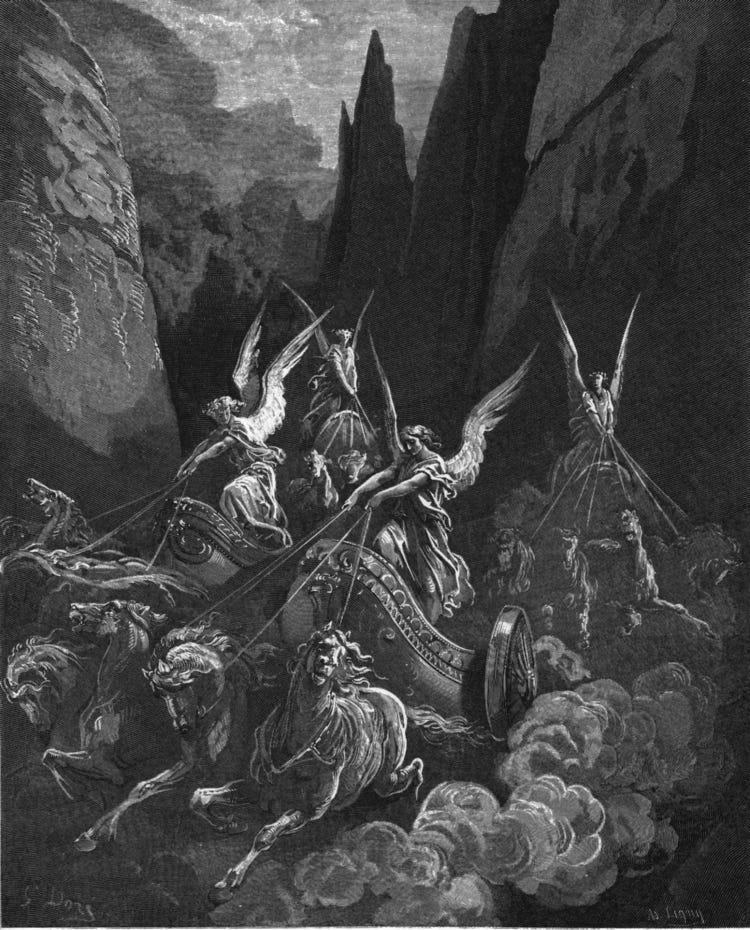
Zechariah's vision of the Four Horsemen of the Apocalypse, engraving by Gustave Doré, 1865.
It often feels like the minor prophets get lost in the shuffle. Compared to the grand stories of Creation, Noah, Moses, King David, the Babylonian Exile and return, what more can short books like Haggai really add?
It turns out quite a bit, if you take the time to look.
The prophetic books, including Zechariah, serve as a critical link between the Old and New Testaments. In a way they serve as a bridge, hardly tucked in the back of the Old Testament because no one knows where to put them. Instead, they provide context for understanding God’s redemptive plan and the fulfillment of prophecy through Jesus. Prophecy in the Bible acts as both a warning and an encouragement, calling people to faithfulness while assuring them of God’s sovereignty.
The Book of Zechariah offers insights into themes of hope, restoration, and the ultimate fulfillment of God’s promises. Its imagery and prophetic visions not only serve to encourage the Israelites during their return from exile but also resonate with themes found in the New Testament, particularly in the Book of Revelation. Perhaps this is why Zechariah was ordered so late in the Old Testament, not just as a bridge to the New Testament but as a parallel with the New Testament bookend of Revelations.
One of the central messages of Zechariah is the promise of hope and restoration. The Israelites, having returned from Babylonian exile, faced the daunting task of rebuilding their temple and their community. Zechariah’s visions of a future where Jerusalem is restored and filled with God’s glory (Zechariah 2:10-12) serve as a reminder that no situation is beyond God's ability to redeem.
10 “Shout and be glad, Daughter Zion. For I am coming, and I will live among you,” declares the Lord. 11 “Many nations will be joined with the Lord in that day and will become my people. I will live among you and you will know that the Lord Almighty has sent me to you. 12 The Lord will inherit Judah as his portion in the holy land and will again choose Jerusalem.
Shortly after, the New Testament delivers similar themes and promises of restoration. Jesus’ life, ministry, death, resurrection, and promise of salvation for those who follow Him stands as the largest parallel. There is also the epistle restorations as well. Saul is transformed into Paul, restored through Christ from a zealous prosecutor of Christians into a zealous apostle for Christ. Both jews and gentiles are restored through Christ as the church begins its work. Even at the very end in the Book of Revelations, the New Jerusalem descends from heaven, adorned like a bride, symbolizing God's eternal presence among His people (Revelation 21:2-4). These texts inspire believers to look forward to a future where God will make all things new, reminding us that present struggles are temporary.
Throughout Zechariah, God’s sovereignty is emphasized through various visions and prophesies. For instance, the vision of the four horsemen (Zechariah 1:7-17) illustrates God’s control over the nations and His active role in world affairs. This assurance was vital for the Israelites, who needed to trust that God was still at work despite their circumstances.
The sovereignty of God is a pivotal theme in Revelations as well, where Christ is depicted as the victorious Lamb who reigns over all creation (Revelation 5:12). The vision of the four horsemen is a stark reminder of God’s power over the Earth. And it is hard not to hear the depiction of the woman in the basket who is being taken to Babylonia and think of the later Whore of Babylon.
He replied, “It is a basket.” And he added, “This is the iniquity of the people throughout the land.”
7 Then the cover of lead was raised, and there in the basket sat a woman! 8 He said, “This is wickedness,” and he pushed her back into the basket and pushed its lead cover down on it.
9 Then I looked up—and there before me were two women, with the wind in their wings! They had wings like those of a stork, and they lifted up the basket between heaven and earth.
10 “Where are they taking the basket?” I asked the angel who was speaking to me.
11 He replied, “To the country of Babylonia to build a house for it. When the house is ready, the basket will be set there in its place.”
Just as Revelations shows the final victory of God, Zechariah and these unfolding events serve to remind that history is ultimately under God’s control, culminating in His perfect plan.
Zechariah emphasizes the need for repentance and a return to righteousness. In Zechariah 1:3, God invites the people to return to Him, promising that He will return to them.
3 Therefore tell the people: This is what the Lord Almighty says: ‘Return to me,’ declares the Lord Almighty, ‘and I will return to you,’ says the Lord Almighty.
This call is crucial for restoring their relationship with God and establishing a faithful community. It will also be echoed in just a few pages of the Bible through the ministry of Jesus.
24 Then Jesus said to his disciples, “Whoever wants to be my disciple must deny themselves and take up their cross and follow me. 25 For whoever wants to save their life will lose it, but whoever loses their life for me will find it. 26 What good will it be for someone to gain the whole world, yet forfeit their soul? Or what can anyone give in exchange for their soul?
Similarly, Revelations contains calls to repentance. The letters to the seven churches highlight the need for vigilance and moral integrity (Revelation 2-3).
Interestingly, the final word in Zechariah proclaims that on the Day of the Lord "in that day there shall be no more the Canaanite in the house of the LORD of hosts," proclaiming the need for purity in the Temple, which would come when God judges at the end of time. The word כְנַעֲנִי rendered "Canaanite" can be translated as “merchant”.
One can’t help but think of John 2:15-17
“And when he had made a scourge of small cords, he drove them all out of the temple, and the sheep, and the oxen; and poured out the changers' money, and overthrew the tables; and said unto them that sold doves, Take these things hence; make not my Father's house an house of merchandise. And his disciples remembered that it was written, The zeal of thine house hath eaten me up.”
A significant portion of Zechariah’s prophecies points toward the coming Messiah. The imagery of the humble king riding on a donkey (Zechariah 9:9) foreshadows Jesus’ triumphant entry into Jerusalem, emphasizing His dual role as both king and servant. Indeed, Zechariah 8:23 feels like an imminent foreshadow of Jesus’ ministry and the spread of the good news across the world.
23 This is what the Lord Almighty says: “In those days ten people from all languages and nations will take firm hold of one Jew by the hem of his robe and say, ‘Let us go with you, because we have heard that God is with you.’”
Furthermore, following His resurrection the activity of Christ amongst the young church tends to underscore Jesus’ role as King and his position at the right hand of God. In Revelation, Jesus is depicted as the conquering King (Revelation 19:11-16). While Zechariah presents Him in humility, Revelation showcases His ultimate authority and victory over evil.
This duality enriches our understanding of Christ’s mission: to save and to reign.
Literally no different than God’s plan with His people at the time around the exile.
Including our role as the people who should strive to follow the Lord. Both Zechariah and the New Testament remind believers that faith must be active, characterized by repentance and righteous living. This is in direct contrast to a passive life characterized by taking delight in wickedness.
No posts
Comments
Nothing yet. Say the first thing.
Sign in to join the conversation.