
A letter from the Likoudis Legacy Foundation
On the first of July, in defiance of Pope Leo’s final appeal, the Society of St. Pius X consecrated four bishops at Écône without a papal mandate, and the Holy See’s decree of excommunication followed within a day. In the days since, I have heard from a good number of readers who are unsettled: some grieving over family and friends, some fielding hard questions in their parishes, and some simply unsure where to begin finding answers to their questions. This letter is my attempt at an answer. What follows are the books I would put in someone’s hands first, along with a few sources worth following as events unfold.
The Church has lost sons and daughters she loves, and they have a claim on our prayers that nothing in what follows should be allowed to obscure. Still, many people caught in the middle of this moment, the confused, the grieving, and those watching someone they love drift toward the errors of radical traditionalism, need something solid to read, and it is for them that I have put this list together.
If you read nothing else, read these three. The first two are classics that have guided the faithful through this crisis for decades: Congar wrote within months of Lefebvre’s “hot summer” of 1976, when the archbishop ordained priests in defiance of Paul VI and incurred suspension a divinis, twelve years before the episcopal consecrations that followed; my grandfather’s book has been answering traditionalist objections since it first appeared in 1981. The third gathers the best of the newer scholarship in one place.
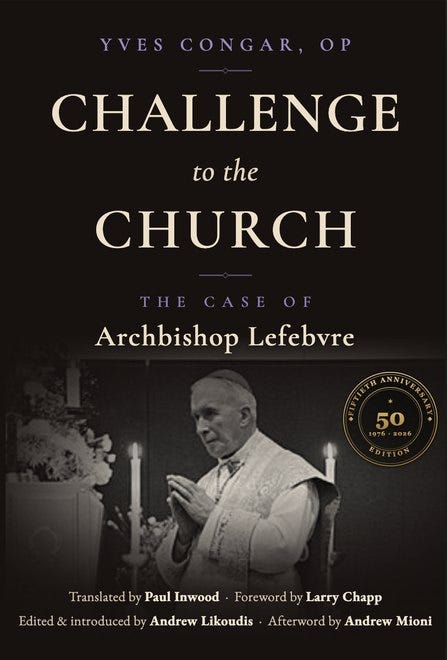
Yves Congar, OP · 50th-anniversary edition, edited by Andrew Likoudis
Foreword by Larry Chapp · Afterword by Andrew Mioni
Congar, whose work shaped the Second Vatican Council, examined the Lefebvre crisis as it broke in 1976, and his judgment has lost none of its force in the fifty years since. We reissued it this month for precisely this moment.
James Likoudis & Kenneth D. Whitehead · Revised edition
My grandfather’s classic, produced with Kenneth Whitehead through Catholics United for the Faith to stem the tide of dissent that followed the Council, and for decades the standard first reference on traditionalist objections, worked through question by question with the documents in hand. It was hailed by the Vatican’s newspaper L’Osservatore Romano and by two Servants of God, John Hardon and Hans Urs von Balthasar, and it is still drawing new readers; Michael Lofton reviewed it warmly not long ago, as did I.
Edited by Andrew Likoudis · Foreword by Rocco Buttiglione
Forty chapters from more than thirty contributors, Cardinal Robert Sarah, Jimmy Akin, Mike Aquilina, and Robert Fastiggi among them, gathered so that a reader can think through authority, tradition, and reform with the whole picture in view. It carries an imprimatur from Archbishop Lori, was praised in Word on Fire’s Evangelization & Culture journal as “an impressive labor of love,” and has drawn warm reviews from writers as far apart as Catholic Culture and the Catholic Worker.
Arguments only carry a person so far, and sometimes what finally reaches someone is the story of a man who lived it and found his way out.
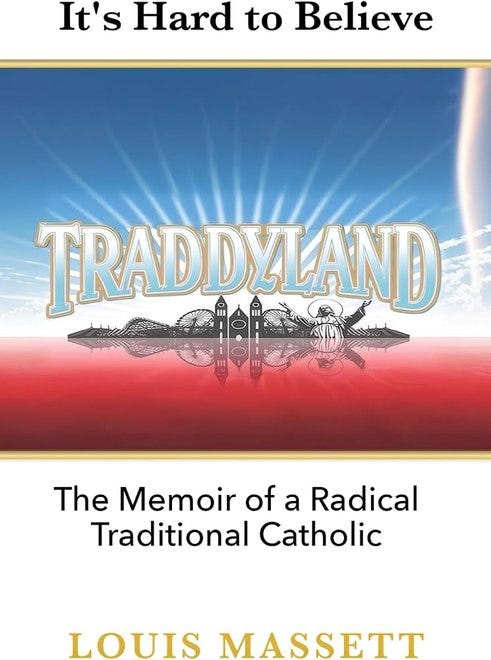
Louis Massett
Massett grew up inside the SSPX world of St. Mary’s, Kansas, and his memoir tells what that world was like from within and what it cost him to find his way back into full communion.
These three take the movement’s arguments seriously enough to answer them properly, and one of their authors write from long experience inside it.
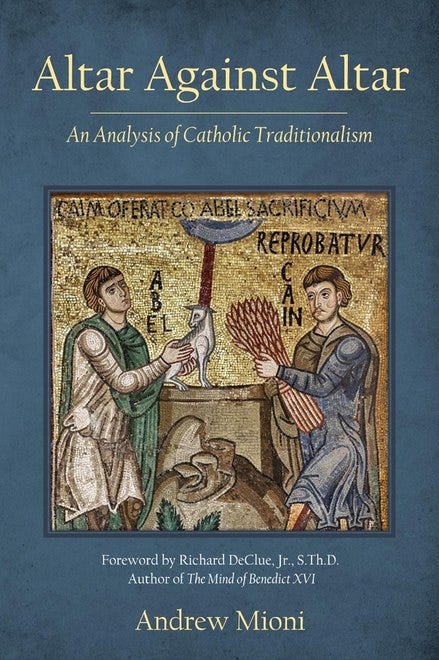
Andrew Mioni · Foreword by Richard DeClue
Mioni writes from years inside these circles, and he works patiently through the SSPX’s claim of a “state of necessity” and the “supplied jurisdiction” said to follow from it, the two pillars on which their independent ministries are made to rest, until very little is left standing of either. I reviewed it at Where Peter Is when it appeared.
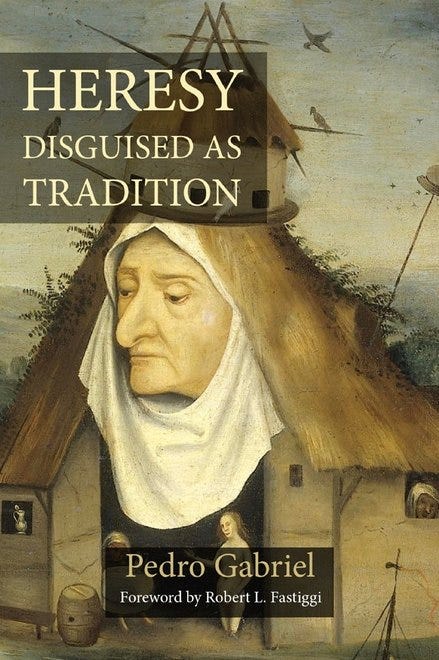
Pedro Gabriel · Foreword by Robert Fastiggi
Gabriel shows that movements claiming a purer tradition against the living Magisterium are nothing new in the Church’s history, and that today’s radical traditionalism repeats their pattern almost point for point. The book took second place in the 2024 Catholic Media Association book awards.
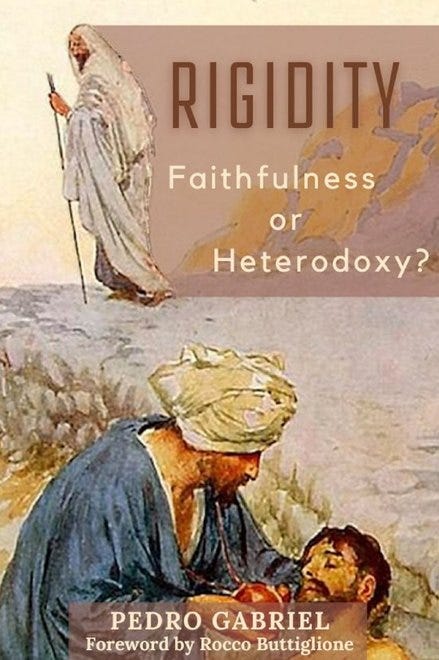
Pedro Gabriel · Foreword by Rocco Buttiglione
When Pope Francis criticized religious rigidity, many heard an attack on faithful Catholics. Gabriel steps back to ask what the pope actually meant, and shows through a series of precedents from Church history that the rigid course has repeatedly led the faithful into heterodoxy rather than away from it, and that refusing rigidity is not the same as embracing laxity. A study, in the end, of what the Church actually asks of the faithful, and of why rigidity should never be mistaken for fidelity.
Traditionalists justify their disobedience by appeal to a crisis dating from the Council. These two books show that the true crisis of faith runs far deeper than 1965, and they reclaim along the way a saint the movement has wrongly claimed for its own.
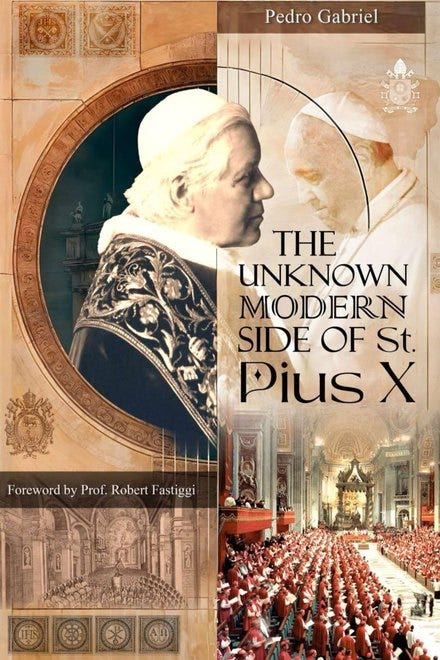
Pedro Gabriel · Foreword by Robert Fastiggi
The pope so often invoked against the modern Church was in fact a reformer, and Gabriel shows how much of his liturgical and pastoral work anticipated the very developments traditionalists now resist in his name.
Andrew Mioni · Foreword by Dave Armstrong
Traces the crisis of faith through two and a half centuries of papal teaching and shows that its roots run far deeper than the Second Vatican Council it is so often blamed on.
Two more before I close, because both arrive within the month and belong on this shelf.
Andrew Mioni · Foreword by Andrew Likoudis
Mioni’s newest, arriving in the coming days, turns from the liturgical wars themselves to the heart of the Mass, drawing on Scripture and the Fathers to show that real participation in the Mass begins with a heart conformed to Christ. I was glad to write the foreword.
And later this month, keep an eye out for a new book by Gary Campbell, a former priest of the Society of St. Pius X, which I edited and wrote an introduction for. I will have more to say about it when it arrives.
For those leaving the movement, or watching someone they love inside it, TradRecovery offers fellowship and practical support from people who have walked the same road home.
A few outlets I trust for reporting on the Church, with a plain word on where each stands editorially.
Where Peter Is · Reporting and commentary faithful to the Magisterium, which is the site’s whole mission; in full disclosure, it is also the site where I serve as Digital Editor.
Vatican News · The Holy See’s own news service, and the place to read what Rome has actually said before reading what anyone else says about it.
OSV News · The national Catholic news service, widely syndicated across diocesan papers and websites.
Word on Fire · Bishop Robert Barron’s Evangelization & Culture journal, with much of its writing available online.
National Catholic Register · Long-established national reporting and analysis; its editorial outlook leans to the conservative side.
The Pillar · Sharp investigative journalism on the life and governance of the Church; likewise leans to the conservative side.
Commonweal · A lay-edited review of religion, politics, and culture, written from a more progressive editorial perspective.
The Tablet · The British Catholic weekly, international in scope and likewise more progressive in tone.
The Church has weathered worse than this, and the promise made to her has never failed. If one of these books finds its way into the hands of someone who needs it, this letter will have been worth sending, so please feel free to share it with anyone it might help, or to point them to the guide online at likoudislegacy.com. And please keep in your prayers all who have been led out of communion in these weeks, praying especially that they find their way home.

In Christ,
Andrew Likoudis
Founder & President, Likoudis Legacy Foundation
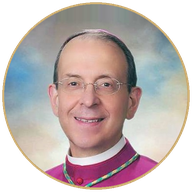
“I applaud the Foundation’s commitment to fostering Christian unity, which is grounded in the dignity of each person and made efficacious through authentic dialogue and a wholistic formation. Efforts that seek reconciliation and deepen mutual understanding within the Body of Christ serve a vital role in the life of the Church today.”
— Most Reverend William E. Lori, Archbishop of Baltimore, June 11, 2026
No posts
Comments
Nothing yet. Say the first thing.
Sign in to join the conversation.