
Mommy’s alright, daddy’s alright They just seem a little weird Surrender, surrender But don’t give yourself away
~Cheap Trick, Surrender

7.17.26 Transmission from The Future of Sanity
If there’s one thing that’s universal about human emotions, it’s that they teach us agency. Throughout our lives, we must learn to ride the waves of our feelings, swimming and surfing them as they rise and fall and buffer us about. We become more competent and self-determined as we discover the levers of control over these powerful inner forces. With practice and confidence, our emotional agency grows stronger.
Imagine anxiously anticipating the first day of a new job. You might experience a range of thoughts and sensations - worries, butterflies in your stomach, memories of other transitions, racing thoughts, hopeful daydreaming, heightened heart rate, or difficulty sleeping. In response to them, you take action - calling friends and family to talk things through, taking extra time to prepare for the big day, or going on a run in the park to sweat out the jitters. As a result, you’re more ready for your first day.
Emotions like anxiety are unpleasant but essential. They make us sit up and pay attention, guiding us towards what we care about and what we need to do next. Our job is to learn how to flexibly manage and modify them. These learnings are at the heart of emotional agency and are the foundation for a sense of well-being in the world.
This foundation is being eroded by a new emotional imperative: emotional surrender (and I don’t mean the good kind). We see it most clearly in digital spaces.
***
Emotional Surrender
There’s been a lot of talk about cognitive surrender, the way we outsource our thinking to external systems like gen AI with little scrutiny, oversight, or overriding human intuition. We’re equally at risk, however, for emotional surrender, where we outsource our feelings to algorithms.
Think about what happens when you shop online, or login to a social media account. Rather than negotiating the rise and fall of feelings anchored in our own internal and external experiences, signals of sadness, joy, outrage, anxiety, shock, and awe impinge on us through screens and “feeds,” surfaced by the algorithm. We learn to “consume” and “produce” the emotional “content” most likely to get clicks, reshares, and likes. When emotions become content, they lose their purpose other than becoming something to buy or sell, to turn on or off like a spigot. This isn’t self-determination. This is emotional surrender.
A writer from The New Critic, in her piece called The Luddite Club, expresses it well:
“I learned what the algorithm seemed to want, how to use hashtags, insert myself into my photos, leave comments on others’ posts — to gain followers, to get friends… Especially now that I view Instagram from an outsiders’ perspective, without the impression of being surrounded by those I know, the app has become an anonymous, spinning motor of stimuli that seems to deal in overwhelm and incoherence.”
There’s a social dimension to this. Humans evolved to experience emotions with other humans - joy, grief, anger, love, uncertainty, and belonging emerge primarily through direct interactions with others. Cross-cultural emotion research even suggests that in certain cultures, emotion is only experienced in social contexts: anger expressed on the face, in the absence of someone to be angry at, isn’t true anger. Whatever our cultural context, however, we know without a doubt that emotions are ready-made for the unpredictability of real human encounters. We interpret emotional signals from conversations, facial expressions, eye contact, touch, and posture in order to understand what’s happening now and predict what will happen next. Emotions help us survive and thrive in the tribe.
Experiencing emotions in an algorithm-centered para-social context changes things. Platforms and AI systems curate, amplify, and respond to our feelings based on incentives having nothing to do with human relationships, or surviving and thriving, but have everything to do with what engages fleeting human attention spans.
***
Vibe Decorating as Agency
In an age of emotional surrender, people desperately want agency, to embody and control it. There are AI “agents” and the Silicon Valley obsession with being agentic versus mimetic: are you the author of your own experiences and choices, or are you passively mirroring others?
But are AI “agents” really agentic? Are we agentic simply by virtue of getting stuff done?
Agency is often confused with capability, being able to perform, or worse, productivity, generating stuff. Agency is neither of those things because just doing things doesn’t make us agentic.
Agency is not reactive, thoughtless, or automatic.
Agency is being the author of our own story, intentionally and deliberately choosing and directing actions, thoughts, and feelings in pursuit of valued goals. Agency doesn’t mean we feel - or are - in total control. Agency isn’t optimized. Rather it tends to be deeply and weirdly human.
For example, I’ve recently discovered that my hobby is vibe-decorating my home. I didn’t think this was an actual hobby because I know nothing formal about decorating. But I know good interior design when I see it. So, moving into a new apartment this year, I placed furniture and art where instinct dictated, and found a way to bring it all together. People noticed. Many liked it or at least had a reaction to it. Some were even charmed by the unexpected niches with interesting objects; and by the mashup of periods that don’t seem to go together, like a mid-century table placed next to an antique Swedish clock, next to a black-and-gilt Baroque card table, right across from memorabilia from Pink Floyd’s The Wall. There are books everywhere (it’s a problem). There’s an unexpected ash tray (we don’t smoke). Anyway, you get my drift. My daughter calls it eccentric. Somehow it seems to work.
It is here, by expressing my eccentric aesthetic sensibilities, that I feel particularly agentic. I’m far outside the constraints and nudges of any algorithm of which I’m aware. Decorating is intentional, deliberate, and it reminds me that the feeling of being agentic requires embodiment.
***
Embodiment
We experience and come to understand our inner and outer worlds through our bodies. I squint my eyes and see the rightness of hanging a picture above a certain table or feel that placing a table next to a particular chair is relaxing.
Communication is at its most potent when it is fully embodied through voice, facial expression, gesture, gaze, posture, touch, and shared physical context. Think over the past week and tick off the number of times you communicated with another human through a device. Twenty times? 30? 50? or perhaps much lower, like 5 or 10 times? Did you make a call on your smartphone (or dumbphone) or did you message someone through the innumerable platforms available to us every moment of every day: Instagram, X, Threads, TikTok, Snapchat, LinkedIn, Reddit, Discord, WhatsApp, Telegram, Facebook, Signal, Messenger, Slack, Teams, Google Chat, iMessage, SMS, and email?
The experience of communicating can be described along two intersecting axes: Embodiment x Agency.
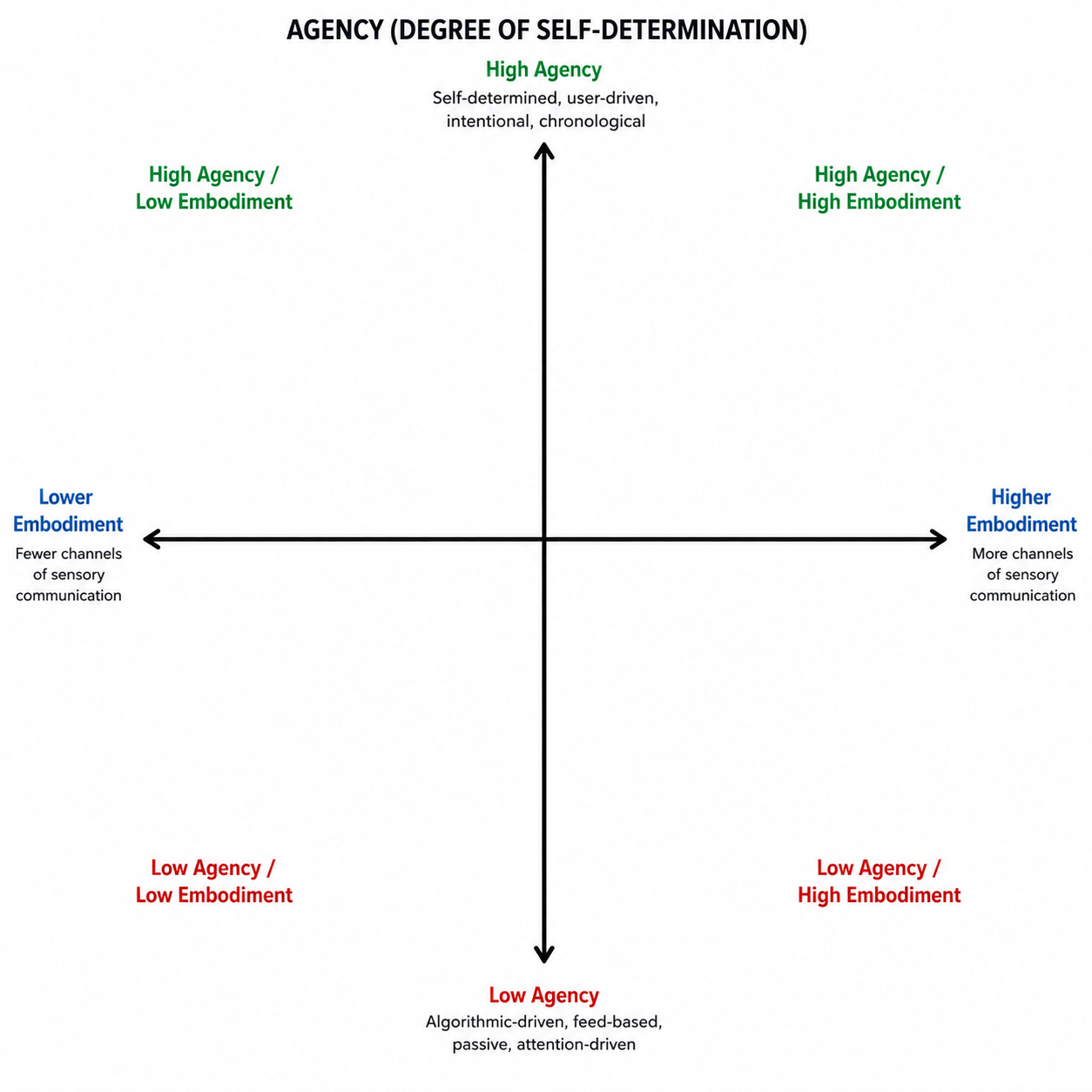
Low agency, low embodiment is what we think of as passive, compulsive 2-d tech use - doomscrolling or getting lost in your TikTok feed for hours. The algorithm shows us what the algorithm shows. Our emotions seem to arise from the interface, the result of how others respond to us and what content rises to the surface. We get stuck on screens instead of being with others. Maybe if we keep scrolling, we’ll find something that will make us feel better. We insert emotional content back into the machine, spin the roulette wheel, and see what happens. It’s vanishingly easy to scroll or text a few words; to click a few buttons and have food appear at our door. It’s much harder to go outside, talk to humans, order a coffee from a barista face-to-face. Relationships are hard. Arguments are difficult. Negotiation and compromise are painful. Embodiment creates friction.
Social media don’t always predictably fall into one of these quadrants. It depends on how you use them. Snapchat is messaging, but it’s also video chat chatting. TikTok is scrolling, but it’s also creating. You can be a consumer or a creator on platforms like TikTok, Instagram or YouTube.
Yet, much of our disembodied, online creativity remains performative and therefore low agency. You’re creating so that others, through the algorithm, notice you. What you say, how you say it, and to whom you’re saying it becomes powerfully based on its algorithmic “value” - how your “content” performs. Your emotional experience of that value is therefore tied to the algorithm.
***
Evolutionary Selection Environments
What I’m saying is that our digital milieus have become new evolutionary selection environments for our emotions, determining which ones are “adaptive” based on algorithmic outputs: virality, emotional escape, frictionlessness, immediacy, and speed. Angry trolling, for example, isn’t just cathartic, it’s productive in digital environments when it goes viral, when its shock-value drives more engagement - even if it’s negative. Avoiding the stresses of life by playing video games is “rewarded” by reducing emotional friction. Ghosting is adaptive from the perspective of emotional escape: you never have to deal with the discomfort and social complexities.
Emotions are sometimes overwhelmingly powerful and painful, but they are also engines of human agency.
Yet these types of emotional “solutions” can wreak havoc if they become habits IRL. At work, becoming the resident office troll will ruin collaboration and get you fired; refusing to talk to a family member will destroy a crucial relationship; and someone who copes with bad things by getting lost in video games risks becoming more stressed and isolated.
In other words, the ways our emotions “work for” us online often don’t always translate to working well for us offline.
Emotions are sometimes overwhelmingly powerful and painful, but they are also engines of human agency. They motivate and move us. They bring bliss as much as suffering. From them, we learn immense amounts - perhaps the most important things - about the world and ourselves, and take actions accordingly, many of them wise. Our feelings are what make us human. It’s ok to sometimes emotionally surrender, but don’t give yourself away.
***
Comments
Nothing yet. Say the first thing.
Sign in to join the conversation.