
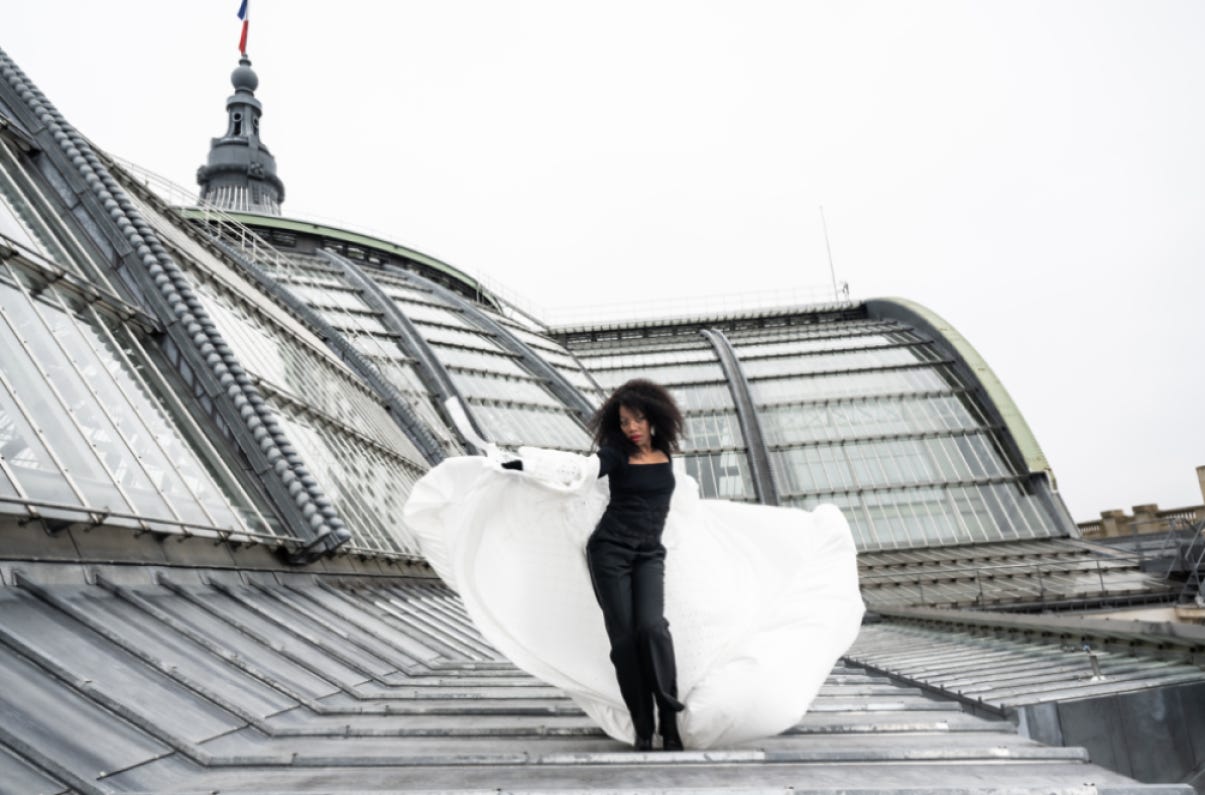
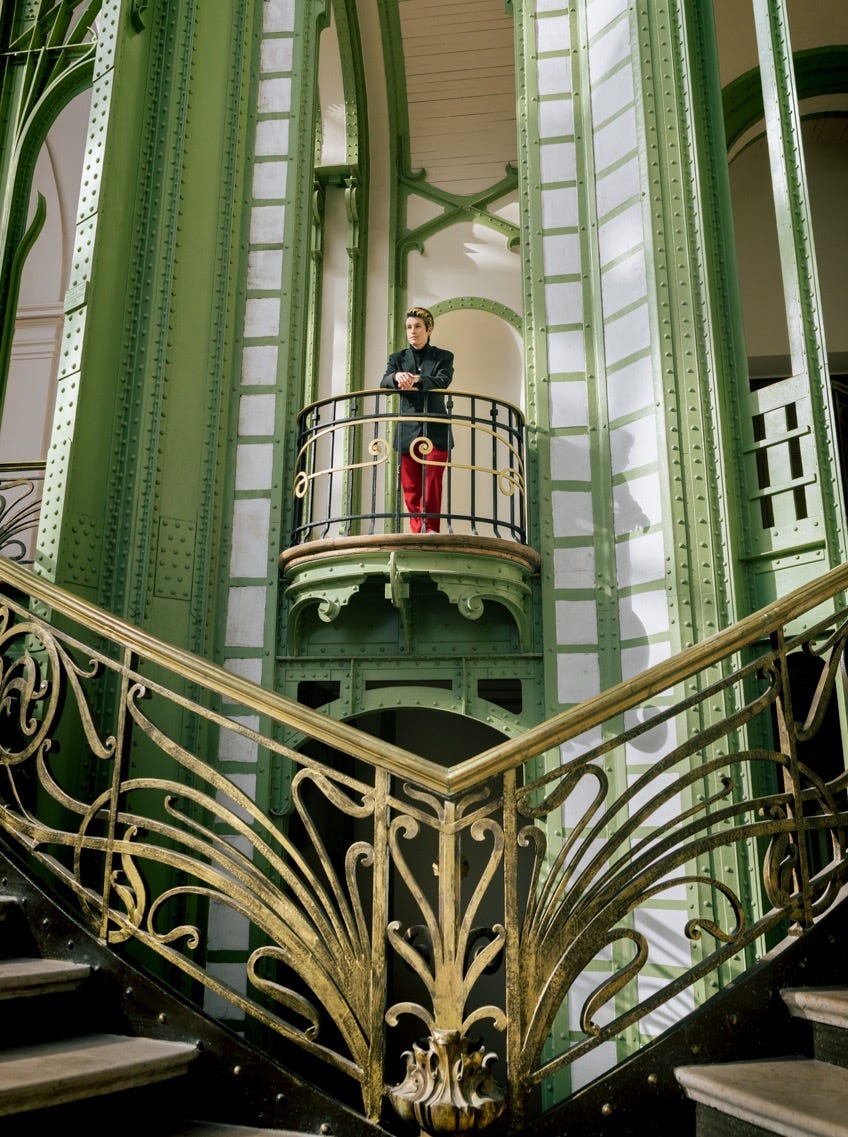
The renovation of the La Grande nef, the “Great Nave”, a monumental iron-and-glass ceiling with cupola, which re-opened last year, has brought the Big Top back to the Grand Palais in Paris.
That seems right to me.
The Grand Palais, at the foot of the Invalides bridge and the top of the riverside leafy-promenade part of the Champs Elysées, had a central part in the 1900 World Fair complex. A successful renewal – and the Grand Palais’ is a really successful renovation – would somehow allude to that heritage.
So it is that, as no fair, especially not a World Fair in Paris, could be complete without a Big Top, the 2026 summer program will continue into a second edition with a slew of top-shelf live circus, dance, music and performance, including hard talent such as Ballet de Lorraine and Ballet de l’Opéra national du Rhin and creativity such as Lucie Antunes’ Symphonie pour 100 batteries (“Symphony for 100 drummers”) and Tiago Rodrigues’ No Yogurt for the dead– which as a candidate for sudden departure myself, I hope is not just more pie-in-the-sky.
Thanks for reading! This post is public so feel free to share it.
See the complete list of live performance acts in the Notes on the Program just below.
It’s no accident that “Grande nef”, “Great nave” (most often meaning the dramatic center of a cathedral), is called “Grande nef”.
Developing brains, skills and arts are key tenets in France’s Republican civil religion of Equality, Solidarity Liberty. And the (Third) Republic built the Grand Palais to showcase “the glory of the art of France” at a World Fair.
So, beyond honoring the Big Top tradition, talent and creativity, Grand Palais also has to show or should show the glory of art as a celebration of the development of brains, skills and arts in a democratic society – for instance, think of the thinking, technology and creativity behind Claire Tabouret’s stained glass windows for Notre Dame, currently on exhibition (See the Notes on the Essay).
In 2026, it seems to me, the glory of art is in intégration, inclusion – and the emphasis I take away from the programming is on the individual and their community of individuals. That’s to say, inclusion is also a function of “community”, as in Lucie Antunes’ “ephemeral community” of drummers – individuals who come together to share and enjoy brains, skills and art.
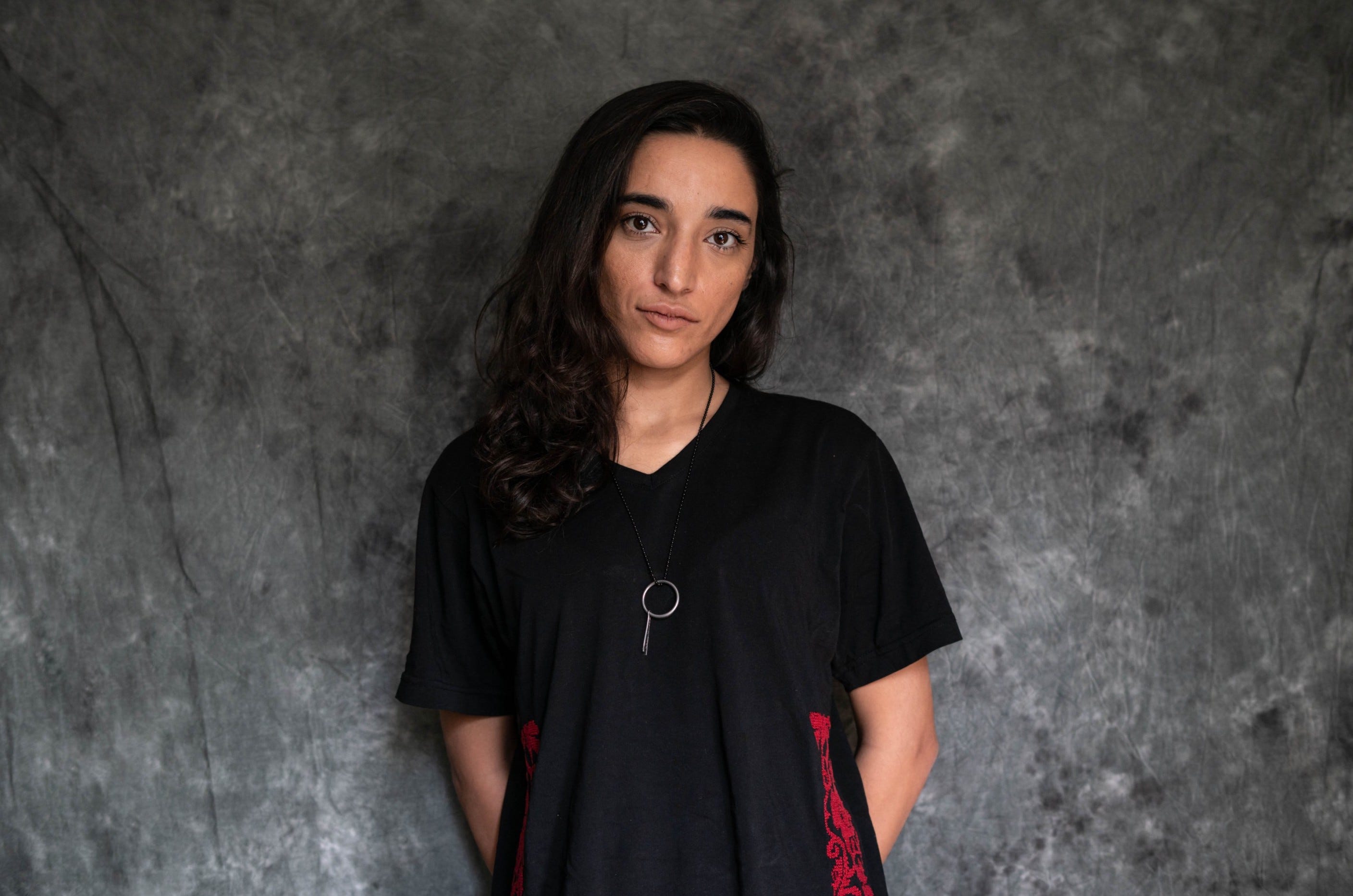
Or, a community such as individuals Nassim Baddag, Lilian Damango and Racha Arodaky, whose Dead leafperformance brings together an intense mix of – wait for the iterations! – intense break (structured, complex and democratic dance born in Black America’s urban culture revolution) and intense contemporary (’68-inspired and re-spiritualized dance forms).
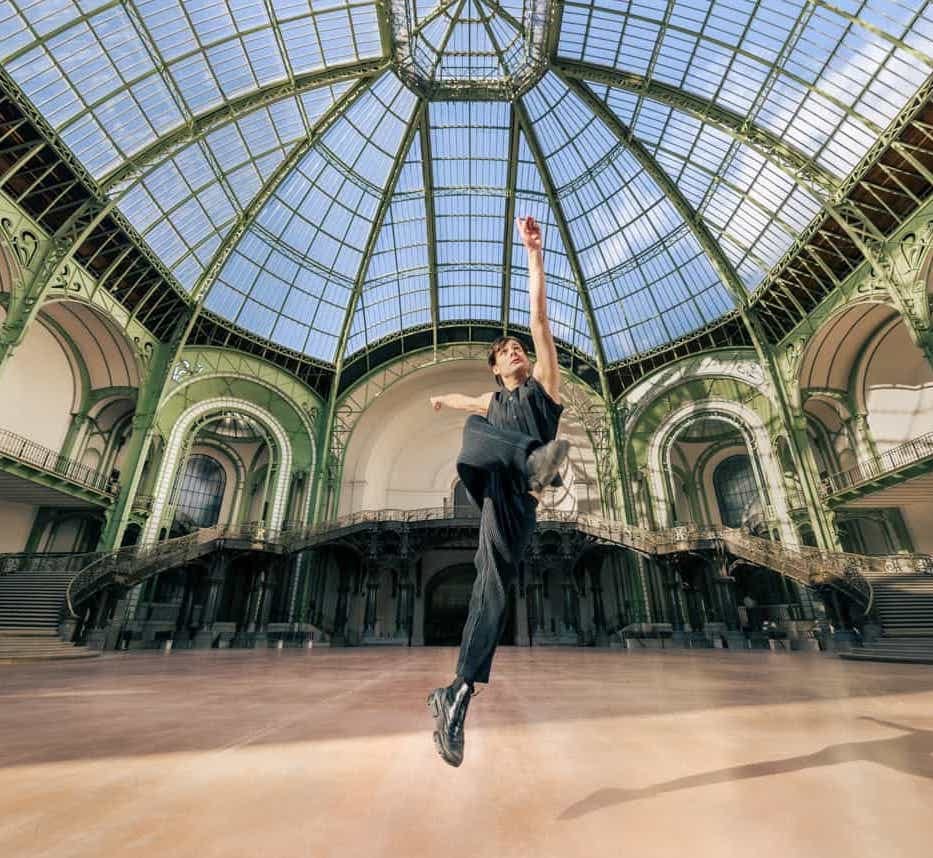
Or Maud Le Pladec, an individual who gets to show herself in community: the successive roles that define her today: dance performer in a duo, choreographer for a group spectacular and director of Ballet de Lorraine.
Or, the performance Derniers feux, in which everybody does everything and which claims itself as happening between the spark and the explosion and caused me to write in my notes, “… projecting a world where technology has killed capitalism and restored individual surplus value and lets everybody do everything”.
Also, Derniers feux reminds me to note that communities are using technology not as a tool but as a new-twist social prosthetic: I once used a landline telephone to call a friend, I now use a smartphone to sustain conversations.
Thanks for reading! This post is public so feel free to share it.
One of my thought-references for this year is Raymond Mason’s bas relief The Departure of Fruit and Vegetables from the Heart of Paris February 28, 1969, now located in the church of Saint Eustache (See Notes on the Essay). The Departure depicts the sellers of the ancient Halles market leaving to make way for, essentially, Centre Pompidou: the end of the Paris of Hemingway and the début of ‘68.
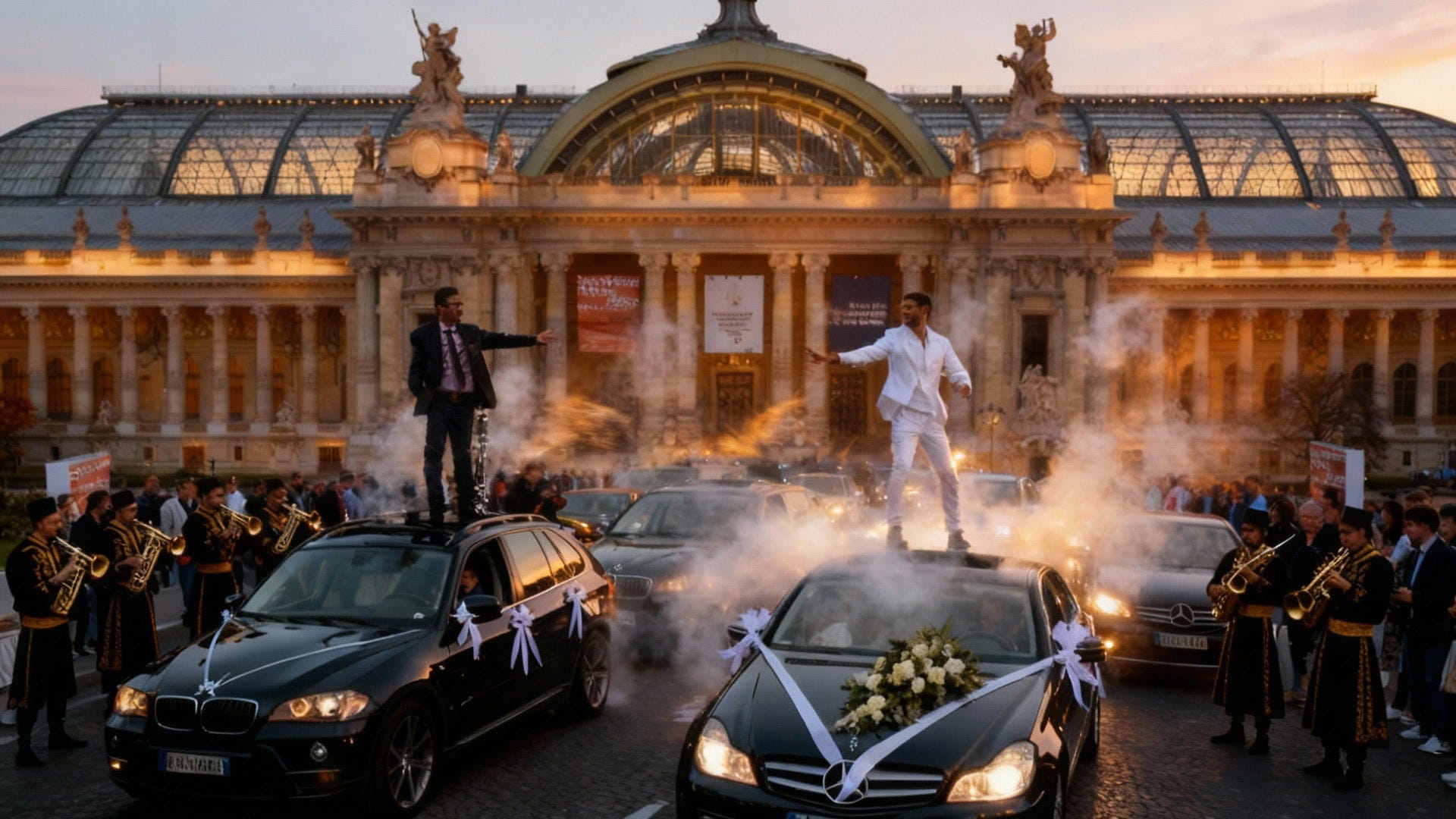
I’m thinking that Mohamed Bourouissa’s Raconte-moi ton mariage (“Tell me about your marriage”) performance event – motorcades converging on the Grand Palais and wedding performance events under the Grande nef – will become my thought-reference for this year 58 of 1968: “The Marriage of Saint Denis and Paris at Grand Palais”.
Saint Denis Basilic - the best example of a luminous-Gothic basilica or cathedral I’ve ever seen - is where the tombs of the ci-devant kings and queens of France are still preserved. The basilica is in the heart of Saint Denis Ville, the biggest and perhaps most historic of the towns of the Département de Seine Saint Denis, which is, in its turn, the biggest part of Paris’ suburban - working class, unprivileged – “crown”.
A lot of folk of North African descent – along with a full bouquet of the globe’s other national varieties along with them – live in Seine Saint Denis department’s many different towns. For good and for ill, Saint Denis Ville is the rhetorical center, the warning and symbol, of France’s post-colonial immigration and integration, inclusion boil-boil-boil-and-bubble-bubble-toil-and-trouble: the department is home to the children of that “Arabe” that that “Frenchman” Mersault, experimenting with existentialism, murdered just for the hell of it in The Stranger.
There’s pretty much a straight-line path of eight miles between Notre Dame and Saint Denis Basilic. Residents of Saint Denis are called “Séquano-Dionysiens”. The “Dionysiens” part of the moniker might explain some at least of the inspiration and subtlety in the choice of wedding as a theme.
“Séquano”, of course, suggests nothing else than mystery.
Marriage. Motorcade.
As a fact, a Hungarian wedding is where I reconciled my WASP country-boy Myself to the oddly more generous ways of people from far away about whom I had previously known nothing. And, I’ve gone through dozens by this time and come out again every time the wiser, sometimes tipsy, sometimes steamy even, and always amused.
A marriage is one of the few moments of life, besides, where actual sex and actual social norms correspond for a fleeting moment. And however a bride and groom might go at it pre-or post-ceremony, wedding guests seem to find a Dionysian angle in the affair, often corresponding just as you like it, thanks.
Thanks for reading! This post is public so feel free to share it.
A motorcade is a demonstration of personal grandeurs momentarily revealed. Yes, maybe some of the Mercedes are rentals or airport shuttles or Uber-driving cousin Sofiane’s cherished big black American SUV. Yes, maybe some of the motors are battered Renaults and a single old Toyota, a beat up Opel or two or a goddamn’ pushbike.
But the fact is.
The fact is, a motorcade is a motorcade, mine, ours. The King of England, Monsieur Le Président de la République, they have motorcades. Especially Monsieur et Madame Jean et Jeanne Lesblonds had one. Everybody can have one and everybody is me, you, la famille Lesmoinsblonds. Like everybody else, genius and art momentarily revealed.
That’s the point.
And then, at the Grand Palais, under the Grande nef, there’s display, performance: a pre-wedding henna party and foods and drinks and dance and brides and grooms and families and friends gawping at each other, feeling the material, nibbling and quaffing and getting acquainted. And all that stuff. Different, but like everybody. That’s the point.
But what makes Mohamed Bourouissa’s motorcade and marriage feast a grand tableau, a “The Marriage of Saint Denis and Paris at Grand Palais” is that, in the end, it makes them witness of the “glory of the art of France”.
The motorcade and the wedding happen only once, and the downstairs’ neighbor’s girl Anna is still learning how to paint, so if you’re in Paris, be sure to be there.
“… With the second edition, the Grand Palais d’été affirms a multidisciplinary and avant garde identity on the artistic scene: two months of performance and events adapted to the Palais’ unique architecture.
The Grande Nef welcomes theater, dance, music, performance and other events open to the whole public. We want the Nef to (re-)take its place as a place of collective experience, public celebration and discovery. …
Events will be followed by “Ciels” a lightshow developed by collectif Visual System for the amazing glass and iron ceiling of the Palais.
This year, invited choreographers will be doing Saturday morning open family-friendly dance workshops under the Nef. …
Some evenings will host “After Nef” events including concerts, public dance and all-night performances by selected artists…” The link to the whole program is below.
See (just below) the Grand Palais d’été site for a complete view of the whole program of events and exhibitions
5-7 June: Circa, Revoir les étoiles (“E quindi uscimmo a riveder le stele” – Dante): New circus from Down Under, Circa takes inspiration from the Divine Comedy to choreograph a tailor-made soar-through of the Grande nef.
10 June: Lucie Antunes, Release party: Lucie Antunes presents Silence, an immersive sound, movement and poetry experience that twines together work by Mathilde Monnier, DJ Canblaster, photographer Wolfgang Tillmans, composer guitarist Halo Maud, music artist Louisahhh, singer and writer Clara Ysé, multi-disciplinary composer and vocalist Vega Voga and text by contemporary poet Laura Vazquez.
12 - 14 June: Némo Flouret, Derniers feux (“Parting fire”): The performers of Derniers feux are also its technicians, musicians, writers, spectators, lighting, idea and sound artisans… Also utopians setting up a work-in-progress around the moment before the fireworks explode: just a few seconds to unify to face the world after this one, challenging fear of danger, facing the emotion and joy of a new eternity.
18 - 20 June: Tiago Rodrigues & NTGent (Ghent Public Theater), No Yogurt for the dead: In order to prove that theater brings the dead and living into fruitful conversation, director-creator Tiago Rodrigues works with the NTGent theater to toss free-range esthetics into a frame of musical comedy.
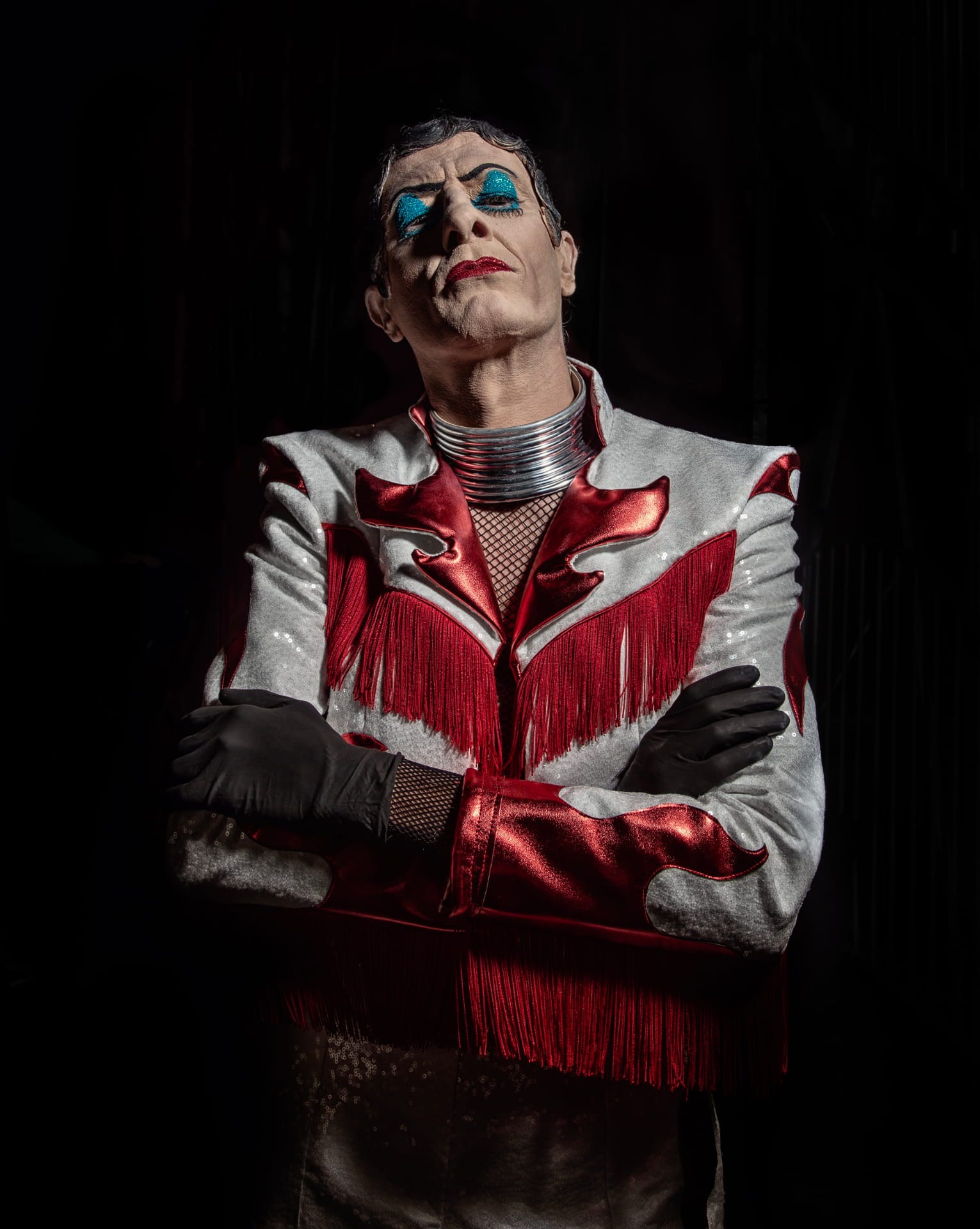
23 June: Drag cabaret drag with Mami Watta, Le Filip, Corrine, Morphine Blaze et al., Sous la jupe du Grand Palais(“Up Grand Palais’ Skirt”): Mami Watta and company re-invent cabaret, bringing together fun and games and public participation for a drag show that is as glamorous as it is eccentric and as fun as it is audacious.
27 June: Lucie Antunes, Symphonie pour 100 batteries (“Symphony for 100 Drummers”): One hundred drummers empathize, sympathize and synchronize to do Antunes’ trance “Symphonie Tribalisme in four movements for one hundred beings”.
30 June – 2 July: Sharon Eyal and Léo Lérus with Ballet de l’Opéra national du Rhin: A double bill by long-time choreographic collaborators Sharon Eyal (The Look - 18 dancers, music by Ori Lichtik) and Léo Lérus (Ici- 12 dancers, sound composition by Denis Guivarc’h). With a scenarization around shadow and silhouette, Eyal’s The Look themes her movement around resilience in face of oppression while Léo Lérus, with complementing solos, small groups and contemporary choreography drawn from Guadeloupe’s Gwoka dance tradition, puts the accent on the physical joy of freedom.
4 July: Mohamed Bourouissa, Raconte moi ton marriage (“Tell me about your marriage”): Organizing creator Mohamed Bourouissa was inspired by the Institut du Monde Arabe’s recent Mariages (Algérie-Maroc-Tunisie)exhibition to put together an inside-outside event beginning with a motorcade headed to the Grand Palais, the heart of Paris, from Paris’ larger northern suburban towns – Gennevilliers, Saint-Ouen, Pantin, Saint-Denis, Argenteuil, la petite couronne. Once also called “The Red Belt” because of their large working class populations and leftist politics, they are now home to many North African (and other, newer) immigrants and their descendants. The event features real marriage stories as well as music and dance performance by and for people of every age, country-community, religious and esthetic persuasion in North Africa.
8 July: Nassim Baddag, Lilian Damango and Racha Arodaky, Dead Leaf: A hybrid choreography of break and contemporary dance: impossible figures and elegant unbalance. Dead leaf explores the “fragility of the present moment and the persistence of movement”.
11 July: Princesse (Josépha) Madoki, All World Waacking Battle 2vs2: A battle is a demonstration of break dance performance prowess, with winners usually by acclamation. Waacking is a break dance genre themed around Hollywood-star mimicry. Princesse Madoki brings her popular-spectacular back for a second round at the Grand Palais and to open the Festival Paris l’été, summer in the city festival.
16-18 July: Maud Le Pladec & CCN - Ballet de Lorraine. Performing offer Including: Lonely Club with Eddy De Pretto and Maud Le Pladec, Crescendo with the Ballet de Lorraine and Synchronicité with the Ballet de Lorraine. Lonely Club puts singer Eddy de Pretto together with choreographer Maud Le Pladec, currently director of the Ballet de Lorraine, for a “choreographed concert” in praise of choir and body. Crescendo is four short Le Pladec pieces ranging from solos to group choreographies by the unique Ballet de Lorraine. Synchronicité re-creates the phenomenal Olympics 2024 street dance. See the link below for commentary on the Ballet de Lorraine and the individual.
13, 20 & 27 June & 4 and 18 July: Grand Mouvement – Public dance workshops.
Grand Palais d’été: https://www.grandpalais.fr/en/programme/grand-palais-dete-2026
Festival Paris l’été: https://www.parislete.fr/en
“Commentary on the Ballet de Lorraine and the individual”, re: Synchronicity: https://open.substack.com/pub/tracydanison/p/synchronicity-and-individuality-in?r=2y0rh2&utm_campaign=post&utm_medium=web
“Grand Palais, at the foot of the Invalides bridge and the top of the leafy-promenade part of the Champs Elysées” … In folklore, crossroads may represent a location “between the worlds” and, as such, a site where supernatural spirits can be contacted and paranormal events can take place. Symbolically, crossroads can indicate a locality where two realms touch and therefore represent liminality, a place literally “neither here nor there”, “betwixt and between” - Wikipedia
“A really successful renovation…” The Grand Palais’ is a really successful renovation, I love it – but, like the un-renovated buildings, the new Grand Palais suffers from woman toilets designed without woman needs in mind. That is why woman toilets most often have long lines while man toilets are three-quarters empty and mobbed by embarrassed women. Wouldn’t it be nice if architects and designers sat down and considered how female bodies are made and then thought about what being a woman imposes on biology and then thought about how to make possible a quick and easy pee or poop in a public space and then designed spaces and facilities that can really do that?
In developing this essay, I keep coming back to thinking about Ray Bradbury’s Something Wicked This Way Comes (1962). The title is taken from a verse from Macbeth, Act 4, Scene 1: “By the pricking of my thumbs/Something wicked this way comes” intones Second Witch. In Bradbury’s tale, a traveling carnival run by a certain Mr Dark comes to a little Midwest American town. Mr Dark has the power to reveal and to grant secret desires. Two barely teenage boys are witness to both powers and their consequences for folk in their community.
Claire Tabouret: //open.substack.com/pub/tracydanison/p/start-the-year-with-claire-
“Technology” … Which reminds me that the dangers of “artificial intelligence” are not in the chips but in the guys: who controls it and who benefits from it.
“Nemo Flouret, Derniers feux … a few seconds to unify to face the world after this one” … Dr. Alexia Lopez observed in the universal vault an architecture of light, a ring of galaxies, that suggest, at least to the physicist Robert Penrose, that the Big Bang recurs – a recurrence due, as I understand it, to the accumulation of unrealized mass or Nothingness. : https://youtu.be/B49058Eot8w?si=TALIR6IFVTxJjBqA
Alexia Lopez: https://uk.linkedin.com/in/alexia-lopez-1981282aa
“The Departure of Fruit and Vegetables from the Heart of Paris February 28, 1969” by Raymond Mason (1922-2010). And come to think of it, it has been a thought-reference for everything all this year, associated with Hexagram 64 of the I Ching, Wei Chi (Before Completion). Action: Prepare. Hu Gua (hidden influence) 63 After Completion: Renew. : https://www.raymond-mason.com
“Ci-devant” (“previously, before, has been”): For those who refused to be “citizen” or for police identification or as a term of abuse, ci-devant was used before noble or aristocratic titles of the Ancien régime – “Louis Capet, ci-devant roi” – in the first years of the French revolution, “has been” indicating, indeed, as it says in the grammar books, that times are different.
“… Where the tombs of the ci-devant kings and queens of France are preserved”: We owe culture and artistic institutions such as the Grand Palais (or the Museum of Modern Art for that matter) to the new spirits raised by the French Revolution. At risk of his own life, Alexandre Lenoir saved royal tombstones and effigies from what in 1794 the Abbé Grégoire in a report to the government called “vandalism” – building on the depredations Vandal tribe, first barbarians to sack Rome. Alexandre Lenoir, who in 1795 would found Le Musée des Monuments française, argued that although the pieces had been made to glorify ci-devants of the Ancien régime, they were especially witness of the artistic genius and should be conserved for the education of the people. (See: Ép.1 La Révolution ou les vandales de l’an II by Louis Gevart originally published 14 March 2019 in Beaux Arts magazine: https: //www.beauxarts.com/grand-format/ep-1-les-vandales-de-lan-ii-ou-la-revolution-par-la-destruction/
Alexandre Lenoir, founding conservator of France’s cultural heritage. Just hope that you’ll show the same mettle when the moment comes, eh?: https://en.wikipedia.org/wiki/Alexandre_Lenoir
Thanks for reading! This post is public so feel free to share it.
No posts
Comments
Nothing yet. Say the first thing.
Sign in to join the conversation.