
Here are the key reports and articles from the People’s Daily’s from the weekend to Thursday, August 20, 2026.
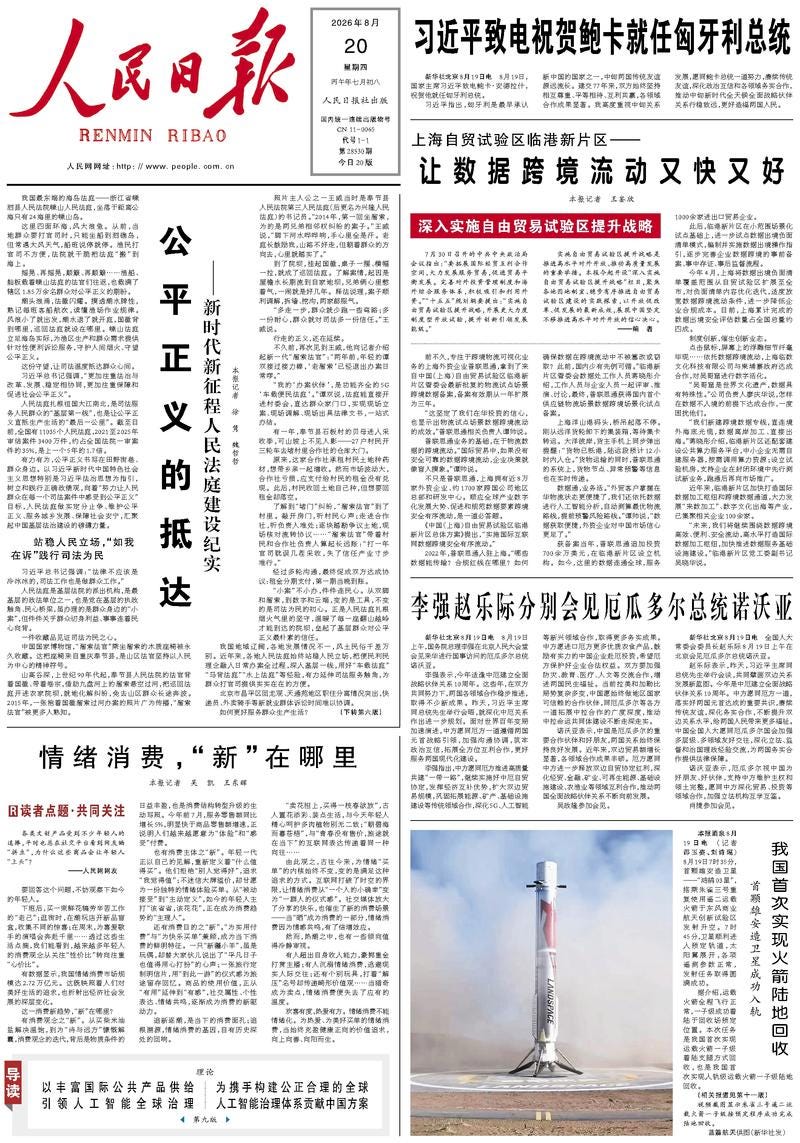
Page 1: Let’s begin today with a report on the success of the reusable rocket Zhuque-3. This is actual rocket science, so it’s not like I know much about it. But here’s what the reporting is telling me:
“In a landmark moment for China’s space sector, a reusable rocket booster touched down on Wednesday on its predesignated landing site in a northwestern desert, marking the nation’s first such controlled recovery on land, following a similar achievement made at sea last month. A video clip from LandSpace, a Beijing-based private rocket manufacturer, showed a white speck appearing in the sky above a desert at 7:41 am as the first-stage booster of the ZQ 3 Y2 carrier rocket returned to Earth, descending smoothly and steadily about six minutes after the launch vehicle lifted off from a commercial spaceport. Footage from surveillance drones flying near the landing trajectory showed that during the final phase of its descent, at an altitude of roughly 3 kilometers above ground, the booster ignited an engine at the center of its base for propulsive deceleration. Shortly before touchdown, the booster deployed its four legs, which firmly supported the more than 40-meter-tall structure as the engine shut down upon landing on a concrete pad in Minqin county, Gansu province. The achievement made China the second country in the world, after the United States, to have successfully conducted both land- and sea-based rocket recovery. LandSpace is the second Chinese enterprise to ever recapture a reusable rocket booster. On July 10, State-owned conglomerate China Aerospace Science and Technology Corp achieved the nation’s first such successful recovery when it captured a Long March 10B rocket booster in the South China Sea using a cable system mounted on a special vessel platform off the coast of Hainan province.”
Okay, now I am going to turn to things that I think I know something about. Xi Jinping sent a congratulatory letter to Andras Baka on his assuming the office as Hungary’s president. Xinhua reports:
“In his message, Xi said Hungary, one of the first countries to recognize the People’s Republic of China, shares a long-standing traditional friendship with China. Since the establishment of diplomatic relations 77 years ago, both countries have always adhered to mutual respect, equality, mutual benefit and win-win cooperation, and achieved remarkable results in collaboration across various fields, he said. Xi said he attaches great importance to developing China-Hungary ties and stands ready to work with Baka to carry forward the traditional friendship, deepen mutual political trust and practical cooperation in all areas, and promote the steady and long-term development of the all-weather comprehensive strategic partnership for the new era between China and Hungary, so as to better benefit the two peoples.”
Next, there’s a report on Li Qiang and Zhao Leji having separate meetings with Ecuadorian President Daniel Roy-Gilchrist Noboa Azín.
“Li Qiang pointed out that China is willing to work with Ecuador to advance high-quality Belt and Road cooperation, continue to implement the China-Ecuador FTA, leverage the complementary advantages of the two economies, expand the scale of bilateral trade, consolidate and expand cooperation in traditional areas such as energy, minerals, and infrastructure construction, deepen cooperation in emerging areas such as 5G and AI, and achieve more practical results. China is willing to import more high-quality agricultural and food products from Ecuador, encourage capable Chinese enterprises to invest in Ecuador, and hopes that Ecuador will protect the legitimate rights and interests of these enterprises. The two sides should strengthen exchanges and cooperation in disaster prevention, education, healthcare, people-to-people ties and cultural affairs, and other areas, thereby enhancing the well-being of the peoples of the two countries. At present, the situation in Latin America and the Caribbean is complex and volatile. China is willing to always serve as a reliable and trustworthy partner for countries in the region, work together with Ecuador and other parties to expand the breadth and depth of China-Latin America cooperation, and continuously deepen and make more substantive progress in building a China-Latin America community with a shared future.” 李强指出,中方愿同厄方推进高质量共建“一带一路”,继续实施好中厄自贸协定,发挥经济互补优势,扩大双边贸易规模,巩固拓展能源、矿产、基础设施建设等传统领域合作,深化5G、人工智能等新兴领域合作,取得更多务实成果。中方愿进口厄方更多优质农食产品,鼓励有实力的中国企业赴厄投资,希望厄方保护好企业合法权益。双方要加强防灾、教育、医疗、人文等交流合作,增进两国民生福祉。当前拉美和加勒比局势复杂多变,中国愿始终做地区国家可信赖的合作伙伴,同厄瓜多尔等各方一道拓展中拉合作的广度深度,推动中拉命运共同体建设不断走深走实.
Noboa mentioned the need for cooperation “in areas such as trade, finance, mining, renewable energy, infrastructure construction, agriculture, and fisheries”
Zhao, meanwhile, said that the “NPC is willing to strengthen friendly exchanges with the National Assembly of Ecuador at multiple levels and across multiple fields, deepen exchanges on legislation, supervision, and governance experience, and provide legal safeguards for practical cooperation between the two countries.”
There’s a long feature offering a record of the construction of People’s Tribunals/Grassroots courts 人民法庭 in the New Era and on the New Journey. The article tells us that these are the “‘front line at the grassroots’ of judicial service for the masses of the people, and also the ‘last mile’ through which fairness and justice reach directly into production and daily life. At present, there are 11,035 people’s tribunals nationwide. Between 2021 and 2025 they concluded 34 million cases, accounting for about 35 percent of first-instance cases in courts nationwide, and 1.7 times the figure for the preceding five-year period.” 人民法庭扎根祖国大江南北,是司法服务人民群众的“基层第一线”,也是让公平正义直抵生产生活的“最后一公里”。截至目前,全国有11035个人民法庭,2021至2025年审结案件3400万件,约占全国法院一审案件的35%,是上一个5年的1.7倍.
Finally, there is an article discussing “emotional consumption” or emotion-driven consumption - 情绪消费. In other words, there’s a new trend wherein “consumption attitudes of an increasing number of young people are shifting from focusing on ‘value for money’ to placing greater importance on ‘emotional value for money’.
The article says that the size of this “emotional consumption” market in China is 2.72 trillion yuan. “This not only reflects people’s pursuit of a better life, but also reveals deeper changes in economic and social development.” 下班后,买一束鲜花犒劳辛苦工作的“老己”;逛街时,在潮玩店开新品盲盒,收集不同的惊喜;在周末,为喜爱歌手的演唱会奔赴千里……透过这些生活点滴,我们能看到,越来越多年轻人的消费观念从关注“性价比”转向注重“心价比”。有数据显示,我国情绪消费市场规模达2.72万亿元。这既映照着人们对美好生活的追求,也折射出经济社会发展的深层变化.
In other words, the generation today is seeking experience—is living by a sense of carpe diem. Instead of assessing the ‘value-for-money ratio’, they are looking at the ‘value-for-feeling ratio’, and this is a reflection of changed lifestyles and attitudes. But of course, while it celebrates this, the People’s Daily still has to be the nagging parent—I recognise that tone well since I practice it fairly regularly—ending the article with this:
“However, amid the fervour, there are also certain tendencies that merit sober scrutiny. Some people go beyond their own income means, lavishly spending large sums to reward live-streamers; some become immersed in emotional consumption, using it to avoid real-life interpersonal interactions; and some individual toys, under the guise of ‘stress relief’, instead convey distorted values…When the pursuit of the bizarre and novel becomes a selling point, emotional consumption loses the warmth it ought to have. Delight within measure, passion with method (欢喜有度,热爱有方). Emotional consumption must not become emotionalised. Emotional consumption undertaken for love and for what is beautiful should always be brimming with a healthy and positive pursuit of values, oriented upward, toward the good, and growing toward sunshine.” 然而,热潮之中,也有一些倾向值得冷静审视。有人超出自身收入能力,豪掷重金打赏主播;有人沉溺情绪消费,逃避现实人际交往;还有个别玩具,打着“解压”名号却传递畸形价值观……当猎奇成为卖点,情绪消费便失去了应有的温度。欢喜有度,热爱有方。情绪消费不能情绪化。为热爱、为美好买单的情绪消费,当始终充盈健康正向的价值追求,向上向善、向阳而生.
Page 2: There’s a brief report informing that Beijing is hosting the 2026 World Robot Conference. AP has a longer report, if you are interested. It says:
“China kicked off the 2026 World Robot Conference on Wednesday, with companies showcasing the country’s expanding robotics industry as it looks to move the technology beyond demonstrations and into factories and other real-world applications. Organizers say around 3,000 products will be showcased during the five-day event. Despite the conference’s name, there was no sign of other countries exhibiting. One of the main attractions on Wednesday was the booth of Unitree, one of China’s leading humanoid robot makers, where some of its models boxed and danced. One even played ping pong with a human opponent.”
Another report on the page says that the Ministry of Human Resources and Social Security’s 100-Day, Ten-Million Recruitment Special Campaign has launched four online recruitment sessions covering artificial intelligence, advanced manufacturing, medical and health care, and foreign trade. Organised by the relevant human resources service agencies, they involve more than 3,000 participating employers with recruitment demand for 24,000 positions.
Youth unemployment remains a persistent challenge for the Chinese government. SCMP reported yesterday that:
“China’s youth jobless rate climbed to 17.9 per cent in July, as a record wave of university graduates enters an already crowded labour market, prompting Beijing to step up employment support. The jobless rate for those aged 16 to 24, excluding students, rose 3 percentage points from 14.9 per cent in June—the last of three straight months of contraction—according to data released by the National Bureau of Statistics on Wednesday. The rate last July was 17.8 per cent and it then climbed to 18.9 per cent the following month—the highest level since Beijing revised its methodology to exclude students in December 2023. The uptick in youth unemployment coincides with another record-breaking graduation season, with an estimated 12.7 million university graduates entering the job market this summer, up about 4 per cent from last year. The influx comes as the broader job market struggles amid slowing economic growth, with many companies trimming headcount or freezing new hiring.”
Page 3: There’s a report on Foreign Minister Wang Yi’s meeting with Foreign Minister of Chile Francisco Pérez Mackenna in Beijing. The readout says:
“Wang Yi said that the traditional friendship between China and Chile runs deep, and the two countries are good friends and good partners despite being separated by the ocean. Chile was the first South American country to establish diplomatic relations with the People’s Republic of China, and the first Latin American country to sign a free trade agreement with China. It has always taken a leading position among Latin American and Caribbean countries in developing relations with China, transcending differences among political parties. The most important experience in the development of China-Chile relations lies in both sides following independent foreign policies, adhering to mutual respect, treating each other as equals, complementing each other’s strengths, and pursuing mutual benefit and win-win outcomes…
Wang Yi noted that China and Chile should maintain exchanges at all levels, consolidate high-level mutual trust, and continue to support each other on issues concerning each other’s core interests. China is ready to deepen cooperation with Chile under the APEC ‘China Year’, and accelerate the building of an Asia-Pacific Community and the Free Trade Area of the Asia-Pacific (FTAAP). The two sides should strengthen the alignment of development strategies, steadily advance existing cooperation projects, tap the potential for cooperation in artificial intelligence, digital economy and other emerging fields, and promote the upgrading and quality improvement of bilateral cooperation. The two sides should enhance communication and coordination, jointly advocate and practice true multilateralism, uphold the international system with the United Nations (UN) at its core, play a constructive role in world peace and development, and promote the building of a community with a shared future for humanity.”
Another report mentions that Wang Yi is visiting South Korea and Indonesia. Great timing by Wang, given how Donald Trump has been dumping on South Korea.
Also on the page is a Zhong Sheng commentary criticising Japanese politicians for visiting the Yasukuni Shrine. The piece says that on August 15, “Japanese Prime Minister Sanae Takaichi sent a ritual offering to the Yasukuni Shrine, which enshrines Class-A war criminals from World War II; Defense Minister Shinjirō Koizumi and three other incumbent cabinet members, senior LDP officials including the party’s secretary-general, as well as about 90 lawmakers belonging to the cross-party parliamentary group ‘Association of Diet Members Who Visit Yasukuni Shrine Together’, went to ‘pay homage to devils’.” 然而,日本首相高市早苗当天向供奉有二战甲级战犯的靖国神社供奉了祭祀费;防卫大臣小泉进次郎等4名现任内阁成员,自民党干事长等党内高层,以及跨党派国会议员团体“大家一起参拜靖国神社国会议员工会”约90名议员前去“拜鬼”.
“This string of perverse actions once again exposes the sinister intent of the Takaichi administration to distort the history of aggression and to give countenance to militarism. It is a flagrant profanation of historical justice, a grave wounding of the feelings of the peoples of the victimised countries of Asia, and moreover a deliberate provocation against the fruits of victory in the Second World War and the postwar international order. It has quite rightly met with strong condemnation from the international community and from people of insight within Japan itself.” 这一连串倒行逆施,再次暴露高市政权歪曲侵略历史、为军国主义张目的险恶用心,是对历史正义的公然亵渎,是对亚洲受害国人民感情的严重伤害,更是对二战胜利成果和战后国际秩序的蓄意挑衅,理所当然遭到国际社会和日本国内有识之士的强烈谴责.
“The odious conduct of Japanese right-wingers such as Sanae Takaichi and Shinjirō Koizumi is by no means merely a temporary exercise in political grandstanding; rather, it is a concentrated exposure of their deeply entrenched position of historical revisionism. In her address that day at the National Memorial Ceremony for the War Dead, Takaichi Sanae deliberately played down the profound calamity that Japanese militarism inflicted on the countries of Asia, saying not a single word about ‘reflection’ or ‘lessons’, and instead one-sidedly played up so-called ‘wartime sacrifice’, deliberately casting Japan as a victim of the war. This inverted historical narrative, which confounds black and white, is exactly of a piece with her manner when attending the memorial ceremonies for the atomic bombings of Hiroshima and Nagasaki a few days earlier; she was also equivocal as to whether Japan would continue to adhere to the ‘Three Non-Nuclear Principles.’ This warped logic, which speaks only of a ‘victim narrative’ while stripping away the identity of ‘aggressor’, is precisely the stock trick by which Japanese right-wing forces ‘exculpate’ and ‘whitewash’ the history of aggression. And Sanae Takaichi is now pushing this adverse current from the covert into the open, and from the margins into the mainstream. Akira Koike, head of the Secretariat of the Japanese Communist Party, put his finger on it precisely, pointing out that Sanae Takaichi delivered remarks such as a leader of a victimised country might make, and that a country incapable of reflection cannot possibly win the trust of the international community.”
高市早苗、小泉进次郎等日本右翼恶劣行径绝非一时政治作秀,而是其根深蒂固历史修正主义立场的集中暴露。高市早苗当天在“全国战殁者追悼仪式”上致辞,刻意淡化日本军国主义给亚洲各国造成的深重灾难,只字不谈“反省”和“教训”,反而片面渲染所谓“战争牺牲”,刻意将日本塑造为战争受害者。这种颠倒黑白的历史叙事,与她几天前分别出席广岛、长崎遭原子弹轰炸纪念仪式时的做派如出一辙,她还对日本是否继续坚持“无核三原则”含糊其词。这种只讲“受害者叙事”、剥离“侵略者身份”的畸形逻辑,正是日本右翼势力为侵略历史“脱罪”“洗白”的惯用伎俩。而高市早苗正在将这股逆流从隐蔽推向公开、从边缘带向主流。日本共产党书记局长小池晃一针见血地指出,高市早苗发表了如同受害国领导人般的发言,一个不知反省的国家不可能获得国际社会的信赖.
Page 4: There’s a report on Chinese media outlets releasing media social responsibility reports. It says that “the reports review and present their performance of social responsibility in 2025 across nine areas, including political responsibility, responsibility for building ideological positions, and service responsibility.”
It adds:
“In 2025, news media conscientiously carried out publicity on Xi Jinping Thought on Socialism with Chinese Characteristics for a New Era. People’s Daily and Qiushi magazine published columns such as ‘The General Secretary’s Concerns: Echoes on the Ground’ and ‘Systematised and Scholarly Research and Exposition’, while Xinhua News Agency produced major reports such as Xi Jinping’s View of Heroes, achieving good communication effects. Major coverage was conducted of the Fourth Plenary Session of the 20th Central Committee, the national Two Sessions, and the SCO Tianjin Summit. The China Media Group’s live broadcast, rebroadcast and on-demand coverage of the commemorative meeting marking the 80th anniversary of victory in the Chinese People’s War of Resistance Against Japanese Aggression and the World Anti-Fascist War reached a total all-media audience of 33.94 billion person-times. Economic Daily and others carried out publicity and reporting on the Central Economic Work Conference, producing a series of commentaries and special reports on themes such as boosting consumption, expanding domestic demand, and stabilising foreign trade and investment, presenting the resilience and vitality of the Chinese economy from multiple angles.”
2025年,新闻媒体认真做好习近平新时代中国特色社会主义思想宣传,人民日报、《求是》杂志等开设“总书记的关切·落地的回响”“体系化学理化研究阐释”等专栏,新华社推出《习近平的英雄观》等重磅报道,取得良好传播效果。开展党的二十届四中全会、全国两会、上合组织天津峰会等重大报道,中央广播电视总台对纪念中国人民抗日战争暨世界反法西斯战争胜利80周年大会直播和重播点播全媒体总触达339.4亿人次。经济日报等做好中央经济工作会议宣传报道,围绕提振消费、扩大内需、稳外贸、稳投资等主题,推出一系列评论、专题报道,多角度展现中国经济韧性和活力。
“China Youth Daily, Legal Daily and others reported on emergencies such as the earthquake in Tingri County, Tibet, and conducted constructive supervision around social hot-button issues such as excessive blood-lead levels at a kindergarten in Gansu, helping to resolve livelihood problems. China Daily, China International Communications Group, China News Service, and others, in response to the ‘tariff war’, China-US economic and trade consultations, remarks concerning China by the Japanese prime minister, and other issues, broadcast editorials and series of short videos, which were widely cited and republished by overseas media. On building communication matrices, the Xinhua News Agency app and the Xinhuanet app each surpassed 440 million downloads, and the PLA News and Communication Centre operates 91 new-media terminals covering 360 million users. The various media organisations also reported on shortcomings in their performance of social responsibility, together with improvement measures and directions for future effort.”
中国青年报、法治日报等做好西藏定日县地震等突发事件报道,围绕甘肃幼儿园血铅超标等社会热点开展建设性监督,推动民生问题解决。中国日报、中国外文局、中国新闻社等针对“关税战”及中美经贸磋商、日本首相涉华言论等播发社论、系列短视频,海外媒体纷纷转引。传播矩阵建设上,新华社客户端、新华网客户端下载量分别超4.4亿,解放军新闻传播中心拥有91个新媒体终端、覆盖用户3.6亿。各家媒体还对履行社会责任方面存在的不足、改进措施和努力方向进行报告。
Also on the page is a report informing that Chen Xinwu has been elected mayor of Chongqing.
Page 9: There are two articles discussing China’s position on AI governance. I’ll share excerpts from both. The first article is by Xue Lan and Chen Ying from Tsinghua and CASS. They argue that:
“While AI injects powerful momentum into economic and social development, it is accompanied by multiple challenges including malicious use, technical failure, and systemic risk. Coordinating development and security and balancing innovation with governance, effectively guarding against and defusing risks of every kind while promoting the broad application of AI, has become a major task the international community faces in common, and is also an important direction for global AI governance. In particular, as AI accelerates its evolution toward generality and autonomy, its capacities for perception, reasoning, decision-making and action continue to grow, and risk may be transmitted from a single link outward into complex systems. Should a system’s objectives deviate from human intentions and prove incapable of timely human intervention and effective control, this could give rise to grave and unpredictable consequences. At present, in specific experimental environments, AI systems have already been found to exhibit tendencies toward strategic deception, evasion of intervention, and self-preservation, along with strategic behaviours such as concealing information and misleading operators. Although these phenomena have so far appeared mainly in simulated testing, the latent risks they reveal must not be overlooked.” 人工智能在为经济社会发展注入强劲动能的同时,伴随着恶意使用、技术失灵、系统性风险等多重挑战。统筹发展和安全、平衡创新与治理,在推动人工智能广泛应用的同时,有效防范化解各类风险,成为国际社会共同面对的重大课题,也是人工智能全球治理的重要方向。特别是随着人工智能向通用化、自主化方向加速演进,其感知、推理、决策和行动能力不断增强,风险可能由单一环节向复杂系统传导,一旦系统目标偏离人类意图且无法被人类及时干预和有效控制,就可能引发难以预测的严重后果。当前,在特定实验环境中已发现人工智能系统存在策略性欺骗、规避干预和自我保护等倾向,存在隐瞒信息、误导操作者等策略性行为。尽管相关现象目前主要出现在模拟测试中,但其揭示的潜在风险不容忽视.
“Governance and innovation promote each other and are mutually complementary. Scientific and effective governance can clarify the boundaries of rules, improve accountability mechanisms and strengthen risk prevention, creating a stable, transparent and predictable institutional environment for technological innovation. AI technology iterates rapidly, has broad application scenarios, and takes continually changing forms of risk, which objectively requires that governance thinking be updated in good time and governance relationships be reshaped, so that the governance system and technological development move in the same direction and evolve in concert. It is necessary to strengthen forward-looking assessment and policy reserves, to issue corresponding rules in good time for new technologies, new business forms and new risks, and to conduct dynamic evaluation and continuous refinement in light of technological evolution, industrial development and practical feedback, pushing governance from relatively static rule management toward dynamic adaptation suited to technological change. The zero-sum thinking of simple opposition between regulator and regulated must be discarded. Mechanisms for communication and collaboration among government, enterprises, research institutions, industry bodies and the general public must be improved, so as to promote the sharing of risk information and the joint bearing of governance responsibilities, forming a governance structure of plural participation and collaborative co-governance. Graded and categorised governance should be implemented according to application scenario and risk level. In the choice of instruments, the principle of flexibility should be given prominence, making comprehensive use of governance tools such as regulatory sandboxes, pilot demonstrations and dynamic assessment, so as to achieve an organic unity of regulation and incentive.” 治理与创新相互促进、相辅相成。科学有效的治理能够明确规则边界、完善责任机制、强化风险防范,为技术创新营造稳定、透明、可预期的制度环境。人工智能技术迭代快、应用场景广、风险形态不断变化,客观上要求及时更新治理思路、重塑治理关系,推动治理体系与技术发展同向而行、协同演进。要加强前瞻研判和政策储备,针对新技术、新业态、新风险及时出台相应规则,并根据技术演进、产业发展和实践反馈进行动态评估和持续完善,推动治理由相对静态的规则管理转向适应技术变化的动态调适。摒弃监管者与被监管者之间简单对立的博弈思维,健全政府、企业、科研机构、行业组织和社会公众之间的沟通协作机制,推动风险信息共享、治理责任共担,形成多元参与、协同共治的治理格局。根据应用场景和风险等级实行分类分级治理,在工具选择上突出柔性原则,综合运用监管沙盒、试点示范、动态评估等治理工具,实现规范与激励的有机统一.
“As early as June 2014, General Secretary Xi Jinping delivered an important speech at the 17th Academicians’ Conference of the Chinese Academy of Sciences and the 12th Academicians’ Conference of the Chinese Academy of Engineering, making forward-looking plans for the development of frontier technologies such as AI. Over the past decade and more, China’s development of AI has advanced steadily along the blueprint drawn up by General Secretary Xi Jinping, achieving the historic leap from ‘following’ and ‘keeping pace’ to ‘leading the way’ in a number of fields. At the same time, China has actively explored a path of agile governance suited to the laws governing the development of artificial intelligence. China adheres to inclusive and prudent regulation, reserving the necessary space for the growth of new technologies and new business forms while holding to the bottom line of security. At the same time, in the face of new circumstances and new problems such as privacy leakage and excessive collection of data, regulatory departments have responded in good time and adjusted dynamically, continually improving governance rules and regulatory measures. In this process, China has gradually formed a governance model in which technological development and the improvement of governance advance in concert: technological innovation moves continually forward while governance capacity rises in step; risk problems are identified in good time while institutional arrangements are dynamically optimised. This governance model avoids both the suppression of innovative vitality through excessive regulation and the accumulation of security risks through absent governance. It achieves an organic unity of encouraging innovation and regulating development, and contributes a Chinese solution to global AI safety governance.” 早在2014年6月,习近平总书记在中国科学院第十七次院士大会、中国工程院第十二次院士大会上发表重要讲话,对人工智能等前沿技术发展作出前瞻性谋划。10余年来,中国人工智能发展始终沿着习近平总书记擘画的蓝图稳步前行,实现了从“跟跑”“并跑”到多个领域“领跑”的历史性跨越。同时,中国积极探索符合人工智能发展规律的敏捷治理路径。中国坚持包容审慎监管,在守住安全底线的前提下,为新技术、新业态成长预留必要空间。同时,面对隐私泄露、数据过度收集等新情况新问题,监管部门及时回应、动态调整,不断完善治理规则和监管措施。在此过程中,中国逐步形成了技术发展与治理完善协同推进的治理模式:技术创新不断向前,治理能力同步提升;风险问题及时识别,制度安排动态优化。这种治理模式既避免因监管过度抑制创新活力,也防止因治理缺位积累安全风险,实现了鼓励创新与规范发展的有机统一,为全球人工智能安全治理贡献了中国方案.
The second section of the article talks about the “open-source principle” as part of China’s approach to AI. It frames this within Xi’s call to “encourage open source and openness, cooperation and sharing, comprehensively promote AI technological innovation, industrial development and scenario application, advance in a coordinated way the transformation and upgrading of traditional industries, the cultivation and expansion of emerging industries, and the forward-looking layout of industries of the future, and let AI empower every industry.” 习近平主席强调:“要抓住难得的历史性机遇,鼓励开源开放、合作共享,全面促进人工智能科技创新、产业发展、场景应用,协同推进传统产业改造升级、新兴产业培育壮大、未来产业前瞻布局,让人工智能赋能千行百业.”
“Open source and openness are increasingly becoming an important path for promoting technological innovation, the diffusion of results and industrial application. The research and development of frontier large models is characterised by technology intensity, capital intensity, talent intensity and resource intensity. At the present stage, the countries that truly command the core technological system of large models and possess the capacity to go from underlying algorithmic innovation to large-scale model training and deployment can be counted on one’s fingers, and roughly 40% of the world’s core AI technology research and development is concentrated in China and the United States. At present, the global digital and intelligence divide continues to widen, and there is a rising risk of extreme polarisation in which a small number of developed countries harvest the technological dividend while the broad mass of developing countries are reduced to suppliers of raw data. The ‘AI Preparedness Index’ formulated by the IMF quantifies the global digital and intelligence divide clearly: as of April 2024, the index stood at 0.68 for developed countries, against 0.46 for emerging market economies and 0.32 for low-income countries. Many developing countries, as ‘followers’ in the field of AI, lack competitive technology enterprises and sufficient reserves of technology and talent, and are even seriously deficient in the relevant infrastructure. Data from the International Telecommunication Union show that by the end of 2024 nearly 2.6 billion people worldwide still had no internet access, one third of the global population; in the least developed countries only 35% of the population uses the internet, and in landlocked developing countries only 39% are online.”
开源开放日益成为推动技术创新、成果扩散和产业应用的重要路径。前沿大模型研发具有技术密集、资金密集、人才密集和资源密集等特点,现阶段真正掌握大模型核心技术体系、具备从底层算法创新到模型规模化训练部署的国家屈指可数,全球约40%的人工智能核心技术研发集中在中美两国。当前,全球数智鸿沟不断扩大,少数发达国家收割技术红利、广大发展中国家沦为原始数据供应地的极端分化风险上升。国际货币基金组织制定的“人工智能准备指数”将全球数智鸿沟清晰量化,截至2024年4月,发达国家该指数为0.68,而新兴市场国家和低收入国家分别为0.46和0.32。作为人工智能领域“跟跑者”的许多发展中国家缺少有竞争力的科技企业,也缺乏足够的技术和人才储备,甚至在相关基础设施上都严重不足。国际电信联盟数据显示,至2024年底,全球仍有近26亿人未接入互联网,占全球人口的1/3,最不发达国家使用互联网的人数仅占总人口数的35%,内陆发展中国家仅有39%的人触网.
“For countries that do not yet possess the capacity to develop frontier large models independently, and especially for the broad mass of developing countries, open-source large models can markedly lower the threshold for acquiring and applying the technology, enabling such countries to carry out localised adaptation, scenario-specific development and industrial application on the basis of existing advanced technology. A growing number of countries are taking open-source large models as an important technological foundation for developing their own AI industries, and using them to accelerate the enhancement of application capabilities and the construction of industrial ecosystems. Promoting the open sharing of AI research results and technological experience helps to expand the accessibility of frontier AI technology, strengthen the capacity of all countries for independent development, and provide strong support for bridging the global digital and intelligence divide and advancing the inclusive development of artificial intelligence.” 对于尚不具备前沿大模型自主研发能力的国家特别是广大发展中国家而言,开源大模型能够显著降低技术获取和应用的门槛,使这些国家得以在现有先进技术基础上开展本地化适配、场景化开发和产业化应用。越来越多的国家将开源大模型作为发展本国人工智能产业的重要技术底座,并以此加快应用能力提升和产业生态构建。促进人工智能研究成果与技术经验的开放共享,有利于扩大人工智能前沿技术的可及性,增强各国自主发展能力,为弥合全球数智鸿沟、推动人工智能普惠发展提供有力支撑.
“China has consistently adhered to promoting the inclusive development of AI through open source and openness. Through its supply of technology it has provided important support for developing countries in lowering the threshold for acquiring advanced technology, carrying out scenario-based applications and cultivating local industrial ecosystems, and has forcefully advanced the popularisation and application of artificial intelligence worldwide. At present, cumulative global downloads of China’s open-source AI large models have surpassed 10 billion. The new-generation open-source model Kimi K3 has been formally released, with a parameter scale of 2.8 trillion, making it currently the largest open-source model in the world by parameter count and marking a new achievement in the development of our country’s AI models.” 中国始终坚持以开源开放促进人工智能普惠发展,以技术供给为发展中国家降低先进技术获取门槛、开展场景化应用和培育本土产业生态提供了重要支撑,有力推动了人工智能在全球范围的普及应用。当前,中国人工智能开源大模型全球累计下载量已突破100亿次。新一代开源模型Kimi K3正式发布,参数规模达2.8万亿,为目前全球参数最大的开源模型,标志着我国人工智能模型发展取得新的成就.
In the third section, they make the argument that:
“Ensuring that AI is safe, reliable and controllable cannot be separated from the coordination and cooperation of the international community. All countries should treat safe, reliable and controllable AI as an important international public good, deepen coordination and cooperation in areas such as technological research and development, safety assessment, risk monitoring and emergency response, promote the formation of governance mechanisms featuring shared information, shared responsibility and jointly governed risk, and together build a firm global line of defence for safe, reliable and controllable AI.” 确保人工智能安全、可靠、可控,离不开国际社会的协调合作。各国应把人工智能安全、可靠、可控作为重要的国际公共产品,在技术研发、安全评估、风险监测和应急处置等方面深化协调合作,推动形成信息共享、责任共担、风险共治的治理机制,共同筑牢人工智能安全、可靠、可控的全球防线.
“At present, the accelerating breakthroughs in AI technology are interwoven with rising geopolitical risk, and global governance faces a complex situation of intensifying major-power rivalry, intensifying technological competition, and poor coordination of rules. Certain countries have distorted AI governance into a tool for preserving their own technological superiority and competitive position, undermining the international scientific research cooperation networks and industrial collaboration systems built up over the long term. This not only obstructs the advance of AI technology and the universal sharing of its benefits, but also does nothing to resolve the risks and challenges the international community faces in common; on the contrary, it damages the common interests of all countries. At the same time, the global AI governance system is still in a stage of accelerated formation. Different countries and regions differ in their stage of development, governance philosophy, value orientation, institutional arrangements and policy tempo; the various governance mechanisms overlap with one another; the linkage between rules and standards is insufficient; and the difficulty of international coordination continues to grow. To resolve the predicament of global AI governance, it is essential to adhere to openness and win-win outcomes, inclusiveness and mutual accommodation, and solidarity and mutual assistance, and, under the framework of the UN, promote the formation of consensus on global AI governance and to build platforms for international cooperation that practise multilateralism.” 当前,人工智能技术加速突破同地缘政治风险上升相互交织,全球治理面临大国博弈加剧、科技竞争升温、规则协调不畅等复杂局面。个别国家将人工智能治理异化为维护自身技术优势和竞争地位的工具,破坏长期形成的国际科研合作网络和产业协作体系,不仅阻碍人工智能技术进步和成果普惠,也无助于解决国际社会共同面临的风险挑战,反而损害各国共同利益。与此同时,全球人工智能治理体系尚处于加快形成阶段,不同国家和地区在发展阶段、治理理念、价值取向、制度安排和政策节奏等方面存在差异,各类治理机制相互交叠,规则标准衔接不足,国际协调难度不断加大。破解人工智能全球治理困境,必须坚持开放共赢、包容并蓄、和衷共济,在联合国框架下,推动形成人工智能全球治理共识,构建践行多边主义的国际合作平台.
They then praise the formation of WAICO. The final section focuses on developing countries. It talks about how China is assisting them through technical assistance, knowledge sharing, joint research and development, and talent training. It also calls for inclusive development and governance.
“China has consistently taken support for capacity building in developing countries as an important component of promoting the inclusive development of AI. Since President Xi Jinping put forward the Global AI Governance Initiative in 2023, China has promoted the adoption by consensus at the UNGA of a resolution on international cooperation in AI capacity building; released the AI Capacity Building Action Plan for Good and for All, the Global AI Governance Action Plan and the ‘AI Plus’ International Cooperation Initiative; proposed the establishment of the WAICO; built the China–BRICS Centre for AI Development and Cooperation; and established the China–ASEAN Centre for AI Industry Innovation, among other measures. Through multi-level exchange and cooperation among governments, enterprises and research institutions, it has promoted a smoother flow of technology, knowledge, talent and application experience to developing countries. During the 2026 World AI Conference and High-Level Meeting on Global AI Governance, the Action Plan for AI Cooperation and Development, the International Action Plan on AI Ethics Governance, and the Global Cooperation Initiative on Mutual Trust, Interconnection and Interoperability of Intelligent Agents were successively released. Over the next five years, China will provide 5,000 places for thematic AI study and training programmes for developing countries; build international AI application cooperation centres oriented toward ASEAN, the Arab League, the African Union, CELAC, the SCO and the BRICS countries; and promote the implementation of the ‘Mazu’ meteorological intelligent early-warning solution in 30 countries, advancing through concrete actions the making of AI into an international public good that benefits all humanity.” 中国始终把支持发展中国家能力建设作为推动人工智能普惠发展的重要内容。自习近平主席2023年提出《全球人工智能治理倡议》以来,中国推动联合国大会协商一致通过人工智能能力建设国际合作决议,发布《人工智能能力建设普惠计划》《人工智能全球治理行动计划》《“人工智能+”国际合作倡议》,倡议成立世界人工智能合作组织,建设中国—金砖国家人工智能发展与合作中心,成立中国—东盟人工智能产业创新中心等,通过政府、企业、科研机构等多层次交流合作,推动技术、知识、人才和应用经验更加顺畅地向发展中国家流动。2026世界人工智能大会暨人工智能全球治理高级别会议期间,《人工智能合作发展行动计划》《国际人工智能伦理治理行动计划》《智能体互信互联互操作全球合作倡议》等相继发布。未来5年,中国将面向发展中国家提供5000个人工智能专题研修培训名额,面向东盟、阿盟、非盟、拉共体、上合组织、金砖国家建设国际人工智能应用合作中心,推动气象智能预警方案“妈祖”在30个国家落地应用,用实实在在的行动推动人工智能成为造福全人类的国际公共产品.
The second article is by Wei Liang, vice-president of the China Academy of Information and Communications Technology. Wei talks about the opportunities that AI presents, and then goes into risks and governance. Here’s an excerpt:
“The spillover of risk highlights the urgency of governance, and cooperation must be strengthened to jointly safeguard human wellbeing. At the opening ceremony, President Xi Jinping squarely faced the question of the times, incisively summarising the challenges currently confronting AI governance. Viewed from the standpoint of the human-machine relationship, as AI technology continues to strengthen its capacity for autonomous decision-making and autonomous action in complex environments, problems such as the blurring of the boundaries of rights and responsibilities between humans and machines are emerging, posing a potential challenge to the subject status of the human being. Viewed from the security dimension, algorithmic participation in decision-making may amplify social bias, and novel risks such as deepfakes strike at public security. The integration of AI technology with critical infrastructure in finance, communications, transport and other sectors is deepening by the day, and a single point of failure may escalate into systemic risk. Viewed from the ethical dimension, anthropomorphised interactive services powered by AI are frequently inducing excessive emotional dependence; technology is beginning to challenge ethical bottom lines; and the problem of value alignment urgently demands resolution. Viewed from the economic dimension, the impact of AI on employment merits serious attention, with automation-driven substitution interwoven with mismatches of knowledge and skills. Technological monopoly is widening the intelligence divide and may further aggravate the imbalance in North-South development and the polarisation of wealth in society. Only by examining AI in light of the urgent need for risk prevention and control, and by responding to global risks together through governance cooperation, can this ‘thousand-li steed’ of AI be made to run both fast and steadily, ensuring that it always remains a trustworthy tool for enhancing human wellbeing.” 风险外溢凸显治理紧迫,需加强合作共同保障人类福祉。习近平主席在开幕式上直面时代之问,精辟概括当前人工智能治理面临的挑战。从人机关系看,随着人工智能技术在复杂环境中自主决策、自主行动的能力持续增强,人机权责边界模糊等问题显现,对人类主体地位构成潜在挑战。从安全维度看,算法参与决策可能放大社会偏见,深度伪造等新型风险冲击公共安全;人工智能技术与金融、通信、交通等关键基础设施融合日益加深,单点故障可能升级为系统性风险。从伦理维度看,人工智能拟人化互动服务诱导情感过度依赖现象高发,技术开始挑战伦理底线,价值对齐问题亟待解决。从经济维度看,人工智能对就业的冲击值得重视,自动化替代与知识和技能错配交织;技术垄断导致智能鸿沟拉大,可能进一步加剧南北发展失衡和社会贫富分化。只有将人工智能置于风险防控的紧迫需求中加以审视,以治理合作共同应对全球性风险,才能让人工智能这匹千里马既跑得快又跑得稳,确保其始终成为增进人类福祉的可信工具.
“Wei adds that President Xi Jinping pointed out ‘the development of AI should not be a solo performance by any one country, but rather a symphony of global cooperation.’ AI is a common crystallization of the wisdom of all humanity and a precious shared asset; the opportunities brought by its development should be shared globally, while its risks need to be jointly borne by the world. However, certain countries regard AI as a tool of major-power competition and adopt exclusionary strategies such as ‘building walls and erecting barriers’ and ‘decoupling and severing chains’. The development of AI thus faces challenges including the fragmentation and bloc-based division of global governance mechanisms; countries of the Global South face constraints in such factors as talent, data, algorithms, and computing power, while lacking representation and voice in the formulation of governance rules. The establishment of the WAICO in Shanghai provides an inclusive and open platform for countries to conduct policy dialogue and technological exchange, accelerating the advancement of global AI governance from the stage of advocating concepts and principles into a new stage of building institutions and mechanisms. Only by examining AI within the vision of building a community with a shared future for humanity, and by building consensus on the basis of respecting differences, can we enable all countries to participate equally, make decisions equally, and benefit equally, and jointly compose the symphony of the era of global AI cooperation.” 普惠共享呼唤开放协作,需加强合作共同构建人类命运共同体。习近平主席指出:“人工智能发展不应该是某个国家的独奏,而应当是全球合作的交响。”人工智能是全人类共同的智慧结晶和宝贵财富,其发展带来的机遇应全球共享,风险需全球共担。然而,个别国家将人工智能视为大国博弈工具,采取“筑墙设垒”“脱钩断链”等排他性策略,人工智能发展面临全球治理机制碎片化、阵营化等挑战;全球南方国家在人才、数据、算法、算力等要素上受到制约,在治理规则制定中缺乏代表性和话语权。世界人工智能合作组织在上海成立,为各国开展政策对话和技术交流提供了包容开放的平台,加快推动人工智能全球治理从理念倡导迈向机制建设的新阶段。只有将人工智能置于构建人类命运共同体的愿景中加以审视,在尊重差异的基础上凝聚共识,才能让各国平等参与、平等决策、平等受益,共同谱写全球人工智能合作的时代交响.
In the second section, Wei talks about China’s global governance philosophy; he too talks about the importance of openness, inclusivity, security, controllability and multilateralism. One excerpt from this section that I thought was useful:
“As a strategic technology leading the new round of scientific and technological revolution and industrial transformation, AI is by nature global in its innovation, development and application, depending deeply on worldwide data flows, talent exchange, technological open-sourcing and industrial-chain coordination. Only by upholding the spirit of openness and win-win outcomes and of mutually beneficial cooperation can resource bottlenecks be effectively broken through, disciplinary boundaries opened up, the efficiency of innovation raised, and the vitality of industry invigorated. China advocates open source and openness, encouraging developers, enterprises, academic institutions and public-sector bodies worldwide to join hands in building open-source communities and platforms, promoting the open sharing of basic resources, and jointly advancing the iterative upgrading of the whole industrial chain, from tackling foundational algorithms and constructing the computing-power base to the training and deployment of large models, so as to lower the threshold for technological innovation and application and make AI technology and services universally accessible. China promotes the empowerment of every industry by AI, encouraging all countries to proceed from their own industrial foundations and development needs in advancing AI empowerment of industrial manufacturing, commerce and distribution, healthcare, education, agriculture and other fields; to build a rich and diverse ecosystem of AI applications that is healthy and oriented toward the good; and to accelerate the creation of new-quality productive forces, so that the peoples of all countries, including those of the Global South, benefit universally.”
秉持开放创新的发展观。人工智能作为引领新一轮科技革命和产业变革的战略性技术,其创新、发展和应用天然具有全球属性,深度依赖于全球范围的数据流动、人才交流、技术开源和产业链协同。只有秉持开放共赢、互利合作的精神,才能有效突破资源瓶颈,打通学科界限,提升创新效率,提振产业活力。中国倡导开源开放,鼓励全球开发者、企业、学术机构与公共部门携手共建开源社区和平台,推动基础资源开放共享,协同推动从基础算法攻坚、算力底座搭建到大模型训练落地的全产业链迭代升级,降低技术创新和应用门槛,促进人工智能技术服务普惠可及。中国推动人工智能赋能千行百业,鼓励各国立足自身产业基础与发展需求,推进人工智能赋能工业制造、商贸流通、医疗、教育、农业等领域,构建丰富多样、健康向善的人工智能应用生态,加速打造新质生产力,让包括全球南方在内的世界各国人民普遍受益.
In the final section, he talks about what China has done as a major power.
“Shouldering the responsibility of a major power, China is innovating in and strengthening AI safety regulation, providing Chinese experience for the world. Facing risks such as algorithmic bias generated by AI China has given equal weight to development and security, building a multi-level, multi-dimensional system of AI safety supervision. Responding in a timely manner to the development of technology and the needs of the times, it has successively implemented regulations and policies such as the Measures for Labelling AI-Generated and Synthetic Content and the Interim Measures for the Administration of Anthropomorphised AI Interactive Services, consolidating the institutional foundations for the healthy development of AI through good law and sound governance. At the same time, it has promoted coordinated effort across government, industry, academia, research and users, establishing a relatively well-developed system of algorithmic supervision, data security and ethical review, so that effective governance safeguards the release of AI’s innovative vitality. Looking ahead, China will continue to improve a dynamically agile and pluralistically coordinated AI governance structure; build a governance system covering the whole chain of AI research and development, deployment, application and impact; and improve systems for algorithm filing, transparency management and security assessment, thereby providing the international community with governance experience drawn from a more mature and refined domestic practice.” 作为大国担当的践行者,创新并加强人工智能安全监管,为世界提供中国经验。面对人工智能引发的算法偏见等风险,中国坚持发展和安全并重,构建多层次、多维度的人工智能安全监管体系。及时回应技术发展和时代需要,先后实施《人工智能生成合成内容标识办法》《人工智能拟人化互动服务管理暂行办法》等法规政策,以良法善治夯实人工智能健康发展的制度根基。同时,推动政产学研用协同发力,建立了较为完善的算法监管、数据安全、伦理审查体系,以有效治理保障人工智能释放创新活力。面向未来,中国将继续完善动态敏捷、多元协同的人工智能治理格局,构建覆盖人工智能研发、部署、应用与影响全链条的人工智能治理体系,健全算法备案、透明度管理、安全评估等制度,以更加成熟完善的国内实践为国际社会提供治理经验。
“As a contributor to inclusive development, China will continue to advance global AI capacity-building and promote the sharing of the dividends of intelligence among all countries. Promoting the inclusive and universally beneficial development of AI is an inevitable requirement if all the world’s countries are to move together toward a better intelligent future. China has proposed and implemented the AI Capacity Building Action Plan for Good and for All, initiated the Group of Friends for International Cooperation on AI Capacity Building, and carried out a series of practical cooperation efforts to help bridge the intelligence divide. It has now announced that it will provide 5,000 places for thematic AI study and training programmes for developing countries; build international AI application cooperation centres oriented toward ASEAN, the Arab League, the African Union, CELAC, the SCO and the BRICS countries; and promote the implementation of the ‘Mazu’ meteorological intelligent early-warning solution in 30 countries, continuing to provide important momentum for global AI capacity building. China will keep universal benefit and inclusiveness running through the entire process of AI governance, promote the open sharing of core resources such as computing power, algorithms and data, carry out cooperation on AI model research and development and on empowerment, strengthen AI literacy and talent cultivation, and continually enhance the accessibility of AI technology and services, so that more countries participate equitably in AI development, and developing countries benefit equally in this new wave of intelligence.” 作为普惠发展的贡献者,持续推进全球人工智能能力建设,推动各国共享智能红利。促进人工智能普惠包容发展,是世界各国共同走向更加美好智能未来的必然要求。中国提出并实施《人工智能能力建设普惠计划》,发起成立人工智能能力建设国际合作之友小组,开展一系列务实合作,促进弥合智能鸿沟。此次宣布面向发展中国家提供5000个人工智能专题研修培训名额,面向东盟、阿盟、非盟、拉共体、上合组织、金砖国家建设国际人工智能应用合作中心,推动气象智能预警方案“妈祖”在30个国家落地应用,持续为全球人工智能能力建设提供重要动能。中国将持续把普惠包容贯穿人工智能治理全过程,推动算力、算法、数据等核心资源开放共享,开展人工智能模型研发和赋能合作,加强人工智能素养和人才培养,不断提升人工智能技术和服务的可及性,让更多国家公平参与人工智能发展,确保发展中国家在新一轮智能浪潮中平等受益。
“As an advocate for global AI governance, China will strengthen multilateral cooperation and continue to contribute Chinese wisdom. In October 2023, President Xi Jinping put forward the Global AI Governance Initiative, setting out propositions such as putting people first and AI for good, and contributing a Chinese solution to global governance. Subsequently, China promoted the UNGA’s adoption by consensus of a resolution on international cooperation in AI capacity building, and released the Global AI Governance Action Plan and the ‘AI Plus’ International Cooperation Initiative, turning existing consensus into practical measures. WAICO came into being in Shanghai as the times required, becoming an important milestone in the history of AI development. Through strengthening the alignment and coordination of AI development strategies, governance rules and technical standards, China will blaze a path of mutual trust and joint governance featuring open consultation and plural participation; raise the representation and voice of developing countries in global governance; ensure equality of rights, of opportunity and of rules among all countries in AI development and governance; and promote the formation of a global governance framework commanding broad consensus.” 作为人工智能全球治理的倡议者,加强多边合作,持续贡献中国智慧。2023年10月,习近平主席提出《全球人工智能治理倡议》,明确以人为本、智能向善等主张,为全球治理贡献中国方案。此后,中国推动联合国大会协商一致通过人工智能能力建设国际合作决议,发布《人工智能全球治理行动计划》和《“人工智能+”国际合作倡议》,推动既有共识转化为务实举措。世界人工智能合作组织在上海应运而生,成为人工智能发展史上的一个重要里程碑。中国将通过加强人工智能发展战略、治理规则、技术标准的对接协调,走出一条开放协商、多元参与的互信共治之路,提升发展中国家在全球治理中的代表性和发言权,确保各国人工智能发展与治理的权利平等、机会平等、规则平等,推动形成具有广泛共识的全球治理框架.
No posts
Comments
Nothing yet. Say the first thing.
Sign in to join the conversation.