
This month on The Stacks, I had the pleasure of chatting with nonfiction editor Julianna Haubner. We talked a lot about what makes good nonfiction1, and the fact that there are nonfiction classics, even if they aren’t as lauded (or taught) as their fiction counterparts. But here’s the thing: Around these parts we laud the laudable and celebrate nonfiction. Today, I’m sharing my list of nonfiction classics. I asked for Julianna’s help with making the list, and it’s a better list thanks to her contributions.
So, what makes a “classic?” This is a hotly debated and entirely subjective question. Something that has always fascinated me about “classics” is that they are so deeply tied to place and audience. They do not and cannot exist in a vacuum; they are part of the fabric of cultures and communities, which is why these lists are ever-changing and evolving.
I have come up with seven criteria for what makes a “classic,” not only for books, but also films, TV shows, art, and even specific sporting events. Not every classic needs to hit every point, but five out of seven feels important. Some criteria feel mandatory (like longevity), while others feel a little less important and tied to external factors (like being well-known). But I do feel strongly that without the following components, it’s not a classic.
Stands the test of time. For something to be a classic, I think it needs to have been around a while. What’s a while? I would say 10 years for a modern classic and at least 20 years for a non-qualified classic. This is especially true in nonfiction because research and our perception of a given subject can change a lot in 20 years. This goes extra for books in the current interest and science fields.
Doesn’t feel dated. Speaking of time, a classic shouldn’t feel too dated. Sure, it might feel “of a time,” but what the work is speaking to should still feel meaningful and urgent. So, a memoir about grief might use the language of its time, but what it says about grief should speak to audiences at the time it was published and 75 years after.
Definitive. Has the book become the one book people talk about when they talk about a subject or idea? It could also be definitive for what it does to the form.
Widely known. Of all the criteria, this is the least crucial, especially because something being known is tied to racism, sexism, classism, and the way art and culture are presented in relationship to criticism and power. That being said, lots of things become classics because word of mouth generates excitement and conversation about them. Even if you haven’t read a classic, you probably have some idea of what it is about, who wrote it, or what the cover looks like.
Becomes part of the cultural lexicon. This is slightly different from the above; it’s not just about being widely known, it is about becoming part of the culture. We reference classics without even knowing the source material. An obvious example of this is, “I'm going to make him an offer he can't refuse,” from The Godfather. I have never seen that movie, but I know the line. This can also include characters who become verbs or research from a book that becomes a fact people share widely2. And in the case of some of the books below, classics can also change laws and public opinion.
Often imitated, never duplicated. A classic inspires people to try to make their own version of it—think an adaptation or parody. This can also be seen when whole genres or fields shift in response to a book. An example of this is the modern classic Gone Girl, which spawned hundreds of thrillers with unreliable female narrators.
Quality. In some ways this is the most subjective criterion, but a classic should be worthy of time and attention. It might not be your taste, and you might not like it, but it should be well made. It should be something you can revisit, and upon returning to the work, it should change and deepen your understanding of what it is or what it is trying to do. There should be more to uncover.
Below is my list of nonfiction classics3, presented in alphabetical order by title. Some of these books I love very deeply (I put those in bold), others I like and appreciate, a few I think are sorta problematic or bad, and some I still haven’t read yet. Please feel free to fight me in the comments.
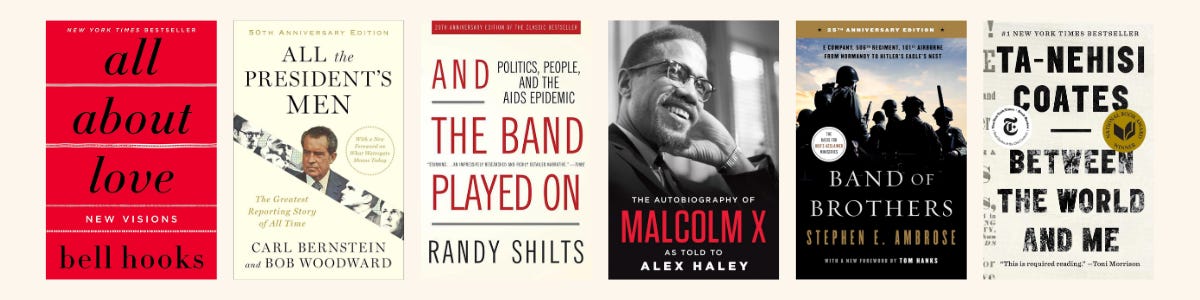
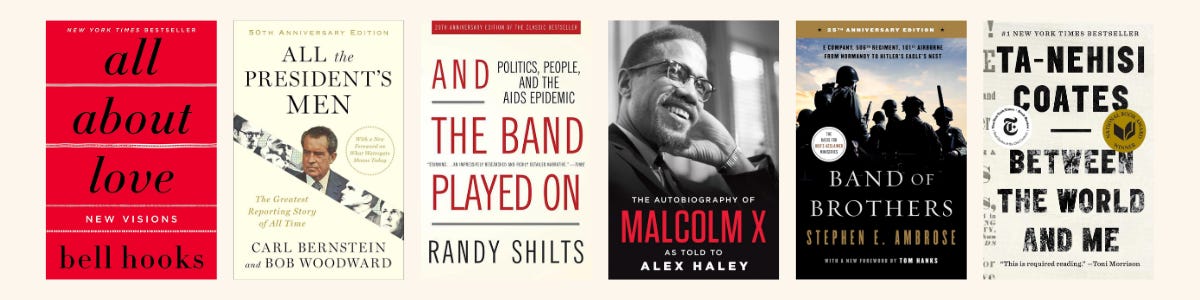
All About Love: New Visions by bell hooks (1999)
All the President’s Men by Bob Woodward and Carl Bernstein (1974)
And the Band Played On: Politics, People, and the AIDS Epidemic by Randy Shilts (1987)
The Autobiography of Malcolm X as told to Alex Haley (1965)
Band of Brothers by Stephen E. Ambrose (1992)
Between the World and Me by Ta-Nehisi Coates (2015)
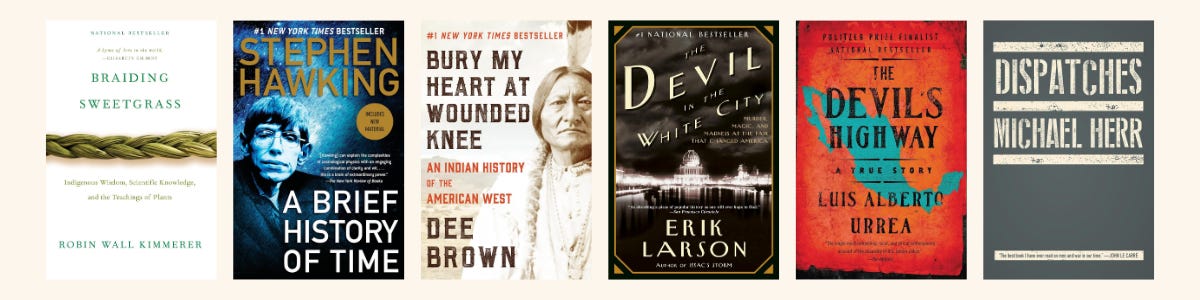
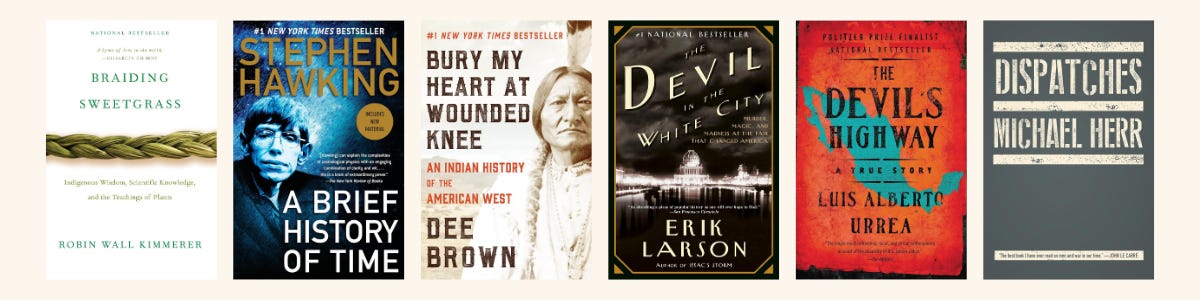
Braiding Sweetgrass: Indigenous Wisdom, Scientific Knowledge and the Teachings of Plants by Robin Wall Kimmerer (2013)
A Brief History of Time by Stephen Hawking (1988)
Bury My Heart at Wounded Knee: An Indian History of the American West by Dee Brown (1970)
The Devil in the White City: Murder, Magic, and Madness at the Fair that Changed America by Erik Larson (2003)
The Devil’s Highway: A True Story by Luis Alberto Urrea (2004)
Dispatches by Michael Herr (1977)
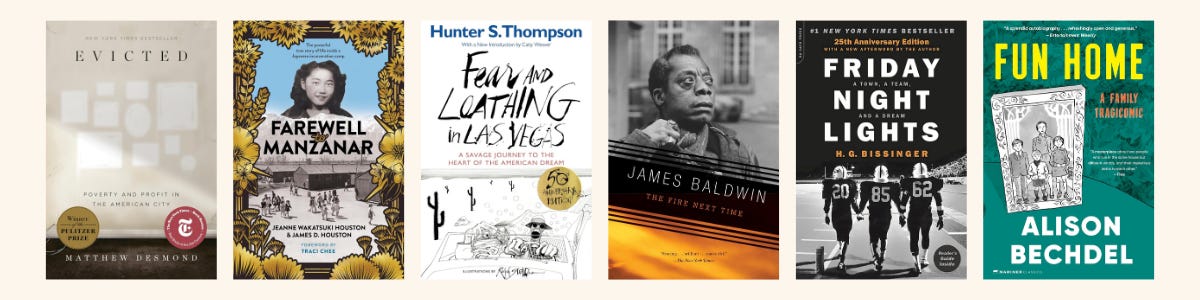
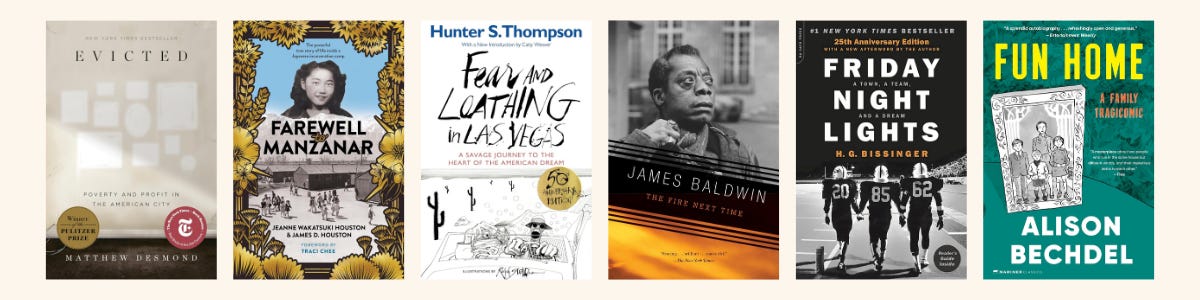
Evicted: Poverty and Profit in the American City by Matthew Desmond (2016)
Farewell to Manzanar by Jeanne Wakatsuki Houston and James D. Houston (1973)
Fear and Loathing in Las Vegas: A Savage Journey to the Heart of the American Dream by Hunter S. Thompson (1971)
The Fire Next Time by James Baldwin (1963)
Friday Night Lights: A Town, a Team, and a Dream by H. G. Bissinger (1990)
Fun Home: A Family Tragicomic by Alison Bechdel (2006)
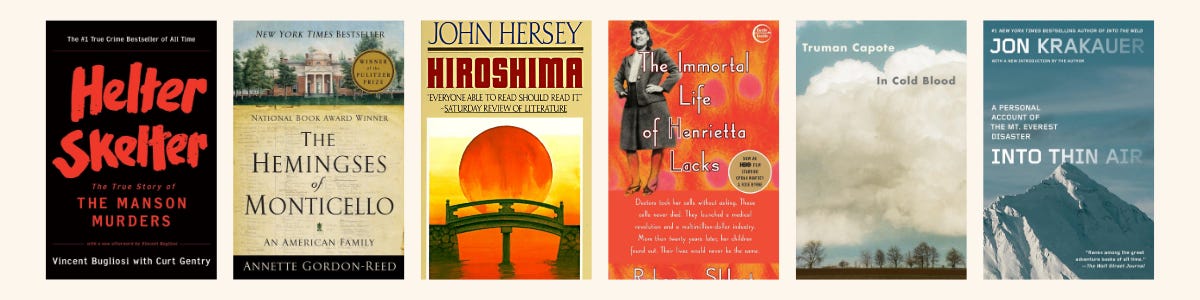
Helter Skelter: The True Story of the Manson Murders by Vincent Bugliosi and Curt Gentry (1974)
The Hemingses of Monticello: An American Family by Annette Gordon-Reed (2008)
Hiroshima by John Hersey (1946)
The Immortal Life of Henrietta Lacks by Rebecca Skloot (2010)
In Cold Blood by Truman Capote (1965)
Into Thin Air: A Personal Account of the Mt. Everest Disaster by Jon Krakauer (1997)
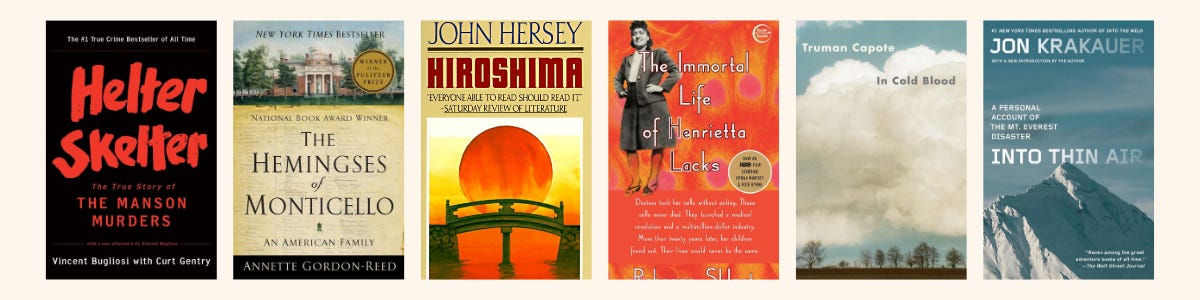
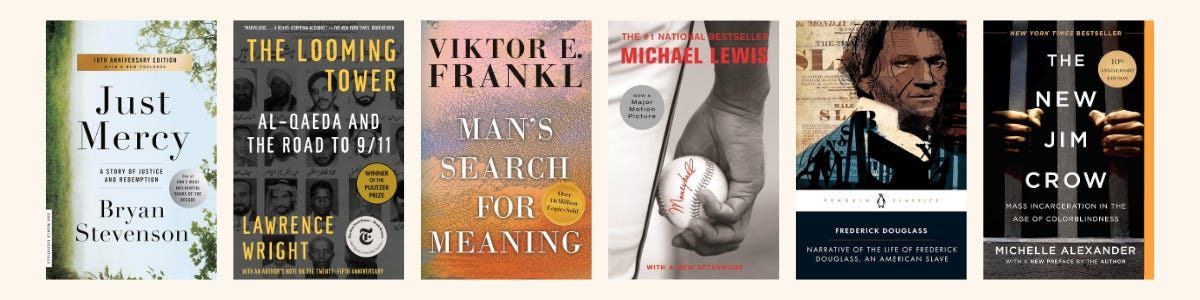
Just Mercy: A Story of Justice and Redemption by Bryan Stevenson (2014)
The Looming Tower: Al-Qaeda and the Road to 9/11 by Lawrence Wright (2006)
Man’s Search for Meaning by Viktor Frankl (1946)
Moneyball: The Art of Winning an Unfair Game by Michael Lewis (2003)
Narrative of the Life of Frederick Douglass, an American Slave by Frederick Douglass (1845)
The New Jim Crow: Mass Incarceration in the Age of Colorblindness by Michelle Alexander (2010)
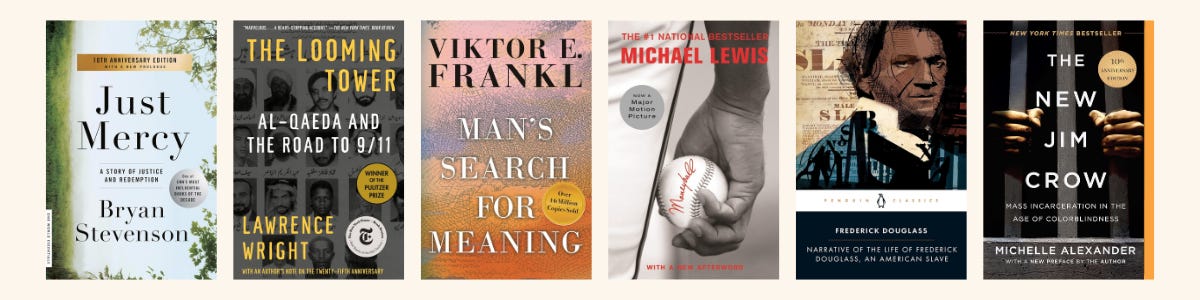
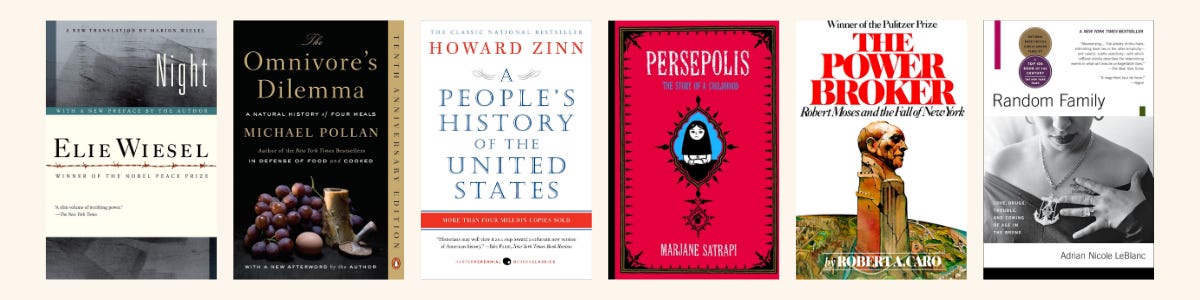
Night by Elie Wiesel (1956)
The Omnivore’s Dilemma: A Natural History of Four Meals by Michael Pollan (2006)
A People’s History of the United States by Howard Zinn (1980)
Persepolis: The Story of a Childhood by Marjane Satrapi (2003)
The Powerbroker: Robert Moses and the Fall of New York by Robert A. Caro (1974)
Random Family: Love, Drugs, Trouble, and Coming of Age in the Bronx by Adrian Nicole LeBlanc (2003)
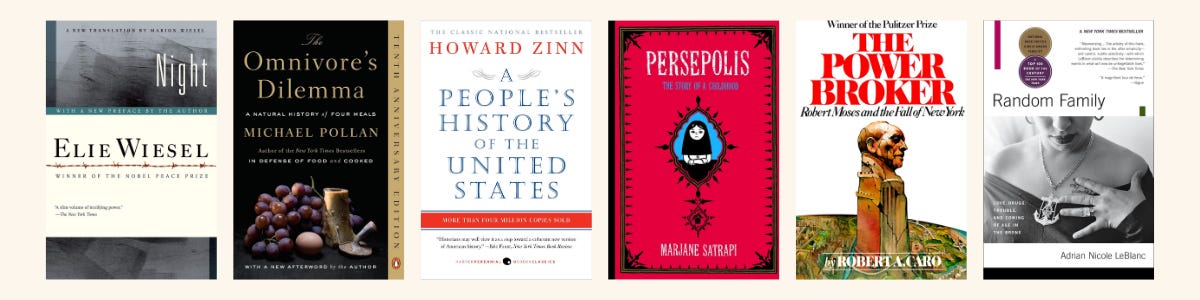
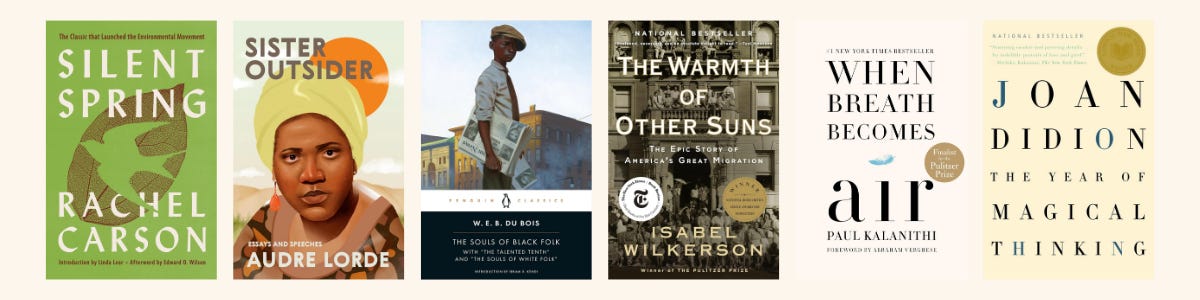
Silent Spring by Rachel Carson (1962)
Sister Outsider: Essays and Speeches by Audre Lorde (1984)
The Souls of Black Folk by W. E. B. Dubois (1903)
The Warmth of Other Suns: The Epic Story of America’s Great Migration by Isabel Wilkerson (2010)
When Breath Becomes Air by Paul Kalanithi (2016)
The Year of Magical Thinking by Joan Didion (2004)
Your turn to tell me what you think in the comments. What do you think of this list? What criteria makes something a classic? What books are you adding or removing from the list?
If you want more nonfiction recommendations, classics and otherwise, check out my Nonfiction Reading Guide which is available for a limited time. Its 30 amazing, unputdownable nonfiction books to fall in love with this summer and beyond.
If you want more of me and my nonsense be sure to listen to The Stacks podcast every Wednesday and follow me over on Instagram for a lot more book content.
You can earn a free subscription to Unstacked by sharing it with the people in your life. Just tap the button below and spread the word.
This post contains affiliate links. If you make a purchase through the links above, I may earn a small commission at no additional cost to you.
Here’s the episode ICYMI.
Even if it turns out to be untrue, like in a book on this list.
You might notice I left off works of theory and philosophy, because I know my audience and I just don’t think we’re doing that here. But like, shout out to Plato and Marie Curie and all the homies. Also, no self-help or business books because I just couldn’t imagine having Rich Dad, Poor Dad on the same list as The Warmth of Other Suns. You’ll forgive me, right?
Comments
Nothing yet. Say the first thing.
Sign in to join the conversation.