
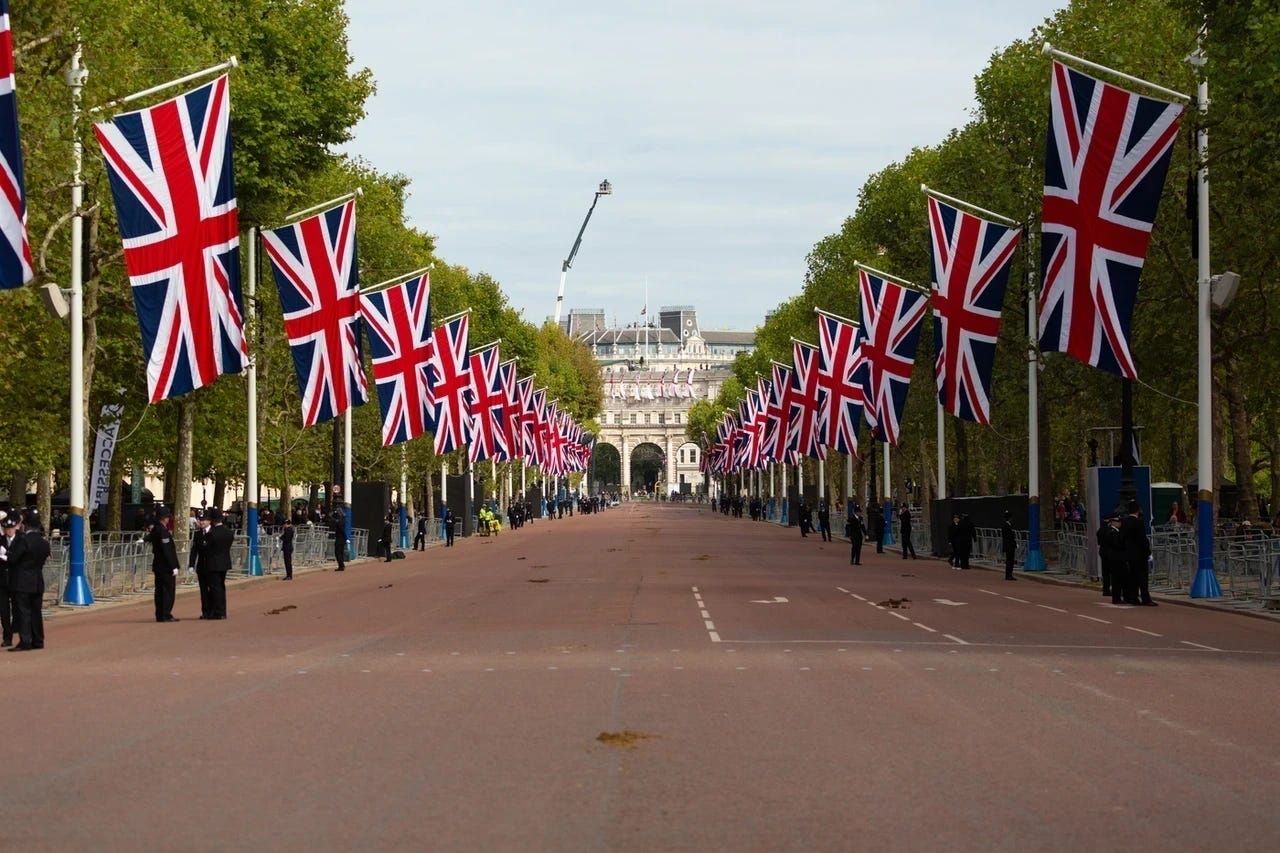
At secondary school I was told that The Mall was red for one reason. The Cold War. In the event of a nuclear attack, the RAF would be able to pick it out from the sky, fly in, and save the Queen. It seemed hard to imagine a Harrier jet swooping down on Buckingham Palace. How would she ever climb up to the cockpit? Gold steps, perhaps. But that is what I believed, and for a while it seemed entirely plausible. It had the ring of a secret the government hadn’t quite got round to denying.
The truth is more mundane, and in its own way more interesting. The surface of The Mall has been coloured red since the 1950s, giving the effect of a giant red carpet rolled permanently from the palace gates. The colour was chosen by David Eccles as Minister of Works, and the pigment came from a chemical works in Northamptonshire. No Harrier jets. No emergency evacuation plan. Just a civil servant deciding that the road leading to Buckingham Palace ought to look like a red carpet, and ordering the appropriate iron oxide accordingly.
But the Cold War story stuck to me for years, and I think I understand why. The Mall invites that kind of mythology. It is a road that has always been about performance and intent, a street that has been deliberately shaped and reshaped to mean something. Most streets arrive fully formed. They follow a field boundary, a river bend, a route that carts had already worn into the ground. The Mall is different. It has been reinvented so many times, for so many different purposes, that what you walk along today bears almost no resemblance to what was there four hundred years ago, except in one respect: it has always been about the performance of power.
That is, perhaps, where to begin.
The First Alley
In the middle of the seventeenth century, the ground now occupied by The Mall was a games pitch. The sport was pall-mall, the same mallet-and-ball game that gave its name to the street immediately to the north, and it had been brought to London by the Stuart kings. James I had introduced it. His grandson Charles II who grew up playing it, brought it back with a renewed enthusiasm after the Restoration in 1660.
The original pall-mall alley ran roughly along the line of what is now Pall Mall itself. But by 1661 that ground was becoming too dusty, churned up by coaches on the adjacent highway. Charles ordered a new alley to be laid out within the park, to the south, longer and better surfaced. That alley, screened by double rows of elm trees on either side and running from St James’s Palace toward what would become Buckingham House, became The Mall.
Charles laid out The Mall in 1662 as a successor to the glorified croquet alley of Pall Mall. But games fall out of fashion. By the early eighteenth century pall-mall had largely been abandoned, and as the sport declined in popularity the Mall became a place of public promenade. The elms remained. The path remained. People came to walk under the trees on summer evenings, to see and be seen, and The Mall began its long second life as one of the most fashionable addresses in London.
A Palace on the North Side
For much of the eighteenth century, the most significant building overlooking The Mall was not a palace at all, but a private house. Carlton House stood on the north side, its gardens running down to the park. It had passed through various aristocratic hands before landing, in 1783, with a young man who would spend the next four decades doing enormous damage to the public finances: George, Prince of Wales, the future Prince Regent and eventually George IV.
George received Carlton House along with a parliamentary grant of £60,000 to refurbish it. He then spent approximately the rest of his life refurbishing it further, never quite satisfied, always adding another wing or redecorating another suite of rooms. He employed a variety of architects to help him realise his ever-changing vision, including Thomas Hopper, James Wyatt, John Nash and Edward Wyatt. By the Regency period, Carlton House had become, in the words of one contemporary, “a centre for all the great politicians and wits who were the favourites of the Regent.” It was, in effect, a rival court, positioned right on the edge of the park, facing down toward The Mall.
In 1820, on the death of his father George III, the Prince Regent became King George IV. And at that point, Carlton House’s fate was sealed. The new king decided it wasn’t grand enough. He turned his attention to Buckingham House, which would be rebuilt as Buckingham Palace. Carlton House was demolished in 1826 and replaced with two grand white stuccoed terraces of expensive houses known as Carlton House Terrace.
Those terraces, designed by John Nash, still stand above the north side of The Mall today: long, colonnaded, cream-painted, looking south across the park. Simon Bradley and Nikolaus Pevsner wrote that they are perhaps the greatest terrace houses ever built in Britain. Between the two blocks, the Duke of York’s Column rises on its stepped plinth, 124 feet of granite with the Duke perched on top, looking out across the trees. The story goes that he was placed so high because his creditors couldn’t reach him. He died owing nearly half a million pounds.
The Invention of a Ceremonial Route
For most of the nineteenth century The Mall remained in a slightly ambiguous state. It was grand but not quite purposeful. Traffic was permitted on The Mall from 1887. With Victoria on the throne and Buckingham Palace fully established as the royal residence, the road’s position at the end of a straight avenue pointing directly at the palace gave it an obvious ceremonial potential. But it hadn’t yet been formally organised around that idea.
That changed in the early twentieth century, and it changed because of a specific anxiety. Residents of London developed a case of street envy. Their 25,000 streets did not include a single one like the Avenue des Champs-Elysées or Pennsylvania Avenue that was suitable for ceremonial parades. Paris had its great axial boulevard. Washington had its monumental route between Capitol and White House. London, the capital of the largest empire the world had seen, had a tree-lined path that wasn’t quite sure what it was.
The solution was a comprehensive redesign, conceived as a ceremonial route to match similar routes being created in Berlin, Mexico City, Oslo, Paris, Saint Petersburg, Vienna and Washington. The architect Aston Webb was given the commission. A new facade was constructed for Buckingham Palace to face down The Mall, and the Victoria Memorial was erected immediately before the palace gates. At the other end, Webb designed Admiralty Arch, completed in 1912, its three wide archways straddling the road and connecting it to Trafalgar Square beyond. The distance from the Victoria Memorial to Admiralty Arch is exactly half a nautical mile. That precision is not accidental. The whole thing was calculated, measured, intended.
The surface of The Mall has been coloured red since the 1950s, giving the effect of a giant red carpet leading up to Buckingham Palace. The colour was chosen by David Eccles as Minister of Works, and the pigment came from a works in Northamptonshire. It is one of those details that seems obvious in retrospect but must have seemed slightly strange at the time: a road painted to look permanent, as if the red carpet had been left down forever.
The Day the Crowd Came
The Mall has witnessed more public emotion than almost any other street in London. Coronations, state funerals, royal weddings, jubilees: the processions have moved along it, and the crowds have gathered on either side, for more than a century now.
But the moment that perhaps best captures what The Mall has meant to ordinary Londoners is not a state occasion at all. On the evening of 8 May 1945, the war in Europe was over. Buckingham Palace was the centre of British celebrations, with the King, Queen and Princess Elizabeth and Princess Margaret appearing on the balcony, the palace’s blacked-out windows still behind them, to cheers from a vast crowd on The Mall.
The blackout windows are the detail that catches. They hadn’t been unblocked yet. The war was over but the furniture of it was still in place, and the crowd on The Mall was celebrating in front of a building that still looked like a building at war. The photographs from that night show people pressed together the full length of the avenue, from the palace gates almost to Admiralty Arch, a mass of people who had lived through something and come out of it and needed to be somewhere that felt like the centre of things.
The Mall was that place. It had been a games pitch, a promenade, the address of a profligate prince, a ceremonial route planned to impress foreign dignitaries. On VE night it became something else: the place where a city came to feel what it felt, together.
What You Walk Through Now
The Mall today is still closed to traffic on Sundays and public holidays, and on any day when a procession is moving along it. The surface is still that particular shade of dull red. The plane trees that replaced the original elms line both sides, their branches meeting overhead in summer.
It is worth pausing at the Admiralty Arch end, where the road narrows through the arches and the scale shifts suddenly from monumental to intimate, and thinking about the layers beneath. The games alley of Charles II. The private gardens of the Prince Regent. The anxious city that wanted a boulevard worthy of an empire. The crowd pressed together in the dark in May 1945.
Streets accumulate. The Mall has accumulated more than most.
Comments
Nothing yet. Say the first thing.
Sign in to join the conversation.