
On Vincent Street in on the Westminster, Pimlico borders, beside the black iron gates of a car park entrance, stands a plain redbrick fireplace. It has no house around it, no roof over it, and nothing structural attached at all: just the chimney breast and hearth of a home that has not existed for over eighty years, fixed to a short stretch of surviving wall opposite Napier Hall on Vincent Square.
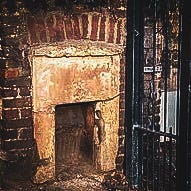
Nothing warns you it’s coming. Most people walking this stretch of Westminster are heading somewhere else, towards Vincent Square itself, or the shops on Rochester Row, or south towards the river. The fireplace sits at the edge of a residential car park, easy to mistake for demolition rubble rather than what it actually is: the last visible fragment of a whole terrace of houses.
Pimlico itself is a Victorian invention, laid out by the builder Thomas Cubitt on marshland reclaimed from the Thames in the middle of the nineteenth century. Vincent Street and Vincent Square took shape as part of that development, a grid of stuccoed terraces built for a rising middle class within walking distance of Westminster. By the twentieth century, streets like this one were solidly residential, unremarkable in the way that most of London’s ordinary housing stock is unremarkable, right up until the war made a point of remarking on it.
That terrace ran along this end of Vincent Street until the Second World War. The area around Vincent Square, then known as Vincent Square Ward, took a heavy pounding during the Blitz. Between October 1940 and June 1941 alone, dozens of incendiary bombs fell across the ward, and one single raid left twenty one properties on Vincent Street damaged beyond repair. The bombing did not stop there. From the middle of 1944 into 1945, the area was hit again, this time by V-1 and V-2 rockets, the unmanned weapons known to Londoners as doodlebugs and, in official German terminology, as vengeance weapons. It is not entirely clear today which of these attacks finished off the row of houses that stood where the car park is now. What is clear is that by the time the war ended, the terrace was gone, and only one chimney breast, embedded in what remained of a party wall, was left standing.
Go back further and the site has an older story too. An 1893 map of the street shows a terrace of five houses here, one of them slightly larger than the rest, built on a small triangle of land to the west. That triangle has since been absorbed into the garden of a house on Vincent Square. The same map shows a narrow passage running behind the terrace, giving access to a row of much smaller dwellings squeezed in behind the privies of the Vincent Street houses, homes fitted into whatever space was left once the grander houses facing the street had taken the best of the plot. It is a small, ordinary detail, but it says something about how this corner of Pimlico was built up in layers long before the Luftwaffe ever reached it: bigger houses at the front, meaner ones packed in behind, generations of Londoners living within feet of each other in very different circumstances.
Today, the site is occupied by Dean Abbott House, a sheltered housing scheme for older residents, set behind security gates and fencing that keep most of what remains of the old terrace out of public view. The fireplace itself sits just outside those gates, on the pavement side, visible to anyone who happens to look. Inside the grounds there are other traces of the vanished houses too, alcoves and fragments of wall that never made it into any guidebook, seen mostly by residents and the odd passer-by who gets talking to someone coming back from the shops.
It would be easy to walk past the Vincent Street fireplace and assume it is nothing more than builders’ leftovers, propped against a wall and forgotten. In fact it is one of the more direct pieces of evidence left in London of what an ordinary domestic interior looked like before a bomb removed everything around it. No plaque marks the spot. No blue heritage roundel explains what happened here. The fireplace does the explaining on its own: the shape of a room that no longer exists, still holding its place on a street where the rest of the house simply is not there anymore.
Pimlico has absorbed most of its wartime scars by now, rebuilt so thoroughly that a stranger walking through would have no reason to think anything unusual happened here at all. London keeps a handful of relics like this one scattered across the city, fragments left standing more by accident than by design, and each one does the same quiet job: proving that a bomb site was once somebody’s front room. But on Vincent Street, one small piece of brickwork still stands as it did when the house around it was there, waiting behind a car park gate for someone to notice it was ever a home at all.
Comments
Nothing yet. Say the first thing.
Sign in to join the conversation.