
As part of my commitment to build in public and share the learnings, I wanted to put some predictions for ‘AI in 2026’ on record. These views are informed by working with the talented team at Visory to build AI into the core of our platform. They are ultimately something to revisit at the end of the year and see what we got right and wrong!
Here’s how I’m organising my thinking:
🟢 Consensus: the ground has already shifted
🟡 Emerging: not yet settled, but the trajectory feels clear
🔴 Contrarian: ideas that cut against conventional thinking
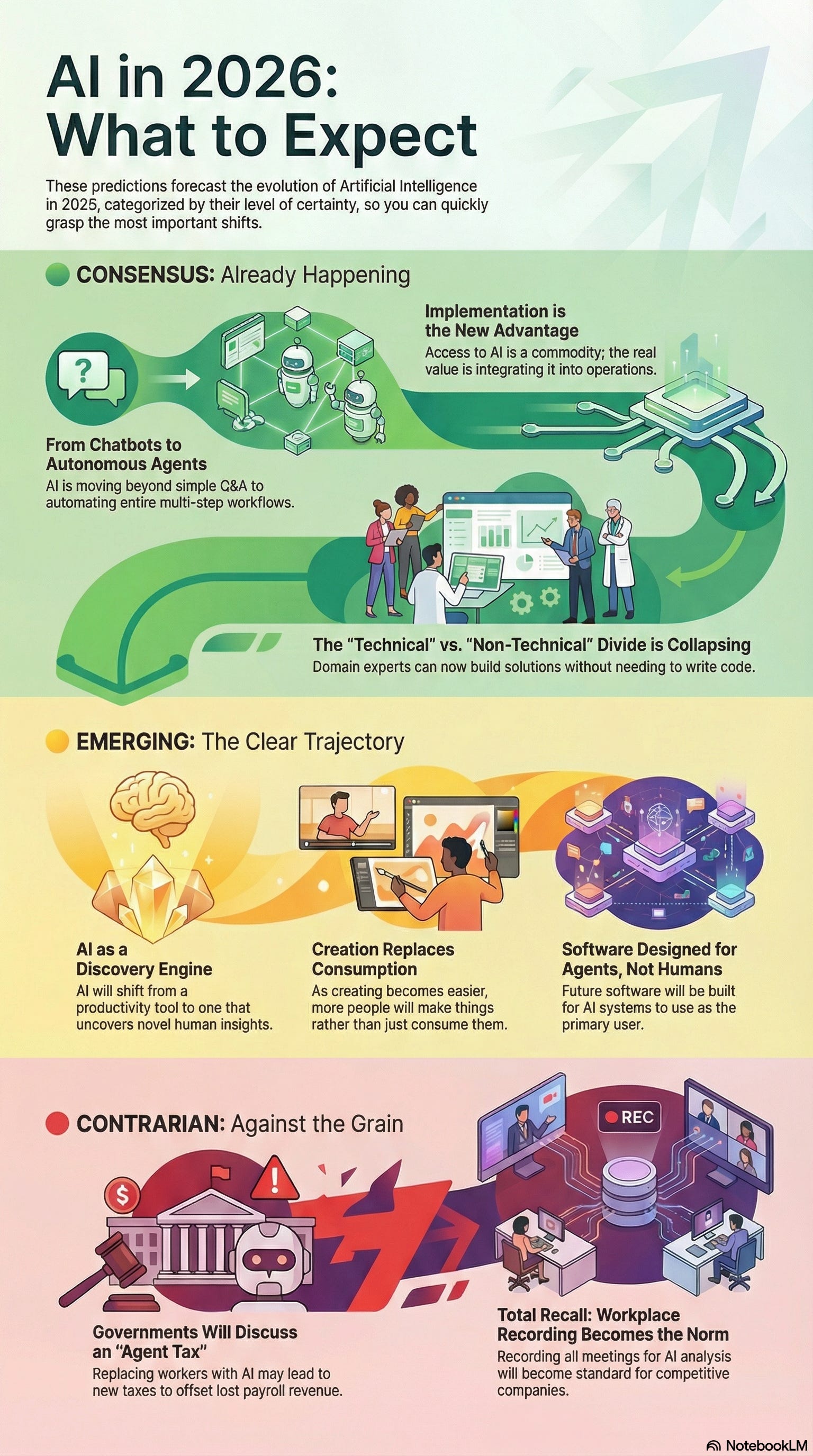
These aren’t predictions anymore. They’re observations about things already happening. If you’re still debating whether these are real, you’re behind.
1. The chatbot era is ending. Agents and workflow automation are taking over.
The era of typing a question into ChatGPT and waiting for an answer is already feeling dated. What’s replacing it? AI systems that handle entire workflows from start to finish, with humans supervising rather than doing every step.
Think less “ask a question, get an answer” and more “hand over a task, review the output.” The AI breaks down requests, routes work to the right place, flags what’s missing, and delivers the output. Work that used to require a senior person to coordinate now happens systematically.
So what’s the implication for leaders? The value isn’t in having access to AI (it’s table stakes, everyone has that now). The value is in knowing how to wire it into your workflows and specific operations.
2. Intelligence is becoming a commodity. Implementation is the advantage.
Model quality is converging fast. The gap between leading AI systems shrinks every quarter, the cost keeps falling, and everyone has equal access. The intelligence is now a commodity and implementation is becoming the competitive edge.
This is bad news for anyone whose strategy is “we have access to the best AI”. It’s good news for anyone whose strategy is “we know how to put AI to work in ways that actually generate outcomes.”
The winners won’t be organisations with the most sophisticated technology. They’ll be the ones who’ve figured out how to integrate AI into existing operations without breaking quality, compliance, or trust. Integration is the hard part, the AI itself is quickly becoming table stakes.
3. The divide between “technical” and “non-technical” people is collapsing.
AI is making the distinction between “technical” and “non-technical” meaningless for a growing range of tasks.
Someone who can clearly describe what they need will be able to build working tools without writing code. Domain experts will create solutions without a technology team. The bottleneck shifts from “can you code?” to “do you understand the problem well enough to describe a solution?”
This is uncomfortable for people who built careers on technical gatekeeping. It’s liberating for everyone else.
This doesn’t mean we won’t need technical people. It means their role is shifting. The best engineers are already 10x more effective. They no longer write every line of code; they review and coordinate agents doing the grunt work for them. They maintain quality and ensure model outputs don’t compromise the overall architecture. As coding models improve, this trend will only accelerate.
These predictions require more conviction. They’re not universally accepted yet, but the trajectory feels inevitable.
1. AI is becoming a discovery engine, not just a productivity tool.
The most underrated shift: AI moving from “do my job faster” to “find things humans couldn’t find.”
People often deride AI models as “intelligent statistical guessing engines” and dismiss what compounding improvements in capability could lead to: sparks of unique creativity and genuinely novel thinking. But we’re already seeing AI surface patterns and connections that humans miss, not because we’re careless, but because the search space is simply too vast for biological minds.
The next step isn’t just faster pattern matching. It’s AI generating hypotheses, identifying non-obvious relationships, and proposing solutions that no human would have reached.
Scale that to scientific research, and we should expect at least one major breakthrough in 2026 that was fundamentally AI-driven. Not AI-assisted, but AI-discovered.
2. Creating will become the new scrolling.
The pessimistic view says AI makes humans passive consumers of generated content. In practice, I think we’re seeing the opposite.
When the barrier to creation drops to zero, the satisfaction of making things becomes accessible to everyone. Building an app, writing music, designing a product - these were previously gated by years of skill acquisition. Now they’re gated only by having an idea.
I’m optimistic about this. The psychological reward of creation is more powerful than consumption. This shift will lower the bar and allow people to experiment with new forms of creativity.
3. Software will start being designed for AI, not humans.
Here’s a subtle but important shift. As AI systems become primary users of software, design priorities change.
Today, we design for human usability. Tomorrow, we design for agents first.
Every piece of business software will eventually need to work seamlessly with AI agents, and this may challenge the patterns by which we build and understand software. Organisations that build this in from the start will have an advantage. Those retrofitting later will be playing catch-up for years.
These predictions go against dominant narratives or point toward futures that might make some people uncomfortable.
1. Governments will start talking about taxing AI agents.
As AI agents become pervasive, they won’t just change how work gets done. They’ll change who gets taxed.
The first wave is already underway: AI replacing offshore labour. Customer support, data entry, basic analysis. Work that was sent overseas for cost savings is now being done by agents for a fraction of the price. Governments in those countries will feel the impact first, but they won’t be the last.
The second wave hits closer to home. As agents become more capable, they’ll start reshaping onshore roles too. And when that happens, governments will face an uncomfortable reality: no payroll tax, no income tax, no superannuation contributions. The fiscal base that funds public services starts to erode.
Expect the first serious policy discussions to emerge this year. Not legislation, but the opening of a dialogue. Should AI agents be treated as a form of employee for tax purposes? If a company replaces ten people with AI systems, should that productivity gain be taxed differently?
2. China is closing the gap faster than the comfortable narrative suggests.
The story in Western circles is that export controls have crippled Chinese AI development. The uncomfortable reality is that constraint often accelerate innovation.
Chinese labs are making extraordinary progress in efficiency, achieving comparable results with less computing power. By late 2026, the performance gap between the US and China will have completely closed. Anyone assuming a durable Western lead should revisit that assumption.
3. Recording everything will become standard practice.
This one will make people uncomfortable. Recording, transcribing, and AI-analysing every workplace meeting will become normal for competitive organisations.
The business logic is hard to argue with. Perfect organisational memory, automated action items, and perfectly searchable records.
Yes, this may change how people behave. Yes, there will be cultural and legal debates around workplace surveillance. But the productivity gains are too large to ignore. Once some organisations adopt it, competitive pressure will push everyone else to follow.
Most years in technology are incremental. The hype says every year is transformative; the reality is that most years are just the previous year +/- 5%.
2026 already feels different. It’s when the theoretical shifts of the past three years could actually hit production at scale, demonstrating real world results.
Let’s see how my predictions fare in 12 months time.
Thomas
No posts
Comments
Nothing yet. Say the first thing.
Sign in to join the conversation.