
it should go without saying that we are enemies of the state. u, me, all of us that dare to seek a better existence which is free of the terror that amerikkka has inflicted on humanity since its inception. we have always been at odds in a way that is absolutely irredeemable, and it should be understood that this is indeed a fight to the death. the present moment once again proves that we cannot occupy the same planet as this wretched empire. so how long must we simply be raw materials?
we have not entered into a new phase of anything. this has always been war, carried out against us with whatever technologies and vocabulary available, and the cage has always been the preferred method of suppression. i use the word cage rather than prison because prison implies a system with an internal logic, a set of rules that could theoretically be reformed, adjusted, made less cruel. but we may find more accuracy by naming it as enslavement., because enslavement names the actual relation. it names what we are to this place. not citizens who have failed, not humans who broke a law, but property that is being retrieved. and when the state cannot successfully incarcerate the body, it has on every occasion of consequence sought to destroy it.
amerikkka has always found more efficiency in bold deception, it tells lies with the confidence of a nation that knows it does not have to answer for its crimes. it speaks the lie with such conviction that the lie becomes the record, the headline, the fact. the word terrorist gets stretched over whoever is currently inconvenient to the theft in progress while it uses its janky-ass rhetoric to word-launder us into consent. amerikkka doesn’t have to stop being the terrorist if it can just keep naming everyone else the terrorist first, loud enough and fast enough. this inversion of both language and function manifests itself as the opening move in a checkmate the state has already been playing toward, the elimination it was always building to. amerikkka will force all who seek freedom from its tyranny to defend themself against the very charge it is guilty of.
u don’t have to go digging thru history for proof of this, although history hands us more examples than we could ever finish counting. it’s happening right now, this year, to people who are still alive to watch their own case get built out of nothing but the word itself.
there is zero ambiguity in how to describe the injustice amerikkka has enacted against those who stood in solidarity outside prairieland detention center. i mean lets be for real, how can we describe this as anything but the continuation of amerikkkas long standing war against the opponents of slavery? the plantation became the sharecropping contract, the sharecropping contract became the convict lease, the convict lease became the prison cell, and the prison cell became the detention bed. every transition preserved the essential structure, which is that certain bodies are held, confined, and extracted from, not as punishment for anything they actually did, but because the whole economic order requires a population that has no meaningful ability to say no.
the prairieland comrades relate to this history in the most direct way possible, which is that they did the one thing amerikkka has never been willing to tolerate without a carceral or violent response: they put their bodies between the machine and its captives. so what amerikkka did to them wasn’t really about the bullet, it aint about no fireworks, its not about no zines. four hundred and fifty years is not a sentence calibrated to a crime. it’s a message calibrated to everyone watching, which is: look at what happens to people who oppose enslavement. look at what we are willing to do to them. u just might be the next motherfuckers we do this to if u don’t cut it out with all this resistance bullshit.
from the state’s perspective, to understand this and yet still act on it publicly, visibly, with our bodies and our presence, is the thing that has always had to be crushed. not because the action itself is existentially dangerous to a state with the largest military apparatus in human history. but because solidarity is contagious. because if enough people stand outside enough cages and name what they’re looking at as it really is, the whole scam stops being able to hide behind the word “legal.” it becomes evident that amerikkkan fascism uses legal fiction to conceal political persecution.
within over a decade of my own incarceration i watched people disappear into sentences that had almost nothing to do with what they’d actually done. enhancements stacked on top of offenses that carried minimal time on their own, until a two became a twenty five. mandatory minimums that stripped judges of any real discretion and replaced judgment with arithmetic. gang enhancements built on conjecture so thin it wouldn’t hold up in a serious conversation, let alone a courtroom, yet applied with total confidence and near-total impunity. but none of the people i watched this happen to got a hashtag. none of them got a single stranger learning their name.
the sentences handed to those defendants at prairieland which even the new york times noted were “significantly longer than the lengthiest handed down to anyone convicted of joining in the january sixth attack on the united states capitol”, are not disproportionate by accident. the disproportion is the message. what the sentencing enhancements do quietly to people nobody is watching, the terrorism designation does publicly to people everybody is watching, and the function in both cases is identical: to make the sentence itself into a spectacle of what happens to anyone who dont fall in line with slavery as a national pastime. the man who caught thirty years for carrying a box of zines and the person i watched catch a twenty five for something they hardly did are both fictional channels for the same demonstration of the state’s power to impose an enormous consequence regardless of whether the consequence fits, and to dare anybody watching to do or say anything about it. most of the time, nobody does. most of the time, the room is empty and the name disappears. prairieland is only different because this time, people are watching.
if we call this an escalation, something unprecedented, a new aggression the state has invented specifically for this moment, then we are, at least partially, carrying a fear that serves the state more than it serves us. because a fear that locates the danger in the novelty of what’s happening implies that there was some prior period where the danger didn’t exist, where we were safer.
the state has been doing this for as long as it has existed. so the more pressing question may be what kind of consciousness we bring to the present, and what kind of solidarity our consciousness produces.
we are in desperate need of a solidarity with mass, and of consequence. what is solidarity when it has no friction? what is it when it is not expansive, and when it is dependent on spectacle, or when it has no congruence with the things that the empire has made normal? what we need is a solidarity whose scope matches the actual scope of what has been done and what is still being done. we are in desperate need of a solidarity with teeth.
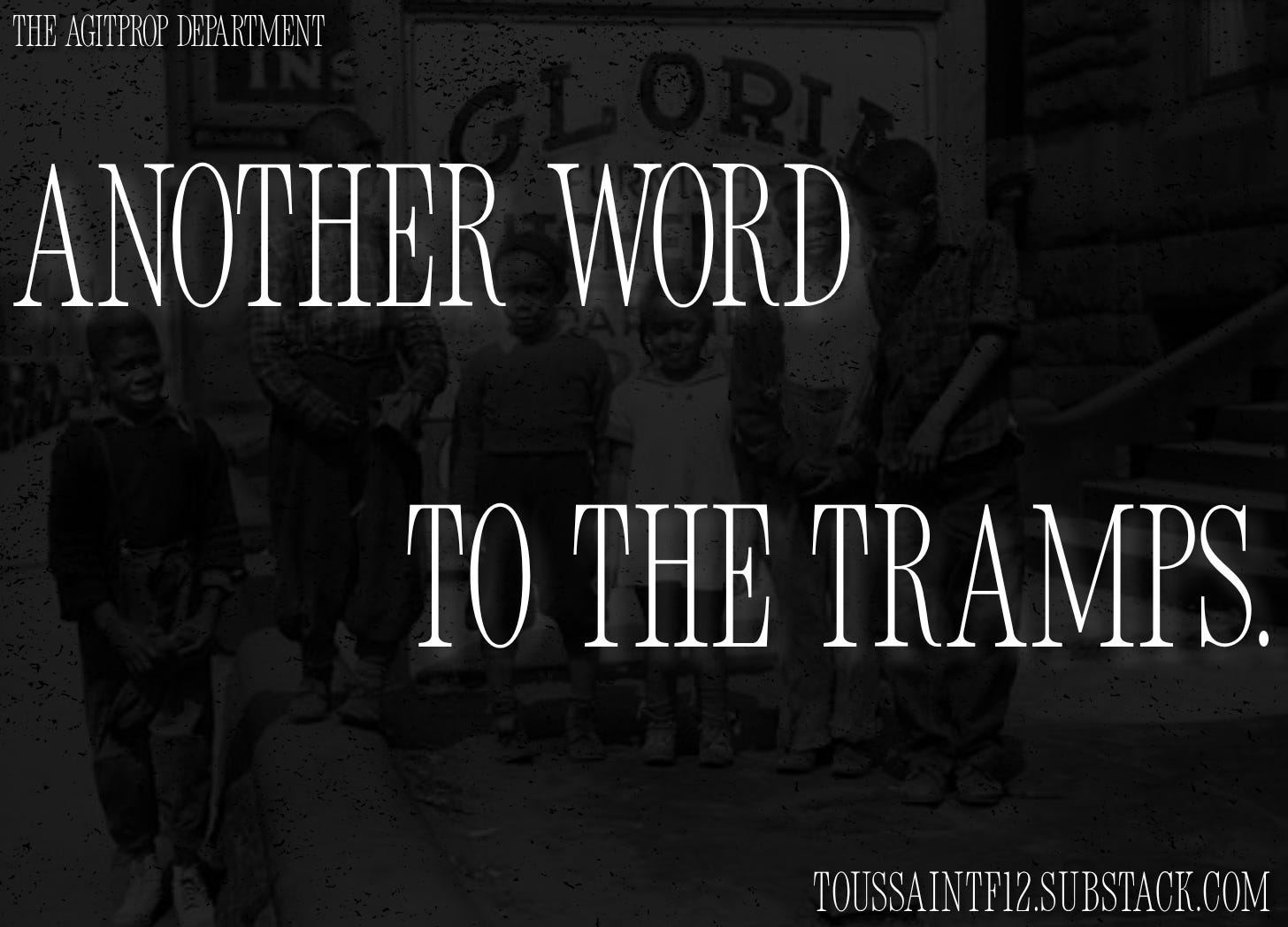
so what does all this mean? what can we hope to extract from this? i believe that this is is where the conception of “political prisoner” itself has to be put on trial.
because what prairieland can do, if we let it do the deeper work, is expose how narrow and ultimately self-defeating our current definition actually is. the category as we use it, reserved for people caged explicitly for their organizing, their speech, their declared opposition to the state, is a category that protects about one percent of the people it should be protecting. it draws a line that says: these prisoners are political, these others are just criminal. and every time we honor that line, every time we pour our solidarity into one side of it and let the other side quietly disappear, we are doing the state’s own work for it. we are accepting its accounting of who ended up where and why.
but consider this: under that same narrow definition, george jackson was not a political prisoner when he walked into california’s prison system. he was eighteen years old. he stole seventy dollars from a gas station, his lawyer promised him a deal. what he got was an indeterminate sentence, one year to life, the kind of number that means the state has decided to keep u until it decides otherwise. no first amendment issue. no declared politics. just a young black man from the working class fed into the same machine that was running on all of them. and from inside that machine he became one of the most important political thinkers this country has ever produced. the cage didn’t interrupt his political life. it was the condition under which his political consciousness was forged, sharpened, and made permanent. he was a prisoner of the politics imposed upon him, who became even further politicized, who gained revolutionary consciousness, who was a prisoner of war.
so what does the narrow definition actually cost us? it costs us george jackson on the day he walked in, before the world decided he counted. it costs us every person i watched disappear into a twenty five year sentence in a courtroom where the gallery was empty and nobody was taking notes. it costs us the person sitting with a gang enhancement that multiplied their time for the crime of being affiliated with a community the state decided to criminalize which, when u trace the actual history of gang legislation, is inseparable from the criminalization of black organizing itself, the same self-defense and community-control traditions that the state couldn’t touch directly so it criminalized sideways, by labeling the community a gang and the association a conspiracy.
but here is what the definition cant explain. there is a quote in blood in my eye from a lawyer named howard moore jr.- “all black people, wherever they are, whatever their crimes, even crimes against other blacks, are political prisoners because the system has dealt with them differently than with whites. whitey gets the benefit of every law, every loophole, and the benefit of being judged by his peers. blacks don’t get the benefit of any such jury trial by peers. such a trial is almost a cinch to result in the conviction of a black person, and it’s a conscious political decision that blacks don’t have those benefits”. this is the arrangement thats decided in advance of any individual case, its what determines who gets processed and how, by whose standard, toward which outcome. and that arrangement is a political act, regardless of what the charge sheet says, regardless of whether anyone on the outside ever calls it political.
so the question the definition can’t answer is this. if the arrangement is already political before anyone walks into a courtroom, what exactly is the “criminal” who isn’t a “political prisoner” being distinguished from? the answer is: nothing real. the distinction is a fiction the state needs us to maintain, because as long as we accept that most people inside just “did something wrong,” the whole apparatus escapes the scrutiny it deserves. the cage gets to keep running as justice. the word “criminal” gets to keep doing what it was always built to do, which is to make the retrieval of certain bodies look like a moral outcome rather than a political one.
and now i want to go somewhere the definition definitely cannot follow us, somewhere it has never been equipped to go, because it requires us to think about the nature of the act itself rather than just the politics of the actor.
u don’t get persecuted for your beliefs. u can believe whatever u wanna believe, internally. and u know what happens? nothing. things don’t start to happen until u externalize those belief out into society, in some fashion or another. a person doesn’t have to act on their beliefs in order to believe them. we know this is true because we can often recognize we aren’t living in line with what we actually believe. and i dont necesserily believe its possible to live in 100 percent accordance with everything u believe, we can only strive to, yet this does not make us non-believers, it makes us practitioners. the persecution begins at the point of externalization, whatever form that takes. what i want to do is draw a distinction between two kinds of externalized acts. not to rank them. the ranking is the state’s move, not ours. but to name something that actually has analytical utility for how we understand what “political” means.
somebody passing out zines outside a detention center is externalizing a belief that reaches beyond their own body. the act is aimed at something collective, a future that isn’t only theirs, a world where the people inside that cage get to exist outside of it. if those zines don’t go out today, probably nobody dies today. probably nothing collapses this week. maybe the rent still gets paid and the car still has gas. the horizon of that act is long. it is oriented toward the survival of something larger than the individual who is holding the box. and if they happen to cross some imaginary line of legality in the course of that act, and that crossing results in their incarceration, we recognize them as a political prisoner without hesitation. the state made it easy for us. they externalized a belief, the state called it a crime, and the connection between conviction and politics is visible enough that we don’t have to argue about it.
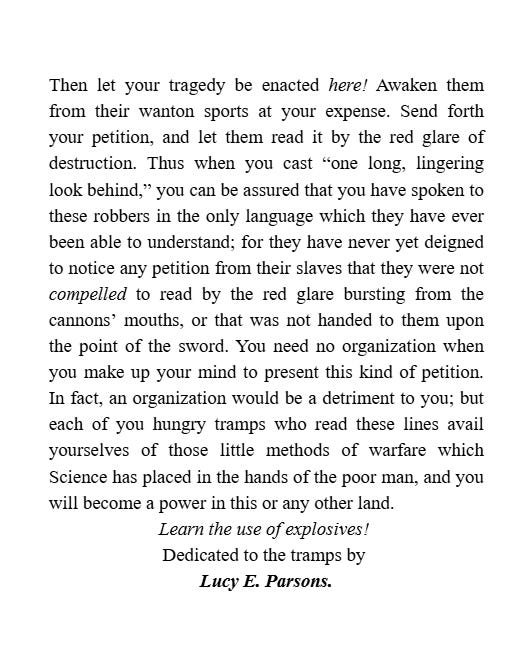
now consider somebody who robs a store to eat tonight. that is also an externalized act. it is also resistance to an imposed condition, the condition being manufactured starvation, a world that decided this person does not get to eat unless they can pay. and the horizon of that act is right now, not next week, not a movement that hasn’t formed yet, tonight. if i don’t rob your ass right now then i don’t eat right now. i don’t pay rent right now. i am on the street right now or i stay on the street. the clock on this act is a different clock than the one running on the zine. the immediacy is different. but the root is identical because there is no version of this story in which that person chose the conditions that made that moment necessary. they are, as lucy parsons put it in her own trial speech: “products of conditions, of certain environments in which they were born, and which have impelled them resistlessly into what they are.” t the act looks individual. the cause is structural. the response by the state is political.
i am not saying these two acts are identical. i am saying the line between them is not the line between “political” and “not political.” it is the line between a collective horizon and individual horizon. a definition of “political prisoner” that only recognizes the first kind of act while filing the second under “crime” is a definition that was never actually describing the world. it was describing the state’s preferred story about the world. and the state’s preferred story is the one where most of the people inside its cages are simply criminals, simply people who made bad choices, simply individuals whose incarceration has nothing to do with power, nothing to do with an economic arrangement that was always going to produce them, nothing to do with the political decision to build a system that needs somebody on the bottom of it. and our acceptance of that story is what continues to manufacture our consent.
.
.
.
.

Comments
Nothing yet. Say the first thing.
Sign in to join the conversation.