
Last week we met Father Giles, who shaped the AP US History exam and thereby shifted the American concept of a good history student. He made the ability to analyze primary sources, rather than just to remember facts, a central component of what it even means to be good at history.
This week, another person-maker. She created a high-stakes hiring algorithm — one that came to define the ideal of a scholar-bureaucrat for more than a thousand years.
In 655 AD, a 31-year old woman known to history as Wu Zeitan became Empress Consort of China. She ruled the empire — at first de facto through her husband and sons, and eventually in her own right — for fifty years, until her death in 705, a unique woman in the otherwise entirely male pantheon of Chinese emperors. (She was judged harshly — seemingly on gendered lines — by later Chinese and historians of China.)
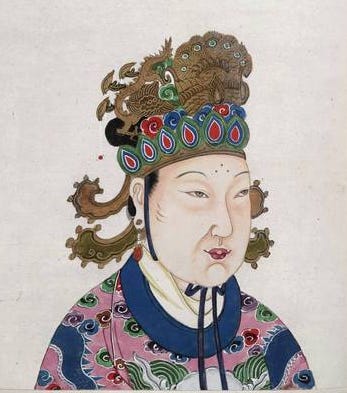
A gifted administrator and shrewd political tactician, Empress Wu fortified her authority partly by remaking the imperial bureaucracy, creating a new class of officials who would be loyal directly to her. She looked beyond the nobles who lived in the capital city of Luoyang, and created a new class of merit-based civil servants drawn from all over the empire, by administering a new examination known as the keju.
She granted favor and wealth to whoever passed the exam, making a new and prestigious route to power. By basing social advantage on performance, rather than directly on birth, Empress Wu had created perhaps her most lasting legacy: the world’s first system of high-stakes standardized testing.1
This system created a new kind of person: the powerful, widely admired scholar-bureaucrat, who had earned his role in the civil service and who would reflect ancient Confucian wisdom while administering the empire and resolving disputes. The keju became in part a system of belief about what made someone worthy to hold authority over others. Examination winners were not only trusted but also celebrated, in art and culture, as living embodiments of the wisdom and refinement of their civilization.
The Chinese system lasted more than a thousand years, and over that time it sparked what strike me as eerily modern debates about the meaning of merit, the sharing of advantage, and the role of rigid criteria.
In the 900s, the Song dynasty introduced objective, anonymous grading. The exam included fill-in-the-bank questions, requiring candidates to memorize quotes from famous texts. Special boarding schools developed to prepare candidates for the exam. Critics worried that these new schools weren’t providing a real education, but only teaching to the test, with an emphasis on rote memorization.2 Shortly after the advent of mechanical printing, students could buy copies of successful exam essays written by past graduates, to use as models.
Access to the prep schools, and success on the exam, was easier for students from high-status families — in the 1200s about half of successful candidates had parents or grandparents in the civil service. But this still meant that the other half of the seats went to high performers who hadn’t been born to their roles. (There were also times in this story when a small number of well-born candidates could skip past the exam, and directly join the civil service through a personal endorsement — akin perhaps to how the children of financial donors to today’s top colleges might skip past an otherwise-disqualifying SAT score.)
In the early 1300s, when China was ruled by Mongol descendants of Genghis Kahn, examiners introduced what we might today consider a racial quota system, with a quarter of all seats in the civil service reserved for Mongols. Later, Chinese rulers used quotas to ensure balance among geographic regions. The imperial exam continued until 1905. Even today, China’s national college entrance exam — the gaokao or “big test” — charts the fate of many students. The top scorers, on both the ancient exam and the current one, are deemed zhongyuan (top scholar) and showered with material and social advantages. In ancient times this might mean a seat at the right hand of the emperor; today, it can mean commercial endorsement deals.
Today’s big test is a gateway to further study, rather than to direct employment in public service. But the test still marks its winners for positions of high honor—and tells a story in which they deserve those positions.
I’ve been struggling in this project to come up with a name for the category that Wu Zeitan and Father Giles are both members of — architect? person-maker? It seems like we should understand their work as creative and world-shaping, rather than merely calculative or measuring. They create, rather than detect, biographical facts.
E. A. Kracke, Region, Family and Individual in the Chinese Examination System, in Chinese thought and institutions. (University of Chicago Press 1957). 253. In English, the word “mandarin” can still be used today mean a highly-trained bureaucrat — a term that we inherit directly from this Chinese practice.
Thomas H. C. Lee, Civil Service Examinations (Keju), in Curzon encyclopedia of Confucianism 82–86 (2003). p. 84
No posts
Comments
Nothing yet. Say the first thing.
Sign in to join the conversation.