
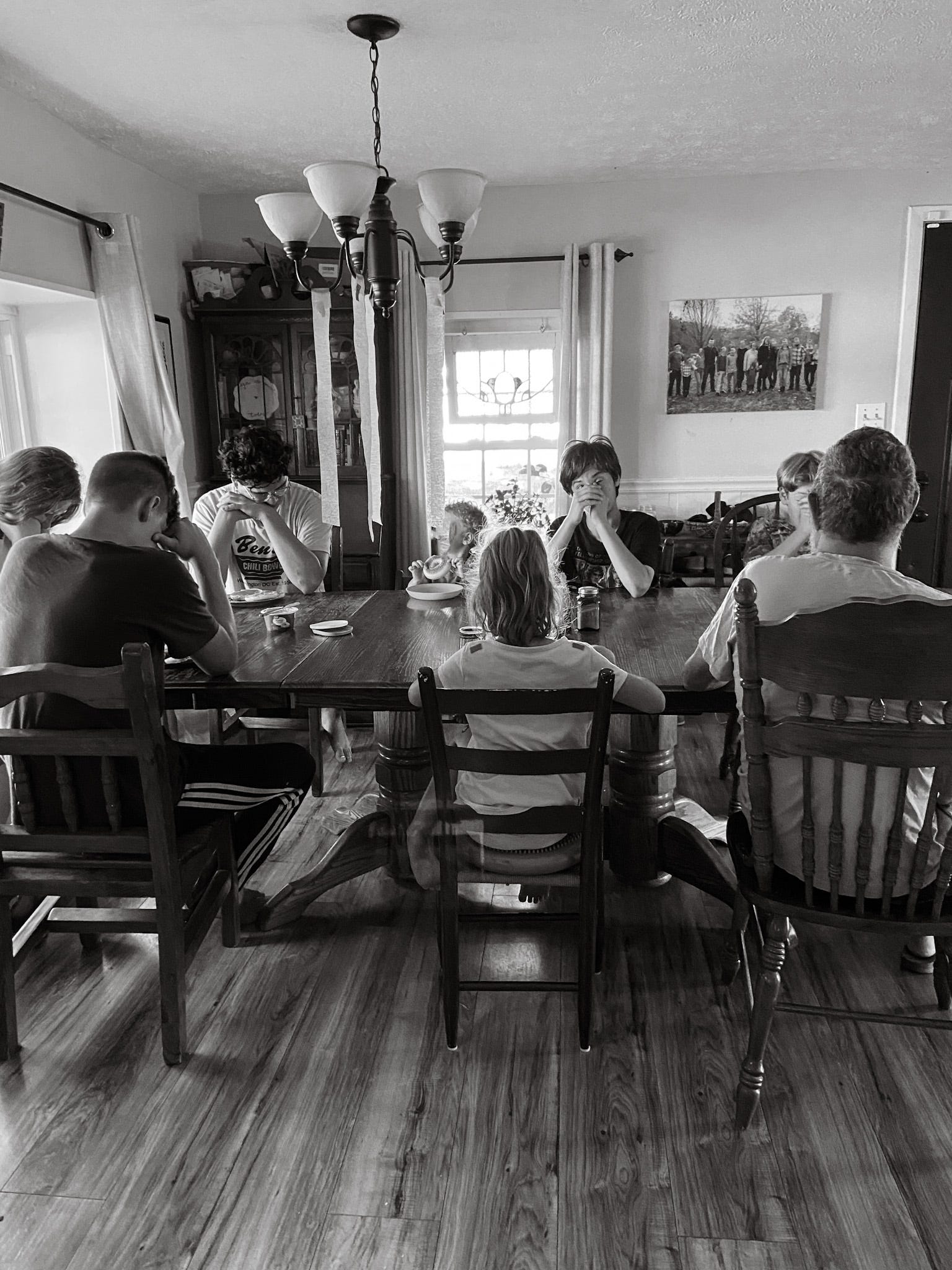
Tomorrow my sixth child turns eighteen.
You might think, by now, I would know exactly how this part of motherhood feels. You might think that after walking through this season again and again, after watching one child after another reach the edge of childhood and begin stretching toward adult life, I would have some navigable emotional map for the whole thing.
But I am finding, once again, that every child grows up in his own way, and every season of release asks something different of a mother’s heart.
This is not exactly the moment when another child leaves home. He still has one more year of high school, one more year under our roof, one more year of ordinary family life woven around dinner tables and laundry baskets and half-finished conversations as we’re interrupted yet again by a younger sibling. I am not yet standing in the doorway of his empty room, absorbing the full weight of absence.
But it is still a shift.
This year will look different. My son will be doing dual enrollment to learn a trade, and that is something we have not walked through before as a family. We’ve done senior years designed to launch kids well in many directions, but not this one. There will be new rhythms, new responsibilities, new paperwork, new conversations, new questions about what comes next. He will still be here, still part of the daily movement of our home, still one of the voices I expect to hear and one of the bodies I expect to maneuver around, but I can already feel the shape of his life beginning to stretch beyond the patterns I have known.
That is how letting go happens, isn’t it?
Not all at once. Not in one dramatic moment when the suitcases are packed and the car pulls away, though sometimes that is the moment we notice it most clearly. More often than not, it happens in smaller adjustments that are ordinary until you rook back and realize they were tiny steps in a different direction. It happens through new schedules that take people out of the home more and more, and new responsibilities that they juggle alongside their family commitments, through early morning shifts and work boots by the door, through parking cars in the driveway so that whoever needs to leave next can actually get out, through applications and tool lists and conversations about the future that no longer feel hypothetical.
It happens when you realize that the child you have been raising has become someone you no longer hold in place.
And that is a strange ache.
Because motherhood, when it is rightly ordered, has always been moving toward release. We know this, at least in theory. We know our children are not meant to remain little. We know they are not meant to need us in the same way forever. We know that diapers and bedtime stories and handwriting lessons and correction and discipline and meals and late-night talks and prayers whispered over sleeping bodies are all part of a much larger work. We are not raising children so they will stay children.
We are raising them so they will grow.
But knowing that doesn’t make the next steps painless.
A child becoming an adult is not proof that motherhood is ending. In many ways, it is proof that motherhood has been doing what it was meant to do all along. We love them, train them, disciple them, correct them, feed them, teach them, forgive them, apologize to them, pray over them, and pour ourselves out in a thousand ordinary ways, not so they will remain dependent forever, but so they will be strengthened for the life for which God created them.
Still, it pulls at the edges of our hearts, because a mother sees both then and now all at once.
Right now, I see the boy he was and the man he is becoming. I see the curly hair on his pillow and the broad shoulders in my doorway. I see the child whose smiles erupted in dimples and the young man headed off to another 6 a.m. shift at work. I see the years gathered up together in one frame, and somehow my heart is expected to make room for all of it—the memory of who he has been, the reality of who he is, and the mystery of who God is making him to be.
This is one of the hidden griefs of faithful motherhood, I think. Not grief because something has gone wrong, but grief because something has gone right.
We can’t help but grieve the passing of seasons we were never meant to keep, and there is a kind of sorrow that comes not from loss in the tragic sense, but from change in the obedient sense. We are asked to love deeply without clutching. We are asked to invest our whole selves without claiming ownership. We are asked to give our children roots and then not resent the fact that roots were never meant to hold them to the ground we thought we were planting them in.
It’s not easy.
It’s not easy when they are three and want to pour their own milk.
It’t not easy when they are twelve and begin carrying thoughts they do not immediately hand to you.
It’s not easy when they are sixteen and pull out of the driveway without you beside them.
It’s not easy when they are eighteen and you realize the world is about to know parts of them that used to unfold mostly inside your home.
And it will not be easy later, either, when the questions get bigger, the consequences get heavier, and your ability to step in becomes smaller. For example, when they turn 18 and the phrase “legal adult,” suddenly means your child.
This is where motherhood becomes a deep act of faith.
We don’t hold faith in our children—as much as we love them— or faith in our own parenting—as much as we pray we have been faithful. We don’t have faith in the systems, the opportunities, the plans, the trades, the colleges, the jobs, the relationships, or the carefully considered next steps.
Our faith is, now and always, in God.
The God who loved them before we did, the God who has never once needed us to be their Holy Spirit.
That truth has steadied me through many seasons of motherhood, but it meets me differently here. When they are small, it is easy to believe that our presence is the center of their world because, in many practical ways, it is. We feed them. We clothe them. We buckle the seatbelts, teach the phonics sounds, check the math, wipe the counters, make the appointments, and interpret the world for them one conversation at a time.
But as they grow, the Lord kindly and painfully reminds us that we were never the center, we were stewards. And stewardship is not possession.
That distinction matters more with every passing year. If I confuse stewardship with ownership, I will treat their growth as a threat. I will see every step toward independence as a personal rejection and panic when their lives begin to look different from what I imagined. I’lll be tempted to tighten my grip in the name of love when what I am really trying to manage is fear.
But if I remember that they belong first and foremost to the Lord, then release becomes obedience., trust., and a mother opening her hands—not because she is done loving, but because love was never meant to become control.
So I am loosening my grip again.
Again, because this is not the first time.
Again, because motherhood is a long series of releases, and the Lord rarely asks for the whole surrender in one moment. He teaches us slowly, beginning with the baby who no longer needs to be rocked to sleep, the toddler who says, “I do it myself,” the child who buckles his own car seat, the teenager who begins to wrestle through convictions that must become his own, and then the young adult whose life starts taking on a shape we can support, but cannot script.
Every stage asks the same question in a slightly different form.
Do you trust Me with this child?
And every time, I want to say yes. Not because the yes is easy, but because God is worthy.
Tomorrow my sixth child turns eighteen. He is still here. There will still be food to make, reminders to give, conversations to have, laundry to trip over, prayers to pray, and memories to be made.
But something is shifting, and I want to honor that shift without fearing it.
I want to look at the young man in front of me and not demand that he remain the little boy I remember. I want to encourage the strength that is growing in him, even when it carries him into places where I cannot follow as closely as I once did. I want to be the kind of mother who can tell the truth about the ache without letting the ache become a millstone around her child’s neck.
Because our children were never ours to keep.
They were entrusted to us for a season. By God’s grace, we love them, train them, disciple them, correct them, feed them, shelter them, and pour ourselves out for them. We teach them the Scriptures. We show them repentance. We tell them the truth. We ask forgiveness when we fail. We make home a place where faith is not merely mentioned, but lived.
And then, little by little, we release them. Not into the hands of the world and not even, ultimately, into their own hands.
We release them back into the hands of the Father who loved them first— and His hands are far more faithful than mine.
In Christ,
Heather
Comments
Nothing yet. Say the first thing.
Sign in to join the conversation.