
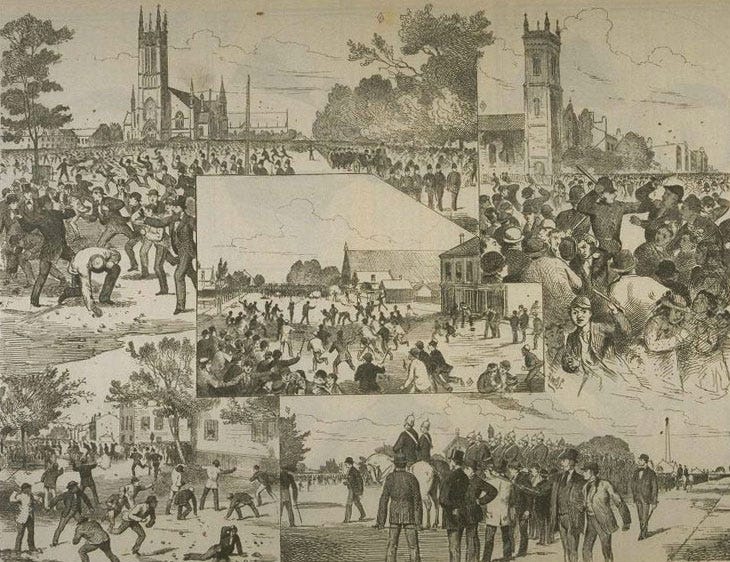
With St. Patrick’s Day coming up this week, I thought I would dig into my archives and share an updated version of an old post about one of the strangest facts in our city’s history. For more than a century, the St. Patrick’s Day Parade wasn’t held in Toronto because it was simply too dangerous. The annual celebration was cancelled in the late 1800s and didn’t resume until the 1980s, when people felt it was finally safe enough to return. The story behind that gap relates to a new online course I’m launching in a couple of weeks (more on that below). It’s a tale of religious hatred and sectarian violence from the days when our city was known as “The Belfast of Canada.”
Toronto was a very Irish place in the second half of the 1800s. By the middle of the century, more a third of our city’s residents had been born on the island of Ireland — the highest percentage on the continent, even higher than Boston or New York. Many of those Irish-Canadians were newcomers who’d been forced to flee the Great Famine and the hateful British policies that accompanied it. (In fact, many people prefer to call it “The Great Hunger” since “famine” makes it sound like a purely natural disaster.) In the summer of 1847 alone, nearly 40,000 Irish refugees came to Toronto — twice the population of the entire city at the time.
The vast majority of those new arrivals were Catholic. And they didn’t exactly find themselves welcomed with open arms.
Our city was extremely Protestant back then — passionately, even angrily so. At its height, about 85% of all Torontonians were Protestants. And many of them were members of a notoriously anti-Catholic organization known as the Orange Order.
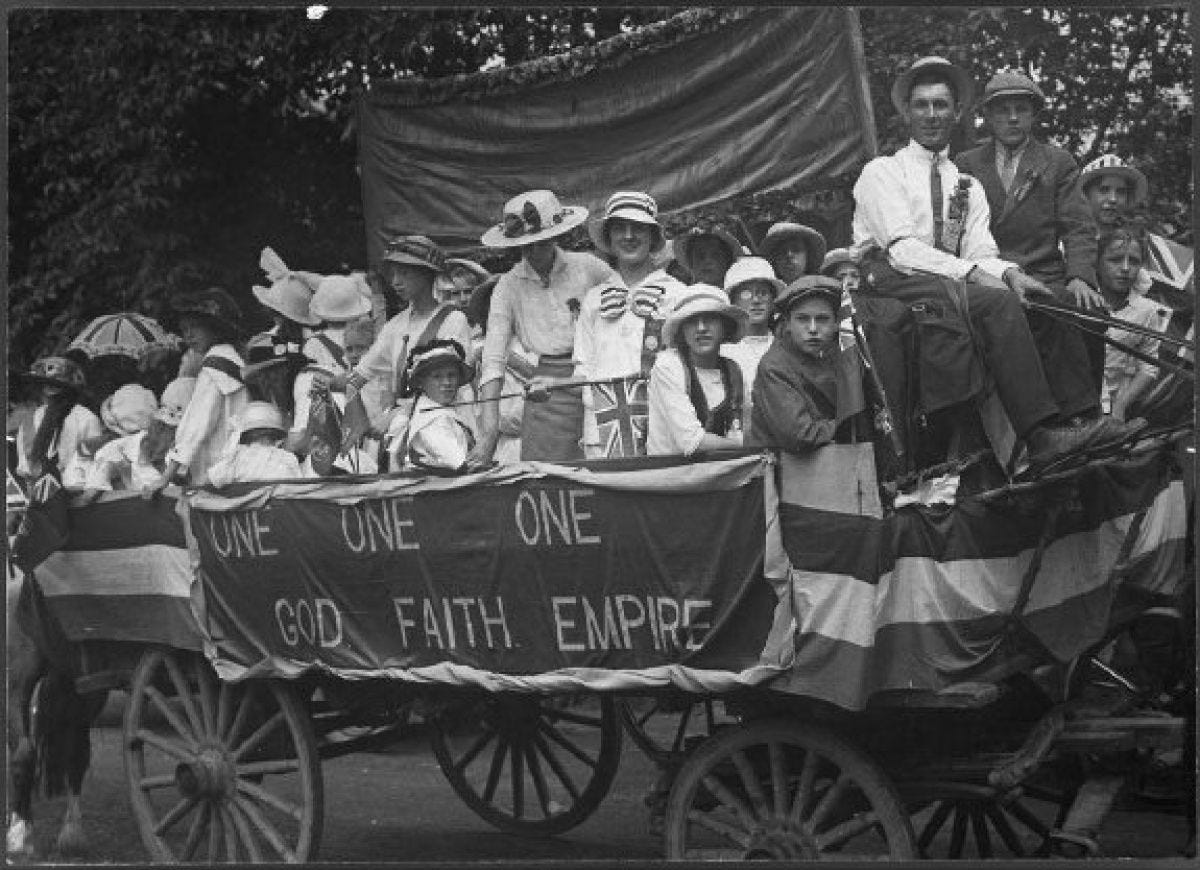
The fraternal society was founded in Northern Ireland in the late 1700s and Orangemen still have a very big presence there to this day. Fiercely Protestant and vehemently anti-Catholic, the Orange Order was deeply associated with the violence of The Troubles; the annual Orange parades can spark riots even now. And while you don’t hear much about the group in Toronto these days, for a long time the Orange Order was the single most powerful organization in our city.
Orangemen kept a stranglehold on Toronto politics for a century. From the middle of the 1800s all the way into the 1950s, nearly every single Mayor of Toronto was a member of an Orange Lodge. City councillors, too. Police officers. Firefighters. For a long time, practically all public employees were Orange. In the days when those Irish refugees were pouring into the city, not a single Catholic held municipal office in Toronto. And for decades to come, well into the 1900s, Catholics had trouble getting hired for any public job in the city.
Prejudice against Irish-Catholics became a defining feature of life in Toronto. The Globe openly complained about their presence: “Irish beggars are to be met everywhere, they are as ignorant & vicious as they are poor. They are lazy, improvident, & unthankful; they fill our poorhouses & our prisons.” And the newspaper was hardly alone in its views. Our city’s Catholic bishop began actively discouraging Irish-Catholics from moving to Toronto, warning them about the terrible discrimination they would face here.
And Orange power in Canada wasn’t limited to Toronto. It spread all over the country, with Orange Lodges opening everywhere from Newfoundland to Vancouver Island. At one point, there were more lodges in Canada than in all of what’s now Northern Ireland. At the time of Confederation, a third of all Protestant men in Canada were, or had been, Orangemen — including Sir John A. Macdonald — and it was said that the federal Conservatives always reserved three seats in their cabinets for Orange MPs.
But no city in Canada was more Orange than Toronto. And it was here that those sectarian tensions most often boiled over into violence.
The riots in Toronto often started with a parade — just like in Belfast. Every year on the twelfth of July, the Orange Order would hold a big parade to celebrate a victory from the 1600s (when the Protestant King William of Orange won a battle against Catholics in Ireland). The “Twelfth” was practically an official holiday in Toronto. At the height of its popularity, thousands of Torontonians marched in the parade. Tens of thousands cheered them on. Municipal employees were given the day off with pay so they could attend.
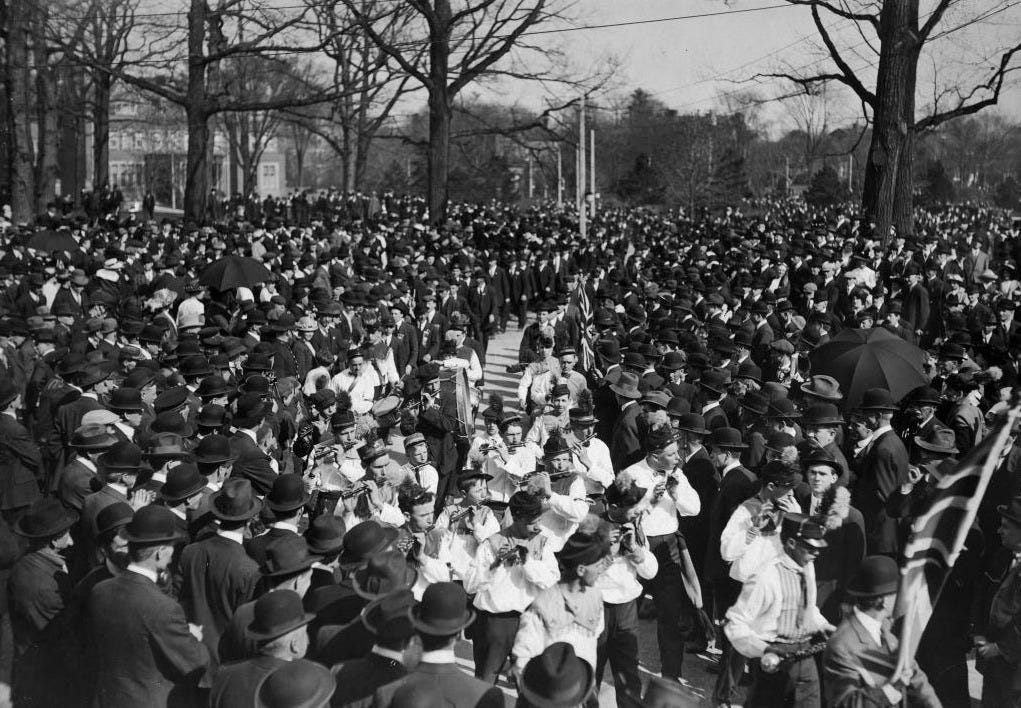
Catholics would generally stay indoors on July 12th, keep their children close. But not always. The parades would occasionally erupt into violence between Orangemen and Irish Catholics, the battles of Belfast fought in the streets of Toronto.
Clashes between Protestants and Catholics became almost an annual tradition in our city. There were countless riots sparked by those sectarian tensions. Street battles broke out after political meetings, during elections, when the Prince of Wales came to visit, on Guy Fawkes Day... Religious processions were attacked, St. Michael’s Cathedral besieged, the bishop pelted with stones... When a famous Irish Fenian revolutionary leader came to town, Orangemen rioted for two days. They smashed the windows of St. Lawrence Hall, destroyed a Fenian tavern and trashed stores on Queen Street. When Catholics celebrated the Papal Jubilee, stones rained down on them at Queen & Spadina. Thousands joined the fight. By the time it was all over, gunshots had been fired on Simcoe Street.
St. Patrick’s Day was especially tense in 1858. That’s the year Thomas D’Arcy McGee came to town as the special at a banquet. He had once been an Irish revolutionary himself, a freedom fighter who eventually moved to the Canadian colonies and switched his allegiances. He was now a loyal British subject and would go on to become a Father of Confederation.
The violence that erupted around that year’s St. Patrick’s Day Parade ended with the death of an Irish-Catholic stable hand named Matthew Sheedy. He was trying to break up a fight when he was fatally stabbed with a pitchfork. And his was certainly not the only life lost to the violence between Canadian Protestants and Catholics. Even McGee himself would end up dead, gunned down in the streets of Ottawa. The man who was hanged for that crime (after a travesty of a trial) was an Irish-Catholic suspected of having Fenian sympathies. And Toronto’s oldest public monument is dedicated to soldiers who died fighting Irish-Catholics. The Volunteers’ Memorial stands just across the street from Queen’s Park, commemorating students from the University of Toronto who were killed in battle against a Fenian army that invaded the Canadian colonies in the 1860s.
Bloody riots were now a common occurrence in Toronto. The violence was getting out of hand, but it was clear the city’s leaders were unable — or unwilling — to do much to curb the Orange violence. So, the city’s Catholics acted instead. While the Orange Parade would continue on as a major public event, the biggest annual Irish Catholic celebration wouldn’t. The St. Patrick’s Day Parade was cancelled in 1878. And it wouldn’t return for a very long time.
It wasn’t until the 1950s that the Orange stranglehold on our city was finally broken. As Toronto began to evolve into a much more multicultural place in the wake of the Second World War, the demographics were shifting dramatically. In 1955, for the first time in the 121 years since the municipal government had been formed, the people of Toronto elected a mayor who wasn’t Protestant: Nathan Phillips was Jewish.
Even then, it would be another thirty years before Toronto decided it was safe enough for the St. Patrick’s Day Parade to return. It was in the 1980s that green-clad revellers took to the streets of our city to march in celebration for the first time in more than a century.
These days it feels as if the nearly whole city celebrates the holiday. And beyond a few drunken louts, there’s not a hint of the violence that once spilled blood in our streets.
Today, Toronto embraces its Irish heritage. And down on the waterfront, in Ireland Park, you’ll find a striking monument: a reminder of the Irish refugees who came to our city all those years ago… And of the contribution they and their descendants — Protestants and Catholics alike — have been making to Toronto ever since.

Only 165 of the 4,469 people who subscribe to The Toronto Time Traveller support it with a paid subscription, keeping it free for everyone else. If you’d like to join their heroic ranks with a few dollars a month, you can make the switch by clicking the button below. Thanks so much to all of you who do!
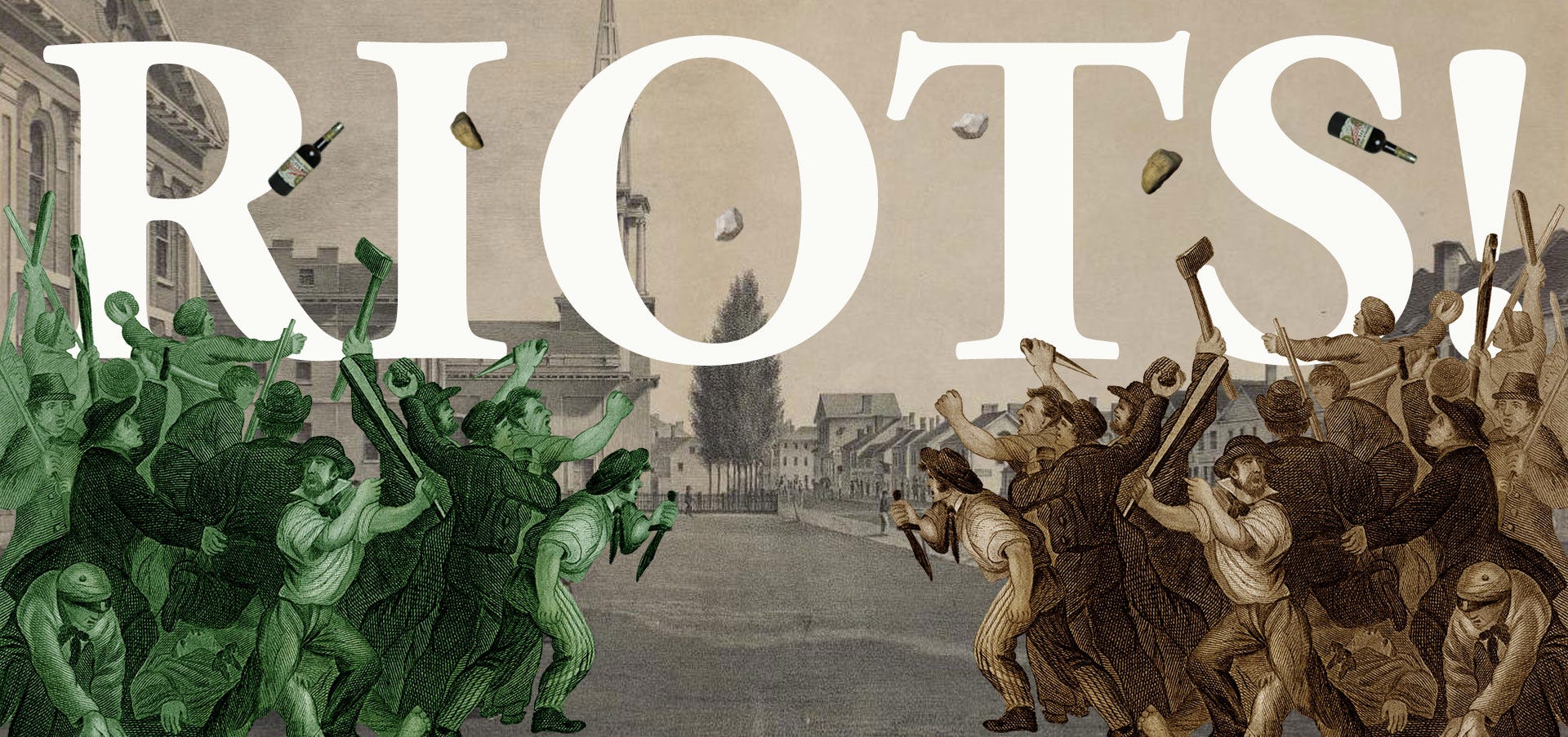
I’ve got a new course coming up soon! I’ve been hoping to one about the long history of riots in our city for quite a while now, and we’re finally doing! So here are all the details…
Description: Toronto’s past has often turned violent. There have been battles fought in our streets over everything from politics to religion to race to rock & roll. In this series of four weekly lectures, we’ll dive into that chaotic history to explore the stories of the riots that have shaken our city to its core. We’ll meet rampaging firefighters and battle-hardened clowns, hateful thugs and the people who’ve stood up to them. We’ll explore sectarian violence and passionate protests, out-of-control parties and outright rebellion. And in the process, we’ll uncover the fault lines that run through our city’s past; competing visions for Toronto fought over with cudgels, crowbars and closed fists.
When: Thursdays at 8pm from March 26 to April 16.
Where: Over Zoom. All lectures will also be recorded, so if you have to miss any of them you can watch them whenever you like. The recordings will remain available for the foreseeable future.
Cost: Pay what you like!
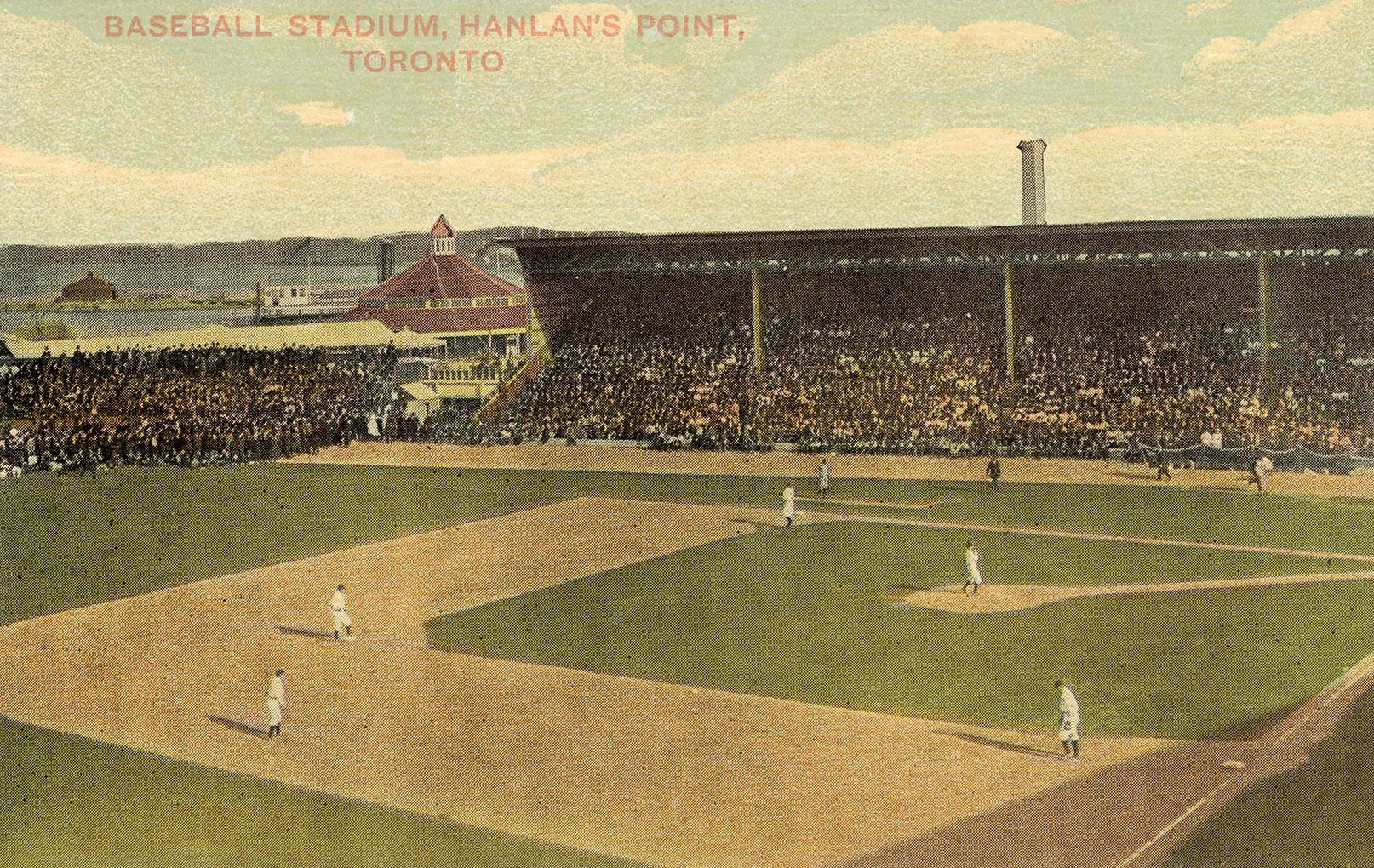
This spring and summer I’m doing another free online lunchtime lecture series for the Toronto Public Library! This time, it’s four monthly talks about the history of baseball in our city (based on my “From Sandlot to SkyDome” course). And the first talk is coming up soon!
Series Description: Baseball was being played in Toronto more than a century before the Blue Jays were born. In this series of talks, we'll explore the game's evolution in our city, from the days when it was a working class sport played by "undesirables" to Joe Carter jumping for joy in front of 50,000 screaming fans. Along the way, we'll meet everyone from con artists and kidnappers to eccentric millionaires and feminist icons, the people who've made Toronto baseball what it is… and helped transform our city in the process.
First up is…
TORONTO BASEBALL TALES: THE STRANGE STORY OF OUR CITY’S FIRST CHAMPIONSHIP
Friday, March 20 — Noon — Online
“The history of baseball in Toronto stretches back to a time long before the Blue Jays first took the field. Our city’s first championship club was formed all the way back in the 1880s, with a roster that included an alcoholic monkey-owning slugger and one of the most notorious con artists on the continent. In this talk, storyteller and historian Adam Bunch focuses on the strange season they won the pennant, the role the franchise played in creating baseball’s colour barrier, and the sport’s infamous reputation in Victorian Toronto as a game for ‘undesirables.’”
And you’ll find the links for the rest of the lectures in the series — “The Bizarre & The Unlikely,” “Icons of the Diamond” and “The Birth of the Blue Jays & The Curse of the Seagull” — here.
The best of everything else that’s new in Toronto’s past…
BIGOTRY NEWS — The city will be getting a new plaque to remember the notorious Bathhouse Raids, in which gay Torontonians were brutally arrested by police before the vast majority of the charges were dropped. Muriel Draaisma wrote about the announcement for the CBC. Read more.
CLASSIFIEDS FOR CHILDREN NEWS — In The Toronto Star, Darcy Ballantyne wrote about her experience trying to track down her biological parents and the disturbing history of “Today’s Child” — “a classified ad that featured children available for adoption.” Read more.
SUBTERRANEAN NEWS — For Toronto Today, Jamie Bradburn wrote about the chaotic first few days of the Bloor-Danforth Subway line, which opened 60 years ago — including the marching band that shut down the whole thing. Read more.
MYSTERIOUS RUIN NEWS — On Bluesky, Toronto Boris dives into the history behind a mysterious ruin on the banks of Highland Creek. Read more.
BATHURST & BLOOR NEWS — Heritage Toronto has published a new online tour of the Bathurst & Bloor neighbourhood created by Alanna Brown. Read more.
NEW IDEAS FOR AN OLD BUILDING NEWS — In The Globe & Mail, Alex Bozikovic shares one potential proposed vision for Old City Hall. Read more.
SKATING INTO HISTORY — TORONTO’S HOCKEY BEGINNINGS
March 19 — 7:30pm — Montgomery’s Inn and Online — Etobicoke Historical Society
“The first organized game of hockey in Canada was played in Montreal in 1875, but it would be more than a decade later before Toronto had its first organized game in 1888. Adam Waiser presents a fascinating look at Toronto’s hockey roots, from the early days of the sport to the birth of the Toronto Maple Leafs. He traces the journey from the Stanley Cup–winning Toronto Blueshirts to the Arenas and St. Patricks, revealing the behind-the-scenes drama that led to the NHL’s creation and the rise of one of its most iconic teams. Adam Waiser is a Toronto-based history enthusiast, storyteller, and co-host of the acclaimed Muddy York: A Toronto History Podcast.”
Free for members; memberships are $25.
THE HISTORY OF CARIBBEAN MUSIC IN TORONTO
March 24 — 6pm — Malvern Library
“Author, music historian and cultural critic, Klive Walker (Dubwise: Reasoning from the Reggae Underground), presents an overview of how Canadians with heritage in the Caribbean have impacted Toronto through music – from the 1950s to the 2000s. This history covers musical genres such as reggae, calypso, hip-hop and rhythm-and-blues and discusses some of the main Caribbean-Canadian personalities and events. The program illustrates the importance of this music to the Caribbean-Canadian community here in Toronto and its powerful influence on the mainstream.”
Free with registration!
A HISTORY OF PUBLIC TRANSPORTATION IN TORONTO
March 25 — 7pm — Northern District Library — North Toronto Historical Society
“An illustrated presentation by NTHS member Eli Aaron, exploring the evolution of public transit in North Toronto and its impact on the area’s development. Eli is an urban planner with an interest in heritage preservation, local history and public transit.”
Free!
NEWSGIRLS: GUTSY PIONEERS IN CANADA’S NEWSROOMS
March 26 — 2pm — Eglinton Square Library
“Toronto author, freelance writer and former Toronto Star reporter, Donna Jean Mackinnon, documents the lives of 10 leading female reporters who started their careers during newspaper's Golden Age. MacKinnon's fascinating, often amusing, presentation includes a slew of vintage photos and intimate anecdotes. Trailblazers in their fields, these adventurous 'newshens', as they were once called, covered every beat from art openings, fashion, crime, politics to major social issues of the day.”
Free!
THE BEATLES & THE TORONTO SOUND
March 28 — 2pm — AGO
“Join music historian Mike Daley as he unpacks, through song and archive, the relationship and evolution of the Toronto music scene in the 1960s and The Beatles. The talk will end with a live performance by Daley and his band, who will recreate The Beatles’ very first Toronto concert, held at the Maple Leaf Gardens in September 1964.”
$10 for members; $13 for annual pass holders; $15 for the public.
SWANSEA MEMORIAL LIBRARY & LIFE IN SWANSEA IN 1925
April 1 — 9pm — Online and at Swansea Town Hall — Swansea Historical Society
“Please mark your calendars for the next meeting of the Swansea Historical Society; it will be a special session with two presentations:
“(1) Speaker Lydia Pyluk – Swansea Memorial Library. This Library began in 1919, located in Swansea Public School, as a memorial to the Swansea residents who served overseas in First World War. Lydia is a Librarian with the Toronto Public Library working at both the Runnymede and Swansea Memorial branches. She has responsibility for the local history section of the Runnymede Branch.
“(2) Speaker TBC – Life in Swansea in 1925. This presentation is based on the recollections of John Richards who was the father of one of our members. John lived an active life, living in three different homes as he grew up in Swansea and attended Swansea Public School.
“Once again, the meeting will be conducted in a hybrid format so that participants can attend in-person at the Swansea Town Hall or connect on-line using the Zoom tool.”
Free!
MESSY CITIES: WHY WE CAN’T PLAN EVERYTHING
April 2 — 7pm — Annette Street Library — West Toronto Junction Historical Society
“Part reading, part talk, and part discussion with a focus on stories from the Junction and Junction Triangle, this event will highlight essays from co-editor Zahra Ebrahim‘s book Messy Cities: Why We Can’t Plan Everything. Zahra will be sharing the inspiration behind the book, the tensions of ‘messiness’ and giving a richer context of the stories shared about our west end community.”
PROTECTING YOUR FAMILY TREASURES
April 8 — 6:30pm — Danforth/Coxwell Library
“How can we ensure that treasured family items last for the next generation Whether these items are books, old photos, letters, or documents, they connect us to our families and comprise part of our shared cultural history. To make sure they last for the people who come after us, it’s important to take special care of them. Conservator Andrew Huot will discuss ways to save, protect, and store these meaningful items.”
Free!
SIR HENRY PELLATT & THE ENGLISH TRIP OF 1910
April 8 — 7pm — Don Mills Library
“Dr. Mima Brown Kapches presents and discusses her Canadian historical non-fiction book, The English Trip of 1910 (2024; Friesen Press). Sir Henry Pellatt (of Casa Loma fame) was the Commanding Officer of the Queen’s Own Rifles of Toronto in 1910, on the occasion of their 50th anniversary. Pellatt organized for over 600 young men from Toronto in the QOR to travel to England on a fully paid trip. This is the story of that adventure.”
Free!
MR. DRESSUP TO DEGRASSI: 42 YEARS OF LEGENDARY TORONTO KIDS TV
Until March 29 — Harbourfront Centre — Museum of Toronto
“Explore reimagined sets, retro living rooms, and hands-on stations that invite you to craft your own TV characters. Meet the felted puppets that sparked imagination and discover the stories behind the city that shaped a generation of children’s television.”
Free! (Donations encouraged.)
ECHOES OF HOME: POP-UP EXHIBIT AT FORT YORK
Until May 3 — Wednesday to Sunday — Fort York
“This pop-up installation explores the compelling stories and experiences of Toronto’s diverse communities who have fought for their sense of home, belonging and identity during periods of conflict and peace. This installation is created in partnership with the Toronto Metropolitan University’s Masters of Digital Media program.”
Free!
THE 52: AN EXHIBITION
Until May — Wednesday to Saturday — Museum of Toronto
“Spanning from the 1800s until today, this exhibition shines a spotlight on the change-makers, rebels, and revolutionaries within Toronto’s 52%. While some of these women’s stories are well known, others have gone relatively untold, until now. This powerful exhibit is currently on view at the Museum of Toronto as part of our fall programming.”
Free! (Donations encouraged.)
No posts
Comments
Nothing yet. Say the first thing.
Sign in to join the conversation.